Saudi Arabia Fish Farming Market Size, Share & Growth Rate
The Saudi Arabia Fish Farming Market was estimated at USD 238 Million in 2025 and is projected to reach USD 304 Million by 2032, growing at a CAGR of 3.6% from 2026 to 2032. This upward trajectory is primarily fueled by the increasing local demand for fish products as a vital source of protein, coupled with strategic government initiatives aimed at enhancing food security. Moreover, advancements in aquaculture technologies are paving the way for more efficient and sustainable farming practices, further propelling the industry forward.
Saudi Arabia Fish Farming Market Year-wise Growth Rate and Key Drivers
This graph highlights how the Saudi Arabia Fish Farming Market has steadily grown over the years, supported by major growth factors.
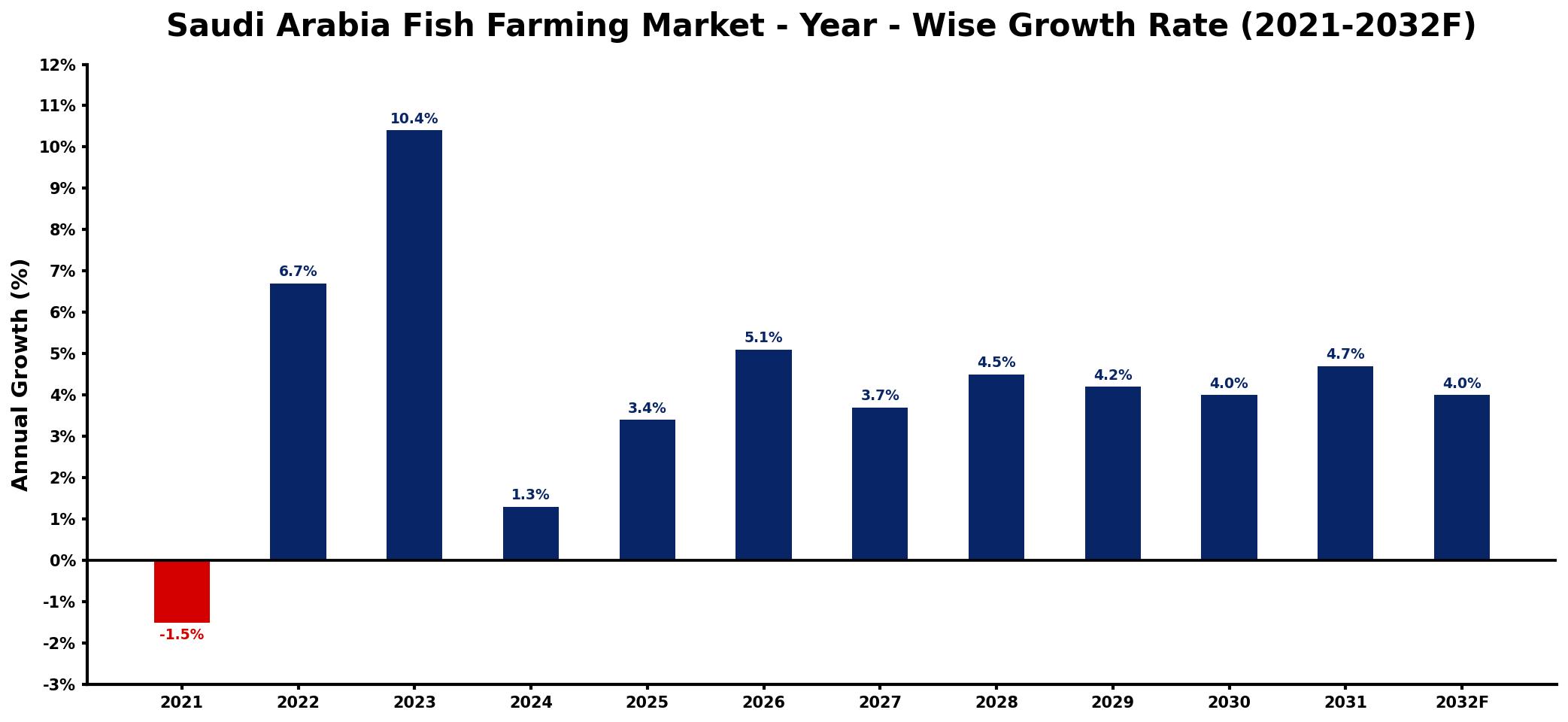
The table below presents the year‑wise growth rates along with the key drivers influencing the market
| Year | Growth Rate | Major Drivers |
| 2021 | -1.5% | market saturation affecting supply |
| 2022 | 6.7% | rising consumer health awareness |
| 2023 | 10.4% | increased investment in technology |
| 2024 | 1.3% | growing export market potential |
| 2025 | 3.4% | expansion of local production capacity |
| 2026 | 5.1% | enhanced distribution network efficiency |
| 2027 | 3.7% | increased government support initiatives |
| 2028 | 4.5% | growing demand for sustainable practices |
| 2029 | 4.2% | rising popularity of aquaculture products |
| 2030 | 4.0% | improvements in breeding techniques |
| 2031 | 4.7% | increased collaboration with research institutions |
| 2032 | 4.0% | expansion into alternative markets |
Note: Market size estimations and growth projections presented in this report are based on 6Wresearch's proprietary forecasting methodology, utilizing the latest available industry data, government publications, and primary research inputs.
Saudi Arabia Fish Farming Market Synopsis
The strongest force shaping the Saudi Arabia Fish Farming Market today is the urgent need to reduce dependency on fish imports. With the nation striving for self-sufficiency in food production, fish farming has emerged as an attractive solution. This sector's potential is being realized through government support, innovative practices, and a favorable climate for aquaculture.
The burgeoning demand for seafood among the local population, combined with environmental considerations, is influencing the market's landscape. Innovative farming techniques and sustainability practices are being adopted, ensuring both economic viability and environmental integrity in fish farming operations across the country.
Saudi Arabia Fish Farming Market Key Takeaways
- Fish farming is increasingly recognized as a key strategy to achieve food security in Saudi Arabia.
- Technological advancements are driving improved efficiencies in aquaculture practices.
- Government policies are fostering investment in domestic fish farming operations.
- Consumer preferences are shifting towards locally sourced seafood, boosting demand.
- Environmental sustainability measures are becoming critical in farming practices.
Evaluation of Restraints in Saudi Arabia Fish Farming Market
Despite its growth potential, the Saudi Arabia Fish Farming Market faces significant restraints that could hinder its progress. Water quality management presents a recurring challenge, as maintaining optimal conditions is vital for fish health and productivity. Additionally, disease prevention remains a critical concern that impacts overall yield and profitability. These challenges necessitate investment in advanced technologies and training for farmers, emphasizing the need for a commitment to both production efficiency and environmental stewardship.
Saudi Arabia Fish Farming Market Trends
Current trends in the Saudi Arabia Fish Farming Market reflect a shift towards more sustainable aquaculture practices, including integrated multi-trophic aquaculture. The adoption of precision farming techniques, enabled by technology, is gaining traction, allowing for real-time monitoring of environmental parameters and fish health. Additionally, consumers are increasingly inclined to purchase seafood that is certified as sustainable, influencing producers to adopt eco-friendly practices.
Saudi Arabia Fish Farming Market Opportunities
There are several promising avenues for growth within the Saudi Arabia Fish Farming Market. With the government emphasizing food security, investments in infrastructure for aquaculture, such as hatcheries and feed mills, present lucrative opportunities. The exploration of new species for farming could also open up niche markets, alongside the development of value-added products from farmed fish, catering to evolving consumer preferences.
Government Initiatives in the Saudi Arabia Fish Farming Market
The Saudi government has implemented various initiatives to bolster the fish farming sector, viewing it as a critical component of its food security strategy. Programs focused on research and development in aquaculture, along with financial incentives for local fish farmers, are creating a more conducive environment for investment. Additionally, policies aimed at reducing seafood import reliance are encouraging the establishment of new farms and the expansion of existing operations.
Future Insights of the Saudi Arabia Fish Farming Market
Looking ahead to 2026-2032, the Saudi Arabia Fish Farming Market is poised for steady growth driven by continued government support and consumer demand for local seafood. Innovations in farming technology and methods will likely enhance productivity and sustainability, allowing the market to adapt to emerging challenges. The integration of digital tools into aquaculture practices will also support the industry's expansion, making fish farming a vital contributor to the country's economic diversification efforts.
Saudi Arabia Fish Farming Market Latest Developments (2025 - 2026)
Recent developments in the Saudi Arabia Fish Farming Market indicate a growing focus on sustainability and technological integration. Various farms are adopting new aquaculture technologies to enhance productivity and minimize environmental impact. There is an increasing trend towards collaboration between public and private sectors to facilitate knowledge sharing and innovation, which is crucial for the industry's long-term resilience and growth.
Saudi Arabia Fish Farming Market - Key Attractiveness of the Report
- 10 Years of Market Numbers
- Historical Data Starting from 2022 to 2025
- Base Year: 2025
- Forecast Data until 2032
- Key Performance Indicators Impacting the Market
- Major Upcoming Developments and Projects
Key Highlights of the Report:
- Saudi Arabia Fish Farming Market Outlook
- Market Size of Saudi Arabia Fish Farming Market, 2025
- Forecast of Saudi Arabia Fish Farming Market, 2032
- Historical Data and Forecast of Saudi Arabia Fish Farming Revenues & Volume for the Period 2022-2032F
- Saudi Arabia Fish Farming Market Trend Evolution
- Saudi Arabia Fish Farming Market Drivers and Challenges
- Saudi Arabia Fish Farming Price Trends
- Saudi Arabia Fish Farming Porter's Five Forces
- Saudi Arabia Fish Farming Industry Life Cycle
- Historical Data and Forecast of Saudi Arabia Fish Farming Market Revenues & Volume By Environment for the Period 2022-2032F
- Historical Data and Forecast of Saudi Arabia Fish Farming Market Revenues & Volume By Marine Water for the Period 2022-2032F
- Historical Data and Forecast of Saudi Arabia Fish Farming Market Revenues & Volume By Fresh Water for the Period 2022-2032F
- Historical Data and Forecast of Saudi Arabia Fish Farming Market Revenues & Volume By Brackish Water for the Period 2022-2032F
- Historical Data and Forecast of Saudi Arabia Fish Farming Market Revenues & Volume By Fish Type for the Period 2022-2032F
- Historical Data and Forecast of Saudi Arabia Fish Farming Market Revenues & Volume By Pompano for the Period 2022-2032F
- Historical Data and Forecast of Saudi Arabia Fish Farming Market Revenues & Volume By Snappers for the Period 2022-2032F
- Historical Data and Forecast of Saudi Arabia Fish Farming Market Revenues & Volume By Groupers for the Period 2022-2032F
- Historical Data and Forecast of Saudi Arabia Fish Farming Market Revenues & Volume By Salmon for the Period 2022-2032F
- Historical Data and Forecast of Saudi Arabia Fish Farming Market Revenues & Volume By Milkfish for the Period 2022-2032F
- Historical Data and Forecast of Saudi Arabia Fish Farming Market Revenues & Volume By Tuna for the Period 2022-2032F
- Historical Data and Forecast of Saudi Arabia Fish Farming Market Revenues & Volume By Tilapia for the Period 2022-2032F
- Historical Data and Forecast of Saudi Arabia Fish Farming Market Revenues & Volume By Others for the Period 2022-2032F
- Saudi Arabia Fish Farming Import Export Trade Statistics
- Market Opportunity Assessment By Environment
- Market Opportunity Assessment By Fish Type
- Saudi Arabia Fish Farming Top Companies Market Share
- Saudi Arabia Fish Farming Competitive Benchmarking By Technical and Operational Parameters
- Saudi Arabia Fish Farming Company Profiles
- Saudi Arabia Fish Farming Key Strategic Recommendations






































