Saudi Arabia Flexible Intermediate Bulk Container Market Size Growth Rate
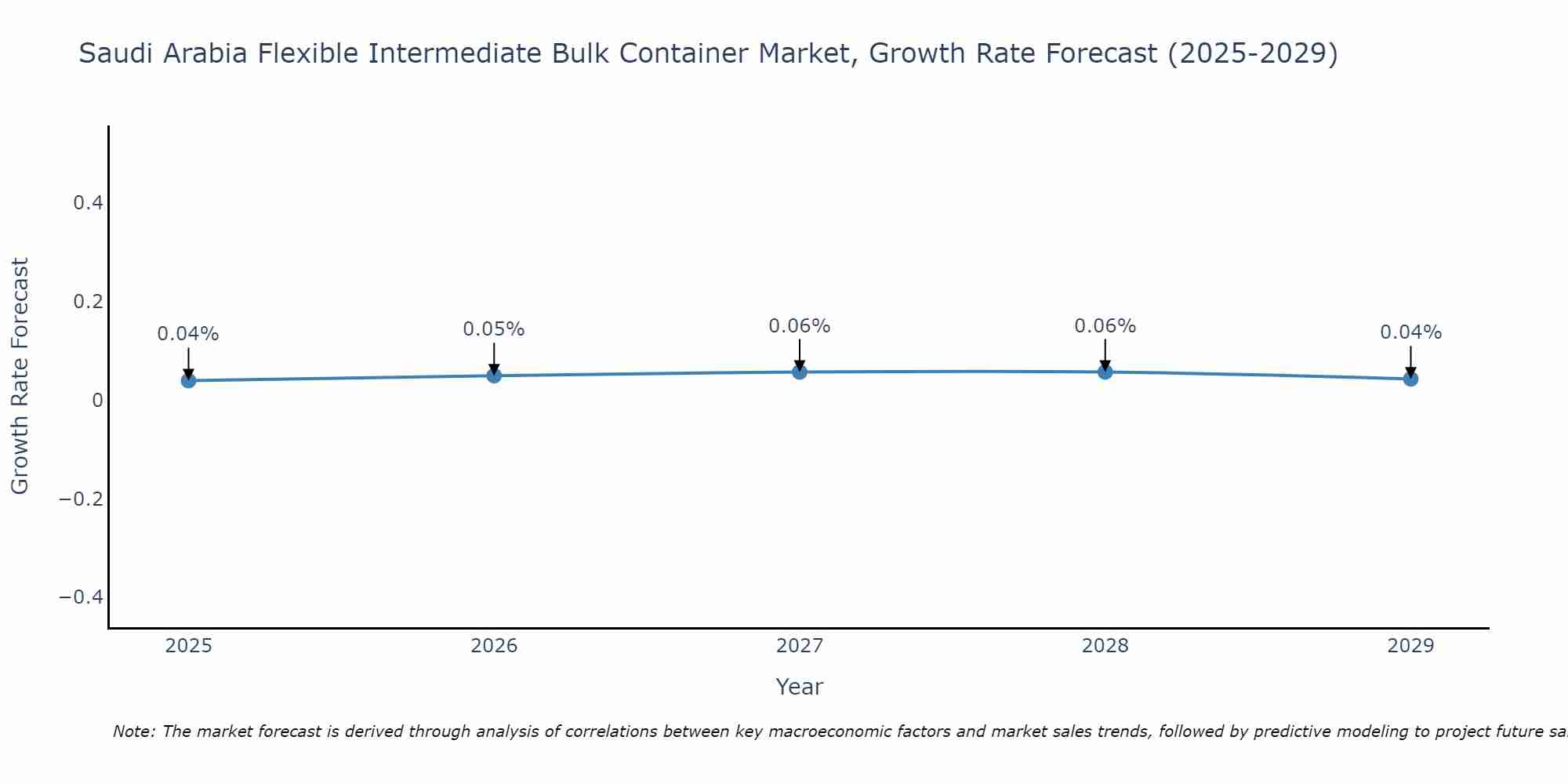
The Saudi Arabia Flexible Intermediate Bulk Container Market is projected to witness mixed growth rate patterns during 2025 to 2029. The growth rate begins at 0.04% in 2025, climbs to a high of 0.06% in 2028, and moderates to 0.04% by 2029.
Saudi Arabia Flexible Intermediate Bulk Container Market Synopsis
The flexible intermediate bulk container (FIBC) market in Saudi Arabia plays a pivotal role in the logistics and transportation of goods. FIBCs, often referred to as bulk bags, are used for storing and transporting a wide range of materials, including chemicals, food products, and construction materials. Their ability to accommodate large quantities of goods while providing cost-effective and efficient packaging solutions has driven their adoption across industries. As international trade and domestic industries continue to expand, the FIBC market is expected to grow in tandem, ensuring the smooth movement of goods.
Drivers of the Market
The Saudi Arabia flexible intermediate bulk container (FIBC) market is witnessing growth due to its role in simplifying bulk transportation and storage of goods. FIBCs, also known as bulk bags or jumbo bags, are widely used in various industries to transport materials such as grains, chemicals, and construction materials. The efficiency they offer in terms of packaging, loading, and unloading of bulk goods has made them a preferred choice. Moreover, their contribution to reducing packaging waste and improving logistics efficiency has further propelled their adoption.
Challenges of the Market
The Saudi Arabia Flexible Intermediate Bulk Container (FIBC) Market encounters challenges related to ensuring the safety and reliability of bulk transportation and storage. Developing FIBCs that can withstand varying weights, resist punctures, and safely contain various types of materials poses technical challenges. Addressing environmental concerns and promoting the reuse or recycling of FIBCs adds to the complexity. Adhering to international standards and regulations for the transport of hazardous materials further contributes to the challenges in this market.
COVID-19 Impact on the Market
The COVID-19 pandemic influenced the FIBC market in Saudi Arabia due to disruptions in supply chains and changes in consumer behavior. As various industries faced disruptions and lockdowns, demand for industrial packaging solutions like FIBCs experienced a decline. The reduction in manufacturing and export activities impacted the transportation of goods, affecting the demand for bulk packaging solutions. However, as essential industries adapted and transportation gradually resumed, the FIBC market began to recover. Moreover, the growing focus on e-commerce and the movement of goods created new opportunities for the packaging sector.
Key Players in the Market
Key players have played a vital role in shaping the FIBC market in Saudi Arabia. Companies like Saudi FIBC Industries, Arabian Bulk Sacks, and RoyalFlex Containers have been producing FIBCs to facilitate the storage and transportation of bulk goods. These key players have not only addressed the industrial needs of the country but have also made strides in international trade by providing reliable and efficient FIBC solutions.
Key Highlights of the Report:
- Saudi Arabia Flexible Intermediate Bulk Container Market Outlook
- Market Size of Saudi Arabia Flexible Intermediate Bulk Container Market, 2024
- Forecast of Saudi Arabia Flexible Intermediate Bulk Container Market, 2031
- Historical Data and Forecast of Saudi Arabia Flexible Intermediate Bulk Container Revenues & Volume for the Period 2021-2031
- Saudi Arabia Flexible Intermediate Bulk Container Market Trend Evolution
- Saudi Arabia Flexible Intermediate Bulk Container Market Drivers and Challenges
- Saudi Arabia Flexible Intermediate Bulk Container Price Trends
- Saudi Arabia Flexible Intermediate Bulk Container Porter's Five Forces
- Saudi Arabia Flexible Intermediate Bulk Container Industry Life Cycle
- Historical Data and Forecast of Saudi Arabia Flexible Intermediate Bulk Container Market Revenues & Volume By Product for the Period 2021-2031
- Historical Data and Forecast of Saudi Arabia Flexible Intermediate Bulk Container Market Revenues & Volume By Type A for the Period 2021-2031
- Historical Data and Forecast of Saudi Arabia Flexible Intermediate Bulk Container Market Revenues & Volume By Type B for the Period 2021-2031
- Historical Data and Forecast of Saudi Arabia Flexible Intermediate Bulk Container Market Revenues & Volume By Type C for the Period 2021-2031
- Historical Data and Forecast of Saudi Arabia Flexible Intermediate Bulk Container Market Revenues & Volume By Type D for the Period 2021-2031
- Historical Data and Forecast of Saudi Arabia Flexible Intermediate Bulk Container Market Revenues & Volume By End-Use for the Period 2021-2031
- Historical Data and Forecast of Saudi Arabia Flexible Intermediate Bulk Container Market Revenues & Volume By Food for the Period 2021-2031
- Historical Data and Forecast of Saudi Arabia Flexible Intermediate Bulk Container Market Revenues & Volume By Chemical for the Period 2021-2031
- Historical Data and Forecast of Saudi Arabia Flexible Intermediate Bulk Container Market Revenues & Volume By Pharmaceuticals for the Period 2021-2031
- Historical Data and Forecast of Saudi Arabia Flexible Intermediate Bulk Container Market Revenues & Volume By Others for the Period 2021-2031
- Saudi Arabia Flexible Intermediate Bulk Container Import Export Trade Statistics
- Market Opportunity Assessment By Product
- Market Opportunity Assessment By End-Use
- Saudi Arabia Flexible Intermediate Bulk Container Top Companies Market Share
- Saudi Arabia Flexible Intermediate Bulk Container Competitive Benchmarking By Technical and Operational Parameters
- Saudi Arabia Flexible Intermediate Bulk Container Company Profiles
- Saudi Arabia Flexible Intermediate Bulk Container Key Strategic Recommendations






































