Saudi Arabia Food And Beverage Vending Machine Market Size, Share & Growth Rate
The Saudi Arabia Food And Beverage Vending Machine Market was estimated at USD 1301 Million in 2025 and is projected to reach USD 1889 Million by 2032, growing at a CAGR of 5.5% from 2026 to 2032. This growth trajectory is primarily driven by the increasing demand for convenience in urban environments, as busy lifestyles and a shift towards on-the-go consumption are becoming the norm among consumers. Additionally, the incorporation of advanced technologies in vending machines, such as digital payments and touchscreen interfaces, is appealing to a tech-savvy demographic eager for modern purchasing solutions.
Saudi Arabia Food And Beverage Vending Machine Market Year-wise Growth Rate and Key Drivers
This graph highlights how the Saudi Arabia Food And Beverage Vending Machine Market has steadily grown over the years, supported by major growth factors.
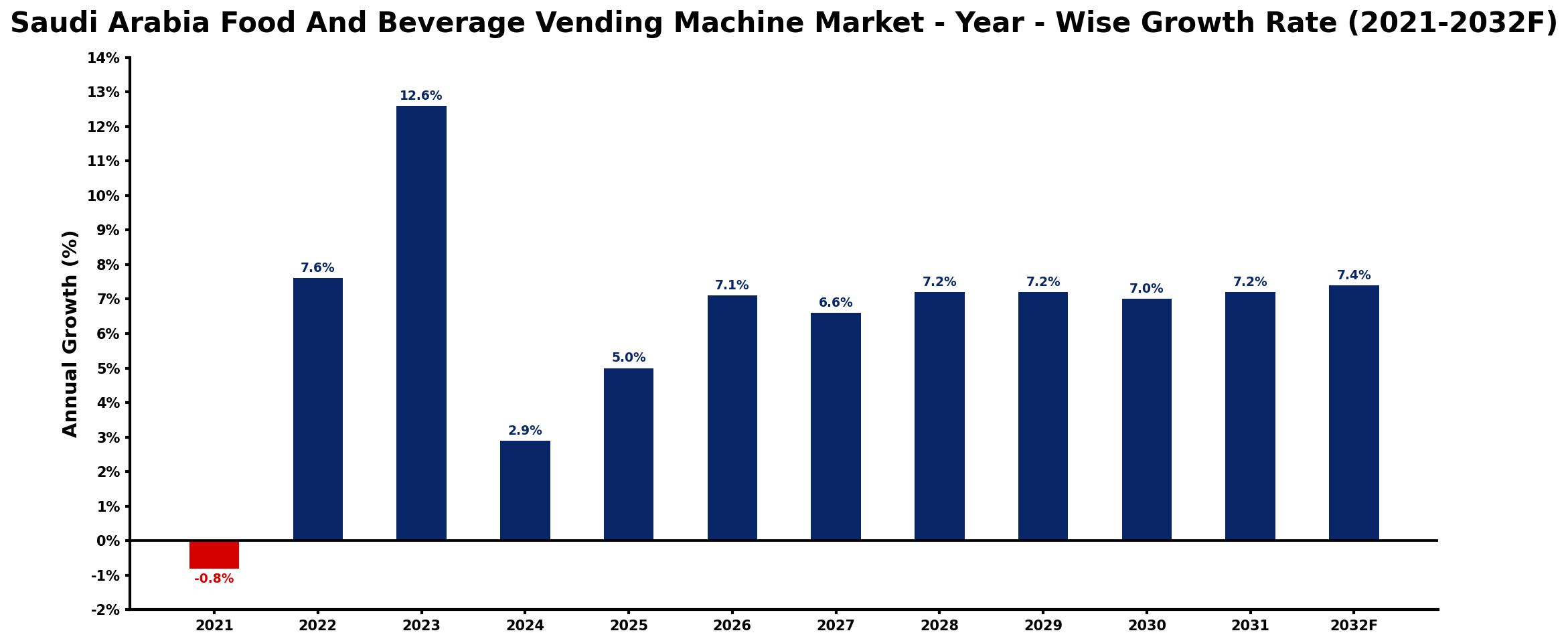
The table below presents the year‑wise growth rates along with the key drivers influencing the market
| Year | Growth Rate | Major Drivers |
| 2021 | -0.8% | decrease in consumer spending habits |
| 2022 | 7.6% | increased investment in automation technology |
| 2023 | 12.6% | growing popularity of contactless payments |
| 2024 | 2.9% | expansion of retail locations nationwide |
| 2025 | 5.0% | rising demand for healthy options |
| 2026 | 7.1% | enhanced user experience through innovation |
| 2027 | 6.6% | increased domestic production output |
| 2028 | 7.2% | increased interest in convenience solutions |
| 2029 | 7.2% | expanding partnerships with local suppliers |
| 2030 | 7.0% | integration of smart technology solutions |
| 2031 | 7.2% | strong emphasis on sustainability initiatives |
| 2032 | 7.4% | development of diverse product offerings |
Note: Market size estimations and growth projections presented in this report are based on 6Wresearch's proprietary forecasting methodology, utilizing the latest available industry data, government publications, and primary research inputs.
Saudi Arabia Food And Beverage Vending Machine Market Synopsis
The Saudi Arabia Food and Beverage Vending Machine market is witnessing a dynamic transformation, fueled by the changing habits of consumers who seek swift and easy access to food and drinks. The growing trend of urbanization, coupled with increased work pressure, necessitates accessible and quick meal options, solidifying the role of vending machines in the retail landscape.
Moreover, consumers are now favoring healthier choices and innovative offerings, prompting vending machine operators to diversify their product lines. The integration of features such as contactless payments and interactive displays further enhances user experience, setting a new standard in the market.
Saudi Arabia Food And Beverage Vending Machine Market Key Takeaways
- The market is evolving with a robust CAGR of 5.5% projected from 2026 to 2032.
- Demand for convenience and healthier options is a significant growth driver.
- Technological advancements are enhancing customer engagement and payment processes.
- Customization and product variety are becoming critical for competitive differentiation.
- Compliance with food safety regulations is essential for market sustainability.
Evaluation of Restraints in Saudi Arabia Food And Beverage Vending Machine Market
Despite the promising growth outlook, the Saudi Arabia Food and Beverage Vending Machine market faces notable constraints that could impede its progress. A significant challenge lies in the customization of machines to meet diverse consumer preferences and dietary restrictions. Crafting vending solutions that cater to a range of tastes while maintaining product quality and safety can be complex and resource-intensive. Furthermore, the competitive landscape from traditional retail outlets presents an ongoing challenge, requiring operators to continually innovate to capture and retain consumer interest. Lastly, issues related to technical reliability and machine maintenance are crucial, as they directly impact customer satisfaction.
Saudi Arabia Food And Beverage Vending Machine Market Trends
Several key trends are shaping the landscape of the Saudi Arabia Food and Beverage Vending Machine market. First, there is a noticeable shift towards healthier and organic product offerings, reflecting consumer demands for nutritious options. Second, the adoption of contactless and cashless payment systems has surged, propelled by the pandemic and a heightened focus on hygiene. Additionally, the implementation of smart technologies, such as IoT connectivity, is enhancing operational efficiency and customer engagement. As consumers become increasingly aware of their food choices, eco-friendly vending solutions are also gaining traction, responding to a growing desire for sustainability.
Saudi Arabia Food And Beverage Vending Machine Market Opportunities
The Saudi Arabia Food and Beverage Vending Machine market presents numerous opportunities for growth and investment. The expansion of urban areas opens new locations for machine installations, particularly in high-traffic zones like shopping malls, airports, and educational institutions. Furthermore, as health-conscious consumer trends continue to rise, theres significant potential for vending operators to introduce a wider array of nutritious and organic product lines. Partnering with local food suppliers can also enhance product authenticity and attract a loyal customer base. Technological advancements in vending machine design and functionality provide a pathway for enhancing user experience, making it an attractive investment space.
Government Initiatives in the Saudi Arabia Food And Beverage Vending Machine Market
The Saudi government has been actively promoting innovation and modernization across various sectors, including retail. Initiatives aimed at enhancing the digital economy are fostering an environment conducive to the growth of smart vending solutions. Public spending on infrastructure improvements, especially in urban areas, is likely to boost the accessibility of vending machines in strategic locations. Additionally, regulations encouraging food safety standards are being implemented to ensure that all food and beverage offerings meet health guidelines, further supporting consumer confidence in vending options.
Future Insights of the Saudi Arabia Food And Beverage Vending Machine Market
Looking ahead, the Saudi Arabia Food and Beverage Vending Machine market is poised for significant evolution from 2026 to 2032. The shift towards convenience and technology integration will likely dominate the landscape, as consumers increasingly prioritize efficiency in their purchasing habits. Enhanced machine functionalities, such as AI-driven recommendations and inventory tracking, will revolutionize consumer interaction. Furthermore, as health and wellness take center stage, the introduction of personalized and tailored offerings will create a more engaging experience. In summary, the market is set to adapt dynamically to changing consumer needs while leveraging technological innovations.
Saudi Arabia Food And Beverage Vending Machine Market Latest Developments (2025 - 2026)
Recent developments in the Saudi Arabia Food and Beverage Vending Machine market indicate a strong trend towards modernization and integration of advanced technologies. Operators are increasingly adopting machine learning to better predict consumer preferences and streamline product offerings. Innovations in payment technologies, particularly contactless options, have also gained momentum in response to consumer demand for convenience and safety. Furthermore, partnerships with local brands are on the rise, as companies seek to provide unique and culturally relevant offerings to enhance customer experience.
Saudi Arabia Food And Beverage Vending Machine Market - Key Attractiveness of the Report
- 10 Years of Market Numbers
- Historical Data Starting from 2022 to 2025
- Base Year: 2025
- Forecast Data until 2032
- Key Performance Indicators Impacting the Market
- Major Upcoming Developments and Projects
Key Highlights of the Report:
- Saudi Arabia Food And Beverage Vending Machine Market Outlook
- Market Size of Saudi Arabia Food And Beverage Vending Machine Market, 2025
- Forecast of Saudi Arabia Food And Beverage Vending Machine Market, 2032
- Historical Data and Forecast of Saudi Arabia Food And Beverage Vending Machine Revenues & Volume for the Period 2022-2032F
- Saudi Arabia Food And Beverage Vending Machine Market Trend Evolution
- Saudi Arabia Food And Beverage Vending Machine Market Drivers and Challenges
- Saudi Arabia Food And Beverage Vending Machine Price Trends
- Saudi Arabia Food And Beverage Vending Machine Porter's Five Forces
- Saudi Arabia Food And Beverage Vending Machine Industry Life Cycle
- Historical Data and Forecast of Saudi Arabia Food And Beverage Vending Machine Market Revenues & Volume By Product Type for the Period 2022-2032F
- Historical Data and Forecast of Saudi Arabia Food And Beverage Vending Machine Market Revenues & Volume By Beverage Vending machine for the Period 2022-2032F
- Historical Data and Forecast of Saudi Arabia Food And Beverage Vending Machine Market Revenues & Volume By Food Vending Machine for the Period 2022-2032F
- Historical Data and Forecast of Saudi Arabia Food And Beverage Vending Machine Market Revenues & Volume By Payment Mode for the Period 2022-2032F
- Historical Data and Forecast of Saudi Arabia Food And Beverage Vending Machine Market Revenues & Volume By Cash for the Period 2022-2032F
- Historical Data and Forecast of Saudi Arabia Food And Beverage Vending Machine Market Revenues & Volume By Cashless for the Period 2022-2032F
- Historical Data and Forecast of Saudi Arabia Food And Beverage Vending Machine Market Revenues & Volume By Application for the Period 2022-2032F
- Historical Data and Forecast of Saudi Arabia Food And Beverage Vending Machine Market Revenues & Volume By Schools for the Period 2022-2032F
- Historical Data and Forecast of Saudi Arabia Food And Beverage Vending Machine Market Revenues & Volume By Offices for the Period 2022-2032F
- Historical Data and Forecast of Saudi Arabia Food And Beverage Vending Machine Market Revenues & Volume By Shopping Complex for the Period 2022-2032F
- Historical Data and Forecast of Saudi Arabia Food And Beverage Vending Machine Market Revenues & Volume By Others for the Period 2022-2032F
- Saudi Arabia Food And Beverage Vending Machine Import Export Trade Statistics
- Market Opportunity Assessment By Product Type
- Market Opportunity Assessment By Payment Mode
- Market Opportunity Assessment By Application
- Saudi Arabia Food And Beverage Vending Machine Top Companies Market Share
- Saudi Arabia Food And Beverage Vending Machine Competitive Benchmarking By Technical and Operational Parameters
- Saudi Arabia Food And Beverage Vending Machine Company Profiles
- Saudi Arabia Food And Beverage Vending Machine Key Strategic Recommendations






































