Saudi Arabia Food Packaging Market Summary
The saudi arabia food packaging market was estimated at USD 390 Million in 2025 and is projected to reach USD 495 Million by 2032, growing at a CAGR of 5.0% from 2026 to 2032.
Saudi Arabia Food Packaging Market Year-wise Growth Rate and Key Drivers
This graph highlights how the Saudi Arabia Food Packaging Market has steadily grown over the past five years, supported by major growth factors.
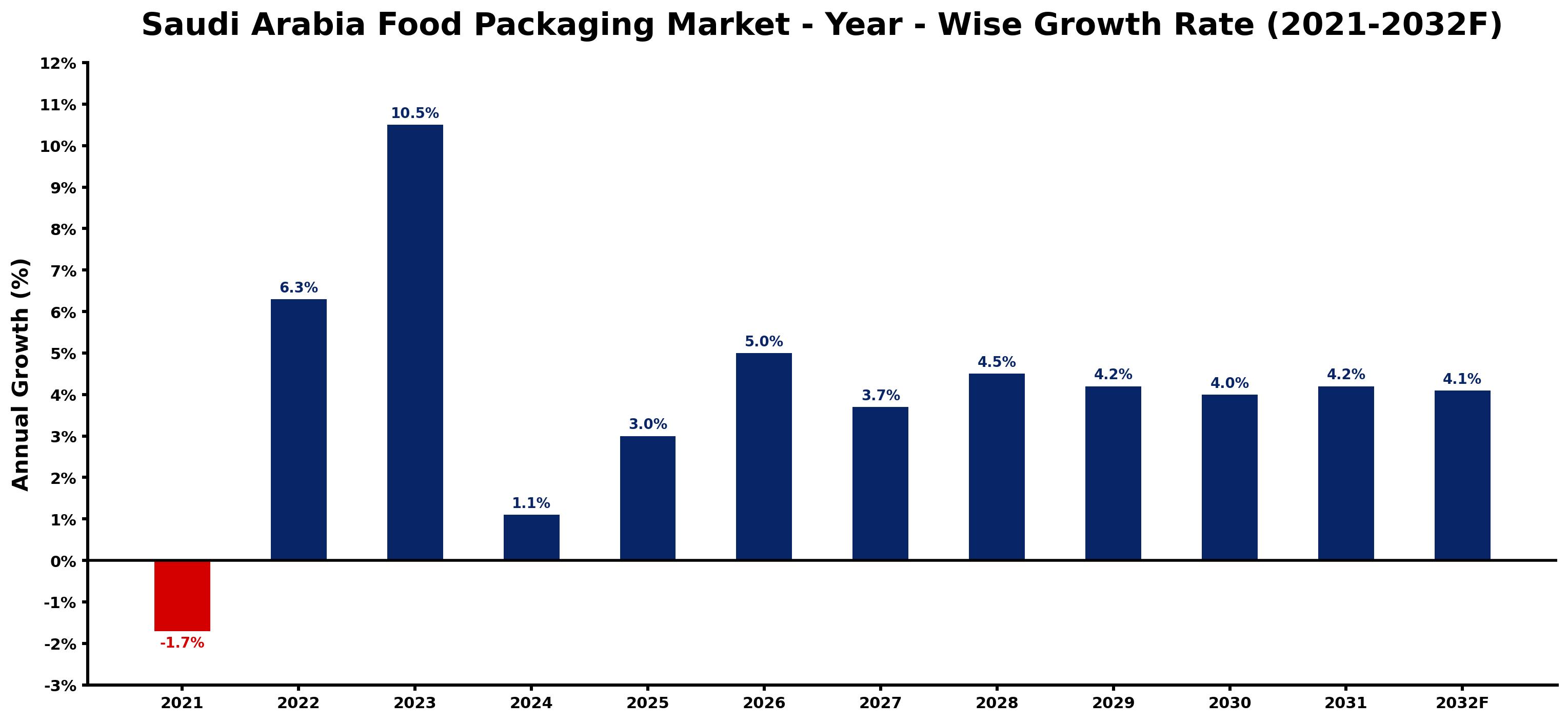
The table below presents the year wise growth rates along with the key drivers influencing the market
| Year | Growth Rate | Major Drivers |
| 2021 | -1.7% | Increased import restrictions on packaging materials hindered supply chain efficiency and elevated costs for manufacturers. |
| 2022 | 6.3% | Emerging trends in sustainability reshape consumer expectations for food packaging materials. |
| 2023 | 10.5% | Retail expansion sees increased demand for diverse and efficient packaging solutions. |
| 2024 | 1.1% | Technological advancements enhance the efficiency of packaging production processes. |
| 2025 | 3.0% | Focus on hygiene and safety elevates demand for secure packaging options. |
| 2026 | 5.0% | Local manufacturers increasingly collaborate with global brands to improve quality standards. |
| 2027 | 3.7% | The booming e-commerce sector necessitates specialized packaging for online food delivery. |
| 2028 | 4.5% | Consumer preferences shift towards eco-friendly packaging, influencing brand strategies. |
| 2029 | 4.2% | Investment in new manufacturing technologies supports higher production capabilities. |
| 2030 | 4.0% | Regulatory measures encourage the use of biodegradable materials in food packaging. |
| 2031 | 4.2% | Increased tourism stimulates demand for packaged food items targeting international visitors. |
| 2032 | 4.1% | The rise of smart packaging technologies enhances consumer engagement with brands. |
Note - Market size estimations and growth projections presented in this report are based on 6Wresearch's advanced forecasting approach, validated with industry datasets as of June 2026.
Saudi Arabia Food Packaging Market Synopsis
The Saudi Arabia Food Packaging Market is projected to reach 5.0% and witness significant growth during the forecast period (2026-2032). The market is expected to expand at a compound annual growth rate (CAGR) of 5.3%, driven by a combination of demographic factors, increased health consciousness, and the rising demand for convenience food solutions. The surging consumption of ready-to-eat meals further emphasizes the necessity for advanced packaging solutions that cater to consumers' preferences for both quality and convenience.
Saudi Arabia Food Packaging Market Growth Drivers
The growth of the Saudi Arabia food packaging market is bolstered by several key factors:
- The population of Saudi Arabia, estimated at 33 million, provides a substantial consumer base that drives demand for various packaged food products across retail, supermarkets, and foodservice sectors.
- An increasing focus on health awareness among consumers has resulted in a rising preference for health-oriented food products, necessitating higher quality packaging to maintain freshness and safety.
- The trend of convenience foods, especially ready-to-eat meals, is rapidly gaining traction; this shift creates a high demand for innovative and customized packaging solutions that enhance the consumer experience.
- Rising disposable incomes have enabled consumers to spend more on premium packaged food products, encouraging manufacturers to invest in improved packaging technologies.
- Shifting lifestyles, combined with urbanization, have influenced consumption patterns, resulting in greater dependence on packaged food items that promise safety, hygiene, and convenience.
Saudi Arabia Food Packaging Market Challenges and Restraints
While the Saudi Arabia food packaging market presents numerous opportunities, it is not without its challenges:
- The high initial costs associated with the adoption of automated production lines can present barriers for small and medium enterprises wishing to modernize their operations.
- A persistent shortage of skilled professionals in the packaging industry poses a significant challenge, hindering the effective implementation of advanced technologies and innovations.
- Stringent government regulations aimed at maintaining high-quality standards can impose additional pressures on manufacturers, resulting in increased costs that may affect profit margins.
- The necessity for continual innovation in packaging solutions demands that companies invest heavily in research and development, which may strain financial resources.
- Market participants must navigate the complexities of sustainability, as consumers increasingly seek eco-friendly packaging options, requiring manufacturers to adapt and invest in sustainable practices.
Saudi Arabia Food Packaging Market COVID-19 Impact
The COVID-19 pandemic has significantly influenced the dynamics of the Saudi Arabia food packaging market. With consumers prioritizing safety and convenience, there has been a marked increase in demand for packaged food products. The shift towards packaged goods was propelled by the need for hygiene and the desire to minimize contact during purchases. This trend has prompted manufacturers to explore new, innovative packaging solutions that not only ensure safety but also appeal aesthetically to consumers while remaining cost-effective.
Saudi Arabia Food Packaging Market Government Investment and Initiatives
The Saudi Arabian government has recognized the importance of the food packaging sector within its broader economic development strategy. Various initiatives have been introduced to foster growth in this market:
- The government supports the food manufacturing and packaging sectors through investment in infrastructure, incentivizing modernization and technological advancement.
- Public spending programs aim to enhance the overall supply chain efficiency, directly benefiting food packaging operations by ensuring timely distribution and quality assurance.
- Strategic partnerships with private entities are encouraged to facilitate knowledge transfer and explore innovative practices in food packaging technologies.
- Regulatory frameworks have been established to streamline operations while maintaining stringent food safety standards, ensuring that manufacturers comply without excessive bureaucratic impediments.
- Investment in training and education programs is also prioritized to cultivate a skilled workforce that can adapt to the evolving demands of the food packaging industry.
Saudi Arabia Food Packaging Market Latest Developments (May 2025 - June 2026)
Recent trends in the Saudi Arabia food packaging market indicate a strong shift towards sustainable practices and technological advancements. Over the period from May 2025 to June 2026, the industry has observed increased investment in environmentally friendly packaging materials and methods aimed at reducing waste and enhancing recycling practices. Additionally, there has been a notable emergence of smart packaging technologies, which include features that extend shelf life and improve food safety. Manufacturers are increasingly adopting automation within their processes to optimize efficiency and reduce costs, further solidifying the market's growth trajectory.
Saudi Arabia Food Packaging Market - Key Attractiveness of the Report
- 10 Years of Market Numbers
- Historical Data Starting from 2022 to 2025
- Base Year: 2025
- Forecast Data until 2032
- Key Performance Indicators Impacting the Market
- Major Upcoming Developments and Projects
Key Highlights of the Report:
- Saudi Arabia Food Packaging Market Outlook
- Market Size of Saudi Arabia Food Packaging Market, 2025
- Forecast of Saudi Arabia Food Packaging Market, 2032
- Historical Data and Forecast of Saudi Arabia Food Packaging Revenues & Volume for the Period 2022-2032F
- Saudi Arabia Food Packaging Market Trend Evolution
- Saudi Arabia Food Packaging Market Drivers and Challenges
- Saudi Arabia Food Packaging Price Trends
- Saudi Arabia Food Packaging Porter's Five Forces
- Saudi Arabia Food Packaging Industry Life Cycle
- Historical Data and Forecast of Saudi Arabia Food Packaging Market Revenues & Volume By Material Types for the Period 2022-2032F
- Historical Data and Forecast of Saudi Arabia Food Packaging Market Revenues & Volume By Paper & board for the Period 2022-2032F
- Historical Data and Forecast of Saudi Arabia Food Packaging Market Revenues & Volume By Plastic for the Period 2022-2032F
- Historical Data and Forecast of Saudi Arabia Food Packaging Market Revenues & Volume By Metal for the Period 2022-2032F
- Historical Data and Forecast of Saudi Arabia Food Packaging Market Revenues & Volume By Glass for the Period 2022-2032F
- Historical Data and Forecast of Saudi Arabia Food Packaging Market Revenues & Volume By Others for the Period 2022-2032F
- Historical Data and Forecast of Saudi Arabia Food Packaging Market Revenues & Volume By Product Types for the Period 2022-2032F
- Historical Data and Forecast of Saudi Arabia Food Packaging Market Revenues & Volume By Rigid for the Period 2022-2032F
- Historical Data and Forecast of Saudi Arabia Food Packaging Market Revenues & Volume By Semi-Rigid for the Period 2022-2032F
- Historical Data and Forecast of Saudi Arabia Food Packaging Market Revenues & Volume By Flexible for the Period 2022-2032F
- Historical Data and Forecast of Saudi Arabia Food Packaging Market Revenues & Volume By Applications for the Period 2022-2032F
- Historical Data and Forecast of Saudi Arabia Food Packaging Market Revenues & Volume By Bakery & Confectionary for the Period 2022-2032F
- Historical Data and Forecast of Saudi Arabia Food Packaging Market Revenues & Volume By Dairy Products for the Period 2022-2032F
- Historical Data and Forecast of Saudi Arabia Food Packaging Market Revenues & Volume By Fruits & Vegetables for the Period 2022-2032F
- Historical Data and Forecast of Saudi Arabia Food Packaging Market Revenues & Volume By Meat, Poultry, & Seafood for the Period 2022-2032F
- Historical Data and Forecast of Saudi Arabia Food Packaging Market Revenues & Volume By Sauces & Dressings for the Period 2022-2032F
- Historical Data and Forecast of Saudi Arabia Food Packaging Market Revenues & Volume By Others for the Period 2022-2032F
- Saudi Arabia Food Packaging Import Export Trade Statistics
- Market Opportunity Assessment By Material Types
- Market Opportunity Assessment By Product Types
- Market Opportunity Assessment By Applications
- Saudi Arabia Food Packaging Top Companies Market Share
- Saudi Arabia Food Packaging Competitive Benchmarking By Technical and Operational Parameters
- Saudi Arabia Food Packaging Company Profiles
- Saudi Arabia Food Packaging Key Strategic Recommendations






































