Saudi Arabia Food Processing & Handling Equipment Market Summary
The saudi arabia food processing & handling equipment market was estimated at USD 209 Million in 2025 and is projected to reach USD 266 Million by 2032, growing at a CAGR of 4.9% from 2026 to 2032.
Saudi Arabia Food Processing & Handling Equipment Market Year-wise Growth Rate and Key Drivers
This graph highlights how the Saudi Arabia Food Processing & Handling Equipment Market has steadily grown over the past five years, supported by major growth factors.
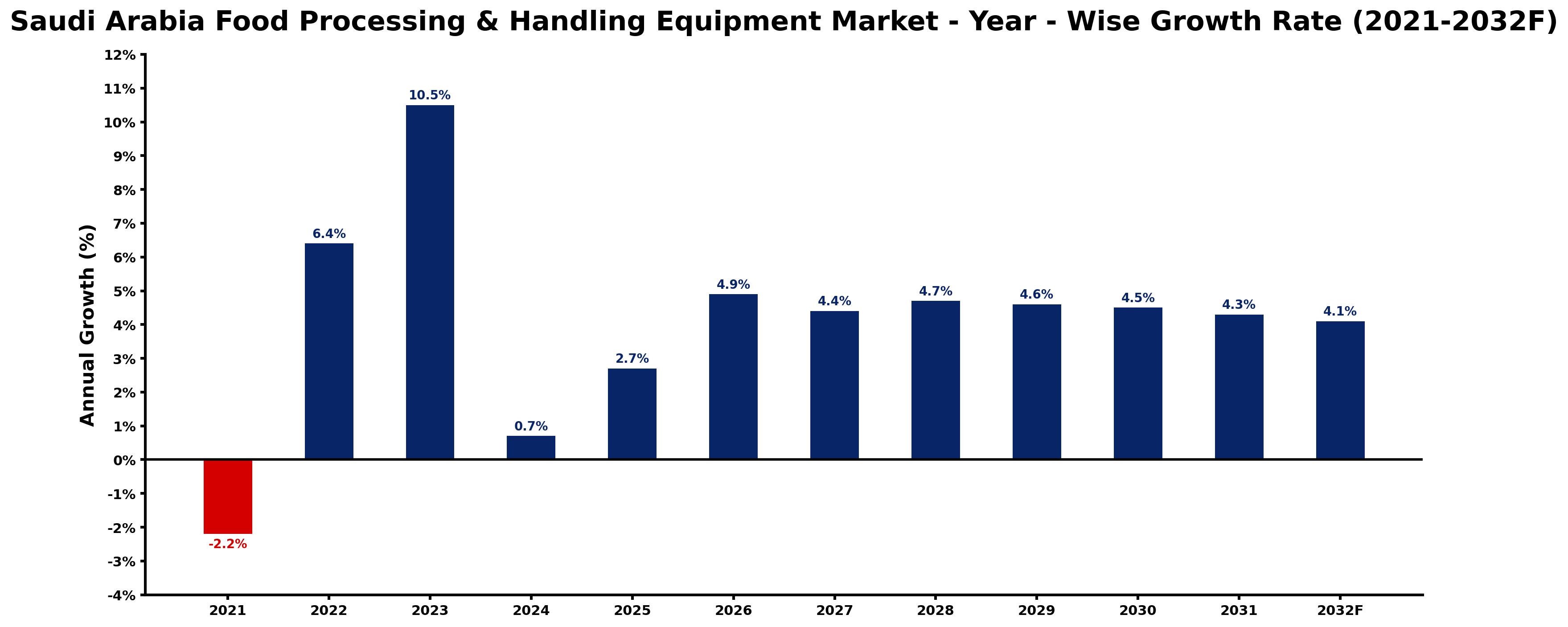
The table below presents the year wise growth rates along with the key drivers influencing the market
| Year | Growth Rate | Major Drivers |
| 2021 | -2.2% | Supply chain disruptions during the pandemic hindered equipment availability, leading to decreased investment in food processing operations. |
| 2022 | 6.4% | Emerging middle class drives preferences for packaged and processed food products significantly. |
| 2023 | 10.5% | Economic diversification efforts boost opportunities for local food processing enterprises across sectors. |
| 2024 | 0.7% | Technological integration in food handling equipment increases efficiency and reduces operational costs. |
| 2025 | 2.7% | Rural infrastructure improvements enhance supply chain logistics for food processing industries. |
| 2026 | 4.9% | Global food supply chain disruptions push local manufacturers to develop robust processing solutions. |
| 2027 | 4.4% | Increased focus on sustainability leads to innovative, eco-friendly food processing technologies. |
| 2028 | 4.7% | Regional trade agreements facilitate market access for advanced food processing technologies. |
| 2029 | 4.6% | Consumer health consciousness promotes demand for organic and minimally processed food options. |
| 2030 | 4.5% | Smart farming trends drive investments in automated food processing and handling machinery. |
| 2031 | 4.3% | The logistics sector's expansion requires modernized food handling systems for efficiency. |
| 2032 | 4.1% | Urbanization trends create higher demand for diverse food processing equipment to meet needs. |
Note - Market size estimations and growth projections presented in this report are based on 6Wresearch's advanced forecasting approach, validated with industry datasets as of June 2026.
Saudi Arabia Food Processing & Handling Equipment Market Synopsis
The Saudi Arabia Food Processing Handling Equipment Market is projected to reach 4.9% and witness significant growth during the forecast period (2026-2032). In 2025, the market was valued at approximately US$ 1,018.5 million, with expectations to grow further at a compound annual growth rate (CAGR) of 6.3%. This growth is primarily fueled by various factors, including a burgeoning population, rising disposable income, rapid urbanization, and an increasing demand for convenience foods. Furthermore, changing lifestyles and preferences among consumers are contributing to a robust growth trajectory for food processing and handling equipment in the region.
Saudi Arabia Food Processing & Handling Equipment Market Growth Drivers
A key driver of the Saudi Arabia Food Processing & Handling Equipment Market is the escalating demand for convenience foods. As consumer lifestyles evolve, there is a notable shift towards convenience among dietary habits, propelling the growth of convenience stores across the nation. This surge in demand is accompanied by government initiatives aimed at developing modern infrastructure that enhances accessibility to convenience food items.
- The increasing number of working individuals and busy families in urban areas is significantly contributing to the popularity of convenience foods, necessitating advanced food processing and handling equipment.
- Technological advancements, particularly in automation and robotics, are transforming the food processing sector, leading to higher operational efficiencies and cost reductions in production processes.
- As the country invests in modernizing its food supply chain, there is a growing need for sophisticated equipment that can enhance production capabilities and meet evolving consumer demands.
- Rising disposable incomes are enabling consumers to favor higher-quality, convenient food products, further stimulating the market for food processing and handling equipment.
- The growth of e-commerce and online grocery platforms is compounding the demand for innovative packaging and handling solutions to maintain product quality and safety during distribution.
Saudi Arabia Food Processing & Handling Equipment Market Challenges and Restraints
Despite favorable growth prospects, the Saudi Arabia Food Processing & Handling Equipment Market faces several challenges that may hinder investment and expansion efforts. One prominent challenge is the high initial setup and installation costs associated with food processing machinery, which can deter potential investors.
- The ongoing maintenance expenses related to advanced machinery can also pose a significant financial burden for companies, leading to a lower return on investment (ROI) from long-term capital expenditures.
- Economic fluctuations, such as those triggered by the COVID-19 pandemic, have resulted in reduced sales across various sectors, including food processing, affecting overall market dynamics.
- Stringent regulatory measures imposed by government authorities on imported machinery can create additional barriers to entry for foreign brands looking to penetrate the Saudi market.
- Increased competition among local and international manufacturers may lead to price wars, further compressing profit margins for existing players in the market.
- The scarcity of skilled labor proficient in operating and maintaining advanced food processing equipment may result in operational challenges for many organizations.
Saudi Arabia Food Processing & Handling Equipment Market Government Investment and Initiatives
The Saudi government has recognized the vital role that the food processing and handling equipment sector plays in ensuring food security and economic diversification. As part of its Vision 2030 initiative, the government is actively investing in developing infrastructure that supports modern food processing capabilities. This includes incentives for upgrading existing facilities, fostering technological innovation, and promoting sustainable practices within the food sector.
- Government programs aimed at enhancing local food production capabilities have been introduced, targeting advancements in food processing technologies to minimize reliance on imports.
- Public-private partnerships are being encouraged to facilitate funding for innovative projects that contribute to modernization in the food processing sector.
- Regulatory frameworks are being established to simplify compliance for manufacturers, easing the path for new investments in food processing equipment.
- Initiatives to support R&D in food technology are also being promoted, encouraging collaboration between academic institutions and industry stakeholders.
- Investment in training programs for the workforce is being prioritized to ensure that employees are equipped with the necessary skills to operate advanced food processing equipment efficiently.
Saudi Arabia Food Processing & Handling Equipment Market Latest Developments (May 2025 - June 2026)
During the period from May 2025 to June 2026, the Saudi Arabia Food Processing & Handling Equipment Market has witnessed several noteworthy developments that reflect ongoing innovations and trends in the sector. Increased adoption of automated solutions has become prominent as businesses seek to optimize production efficiency amid rising operational costs.
- There has been a steady rise in investments directed towards integrating Artificial Intelligence (AI) and machine learning technologies within food processing operations to enhance predictive maintenance capabilities.
- Innovations in sustainable packaging solutions have gained traction, aligning with global trends focused on reducing environmental impact and enhancing product safety.
- Challenges posed by labor shortages have prompted companies to explore collaborative robots (cobots) that can work alongside human operators to improve efficiency and output without requiring extensive retraining.
- Market players have focused on developing equipment that can maintain high standards of hygiene and safety in food processing, addressing consumer concerns heightened by the pandemic.
- Collaborations between local firms and international technology providers have increased, resulting in knowledge transfer and the introduction of cutting-edge processing technologies into the Saudi market.
Saudi Arabia Food Processing & Handling Equipment Market - Key Attractiveness of the Report
- 10 Years of Market Numbers
- Historical Data Starting from 2022 to 2025
- Base Year: 2025
- Forecast Data until 2032
- Key Performance Indicators Impacting the Market
- Major Upcoming Developments and Projects
Key Highlights of the Report:
- Saudi Arabia Food Processing & Handling Equipment Market Outlook
- Market Size of Saudi Arabia Food Processing & Handling Equipment Market, 2025
- Forecast of Saudi Arabia Food Processing & Handling Equipment Market, 2032
- Historical Data and Forecast of Saudi Arabia Food Processing & Handling Equipment Revenues & Volume for the Period 2022-2032F
- Saudi Arabia Food Processing & Handling Equipment Market Trend Evolution
- Saudi Arabia Food Processing & Handling Equipment Market Drivers and Challenges
- Saudi Arabia Food Processing & Handling Equipment Price Trends
- Saudi Arabia Food Processing & Handling Equipment Porter's Five Forces
- Saudi Arabia Food Processing & Handling Equipment Industry Life Cycle
- Historical Data and Forecast of Saudi Arabia Food Processing & Handling Equipment Market Revenues & Volume By Equipment Type for the Period 2022-2032F
- Historical Data and Forecast of Saudi Arabia Food Processing & Handling Equipment Market Revenues & Volume By Food Processing equipment for the Period 2022-2032F
- Historical Data and Forecast of Saudi Arabia Food Processing & Handling Equipment Market Revenues & Volume By Foodservice equipment for the Period 2022-2032F
- Historical Data and Forecast of Saudi Arabia Food Processing & Handling Equipment Market Revenues & Volume By Food Packaging equipment for the Period 2022-2032F
- Historical Data and Forecast of Saudi Arabia Food Processing & Handling Equipment Market Revenues & Volume By Application for the Period 2022-2032F
- Historical Data and Forecast of Saudi Arabia Food Processing & Handling Equipment Market Revenues & Volume By Bakery & confectionery products for the Period 2022-2032F
- Historical Data and Forecast of Saudi Arabia Food Processing & Handling Equipment Market Revenues & Volume By Meat & poultry products for the Period 2022-2032F
- Historical Data and Forecast of Saudi Arabia Food Processing & Handling Equipment Market Revenues & Volume By Dairy products for the Period 2022-2032F
- Historical Data and Forecast of Saudi Arabia Food Processing & Handling Equipment Market Revenues & Volume By Alcoholic beverages for the Period 2022-2032F
- Historical Data and Forecast of Saudi Arabia Food Processing & Handling Equipment Market Revenues & Volume By Non-alcoholic beverages for the Period 2022-2032F
- Historical Data and Forecast of Saudi Arabia Food Processing & Handling Equipment Market Revenues & Volume By Fish & seafood products for the Period 2022-2032F
- Historical Data and Forecast of Saudi Arabia Food Processing & Handling Equipment Market Revenues & Volume By Others? for the Period 2022-2032F
- Historical Data and Forecast of Saudi Arabia Food Processing & Handling Equipment Market Revenues & Volume By Form for the Period 2022-2032F
- Historical Data and Forecast of Saudi Arabia Food Processing & Handling Equipment Market Revenues & Volume By Solid for the Period 2022-2032F
- Historical Data and Forecast of Saudi Arabia Food Processing & Handling Equipment Market Revenues & Volume By Liquid for the Period 2022-2032F
- Historical Data and Forecast of Saudi Arabia Food Processing & Handling Equipment Market Revenues & Volume By Semi-solid for the Period 2022-2032F
- Saudi Arabia Food Processing & Handling Equipment Import Export Trade Statistics
- Market Opportunity Assessment By Equipment Type
- Market Opportunity Assessment By Application
- Market Opportunity Assessment By Form
- Saudi Arabia Food Processing & Handling Equipment Top Companies Market Share
- Saudi Arabia Food Processing & Handling Equipment Competitive Benchmarking By Technical and Operational Parameters
- Saudi Arabia Food Processing & Handling Equipment Company Profiles
- Saudi Arabia Food Processing & Handling Equipment Key Strategic Recommendations






































