Saudi Arabia Food products machinery Market Summary
The saudi arabia food products machinery market was estimated at USD 472 Million in 2025 and is projected to reach USD 598 Million by 2032, growing at a CAGR of 4.6% from 2026 to 2032.
Saudi Arabia Food products machinery Market Year-wise Growth Rate and Key Drivers
This graph highlights how the Saudi Arabia Food products machinery Market has steadily grown over the past five years, supported by major growth factors.
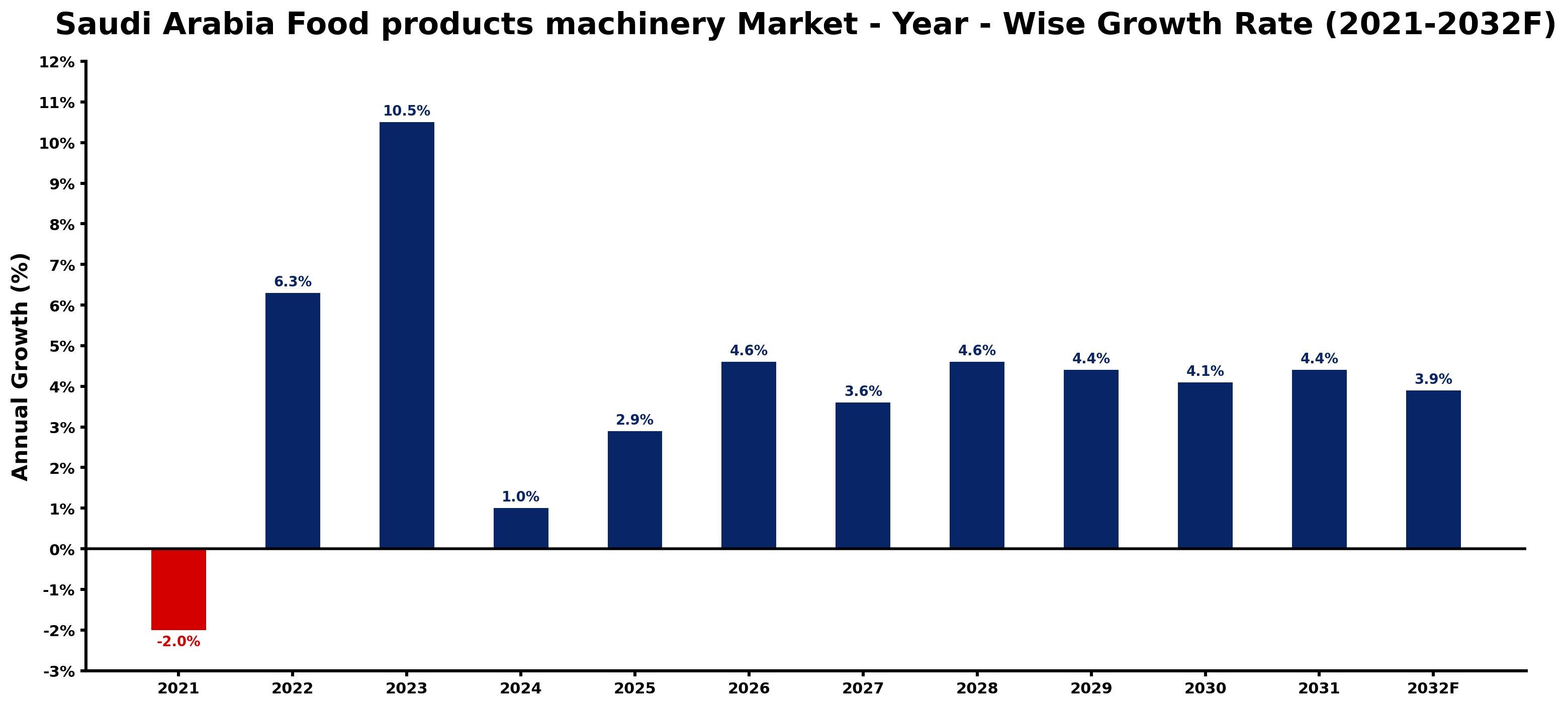
The table below presents the year wise growth rates along with the key drivers influencing the market
| Year | Growth Rate | Major Drivers |
| 2021 | -2.0% | Supply chain disruptions and reduced international trade hampered the availability of essential food processing equipment. |
| 2022 | 6.3% | Local manufacturers explored partnerships to meet the evolving needs of the market. |
| 2023 | 10.5% | Technological innovations in automation boosted productivity across various food sectors. |
| 2024 | 1.0% | Investment in sustainable practices became essential for competitiveness in the industry. |
| 2025 | 2.9% | Emerging trends in healthy eating spurred demand for specialized food processing equipment. |
| 2026 | 4.6% | Startups in food tech attracted venture capital, driving innovation and market entry. |
| 2027 | 3.6% | Government plans for modernization in agriculture positively impacted machinery purchases. |
| 2028 | 4.6% | International brands increasingly viewed Saudi Arabia as a key growth opportunity. |
| 2029 | 4.4% | Shifts towards local sourcing encouraged the development of regional machinery suppliers. |
| 2030 | 4.1% | Post-pandemic recovery enabled restaurants to invest in advanced food production equipment. |
| 2031 | 4.4% | E-commerce growth forced food producers to adapt swiftly to changing consumer preferences. |
| 2032 | 3.9% | Collaboration between tech firms and food producers enhanced machinery efficiency and safety. |
Note - Market size estimations and growth projections presented in this report are based on 6Wresearch's advanced forecasting approach, validated with industry datasets as of June 2026.
Saudi Arabia Food products machinery Market Synopsis
The Saudi Arabia Food products machinery Market is projected to reach 4.6% and witness significant growth during the forecast period (2026-2032). The market is characterized by an increasing demand for food processing equipment, driven primarily by a burgeoning population and rising income levels. As one of the Middle East's largest markets for food products machinery, Saudi Arabia is strategically positioned to leverage its location for import and distribution of advanced food processing technologies, further heightened by shifting consumer preferences towards health-conscious eating habits.
Saudi Arabia Food products machinery Market Growth Drivers
Several key factors contribute to the growth of the Saudi Arabia Food products machinery Market. The primary drivers include:
- Increasing consumer income levels, which have significantly raised the demand for high-quality and diverse food products, necessitating the adoption of advanced food processing machinery.
- Rising demand for convenience foods, which has prompted manufacturers to enhance their production capabilities, leading to an uptick in machinery investments.
- Growing awareness and focus on healthy eating habits, which encourages food producers to adopt innovative and health-oriented processing technologies.
- Changing lifestyles, particularly among urban populations, which demand quick and efficient meal solutions, further driving the need for modern food processing equipment.
- Government investments in infrastructure development, which aim to modernize existing facilities and enhance the overall productivity of the food processing sector.
Saudi Arabia Food products machinery Market Challenges and Restraints
Despite the promising growth outlook, the Saudi Arabia Food products machinery Market faces several challenges that could hinder its expansion. These challenges include:
- The high cost of food processing machinery, which can limit access for smaller businesses and hinder their ability to compete in the market.
- Limited availability of spare parts, which can affect maintenance schedules and operational efficiency for local manufacturers, leading to increased downtime.
- Stringent regulations imposed by the Food Safety Committee, which require food processors to adhere to rigorous safety standards that can complicate operational practices.
- The impact of geopolitical tensions in the region, which could disrupt supply chains and lead to increased costs for imported machinery.
- Potential labor shortages due to economic fluctuations and shifts in workforce demographics, which can affect production capabilities and market growth.
Saudi Arabia Food products machinery Market Government Investment and Initiatives
The Saudi Arabian government has recognized the importance of the food products machinery sector in promoting food security and economic diversification. A series of strategic initiatives have been launched to foster growth in this area, including:
- Increased public spending on infrastructure projects aimed at modernizing food processing facilities, which enhances efficiency and production capacity.
- Implementation of policies designed to attract foreign direct investment in the food processing machinery sector, thereby facilitating technology transfer and innovation.
- Support for local manufacturers through subsidies and financing options to encourage the development of home-grown solutions in food processing technologies.
- Programs aimed at enhancing workforce skills in the food technology sector, which are crucial for maintaining industry competitiveness.
- Collaboration with international organizations and institutions to establish regulatory frameworks that promote safe food processing practices.
Saudi Arabia Food products machinery Market Latest Developments (May 2025 - June 2026)
In the period from May 2025 to June 2026, the Saudi Arabia Food products machinery Market has experienced several noteworthy developments. These include a noticeable shift towards automation and smart technologies, which have gained traction as manufacturers seek to optimize production processes. Additionally, regional trade agreements have facilitated the importation of advanced machinery, allowing local businesses to enhance their capabilities. Moreover, the government has launched new initiatives aimed at boosting R&D in food technology, encouraging innovation within the sector. There has also been an increase in partnerships between local businesses and international firms, aimed at knowledge sharing and capacity building. Lastly, stakeholders have begun to prioritize sustainability in food processing, seeking machinery that reduces waste and energy consumption, aligning with global trends towards environmental responsibility.
Saudi Arabia Food products machinery Market - Key Attractiveness of the Report
- 10 Years of Market Numbers
- Historical Data Starting from 2022 to 2025
- Base Year: 2025
- Forecast Data until 2032
- Key Performance Indicators Impacting the Market
- Major Upcoming Developments and Projects
Key Highlights of the Report:
- Saudi Arabia Food products machinery Market Outlook
- Market Size of Saudi Arabia Food products machinery Market, 2025
- Forecast of Saudi Arabia Food products machinery Market, 2032
- Historical Data and Forecast of Saudi Arabia Food products machinery Revenues & Volume for the Period 2022-2032F
- Saudi Arabia Food products machinery Market Trend Evolution
- Saudi Arabia Food products machinery Market Drivers and Challenges
- Saudi Arabia Food products machinery Price Trends
- Saudi Arabia Food products machinery Porter's Five Forces
- Saudi Arabia Food products machinery Industry Life Cycle
- Historical Data and Forecast of Saudi Arabia Food products machinery Market Revenues & Volume By Type for the Period 2022-2032F
- Historical Data and Forecast of Saudi Arabia Food products machinery Market Revenues & Volume By Dairy Product Plant Machinery and Equipment for the Period 2022-2032F
- Historical Data and Forecast of Saudi Arabia Food products machinery Market Revenues & Volume By Bakery Machinery and Equipment for the Period 2022-2032F
- Historical Data and Forecast of Saudi Arabia Food products machinery Market Revenues & Volume By Meat and Poultry Processing And Preparation Machinery for the Period 2022-2032F
- Historical Data and Forecast of Saudi Arabia Food products machinery Market Revenues & Volume By Other Commercial Food Products Machinery for the Period 2022-2032F
- Historical Data and Forecast of Saudi Arabia Food products machinery Market Revenues & Volume By Applications for the Period 2022-2032F
- Historical Data and Forecast of Saudi Arabia Food products machinery Market Revenues & Volume By Bakery & Confectionery for the Period 2022-2032F
- Historical Data and Forecast of Saudi Arabia Food products machinery Market Revenues & Volume By Meat, Poultry, and Seafood for the Period 2022-2032F
- Historical Data and Forecast of Saudi Arabia Food products machinery Market Revenues & Volume By Dairy for the Period 2022-2032F
- Historical Data and Forecast of Saudi Arabia Food products machinery Market Revenues & Volume By Beverages for the Period 2022-2032F
- Historical Data and Forecast of Saudi Arabia Food products machinery Market Revenues & Volume By Others for the Period 2022-2032F
- Saudi Arabia Food products machinery Import Export Trade Statistics
- Market Opportunity Assessment By Type
- Market Opportunity Assessment By Applications
- Saudi Arabia Food products machinery Top Companies Market Share
- Saudi Arabia Food products machinery Competitive Benchmarking By Technical and Operational Parameters
- Saudi Arabia Food products machinery Company Profiles
- Saudi Arabia Food products machinery Key Strategic Recommendations






































