Saudi Arabia Food Retail Market Summary
The saudi arabia food retail market was estimated at USD 906 Million in 2025 and is projected to reach USD 1343 Million by 2032, growing at a CAGR of 7.6% from 2026 to 2032.
Saudi Arabia Food Retail Market Year-wise Growth Rate and Key Drivers
This graph highlights how the Saudi Arabia Food Retail Market has steadily grown over the past five years, supported by major growth factors.
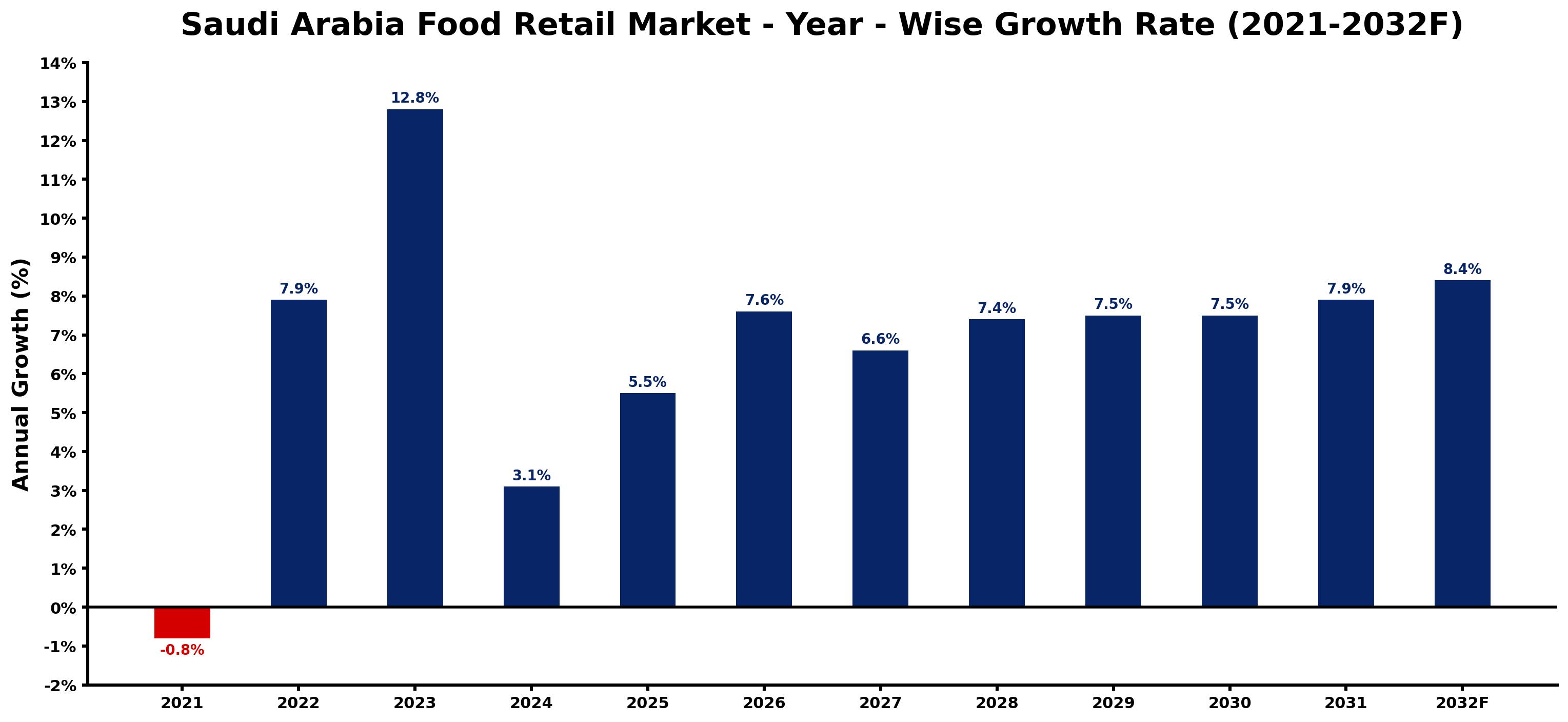
The table below presents the year wise growth rates along with the key drivers influencing the market
| Year | Growth Rate | Major Drivers |
| 2021 | -0.8% | Heightened health concerns led to reduced foot traffic in supermarkets, negatively impacting overall sales performance. |
| 2022 | 7.9% | Major retailers expanded their presence in underserved urban and rural areas. |
| 2023 | 12.8% | Health-conscious choices gained traction, influencing product offerings across supermarkets. |
| 2024 | 3.1% | Innovations in supply chain logistics improved efficiency for food retailers nationwide. |
| 2025 | 5.5% | Local sourcing initiatives emerged, enhancing food quality and supporting local farmers. |
| 2026 | 7.6% | Smart technology integration streamlined operations and enhanced customer shopping experiences. |
| 2027 | 6.6% | Growing expatriate populations diversified food preferences, expanding market opportunities. |
| 2028 | 7.4% | Increased participation in sustainability practices resonated with environmentally-minded consumers. |
| 2029 | 7.5% | Expansions of e-commerce platforms facilitated wider access to regional food products. |
| 2030 | 7.5% | Investment in cold storage facilities bolstered the supply chain for perishable goods. |
| 2031 | 7.9% | Emergence of private labels offered consumers more affordable and quality options. |
| 2032 | 8.4% | Integration of artificial intelligence optimized inventory management for food retailers. |
Note - Market size estimations and growth projections presented in this report are based on 6Wresearch's advanced forecasting approach, validated with industry datasets as of June 2026.
Saudi Arabia Food Retail Market Synopsis
The Saudi Arabia Food Retail Market is projected to reach 7.6% and witness significant growth during the forecast period (2026-2032). The sector is poised for expansion due to several factors, including shifting consumer preferences, technological advancements, and capital inflows from private equity firms. As the population increasingly gravitates towards processed and convenience foods, the landscape of food retailing is evolving rapidly, presenting ample opportunities for stakeholders.
Saudi Arabia Food Retail Market Growth Drivers
Several key drivers are fueling the growth of the Saudi Arabia food retail market. The following factors significantly contribute to this upward trajectory:
- The rising consumer preference for processed and convenience foods is reshaping shopping habits, leading to increased purchases of ready-to-eat and easy-to-prepare meal options.
- A surge in demand for e-commerce platforms is transforming how consumers access food, with online grocery shopping becoming a prevalent choice among various demographics.
- Middle-class families are experiencing a rise in disposable income, enabling them to spend more on diverse food choices and premium products.
- Changing lifestyles, particularly among younger generations, are driving a demand for innovative food products and shopping experiences, prompting retailers to adapt their offerings.
- Intensive advertising campaigns conducted by retailers are enhancing brand visibility and enticing consumers to explore new food options, further stimulating market growth.
Saudi Arabia Food Retail Market Challenges and Restraints
While the Saudi Arabia food retail market is on a growth trajectory, it faces several challenges that could impede its progress:
- The lack of developed cold chain infrastructure poses a significant barrier to the efficient distribution of perishable goods, impacting the overall supply chain effectiveness.
- High costs associated with establishing retail store outlets can limit new entrants and expansion efforts, particularly in underserved areas.
- Regulatory hurdles and compliance requirements could complicate operations for retailers, thereby affecting their profitability and market entry strategies.
- The volatility of food prices, influenced by external market conditions and domestic policy shifts, poses an ongoing challenge for both consumers and retailers.
- Shifting consumer preferences can lead to unpredictability in demand, making it challenging for retailers to maintain inventory levels and manage supply effectively.
Saudi Arabia Food Retail Market Covid-19 Impact
The Covid-19 pandemic has profoundly impacted the operations of the food retail sector in Saudi Arabia, resulting in challenges across production, distribution, and sales channels. The necessary lockdown measures led to significant declines in sales revenues, as many consumers shifted to bulk buying and online purchasing trends. Retailers faced temporary store closures, disrupting normal retail activities and affecting inventory management. As the industry adapts to the new normal, understanding these shifts is crucial for future strategic planning.
Saudi Arabia Food Retail Market Government Investment and Initiatives
The Saudi government has demonstrated a commitment to enhancing the food retail sector through various investment initiatives and policy frameworks. These efforts are aimed at increasing food security, improving supply chains, and fostering private sector participation. Key initiatives include:
- Investment in infrastructure improvements, particularly in logistics and cold chain facilities, to streamline food distribution and reduce wastage.
- Promotion of public-private partnerships to stimulate growth in the food retail market, ensuring that private capital can effectively complement government efforts.
- Implementation of regulatory reforms to simplify business operations and enhance the ease of doing business in the food retail sector.
- Support for local food producers and farmers through subsidies and incentives, encouraging sourcing from within the country and boosting local economies.
- Focus on sustainability and technological integration within food retailing to promote environmentally friendly practices and improve overall efficiency.
Saudi Arabia Food Retail Market Latest Developments (May 2025 - June 2026)
Recent developments in the Saudi Arabia food retail market highlight a notable shift towards digitalization and sustainability. Retailers are increasingly investing in e-commerce platforms to meet the rising consumer demand for online shopping. Additionally, there has been a concerted effort to enhance the cold chain infrastructure, addressing a key challenge identified in the sector. Sustainability initiatives are gaining momentum, with various retailers launching eco-friendly products and packaging solutions. Government policies promoting local sourcing and efficiency improvements are expected to have a lasting impact on the sector's growth trajectory.
Saudi Arabia Food Retail Market - Key Attractiveness of the Report
- 10 Years of Market Numbers
- Historical Data Starting from 2022 to 2025
- Base Year: 2025
- Forecast Data until 2032
- Key Performance Indicators Impacting the Market
- Major Upcoming Developments and Projects
Key Highlights of the Report:
- Saudi Arabia Food Retail Market Outlook
- Market Size of Saudi Arabia Food Retail Market, 2025
- Forecast of Saudi Arabia Food Retail Market, 2032
- Historical Data and Forecast of Saudi Arabia Food Retail Revenues & Volume for the Period 2022-2032F
- Saudi Arabia Food Retail Market Trend Evolution
- Saudi Arabia Food Retail Market Drivers and Challenges
- Saudi Arabia Food Retail Price Trends
- Saudi Arabia Food Retail Porter's Five Forces
- Saudi Arabia Food Retail Industry Life Cycle
- Historical Data and Forecast of Saudi Arabia Food Retail Market Revenues & Volume By Product Types for the Period 2022-2032F
- Historical Data and Forecast of Saudi Arabia Food Retail Market Revenues & Volume By Unpackaged Food for the Period 2022-2032F
- Historical Data and Forecast of Saudi Arabia Food Retail Market Revenues & Volume By Packaged Food for the Period 2022-2032F
- Historical Data and Forecast of Saudi Arabia Food Retail Market Revenues & Volume By Drinks for the Period 2022-2032F
- Historical Data and Forecast of Saudi Arabia Food Retail Market Revenues & Volume By Household Products for the Period 2022-2032F
- Historical Data and Forecast of Saudi Arabia Food Retail Market Revenues & Volume By Packaging Types for the Period 2022-2032F
- Historical Data and Forecast of Saudi Arabia Food Retail Market Revenues & Volume By Boxes for the Period 2022-2032F
- Historical Data and Forecast of Saudi Arabia Food Retail Market Revenues & Volume By Cans for the Period 2022-2032F
- Historical Data and Forecast of Saudi Arabia Food Retail Market Revenues & Volume By Cellophane Wrapping for the Period 2022-2032F
- Historical Data and Forecast of Saudi Arabia Food Retail Market Revenues & Volume By Cylindrical Cardboard for the Period 2022-2032F
- Saudi Arabia Food Retail Import Export Trade Statistics
- Market Opportunity Assessment By Product Types
- Market Opportunity Assessment By Packaging Types
- Saudi Arabia Food Retail Top Companies Market Share
- Saudi Arabia Food Retail Competitive Benchmarking By Technical and Operational Parameters
- Saudi Arabia Food Retail Company Profiles
- Saudi Arabia Food Retail Key Strategic Recommendations






































