saudi arabia fragrance market
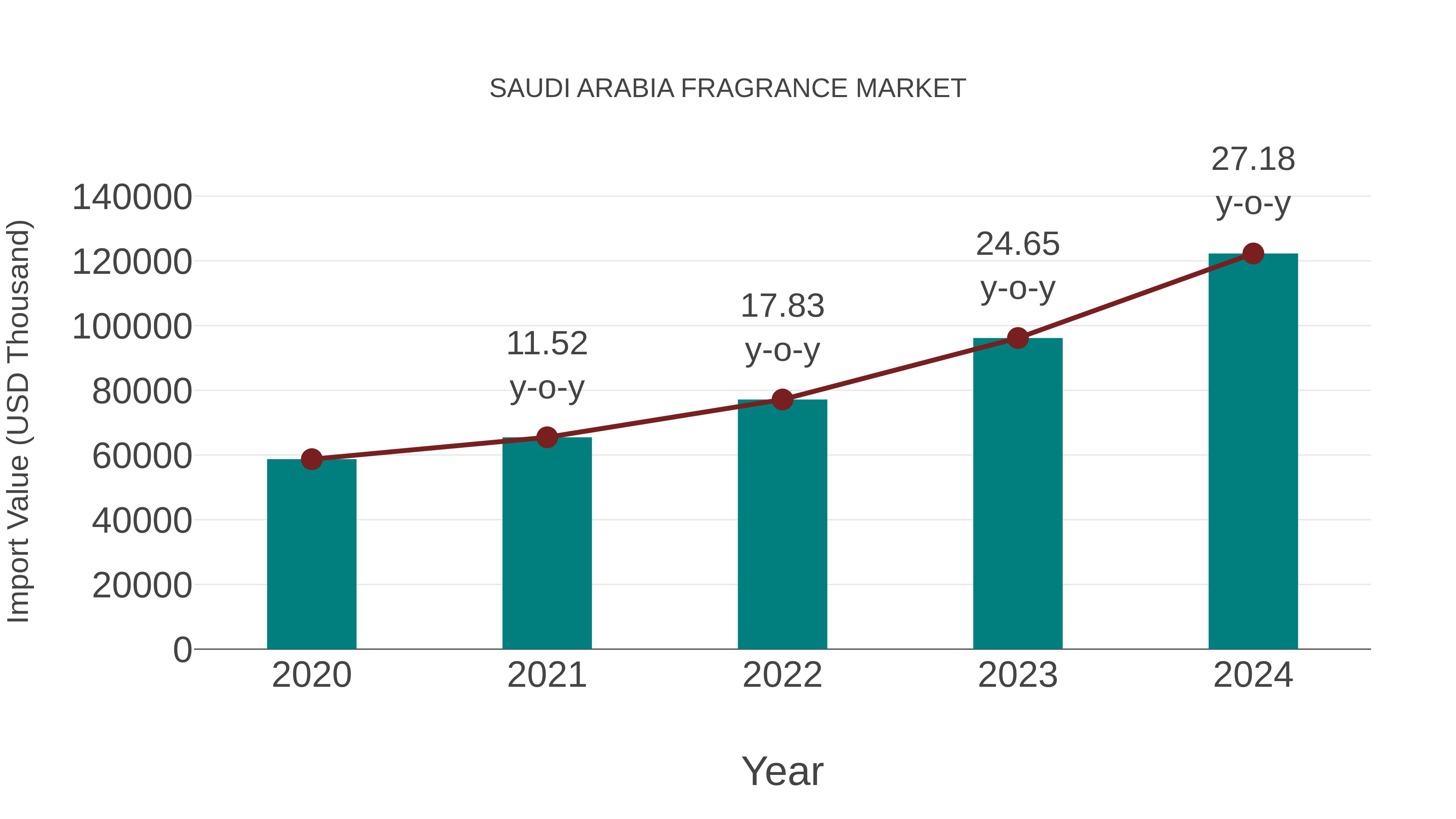
Saudi Arabia Fragrance Market Growth Rate
According to 6Wresearch internal database and industry insights, the Saudi Arabia Fragrance Market is projected to grow at a compound annual growth rate (CAGR) of 7.9% during the forecast period (2026-2032).
Five-Year Growth Trajectory of the Saudi Arabia Fragrance Market with Core Drivers
Below mentioned is the evaluation of year-wise growth rate along with key growth drivers:
| Year | Est. Annual Growth (%) | Growth Drivers |
| 2021 | 4.1% | Strong traditional usage of perfumes and deodorants |
| 2022 | 5% | Growth of organized retail and mall-based perfumery stores |
| 2023 | 6.1% | Rising demand for premium and oud-based fragrances |
| 2024 | 7% | Expansion of e-commerce and luxury fragrance brands |
| 2025 | 7.5% | Increasing youth population and gifting culture |
Topics Covered in the Saudi Arabia Fragrance Market Report
The Saudi Arabia Fragrance Market report thoroughly covers the market by product type, application, and distribution channel. The report provides an unbiased and in-depth analysis of current market trends, high-growth opportunities, and key demand drivers, enabling stakeholders to align strategies with evolving consumer preferences, luxury consumption patterns, and regulatory frameworks shaping the fragrance industry in Saudi Arabia.
Saudi Arabia Fragrance Market Highlights
| Report Name | Saudi Arabia Fragrance Market |
| Forecast Period | 2026–2032 |
| CAGR | 7.9% |
| Growing Sector | Personal Care Fragrances |
Saudi Arabia Fragrance Market Synopsis
Saudi Arabia Fragrance Market is anticipated to witness steady growth driven due to a strong cultural love of perfumes, especially oud and oriental scents. Demand is increasing due to rapid urbanization, growing adoption of premium lifestyles, and higher consumer spending on personal grooming and fragrance products. Additionally, the growing use of home fragrance products and the tradition of gift-giving during holidays are further supporting market growth. The presence of global luxury brands alongside strong regional players enhances product availability, innovation, and consumer exposure to new fragrance offerings in the market.
Evaluation of Growth Drivers in the Saudi Arabia Fragrance Market
Below mentioned are some prominent drivers and their influence on the market dynamics:
| Drivers | Primary Segments Affected | Why it Matters (Evidence) |
| Cultural Preference for Perfumes | Perfumes; Personal Care | Perfumes are deeply integrated into daily grooming routines and cultural traditions, sustaining consistent demand. |
| Premium Lifestyle Adoption | Perfumes; Deodorants | Rising disposable incomes and aspirational lifestyles support growing demand for luxury and branded fragrances. |
| Growth of Modern Retail | All Types; Offline Channels | Expansion of malls and specialty stores enhances brand visibility, product trials, and consumer engagement. |
| E-commerce Expansion | All Types; Online Channels | Digital platforms improve product accessibility, offer wider variety, and enable direct-to-consumer sales. |
| Household Fragrance Usage | Household Care | Increasing focus on ambient living, home aesthetics, and wellness boosts demand for household fragrance products |
Saudi Arabia Fragrance Market is expected to grow at a CAGR of 7.9% during the forecast period of 2026-2032. Growth is driven by premium perfume demand, strong cultural usage, and expanding retail channels. More online sales, trends in luxury gifts, and new ideas in oriental and long-lasting formulations are all helping the market grow even more in both the personal and household care segments. Additionally, rising disposable incomes, increasing tourist inflows, and the growing influence of social media and celebrity endorsements are further accelerating fragrance adoption across diverse consumer segments.
Evaluation of Restraints in the Saudi Arabia Fragrance Market
Below mentioned are some major restraints and their influence on the market dynamics:
| Restraints | Primary Segments Affected | What This Means (Evidence) |
| High Dependence on Imports | Perfumes | Increases pricing volatility and supply chain risks due to reliance on foreign suppliers. |
| Counterfeit Luxury Products | Perfumes | Damages brand trust, erodes revenues, and affects consumer confidence in premium offerings. |
| Strict Regulatory Compliance | Manufacturers | Raises formulation, testing, and approval costs, impacting time-to-market and margins. |
| Market Saturation in Urban Areas | Perfumes | Intensifies competition among brands, leading to higher marketing spend and price pressures. |
| Price Sensitivity in Mass Segment | Deodorants | Limits penetration of premium products in cost-conscious consumer segments. |
Saudi Arabia Fragrance Market Industry Challenges
Despite favorable growth conditions, the Saudi Arabia Fragrance Industry is facing many challenges such as Intense competition in the luxury brands sector, widespread availability of counterfeit items, and a strong dependency on imported perfumes. In addition, it is crucial for companies to continuously differentiate their products, comply with regulatory standards, and adhere to quality norms, while effectively addressing consumer price sensitivity particularly within the mass-market segments.
Saudi Arabia Fragrance Market Trends
Key trends evaluating the landscape of the Saudi Arabia Fragrance Market Growth are:
- Luxury Oud-Based Perfumes: Oud-centric and oriental fragrance formulations continue to dominate consumer preferences, driven by strong cultural affinity, premium positioning, and long-lasting scent profiles.
- Personalized Scents: Custom-made and personalized fragrances are gaining popularity among high-income consumers.
- Expansion of Household Fragrances: Beyond traditional air fresheners and incense, a wider range of home fragrance products is gaining popularity.
Investment Opportunities in the Saudi Arabia Fragrance Market
Some prominent investment opportunities in the Saudi Arabia Fragrance Market include:
- Local Perfume Manufacturing: Establishing domestic production units helps reduce dependence on imports, lowers costs, and improves supply chain efficiency.
- Luxury Fragrance Retailing: Premium and luxury fragrance brands can effectively reach their target customers through boutique outlets located in shopping malls, where high footfall and experiential retail support brand positioning.
- E-commerce Platforms for Fragrances: Investment in e-commerce platforms enables fragrance brands to reach consumers in non-metro and outer urban areas.
Top 5 Leading Players in the Saudi Arabia Fragrance Market
Some leading players operating in the Saudi Arabia Fragrance Market include:
1. Abdul Samad Al Qurashi
| Company Name | Abdul Samad Al Qurashi |
|---|---|
| Established Year | 1932 |
| Headquarters | Makkah, Saudi Arabia |
| Official Website | - |
Abdul Samad Al Qurashi is a leading luxury perfume brand specializing in oud-based and oriental fragrances, widely preferred for personal use and gifting across Saudi Arabia.
2. Arabian Oud
| Company Name | Arabian Oud |
|---|---|
| Established Year | 1982 |
| Headquarters | Riyadh, Saudi Arabia |
| Official Website | Click Here |
Arabian Oud offers an extensive range of premium perfumes and oils, combining traditional Middle Eastern scents with modern fragrance innovation.
3. Ajmal Perfumes
| Company Name | Ajmal Perfumes |
|---|---|
| Established Year | 1951 |
| Headquarters | Dubai, UAE |
| Official Website | Click Here |
Ajmal Perfumes has strong presence in Saudi Arabia, delivering oriental and contemporary fragrances through extensive retail networks.
4. LVMH
| Company Name | LVMH |
|---|---|
| Established Year | 1987 |
| Headquarters | Paris, France |
| Official Website | Click Here |
LVMH markets luxury fragrance brands in Saudi Arabia, catering to premium consumers through exclusive retail and duty-free channels.
5. Chanel
| Company Name | Chanel |
|---|---|
| Established Year | 1910 |
| Headquarters | Paris, France |
| Official Website | Click Here |
Chanel supplies high-end perfumes in Saudi Arabia, leveraging strong brand equity, exclusivity, and premium retail positioning.
Government Regulations Introduced in the Saudi Arabia Fragrance Market
According to Saudi Arabia government data, The Saudi Arabia Food and Drug Authority's regulatory supervision ensures the products are safe for use and meet standards of quality. Goals of the Vision 2030 include the growth of local production, the development of luxury retail offerings, and foreign investments in the consumer products sector. Additionally, the easing of licensing requirements for the importation of cosmetic and perfumes products ensures market development in the country in addition to attaining international standards.
Future Insights of the Saudi Arabia Fragrance Market
The outlook for the Saudi Arabia Fragrance Market remains highly positive due to more people are buying luxury goods, the population of young people is growing, and digital retail is becoming more popular. Increased investment in local manufacturing, the launch of new high-end fragrance products, and the expansion of household scent offerings are expected to open new growth opportunities. Alignment with Vision 2030 initiatives and evolving consumer lifestyles will further improve long-term market growth.
Market Segmentation Analysis
The report offers a comprehensive study of the subsequent market segments and their leading categories.
Perfumes to Dominate the Market – By Product Type
According to Rahul, Senior Research Analyst, 6Wresearch, perfumes dominate the Saudi Arabia Fragrance Market Share due to strong cultural usage, preference for oud-based luxury scents, and high spending on premium personal grooming products.
Personal Care to Dominate the Market – By Application
Personal care constitutes the largest segment, as perfumes and deodorants are used daily. Grooming rituals and gift-giving traditions, supported by strong media and influencer engagement, significantly increase overall demand.
Offline Channels to Dominate Market – By Distribution Channel
Offline distribution is dominated by luxury malls and dedicated perfume boutiques. Physical retail provides an enhanced shopping experience along with assurance of product authenticity, which is especially important for premium fragrance purchases.
Key Attractiveness of the Report
- 10 Years of Market Numbers.
- Historical Data Starting from 2022 to 2025.
- Base Year: 2025.
- Forecast Data until 2032.
- Key Performance Indicators Impacting the Market.
- Major Upcoming Developments and Projects.
Key Highlights of the Report:
- Saudi Arabia Fragrance Market Outlook
- Market Size of Saudi Arabia Fragrance Market, 2025
- Forecast of Saudi Arabia Fragrance Market, 2032
- Historical Data and Forecast of Saudi Arabia Fragrance Revenues & Volume for the Period 2022- 2032
- Saudi Arabia Fragrance Market Trend Evolution
- Saudi Arabia Fragrance Market Drivers and Challenges
- Saudi Arabia Fragrance Price Trends
- Saudi Arabia Fragrance Porter's Five Forces
- Saudi Arabia Fragrance Industry Life Cycle
- Historical Data and Forecast of Saudi Arabia Fragrance Market Revenues & Volume By Product Type for the Period 2022- 2032
- Historical Data and Forecast of Saudi Arabia Fragrance Market Revenues & Volume By Deodorants for the Period 2022- 2032
- Historical Data and Forecast of Saudi Arabia Fragrance Market Revenues & Volume By Perfumes for the Period 2022- 2032
- Historical Data and Forecast of Saudi Arabia Fragrance Market Revenues & Volume By Others for the Period 2022- 2032
- Historical Data and Forecast of Saudi Arabia Fragrance Market Revenues & Volume By Application for the Period 2022- 2032
- Historical Data and Forecast of Saudi Arabia Fragrance Market Revenues & Volume By Personal Care for the Period 2022- 2032
- Historical Data and Forecast of Saudi Arabia Fragrance Market Revenues & Volume By Household Care for the Period 2022- 2032
- Historical Data and Forecast of Saudi Arabia Fragrance Market Revenues & Volume By Others for the Period 2022- 2032
- Historical Data and Forecast of Saudi Arabia Fragrance Market Revenues & Volume By Distribution Channel for the Period 2022- 2032
- Historical Data and Forecast of Saudi Arabia Fragrance Market Revenues & Volume By Offline for the Period 2022- 2032
- Historical Data and Forecast of Saudi Arabia Fragrance Market Revenues & Volume By Online for the Period 2022- 2032
- Saudi Arabia Fragrance Import Export Trade Statistics
- Market Opportunity Assessment By Product Type
- Market Opportunity Assessment By Application
- Market Opportunity Assessment By Distribution Channel
- Saudi Arabia Fragrance Top Companies Market Share
- Saudi Arabia Fragrance Competitive Benchmarking By Technical and Operational Parameters
- Saudi Arabia Fragrance Company Profiles
- Saudi Arabia Fragrance Key Strategic Recommendations
Market Covered
The report offers a comprehensive study of the subsequent market segments:
By Product Type
- Deodorants
- Perfumes
- Others
By Application
- Personal Care
- Household Care
- Others
By Distribution Channel
- Offline
- Online






































