Saudi Arabia Gas Chromatography Systems Market Size, Share & Growth Rate
The Saudi Arabia Gas Chromatography Systems Market was estimated at USD 343 Million in 2025 and is projected to reach USD 438 Million by 2032, growing at a CAGR of 3.6% from 2026 to 2032. This growth trajectory is fueled by increased research and testing activities across diverse sectors, particularly in pharmaceuticals, food and beverages, and environmental monitoring. The push for enhanced quality control measures and regulatory compliance will further elevate the demand for advanced gas chromatography systems in the region.
Saudi Arabia Gas Chromatography Systems Market Year-wise Growth Rate and Key Drivers
This graph highlights how the Saudi Arabia Gas Chromatography Systems Market has steadily grown over the years, supported by major growth factors.
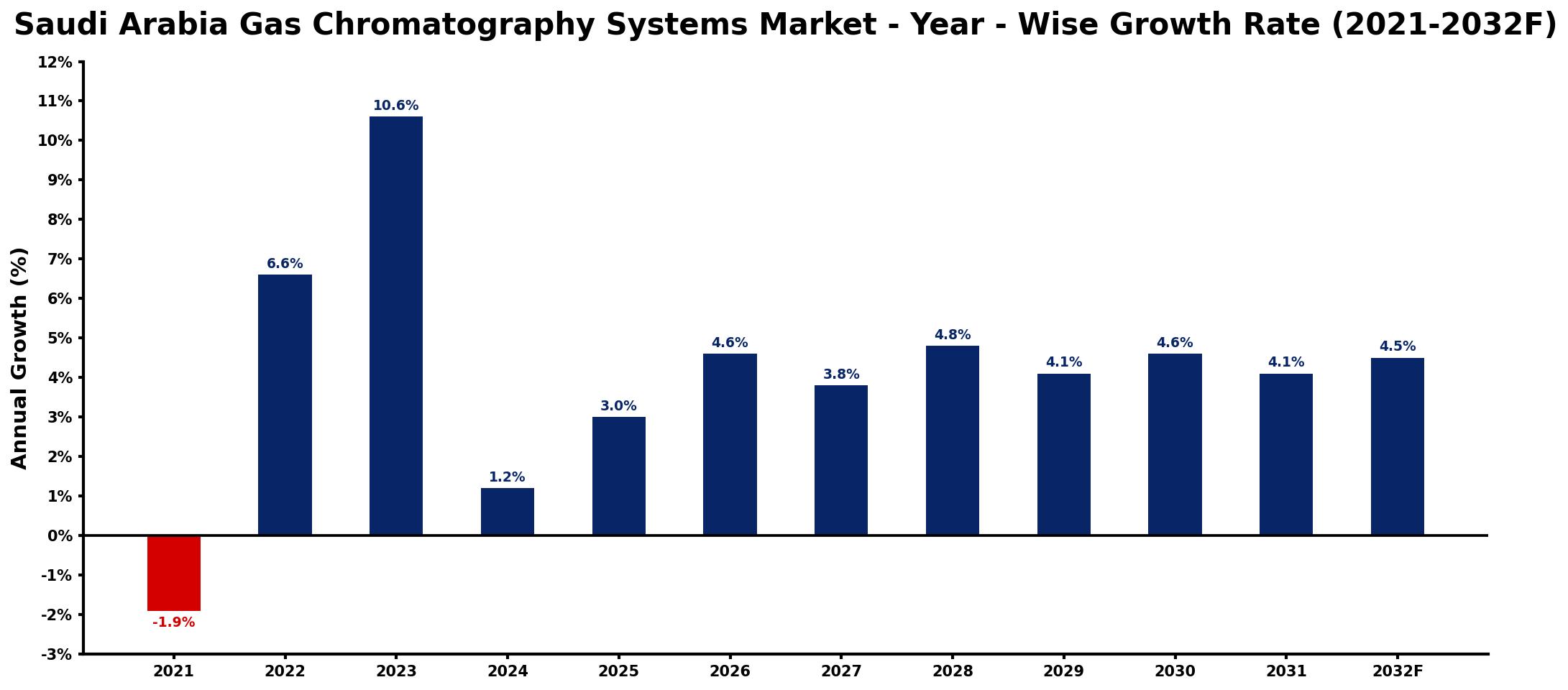
The table below presents the year‑wise growth rates along with the key drivers influencing the market
| Year | Growth Rate | Major Drivers |
| 2021 | -1.9% | supply chain disruptions impacted operations |
| 2022 | 6.6% | increased investments in laboratories |
| 2023 | 10.6% | growing demand from pharmaceuticals |
| 2024 | 1.2% | expansion of environmental regulations |
| 2025 | 3.0% | rise in food safety standards |
| 2026 | 4.6% | increased industrial automation initiatives |
| 2027 | 3.8% | growth in academic research funding |
| 2028 | 4.8% | surge in biotechnology applications |
| 2029 | 4.1% | enhanced focus on quality control |
| 2030 | 4.6% | improved processing technologies adoption |
| 2031 | 4.1% | increased emphasis on sustainability |
| 2032 | 4.5% | rising demand from electronics |
Note: Market size estimations and growth projections presented in this report are based on 6Wresearch's proprietary forecasting methodology, utilizing the latest available industry data, government publications, and primary research inputs.
Saudi Arabia Gas Chromatography Systems Market Synopsis
The strongest force currently shaping the Saudi Arabia Gas Chromatography Systems Market is the increasing emphasis on quality control and regulatory compliance across various industries. The pharmaceutical sector, in particular, is witnessing a surge in demand for robust analytical techniques, reinforcing the necessity of gas chromatography.
Furthermore, as the nation invests in its research capabilities and infrastructure, applications in environmental monitoring and petrochemical analysis are expanding. This creates a ripe environment for the advancement and adoption of state-of-the-art gas chromatography systems, poised to meet the intricate demands of these industries.
Saudi Arabia Gas Chromatography Systems Market Key Takeaways
- The market is projected to grow at a CAGR of 3.6%, reaching USD 438 Million by 2032.
- Quality control and regulatory compliance drive the demand across pharmaceuticals and food sectors.
- Technological advancements are enhancing the functionality and efficiency of gas chromatography systems.
- The pandemic has temporarily hindered growth but has also spurred adaptation and innovation in laboratory operations.
- Government initiatives are supporting increased research funding, benefiting the chromatography market.
Evaluation of Restraints in Saudi Arabia Gas Chromatography Systems Market
Despite the promising growth outlook, the Saudi Arabia Gas Chromatography Systems Market faces significant restraints. The complexity of technology presents challenges for seamless integration into existing workflows, often leading to high initial costs that deter potential adopters. Additionally, the need for specialized training to operate these sophisticated systems further complicates market penetration. Ensuring reliable after-sales support is essential to overcome user hesitations and foster long-term adoption.
Saudi Arabia Gas Chromatography Systems Market Trends
Several key trends are influencing the Saudi Arabia Gas Chromatography Systems Market. The integration of automation in chromatography systems is enhancing efficiency, allowing laboratories to achieve higher throughput and improved accuracy. Moreover, advancements in detection technologies, such as mass spectrometry coupled with gas chromatography, are expanding the scope of applications, particularly in environmental analysis. There's also a growing trend toward eco-friendly and sustainable analytical practices, urging manufacturers to develop greener solutions.
Saudi Arabia Gas Chromatography Systems Market Opportunities
Opportunities for growth within the Saudi Arabia Gas Chromatography Systems Market are abundant. The pharmaceutical sector, with its ongoing investment in drug development, presents a significant avenue for sales. Additionally, as environmental regulations tighten, industries are increasingly required to conduct thorough analyses of emissions and waste, creating a higher demand for reliable chromatography systems. Innovative technologies that enhance performance while reducing costs will attract investments and partnerships, further driving market expansion.
Government Initiatives in the Saudi Arabia Gas Chromatography Systems Market
The Saudi government is actively promoting research and development initiatives, particularly in the fields of healthcare and environmental safety. By increasing public funding for scientific research, the government is fostering an ecosystem conducive to technological innovation. Additionally, there are initiatives aimed at enhancing educational programs in analytical chemistry, which helps build a skilled workforce adept at utilizing gas chromatography systems effectively.
Future Insights of the Saudi Arabia Gas Chromatography Systems Market
Looking ahead to 2026-2032, the Saudi Arabia Gas Chromatography Systems Market is expected to evolve significantly. As industries continue to prioritize quality and compliance, the integration of artificial intelligence and machine learning within chromatography systems may emerge, enabling smarter and more efficient analysis. The ongoing push towards environmental sustainability is likely to spur the development of innovative techniques that minimize waste and energy consumption. Overall, the market is well-positioned for robust growth, driven by technological advancements and increasing industry demands.
Saudi Arabia Gas Chromatography Systems Market Latest Developments (2025 - 2026)
In recent months, the Saudi Arabia Gas Chromatography Systems Market has seen notable industry direction towards greater automation and user-friendly interfaces. Several manufacturers are launching advanced systems that integrate seamlessly with laboratory management software, enhancing data analysis capabilities. Additionally, there has been a heightened focus on remote monitoring solutions, allowing laboratories to conduct analyses more efficiently while maintaining compliance with safety regulations.
Saudi Arabia Gas Chromatography Systems Market - Key Attractiveness of the Report
- 10 Years of Market Numbers
- Historical Data Starting from 2022 to 2025
- Base Year: 2025
- Forecast Data until 2032
- Key Performance Indicators Impacting the Market
- Major Upcoming Developments and Projects
Key Highlights of the Report:
- Saudi Arabia Gas Chromatography Systems Market Outlook
- Market Size of Saudi Arabia Gas Chromatography Systems Market, 2025
- Forecast of Saudi Arabia Gas Chromatography Systems Market, 2032
- Historical Data and Forecast of Saudi Arabia Gas Chromatography Systems Revenues & Volume for the Period 2022-2032F
- Saudi Arabia Gas Chromatography Systems Market Trend Evolution
- Saudi Arabia Gas Chromatography Systems Market Drivers and Challenges
- Saudi Arabia Gas Chromatography Systems Price Trends
- Saudi Arabia Gas Chromatography Systems Porter's Five Forces
- Saudi Arabia Gas Chromatography Systems Industry Life Cycle
- Historical Data and Forecast of Saudi Arabia Gas Chromatography Systems Market Revenues & Volume By Product for the Period 2022-2032F
- Historical Data and Forecast of Saudi Arabia Gas Chromatography Systems Market Revenues & Volume By Systems for the Period 2022-2032F
- Historical Data and Forecast of Saudi Arabia Gas Chromatography Systems Market Revenues & Volume By Detectors for the Period 2022-2032F
- Historical Data and Forecast of Saudi Arabia Gas Chromatography Systems Market Revenues & Volume By Auto-samplers for the Period 2022-2032F
- Historical Data and Forecast of Saudi Arabia Gas Chromatography Systems Market Revenues & Volume By Fraction Collectors for the Period 2022-2032F
- Historical Data and Forecast of Saudi Arabia Gas Chromatography Systems Market Revenues & Volume By Other Products for the Period 2022-2032F
- Historical Data and Forecast of Saudi Arabia Gas Chromatography Systems Market Revenues & Volume By End User for the Period 2022-2032F
- Historical Data and Forecast of Saudi Arabia Gas Chromatography Systems Market Revenues & Volume By Pharmaceutical and Bioindustries for the Period 2022-2032F
- Historical Data and Forecast of Saudi Arabia Gas Chromatography Systems Market Revenues & Volume By Academic Research Institutes for the Period 2022-2032F
- Historical Data and Forecast of Saudi Arabia Gas Chromatography Systems Market Revenues & Volume By Other End Users for the Period 2022-2032F
- Saudi Arabia Gas Chromatography Systems Import Export Trade Statistics
- Market Opportunity Assessment By Product
- Market Opportunity Assessment By End User
- Saudi Arabia Gas Chromatography Systems Top Companies Market Share
- Saudi Arabia Gas Chromatography Systems Competitive Benchmarking By Technical and Operational Parameters
- Saudi Arabia Gas Chromatography Systems Company Profiles
- Saudi Arabia Gas Chromatography Systems Key Strategic Recommendations






































