Saudi Arabia Glass Vacuum Flask Market Size, Share & Growth Rate
The Saudi Arabia Glass Vacuum Flask Market was estimated at USD 154 Million in 2025 and is projected to reach USD 196 Million by 2032, growing at a CAGR of 3.5% from 2026 to 2032. This upward trajectory is bolstered by rising consumer awareness regarding the benefits of temperature retention in beverages, paired with the growing demand for sustainable and health-conscious product options. As lifestyle shifts toward more outdoor activities and a preference for eco-friendly materials, the glass vacuum flask is positioned to capture a significant share of consumer interest.
Saudi Arabia Glass Vacuum Flask Market Year-wise Growth Rate and Key Drivers
This graph highlights how the Saudi Arabia Glass Vacuum Flask Market has steadily grown over the years, supported by major growth factors.
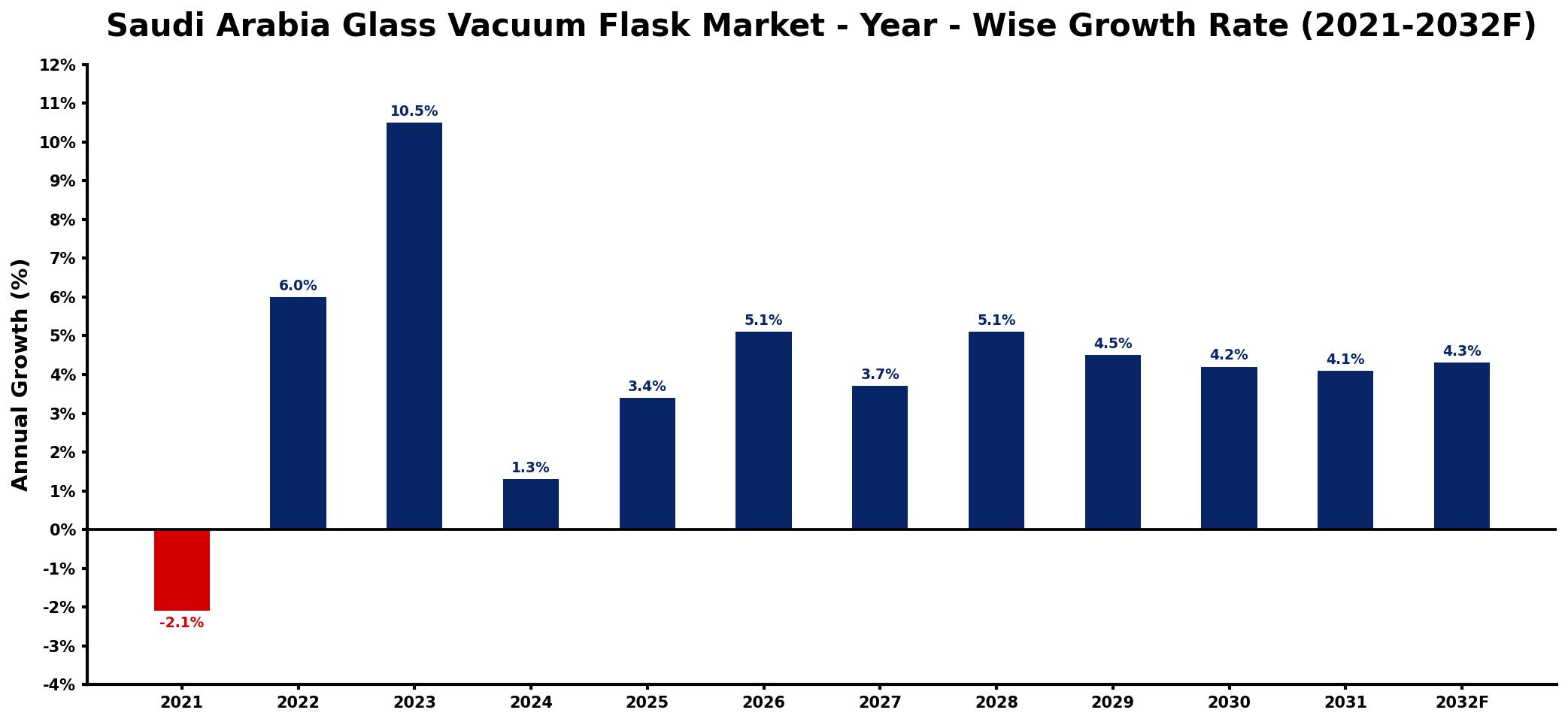
The table below presents the year‑wise growth rates along with the key drivers influencing the market
| Year | Growth Rate | Major Drivers |
| 2021 | -2.1% | decrease in consumer spending habits |
| 2022 | 6.0% | rising popularity of outdoor activities |
| 2023 | 10.5% | increased health consciousness among consumers |
| 2024 | 1.3% | growing demand for eco-friendly products |
| 2025 | 3.4% | expansion of retail distribution channels |
| 2026 | 5.1% | surge in corporate gifting trends |
| 2027 | 3.7% | enhancement of online shopping platforms |
| 2028 | 5.1% | increased pharmaceutical industry usage |
| 2029 | 4.5% | increased awareness of hydration benefits |
| 2030 | 4.2% | rise in sustainable lifestyle choices |
| 2031 | 4.1% | development of innovative product designs |
| 2032 | 4.3% | strengthening of local manufacturing capabilities |
Note: Market size estimations and growth projections presented in this report are based on 6Wresearch's proprietary forecasting methodology, utilizing the latest available industry data, government publications, and primary research inputs.
Saudi Arabia Glass Vacuum Flask Market Synopsis
The Saudi Arabia glass vacuum flask market has experienced notable growth recently, driven by increasing health consciousness and sustainability trends. As consumers prioritize their well-being and environmental impact, the appeal of glass vacuum flasks has surged, particularly among those seeking to reduce reliance on single-use plastics.
However, this market is poised for further expansion as innovative designs and advanced thermal technologies are introduced. The evolving lifestyle preferences, including a growing inclination for outdoor activities and on-the-go consumption, are likely to maintain the market's momentum in the coming years.
Saudi Arabia Glass Vacuum Flask Market Key Takeaways
- Robust growth is driven by rising consumer preference for health-conscious and eco-friendly products.
- Innovative designs and advanced thermal insulation are enhancing product appeal among diverse consumer segments.
- Heightened awareness around reducing single-use plastics supports the demand for reusable glass vacuum flasks.
- Outdoor and active lifestyles are influencing purchasing decisions, bolstering demand for reliable beverage containers.
- Market participants must focus on durability and consumer education to address safety perceptions associated with glass products.
Evaluation of Restraints in Saudi Arabia Glass Vacuum Flask Market
Despite its growth potential, the Saudi Arabia glass vacuum flask market faces significant restraints. A prevailing concern among consumers is the perceived fragility of glass flasks, especially for those engaging in outdoor activities. This perception can deter potential buyers who prioritize durability. Additionally, the competition from alternative materials and new insulation technologies that promise better performance poses a challenge to market penetration. Education campaigns focused on the safety and longevity of glass products, as well as strategic design improvements, will be essential for alleviating these concerns and capturing a broader market base.
Saudi Arabia Glass Vacuum Flask Market Trends
Several trends are currently shaping the Saudi Arabia glass vacuum flask market. Firstly, a noticeable shift towards aesthetically pleasing designs is emerging, with consumers favoring products that not only perform well but also align with their personal style. Additionally, innovations in thermal insulation technology are gaining traction, with manufacturers focusing on improving heat retention capabilities to enhance user experience. Furthermore, the growing popularity of health and wellness initiatives is driving interest in products that promote sustainable and safe beverage storage options.
Saudi Arabia Glass Vacuum Flask Market Opportunities
Significant growth opportunities exist within the Saudi Arabia glass vacuum flask market, particularly in expanding product offerings that cater to niche consumer segments. Brands can capitalize on the trend toward personalization and customization, creating unique designs that resonate with younger consumers. Moreover, partnerships with outdoor brands and lifestyle influencers can enhance visibility and reach, driving adoption among outdoor enthusiasts. As sustainability continues to be a priority, there is an opportunity to highlight the eco-friendly aspects of glass vacuum flasks, further attracting environmentally conscious consumers.
Government Initiatives in the Saudi Arabia Glass Vacuum Flask Market
The Saudi government is actively promoting initiatives aimed at reducing plastic waste and enhancing sustainability efforts. These programs include encouraging the use of reusable products like glass vacuum flasks. Investments in environmental education campaigns and incentives for businesses that prioritize eco-friendly manufacturing processes contribute positively to the market landscape. Moreover, the government's focus on fostering a culture of health and wellness is expected to further bolster the appeal of reusable beverage containers.
Future Insights of the Saudi Arabia Glass Vacuum Flask Market
Looking forward to the years 2026-2032, the Saudi Arabia glass vacuum flask market is anticipated to witness continued growth, propelled by an increasing awareness of health and environmental issues. As consumers lean toward sustainable options that reflect their values, glass vacuum flasks are likely to become staples in households and among outdoor enthusiasts. Furthermore, advancements in design and insulation technology will enhance product durability and performance, solidifying the markets position within the beverage container segment.
Saudi Arabia Glass Vacuum Flask Market Latest Developments (2025 - 2026)
Recent developments in the Saudi Arabia glass vacuum flask market indicate a trend toward innovative product launches that focus on enhanced usability and design. Companies are increasingly adopting eco-friendly materials and practices in their manufacturing processes, aligning with consumer demand for sustainable options. Additionally, the rise of e-commerce platforms is facilitating greater accessibility for consumers, allowing for a wider range of choices in the glass vacuum flask category. Marketing strategies are also evolving, emphasizing hygiene and safety, especially in the post-pandemic landscape.
Saudi Arabia Glass Vacuum Flask Market - Key Attractiveness of the Report
- 10 Years of Market Numbers
- Historical Data Starting from 2022 to 2025
- Base Year: 2025
- Forecast Data until 2032
- Key Performance Indicators Impacting the Market
- Major Upcoming Developments and Projects
Key Highlights of the Report:
- Saudi Arabia Glass Vacuum Flask Market Outlook
- Market Size of Saudi Arabia Glass Vacuum Flask Market, 2025
- Forecast of Saudi Arabia Glass Vacuum Flask Market, 2032
- Historical Data and Forecast of Saudi Arabia Glass Vacuum Flask Revenues & Volume for the Period 2022-2032F
- Saudi Arabia Glass Vacuum Flask Market Trend Evolution
- Saudi Arabia Glass Vacuum Flask Market Drivers and Challenges
- Saudi Arabia Glass Vacuum Flask Price Trends
- Saudi Arabia Glass Vacuum Flask Porter's Five Forces
- Saudi Arabia Glass Vacuum Flask Industry Life Cycle
- Historical Data and Forecast of Saudi Arabia Glass Vacuum Flask Market Revenues & Volume By Type for the Period 2022-2032F
- Historical Data and Forecast of Saudi Arabia Glass Vacuum Flask Market Revenues & Volume By 0.5 L for the Period 2022-2032F
- Historical Data and Forecast of Saudi Arabia Glass Vacuum Flask Market Revenues & Volume By 0.6 L-1L for the Period 2022-2032F
- Historical Data and Forecast of Saudi Arabia Glass Vacuum Flask Market Revenues & Volume By 1.1 L-1.5 L for the Period 2022-2032F
- Historical Data and Forecast of Saudi Arabia Glass Vacuum Flask Market Revenues & Volume By 1.6L-2L for the Period 2022-2032F
- Historical Data and Forecast of Saudi Arabia Glass Vacuum Flask Market Revenues & Volume By >2L for the Period 2022-2032F
- Historical Data and Forecast of Saudi Arabia Glass Vacuum Flask Market Revenues & Volume By Application for the Period 2022-2032F
- Historical Data and Forecast of Saudi Arabia Glass Vacuum Flask Market Revenues & Volume By Supermarkets/Hypermarkets for the Period 2022-2032F
- Historical Data and Forecast of Saudi Arabia Glass Vacuum Flask Market Revenues & Volume By Departmental Stores for the Period 2022-2032F
- Historical Data and Forecast of Saudi Arabia Glass Vacuum Flask Market Revenues & Volume By Specialty Stores for the Period 2022-2032F
- Historical Data and Forecast of Saudi Arabia Glass Vacuum Flask Market Revenues & Volume By Online Retail for the Period 2022-2032F
- Saudi Arabia Glass Vacuum Flask Import Export Trade Statistics
- Market Opportunity Assessment By Type
- Market Opportunity Assessment By Application
- Saudi Arabia Glass Vacuum Flask Top Companies Market Share
- Saudi Arabia Glass Vacuum Flask Competitive Benchmarking By Technical and Operational Parameters
- Saudi Arabia Glass Vacuum Flask Company Profiles
- Saudi Arabia Glass Vacuum Flask Key Strategic Recommendations






































