Saudi Arabia Greenhouse, Nursery, and Flowers Market: Import Trend Analysis
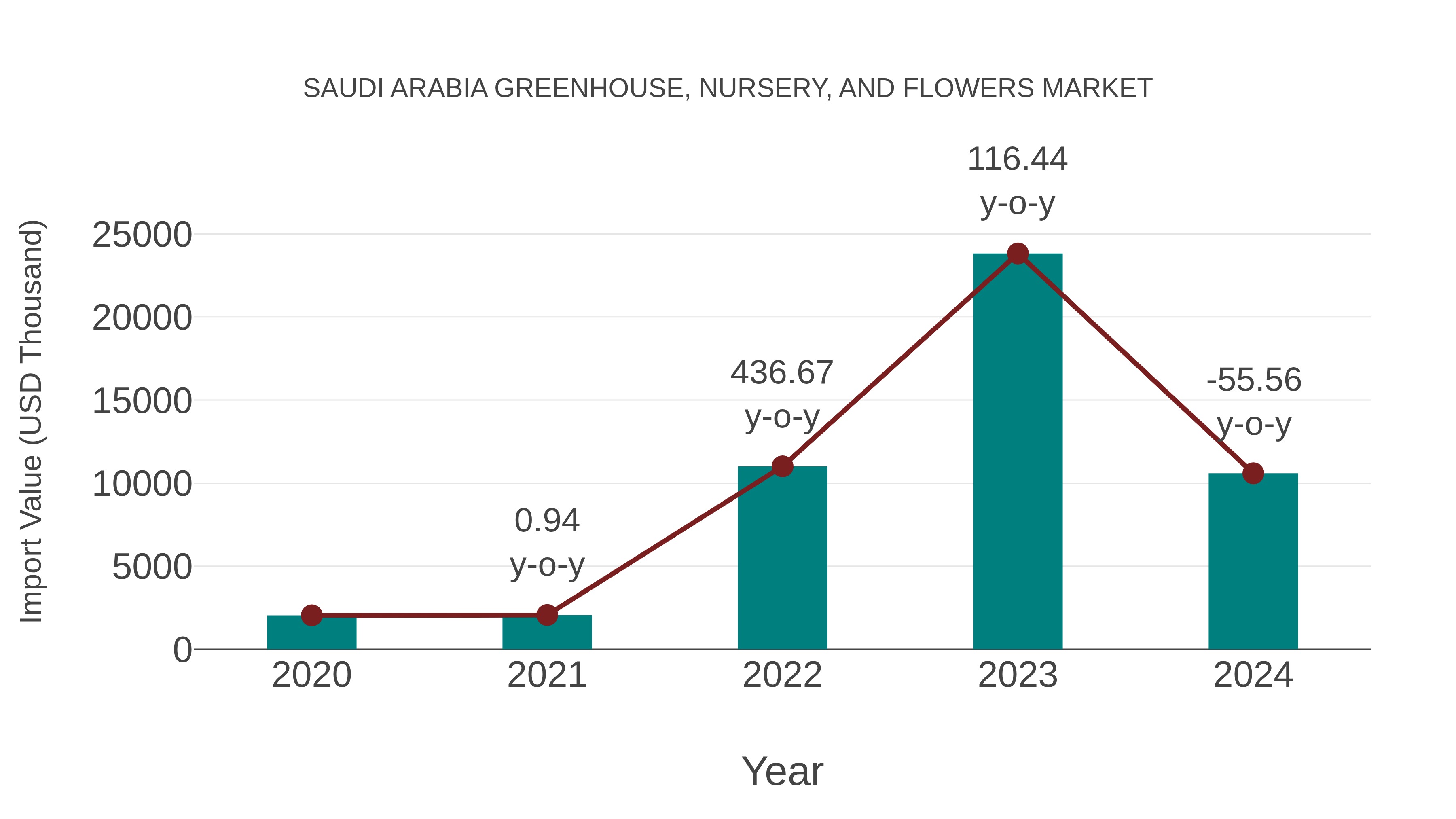
In the Saudi Arabia greenhouse, nursery, and flowers market, the import trend experienced a notable decline from 2023 to 2024, with a growth rate of -55.56%. However, the compound annual growth rate (CAGR) for the period 2020-2024 stood at a substantial 51.09%. This significant decrease in import momentum from 2023 to 2024 could be attributed to shifts in demand, possibly influenced by evolving consumer preferences or changes in trade policies impacting the market`s stability.
Saudi Arabia Greenhouse Nursery and Flowers Market Synopsis
The greenhouse nursery and flowers market are integral to Saudi Arabia landscaping, ornamental, and gardening industries. The country`s commitment to enhancing urban aesthetics and green spaces has driven demand for a wide variety of nursery plants and flowers. Greenhouse facilities offer controlled conditions for propagation and growth, ensuring healthy and vibrant plants. These products cater to public parks, private gardens, and commercial landscapes, contributing to the country`s beautification efforts and improving the overall environment.
Drivers of the Market
In the Saudi Arabia greenhouse nursery and flowers market, factors such as landscaping trends, urban beautification initiatives, and the rising importance of ornamental plants drive the demand for greenhouse-grown nursery and flowers. Ornamental plants are valued for their aesthetic appeal and contribute to creating pleasant urban environments. Greenhouse cultivation enables the production of high-quality plants with optimal growth conditions, ensuring their suitability for landscaping and beautification projects. Moreover, the cultural significance of flowers in various occasions and ceremonies further drives the growth of the greenhouse nursery and flowers market.
Challenges of the Market
The Saudi Arabia Greenhouse Nursery and Flowers Market faces challenges related to diversifying flower species and meeting seasonal demand. Efficiently producing a wide variety of flowers year-round and ensuring their freshness upon delivery require advanced cultivation practices and logistics. Addressing consumer preferences for sustainable and locally grown flowers also poses challenges.
COVID-19 Impact on the Market
The greenhouse nursery and flowers market faced challenges as demand from events, weddings, and landscaping projects declined due to restrictions on gatherings and closures of public spaces. This led to reduced orders and disruptions in the supply chain for flowers and ornamental plants. Many businesses in this sector had to pivot their operations or explore new revenue streams, such as offering online sales and home delivery. The market`s recovery was closely linked to the reopening of the events and hospitality sectors.
Key Players in the Market
Major companies active in this sector are King Saud University Agricultural Research Center (KSU/ARC), State Plant Protection Organization of Ministry of Environment Water and Agriculture , Saadallah Sons For Flower Auction , Arabaeyat for Greenhouses Construction company(ARABGREENHOUSES)and National GreenTech group Company(Ngtc).
Key Highlights of the Report:
- Saudi Arabia Greenhouse, Nursery, And Flowers Market Outlook
- Market Size of Saudi Arabia Greenhouse, Nursery, And Flowers Market, 2025
- Forecast of Saudi Arabia Greenhouse, Nursery, And Flowers Market, 2032
- Historical Data and Forecast of Saudi Arabia Greenhouse, Nursery, And Flowers Revenues & Volume for the Period 2022-2032F
- Saudi Arabia Greenhouse, Nursery, And Flowers Market Trend Evolution
- Saudi Arabia Greenhouse, Nursery, And Flowers Market Drivers and Challenges
- Saudi Arabia Greenhouse, Nursery, And Flowers Price Trends
- Saudi Arabia Greenhouse, Nursery, And Flowers Porter's Five Forces
- Saudi Arabia Greenhouse, Nursery, And Flowers Industry Life Cycle
- Historical Data and Forecast of Saudi Arabia Greenhouse, Nursery, And Flowers Market Revenues & Volume By Type for the Period 2022-2032F
- Historical Data and Forecast of Saudi Arabia Greenhouse, Nursery, And Flowers Market Revenues & Volume By Food Crops Grown Under Cover for the Period 2022-2032F
- Historical Data and Forecast of Saudi Arabia Greenhouse, Nursery, And Flowers Market Revenues & Volume By Nursery and Floriculture Production for the Period 2022-2032F
- Historical Data and Forecast of Saudi Arabia Greenhouse, Nursery, And Flowers Market Revenues & Volume By End-User for the Period 2022-2032F
- Historical Data and Forecast of Saudi Arabia Greenhouse, Nursery, And Flowers Market Revenues & Volume By B2B for the Period 2022-2032F
- Historical Data and Forecast of Saudi Arabia Greenhouse, Nursery, And Flowers Market Revenues & Volume By B2C for the Period 2022-2032F
- Saudi Arabia Greenhouse, Nursery, And Flowers Import Export Trade Statistics
- Market Opportunity Assessment By Type
- Market Opportunity Assessment By End-User
- Saudi Arabia Greenhouse, Nursery, And Flowers Top Companies Market Share
- Saudi Arabia Greenhouse, Nursery, And Flowers Competitive Benchmarking By Technical and Operational Parameters
- Saudi Arabia Greenhouse, Nursery, And Flowers Company Profiles
- Saudi Arabia Greenhouse, Nursery, And Flowers Key Strategic Recommendations






































