Saudi Arabia Hams, Shoulders and Cuts of Swine Market Size, Share & Growth Rate
The Saudi Arabia Hams, Shoulders and Cuts of Swine Market was estimated at USD 391 Million in 2025 and is projected to reach USD 502 Million by 2032, growing at a CAGR of 3.6% from 2026 to 2032. This growth trajectory is largely driven by the increasing presence of non-Muslim expatriates and evolving culinary preferences within certain communities in Saudi Arabia. As the demand for pork products rises, particularly among specific segments of the population, the market is navigating a complex landscape shaped by cultural dynamics and dietary choices.
Saudi Arabia Hams, Shoulders and Cuts of Swine Market Year-wise Growth Rate and Key Drivers
This graph highlights how the Saudi Arabia Hams, Shoulders and Cuts of Swine Market has steadily grown over the years, supported by major growth factors.
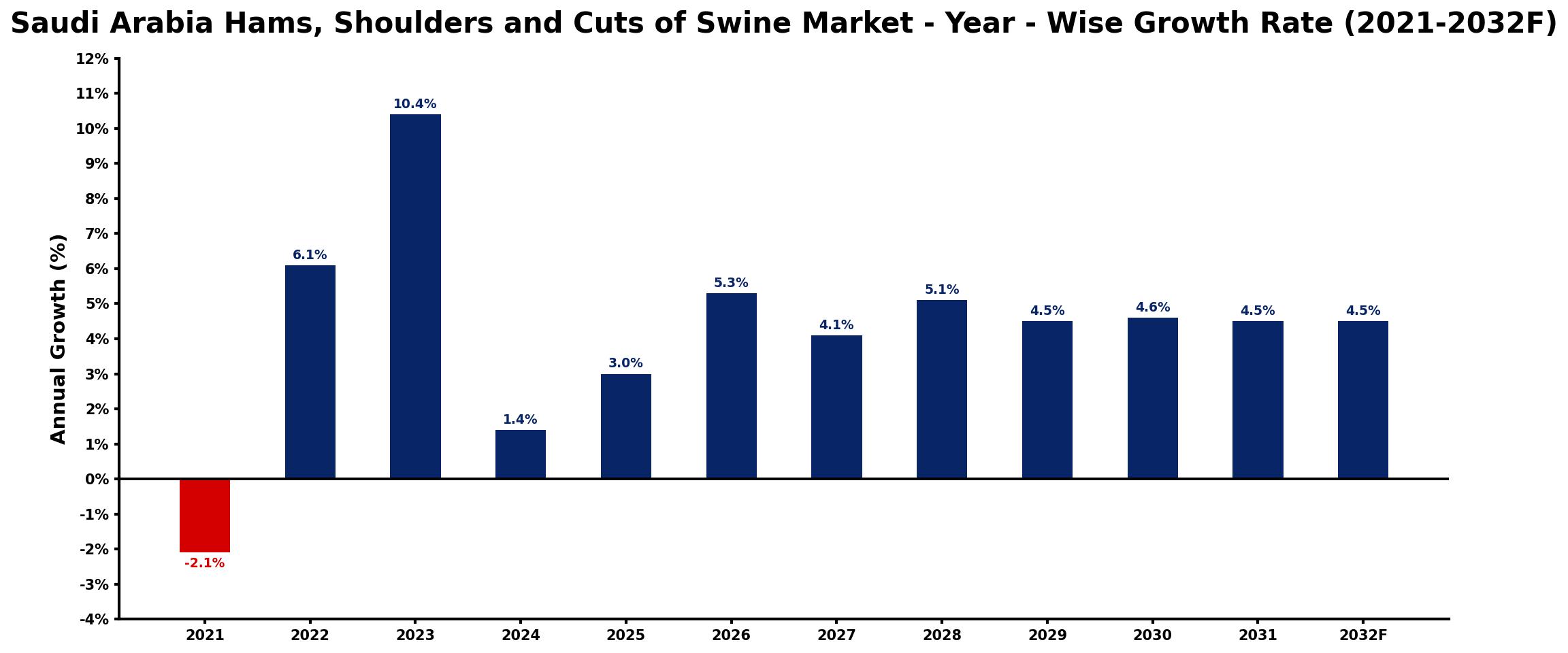
The table below presents the year‑wise growth rates along with the key drivers influencing the market
| Year | Growth Rate | Major Drivers |
| 2021 | -2.1% | Consumer preferences shifted downwards |
| 2022 | 6.1% | Rising demand for alternative meats |
| 2023 | 10.4% | Increased investment in processing facilities |
| 2024 | 1.4% | Expansion of distribution networks observed |
| 2025 | 3.0% | Growth in health-conscious consumer base |
| 2026 | 5.3% | Surge in culinary tourism activities |
| 2027 | 4.1% | Emergence of gourmet food trends |
| 2028 | 5.1% | Technological advancements in food production |
| 2029 | 4.5% | Strengthened international trade agreements |
| 2030 | 4.6% | Growing popularity of ethnic cuisines |
| 2031 | 4.5% | Heightened focus on sustainability practices |
| 2032 | 4.5% | Enhanced marketing strategies implemented |
Note: Market size estimations and growth projections presented in this report are based on 6Wresearch's proprietary forecasting methodology, utilizing the latest available industry data, government publications, and primary research inputs.
Saudi Arabia Hams, Shoulders and Cuts of Swine Market Synopsis
In Saudi Arabia, the market for hams, shoulders, and cuts of swine operates within a unique context marked by religious dietary restrictions. The prohibition of pork in Islamic traditions significantly influences demand, resulting in a market that, while niche, is critical for non-Muslim residents seeking swine products. This limited reach, however, is countered by a growing segment of consumers looking for alternatives driven by personal choices and cultural heritage.
The demographic landscape of Saudi Arabia, including an influx of expatriates and a diversifying palate, fosters a specialized market for these products. As culinary preferences evolve, there is an increasing need for suppliers to offer quality swine cuts and innovative pork alternatives that appeal to discerning consumers. This dynamic not only influences market supply but also shapes the ongoing development of distribution channels within the country.
Saudi Arabia Hams, Shoulders and Cuts of Swine Market Key Takeaways
- The market remains small but focused, catering primarily to non-Muslim expatriates and specific culinary contexts.
- Growth is supported by an expanding demand for pork products among expatriate communities.
- Key players are emphasizing high-quality alternatives and educational initiatives to better serve consumer preferences.
- Regulatory frameworks continue to shape market dynamics, requiring strategic compliance from suppliers.
- The market's recovery post-COVID-19 has been gradual, following the reopening of the hospitality sector.
Evaluation of Restraints in Saudi Arabia Hams, Shoulders and Cuts of Swine Market
The Saudi Arabia Hams, Shoulders and Cuts of Swine Market faces notable restraints primarily due to the prevailing religious prohibitions surrounding pork consumption. This cultural barrier limits the overall market size, necessitating that businesses adopt targeted strategies to reach their specific audience effectively. Additionally, the challenge of sourcing high-quality pork alternatives and the necessity to educate potential consumers on their culinary uses and nutritional benefits remain critical hurdles. Establishing a strong supply chain that aligns with local tastes while adhering to cultural norms is essential for sustained market growth.
Saudi Arabia Hams, Shoulders and Cuts of Swine Market Trends
Current trends indicate a shift towards increased culinary experimentation among specific consumer groups, with non-Muslims seeking diverse meat options. Furthermore, there is a growing interest in processed and pre-packaged pork products that offer convenience without compromising on quality. Technological advancements in meat processing and preservation are shaping the way these products are marketed and distributed, leading to enhanced product visibility in supermarkets and specialty stores.
Saudi Arabia Hams, Shoulders and Cuts of Swine Market Opportunities
With the ongoing cultural shifts, there lies a promising opportunity for businesses to innovate within the niche pork market. Developing a broader range of products that meet both local regulations and consumer preferences could drive significant growth. Additionally, leveraging digital marketing strategies to reach target demographics, such as expatriates, can enhance brand visibility and increase market share. Collaborations with local chefs and culinary influencers may also promote the appeal of pork products within targeted communities.
Government Initiatives in the Saudi Arabia Hams, Shoulders and Cuts of Swine Market
The Saudi government has shown a nuanced approach towards the meat industry, recognizing the diverse dietary needs of its population. While policies generally reinforce Islamic dietary laws, there are ongoing discussions to facilitate the importation and sale of pork products for non-Muslim residents. Initiatives aimed at improving food safety standards and ensuring quality in meat processing could further enhance market viability. These efforts may also encourage international suppliers to engage more actively in the Saudi pork market.
Future Insights of the Saudi Arabia Hams, Shoulders and Cuts of Swine Market
Looking ahead to 2026-2032, the Saudi Arabia Hams, Shoulders and Cuts of Swine Market is poised for gradual growth driven by demographic changes and evolving tastes. As the expatriate community continues to flourish, the demand for pork products is likely to rise, offering a fertile ground for market expansion. Innovations in product development and distribution, coupled with an emphasis on quality, will be key in capitalizing on these opportunities. Moreover, the potential for future regulatory adjustments could also create a more favorable environment for market players.
Saudi Arabia Hams, Shoulders and Cuts of Swine Market Latest Developments (2025 - 2026)
In recent months, the Saudi Arabia Hams, Shoulders and Cuts of Swine Market has seen notable shifts as food establishments gradually return to pre-pandemic operations. Restaurants and retail outlets have begun to expand their pork offerings, responding to increasing consumer interest. Concurrently, there are efforts being made by several suppliers to diversify their product ranges with alternative pork cuts and value-added products, aiming to cater to evolving consumer preferences while adhering to regulatory standards.
Saudi Arabia Hams, Shoulders and Cuts of Swine Market - Key Attractiveness of the Report
- 10 Years of Market Numbers
- Historical Data Starting from 2022 to 2025
- Base Year: 2025
- Forecast Data until 2032
- Key Performance Indicators Impacting the Market
- Major Upcoming Developments and Projects
Key Highlights of the Report:
- Saudi Arabia Hams, Shoulders and Cuts of Swine Market Outlook
- Market Size of Saudi Arabia Hams, Shoulders and Cuts of Swine Market, 2025
- Forecast of Saudi Arabia Hams, Shoulders and Cuts of Swine Market, 2032
- Historical Data and Forecast of Saudi Arabia Hams, Shoulders and Cuts of Swine Revenues & Volume for the Period 2022-2032F
- Saudi Arabia Hams, Shoulders and Cuts of Swine Market Trend Evolution
- Saudi Arabia Hams, Shoulders and Cuts of Swine Market Drivers and Challenges
- Saudi Arabia Hams, Shoulders and Cuts of Swine Price Trends
- Saudi Arabia Hams, Shoulders and Cuts of Swine Porter's Five Forces
- Saudi Arabia Hams, Shoulders and Cuts of Swine Industry Life Cycle
- Historical Data and Forecast of Saudi Arabia Hams, Shoulders and Cuts of Swine Market Revenues & Volume By Product Type for the Period 2022-2032F
- Historical Data and Forecast of Saudi Arabia Hams, Shoulders and Cuts of Swine Market Revenues & Volume By Processed Meat for the Period 2022-2032F
- Historical Data and Forecast of Saudi Arabia Hams, Shoulders and Cuts of Swine Market Revenues & Volume By Frozen Meat for the Period 2022-2032F
- Historical Data and Forecast of Saudi Arabia Hams, Shoulders and Cuts of Swine Market Revenues & Volume By Chilled Meat for the Period 2022-2032F
- Historical Data and Forecast of Saudi Arabia Hams, Shoulders and Cuts of Swine Market Revenues & Volume By Canned Meat for the Period 2022-2032F
- Historical Data and Forecast of Saudi Arabia Hams, Shoulders and Cuts of Swine Market Revenues & Volume By Fresh Meat for the Period 2022-2032F
- Historical Data and Forecast of Saudi Arabia Hams, Shoulders and Cuts of Swine Market Revenues & Volume By Animal Type for the Period 2022-2032F
- Historical Data and Forecast of Saudi Arabia Hams, Shoulders and Cuts of Swine Market Revenues & Volume By Cattle and Buffalo for the Period 2022-2032F
- Historical Data and Forecast of Saudi Arabia Hams, Shoulders and Cuts of Swine Market Revenues & Volume By Pig for the Period 2022-2032F
- Historical Data and Forecast of Saudi Arabia Hams, Shoulders and Cuts of Swine Market Revenues & Volume By Poultry for the Period 2022-2032F
- Historical Data and Forecast of Saudi Arabia Hams, Shoulders and Cuts of Swine Market Revenues & Volume By Sheep and Goat for the Period 2022-2032F
- Historical Data and Forecast of Saudi Arabia Hams, Shoulders and Cuts of Swine Market Revenues & Volume By Other Animals for the Period 2022-2032F
- Historical Data and Forecast of Saudi Arabia Hams, Shoulders and Cuts of Swine Market Revenues & Volume By Distribution Channel for the Period 2022-2032F
- Historical Data and Forecast of Saudi Arabia Hams, Shoulders and Cuts of Swine Market Revenues & Volume By Business to Consumers (B2C) for the Period 2022-2032F
- Historical Data and Forecast of Saudi Arabia Hams, Shoulders and Cuts of Swine Market Revenues & Volume By Modern Groceries for the Period 2022-2032F
- Historical Data and Forecast of Saudi Arabia Hams, Shoulders and Cuts of Swine Market Revenues & Volume By Wet & Butcher Shops for the Period 2022-2032F
- Historical Data and Forecast of Saudi Arabia Hams, Shoulders and Cuts of Swine Market Revenues & Volume By Convenience Stores for the Period 2022-2032F
- Historical Data and Forecast of Saudi Arabia Hams, Shoulders and Cuts of Swine Market Revenues & Volume By Business to Business (B2B) for the Period 2022-2032F
- Historical Data and Forecast of Saudi Arabia Hams, Shoulders and Cuts of Swine Market Revenues & Volume By Other Channel for the Period 2022-2032F
- Saudi Arabia Hams, Shoulders and Cuts of Swine Import Export Trade Statistics
- Market Opportunity Assessment By Product Type
- Market Opportunity Assessment By Animal Type
- Market Opportunity Assessment By Distribution Channel
- Saudi Arabia Hams, Shoulders and Cuts of Swine Top Companies Market Share
- Saudi Arabia Hams, Shoulders and Cuts of Swine Competitive Benchmarking By Technical and Operational Parameters
- Saudi Arabia Hams, Shoulders and Cuts of Swine Company Profiles
- Saudi Arabia Hams, Shoulders and Cuts of Swine Key Strategic Recommendations






































