Saudi Arabia Hand Carts & Trolleys Market Summary
The saudi arabia hand carts & trolleys market was estimated at USD 203 Million in 2025 and is projected to reach USD 258 Million by 2032, growing at a CAGR of 5.2% from 2026 to 2032.
Saudi Arabia Hand Carts & Trolleys Market Year-wise Growth Rate and Key Drivers
This graph highlights how the Saudi Arabia Hand Carts & Trolleys Market has steadily grown over the past five years, supported by major growth factors.
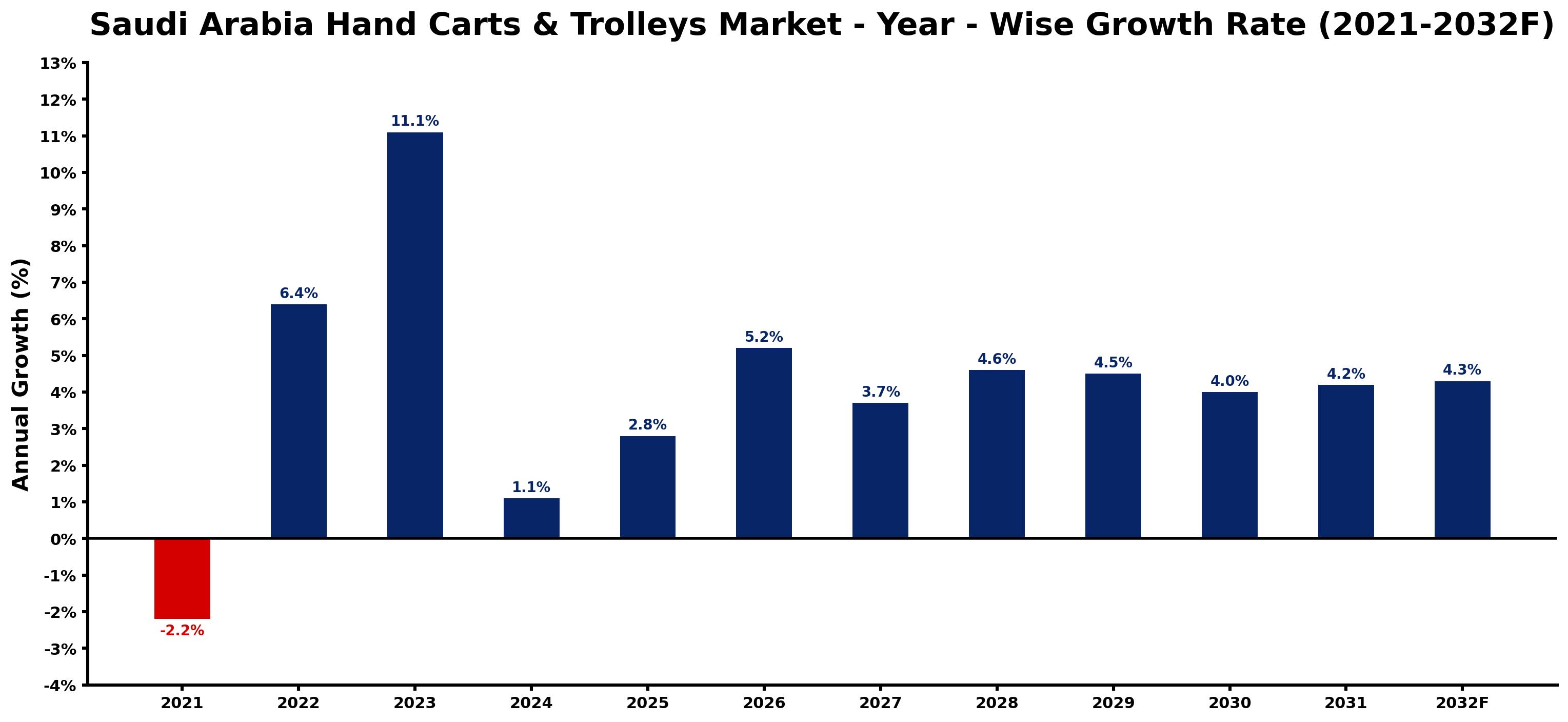
The table below presents the year wise growth rates along with the key drivers influencing the market
| Year | Growth Rate | Major Drivers |
| 2021 | -2.2% | Increased competition from advanced logistics solutions diminished demand for traditional hand carts and trolleys. |
| 2022 | 6.4% | Local manufacturers are adapting designs to meet the demands of Saudi urban projects. |
| 2023 | 11.1% | Energy-efficient materials attract attention amid sustainability trends in retail and logistics. |
| 2024 | 1.1% | Infrastructure expansion in regions like Neom fuels the need for efficient transport solutions. |
| 2025 | 2.8% | E-commerce growth necessitates improved logistical support, highlighting the utility of hand carts. |
| 2026 | 5.2% | Retail sector investments encourage operators to streamline operations using mobile transport options. |
| 2027 | 3.7% | Adoption of modern warehousing techniques drives demand for specialized hand carts and trolleys. |
| 2028 | 4.6% | Increasing urbanization in Saudi cities creates new opportunities for versatile transport solutions. |
| 2029 | 4.5% | Shifts toward localized manufacturing reduce lead times and improve inventory management practices. |
| 2030 | 4.0% | Corporate sustainability commitments foster innovation in eco-friendly hand cart designs and materials. |
| 2031 | 4.2% | Technological upgrades in design enhance the functionality of trolleys for specific industries. |
| 2032 | 4.3% | Expansion of tourism sectors in Saudi Arabia increases demand for practical transportation solutions. |
Note - Market size estimations and growth projections presented in this report are based on 6Wresearch's advanced forecasting approach, validated with industry datasets as of June 2026.
Saudi Arabia Hand Carts & Trolleys Market Synopsis
The Saudi Arabia Hand Carts Trolleys Market is projected to reach 5.2% and witness significant growth during the forecast period (2026-2032). This anticipated growth is driven by an escalating demand for materials handling solutions across several key sectors, including automotive, retail, logistics, healthcare, and food & beverage. Additionally, the rising trend of e-commerce plays a crucial role in augmenting the market's dynamics, as businesses increasingly seek effective transportation solutions for goods. Manufacturers are also focusing on enhancing operational efficiency and achieving cost reductions, further boosting the sales of hand carts and trolleys in Saudi Arabia.
Saudi Arabia Hand Carts & Trolleys Market Growth Drivers
The growth of the Saudi Arabia Hand Carts & Trolleys Market can be attributed to several factors:
- The construction sector's expansion demands efficient material handling systems, driving the need for hand carts and trolleys.
- Retail stores and logistics companies require advanced handling solutions to improve operational workflows, thereby increasing demand.
- Technological advancements in automation are expected to minimize errors associated with manual handling operations.
- The rapid growth of e-commerce activities, fueled by increased internet penetration and smartphone usage, presents ample opportunities for market participants.
- Innovative product designs and attractive pricing strategies are key to stimulating revenue within the regional landscape.
Saudi Arabia Hand Carts & Trolleys Market Trends and Opportunities
The market is poised for transformative growth as various industry trends gain traction:
- The integration of smart technologies, such as IoT, is likely to enhance the functionality of hand carts and trolleys, making them more efficient.
- Sustainability trends are pushing manufacturers to develop eco-friendly products, appealing to environmentally conscious consumers and businesses.
- Collaborative logistics, driven by e-commerce, is altering how products are moved and stored, creating new opportunities for innovative handling solutions.
- The increasing focus on supply chain resilience due to recent global disruptions will emphasize the need for reliable materials handling equipment.
- Government initiatives aimed at enhancing infrastructure are expected to further support demand for efficient material handling solutions.
Saudi Arabia Hand Carts & Trolleys Market Challenges and Restraints
While opportunities abound, the market faces several challenges that could hinder growth:
- The prevalence of counterfeit products at lower price points threatens the profitability of legitimate offerings, impacting sales volumes.
- A lack of skilled labor capable of efficiently using advanced material handling tools may slow market uptake.
- Economic fluctuations resulting from geopolitical tensions could adversely affect industry investment and growth.
- The rapid pace of technological change may leave some manufacturers scrambling to keep up with innovation.
- Increased competition, both from domestic and international players, may pressure prices and squeeze margins.
Saudi Arabia Hand Carts & Trolleys Market Government Investment and Initiatives
The Saudi government plays a pivotal role in the hand carts and trolleys market through various investments and initiatives:
- Government policy encourages the development of logistics infrastructure, which inadvertently boosts the demand for materials handling equipment.
- Public spending on urban development and infrastructure projects significantly influences market dynamics, driving the need for efficient handling solutions.
- Incentives for local manufacturing can bolster the domestic production of hand carts and trolleys, reducing reliance on imports.
- Training programs may be initiated to enhance the skills of the labor force, ensuring efficient operation of handling equipment.
- Aligning with the Vision 2030 initiative, the government aims to diversify the economy and support local industries, including material handling solutions.
Saudi Arabia Hand Carts & Trolleys Market Latest Developments (May 2025 - June 2026)
The period from May 2025 to June 2026 has seen notable developments in the Saudi Arabia Hand Carts & Trolleys Market:
- The market is increasingly adopting automation technologies, enhancing the efficiency of hand carts and trolleys in various sectors.
- Sustainable practices have gained momentum, with companies focusing on eco-friendly materials and processes in product manufacturing.
- The rise of e-commerce has led to innovative logistics solutions, integrating hand carts and trolleys into last-mile delivery systems.
- Challenges such as supply chain disruptions have prompted organizations to reassess their material handling processes, creating opportunities for improvement.
- Overall, the market exhibits resilience amidst global economic challenges, adapting to changing consumer demands and operational practices.
Saudi Arabia Hand Carts & Trolleys Market - Key Attractiveness of the Report
- 10 Years of Market Numbers
- Historical Data Starting from 2022 to 2025
- Base Year: 2025
- Forecast Data until 2032
- Key Performance Indicators Impacting the Market
- Major Upcoming Developments and Projects
Key Highlights of the Report:
- Saudi Arabia Hand Carts & Trolleys Market Outlook
- Market Size of Saudi Arabia Hand Carts & Trolleys Market, 2025
- Forecast of Saudi Arabia Hand Carts & Trolleys Market, 2032
- Historical Data and Forecast of Saudi Arabia Hand Carts & Trolleys Revenues & Volume for the Period 2022-2032F
- Saudi Arabia Hand Carts & Trolleys Market Trend Evolution
- Saudi Arabia Hand Carts & Trolleys Market Drivers and Challenges
- Saudi Arabia Hand Carts & Trolleys Price Trends
- Saudi Arabia Hand Carts & Trolleys Porter's Five Forces
- Saudi Arabia Hand Carts & Trolleys Industry Life Cycle
- Historical Data and Forecast of Saudi Arabia Hand Carts & Trolleys Market Revenues & Volume By Types for the Period 2022-2032F
- Historical Data and Forecast of Saudi Arabia Hand Carts & Trolleys Market Revenues & Volume By Steel Hand Truck for the Period 2022-2032F
- Historical Data and Forecast of Saudi Arabia Hand Carts & Trolleys Market Revenues & Volume By Aluminium Hand Truck for the Period 2022-2032F
- Historical Data and Forecast of Saudi Arabia Hand Carts & Trolleys Market Revenues & Volume By Applications for the Period 2022-2032F
- Historical Data and Forecast of Saudi Arabia Hand Carts & Trolleys Market Revenues & Volume By Online Sales for the Period 2022-2032F
- Historical Data and Forecast of Saudi Arabia Hand Carts & Trolleys Market Revenues & Volume By Offline Sales for the Period 2022-2032F
- Saudi Arabia Hand Carts & Trolleys Import Export Trade Statistics
- Market Opportunity Assessment By Types
- Market Opportunity Assessment By Applications
- Saudi Arabia Hand Carts & Trolleys Top Companies Market Share
- Saudi Arabia Hand Carts & Trolleys Competitive Benchmarking By Technical and Operational Parameters
- Saudi Arabia Hand Carts & Trolleys Company Profiles
- Saudi Arabia Hand Carts & Trolleys Key Strategic Recommendations






































