Saudi Arabia Hay Making Machinery Market Size, Share & Growth Rate
The Saudi Arabia Hay Making Machinery Market was estimated at USD 162 Million in 2025 and is projected to reach USD 207 Million by 2032, growing at a CAGR of 3.6% from 2026 to 2032. The growth trajectory of this market is closely linked to the increasing demand for efficient agricultural practices amidst rising livestock feed requirements. The interdependence between the livestock sector and hay production is driving the adoption of advanced machinery, as farmers seek to optimize their operations and enhance productivity.
Saudi Arabia Hay Making Machinery Market Year-wise Growth Rate and Key Drivers
This graph highlights how the Saudi Arabia Hay Making Machinery Market has steadily grown over the years, supported by major growth factors.
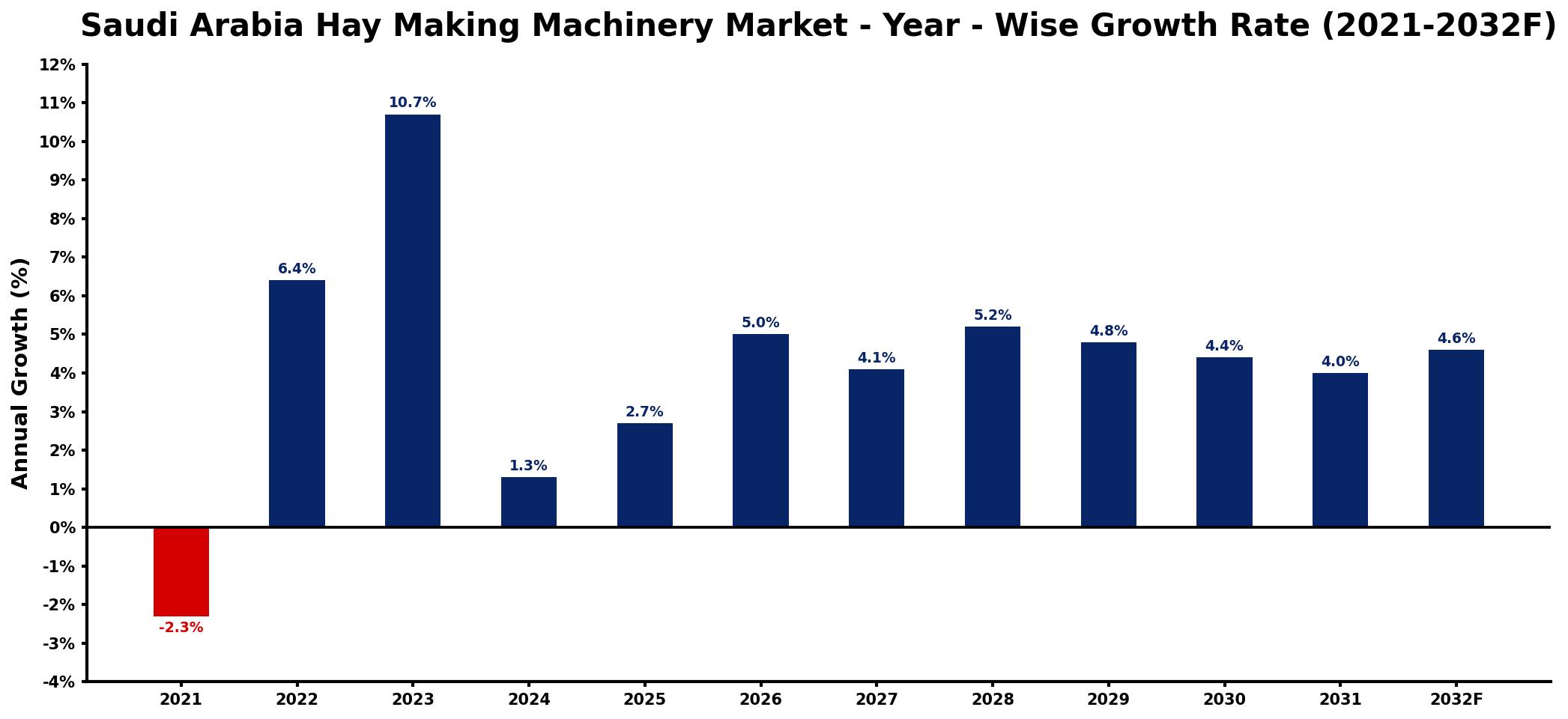
The table below presents the year‑wise growth rates along with the key drivers influencing the market
| Year | Growth Rate | Major Drivers |
| 2021 | -2.3% | decreased agricultural investment activity |
| 2022 | 6.4% | rising demand for automation solutions |
| 2023 | 10.7% | expansion of livestock farming sector |
| 2024 | 1.3% | increased focus on sustainability practices |
| 2025 | 2.7% | growing interest in precision agriculture |
| 2026 | 5.0% | enhanced government support initiatives |
| 2027 | 4.1% | rising export opportunities for products |
| 2028 | 5.2% | emerging technologies in farming operations |
| 2029 | 4.8% | increased rural infrastructure developments |
| 2030 | 4.4% | rising procurement volume requirements |
| 2031 | 4.0% | rising adoption of renewable energy |
| 2032 | 4.6% | expanding agricultural research funding |
Note: Market size estimations and growth projections presented in this report are based on 6Wresearch's proprietary forecasting methodology, utilizing the latest available industry data, government publications, and primary research inputs.
Saudi Arabia Hay Making Machinery Market Synopsis
The primary force shaping the Saudi Arabia Hay Making Machinery Market is the increasing focus on self-sufficiency in food production. As the population continues to grow, the need for effective livestock feed solutions has never been more critical. Hay, being a vital component of animal nutrition, ensures that farmers can meet both domestic and export demand.
Additionally, advancements in agricultural technology are transforming traditional practices. The integration of modern hay making machinery allows for better efficiency in harvesting, drying, and baling processes. This shift not only improves productivity but also aligns with the broader government initiatives aimed at enhancing agricultural output and sustainability in Saudi Arabia.
Saudi Arabia Hay Making Machinery Market Key Takeaways
- The market is projected to grow from USD 162 Million in 2025 to USD 207 Million by 2032.
- Increasing livestock production is a key driver for hay demand, impacting machinery sales.
- Government initiatives promoting agricultural efficiency are positively influencing the market.
- The adoption of advanced technology is crucial for optimizing hay making processes.
- Education and awareness about the benefits of hay making machinery are essential for market growth.
Evaluation of Restraints in Saudi Arabia Hay Making Machinery Market
The Saudi Arabia Hay Making Machinery Market faces significant restraints primarily due to the challenges posed by the country's arid climate and water scarcity. Limited agricultural land and dependence on irrigation for hay production constrain the overall growth of the sector. Furthermore, the niche nature of hay making machinery necessitates a degree of knowledge among potential buyers, which may hinder widespread adoption. Economic fluctuations can also deter farmers from making significant investments in advanced machinery, particularly in uncertain times.
Saudi Arabia Hay Making Machinery Market Trends
Several trends are emerging within the Saudi Arabia Hay Making Machinery Market that are reshaping the landscape. First, the move towards mechanization is becoming increasingly prevalent as farmers look to reduce labor costs and improve operational efficiency. Additionally, there is a growing emphasis on sustainability, leading to an interest in equipment that utilizes less water and energy. Finally, the incorporation of smart technologies such as IoT is paving the way for more precise hay production processes, allowing farmers to optimize their yield further.
Saudi Arabia Hay Making Machinery Market Opportunities
Opportunities for growth in the Saudi Arabia Hay Making Machinery Market lie in the increasing investments in agricultural research and development. As more farmers seek innovative solutions to meet the demands of livestock nutrition, the market presents avenues for companies to develop cutting-edge equipment. Furthermore, the shift towards organic farming practices opens up the potential for specialized hay production machinery that caters to this sector.
Government Initiatives in the Saudi Arabia Hay Making Machinery Market
The Saudi government has recognized the importance of agriculture in achieving food security and self-sufficiency. Initiatives are in place to enhance agricultural productivity through financial incentives, support programs, and investment in infrastructure. By promoting advanced farming techniques and sustainable practices, these efforts are expected to bolster the hay making machinery market, ensuring that farmers have access to the latest technologies.
Future Insights of the Saudi Arabia Hay Making Machinery Market
Looking ahead to 2026-2032, the Saudi Arabia Hay Making Machinery Market is poised for continued growth. The ongoing emphasis on optimizing agricultural practices, combined with a rising population and evolving dietary preferences, will sustain the demand for efficient hay production. As new technologies emerge, farmers will increasingly adopt machinery that enhances productivity while conserving resources, aligning with the governments agricultural goals and supporting the market's upward trajectory.
Saudi Arabia Hay Making Machinery Market Latest Developments (2025 - 2026)
Recent developments in the Saudi Arabia Hay Making Machinery Market have included advancements in smart farming technologies, which integrate artificial intelligence for enhanced operational efficiency. Additionally, partnerships between agricultural equipment manufacturers and local farmers have been established to facilitate knowledge transfer and machinery demonstrations. These initiatives are geared towards encouraging more widespread adoption of hay making machinery, crucial for meeting the growing needs of the livestock sector.
Saudi Arabia Hay Making Machinery Market - Key Attractiveness of the Report
- 10 Years of Market Numbers
- Historical Data Starting from 2022 to 2025
- Base Year: 2025
- Forecast Data until 2032
- Key Performance Indicators Impacting the Market
- Major Upcoming Developments and Projects
Key Highlights of the Report:
- Saudi Arabia Hay Making Machinery Market Outlook
- Market Size of Saudi Arabia Hay Making Machinery Market, 2025
- Forecast of Saudi Arabia Hay Making Machinery Market, 2032
- Historical Data and Forecast of Saudi Arabia Hay Making Machinery Revenues & Volume for the Period 2022-2032F
- Saudi Arabia Hay Making Machinery Market Trend Evolution
- Saudi Arabia Hay Making Machinery Market Drivers and Challenges
- Saudi Arabia Hay Making Machinery Price Trends
- Saudi Arabia Hay Making Machinery Porter's Five Forces
- Saudi Arabia Hay Making Machinery Industry Life Cycle
- Historical Data and Forecast of Saudi Arabia Hay Making Machinery Market Revenues & Volume By Type for the Period 2022-2032F
- Historical Data and Forecast of Saudi Arabia Hay Making Machinery Market Revenues & Volume By Mower for the Period 2022-2032F
- Historical Data and Forecast of Saudi Arabia Hay Making Machinery Market Revenues & Volume By Balers for the Period 2022-2032F
- Historical Data and Forecast of Saudi Arabia Hay Making Machinery Market Revenues & Volume By Tedder for the Period 2022-2032F
- Historical Data and Forecast of Saudi Arabia Hay Making Machinery Market Revenues & Volume By Rakes for the Period 2022-2032F
- Saudi Arabia Hay Making Machinery Import Export Trade Statistics
- Market Opportunity Assessment By Type
- Saudi Arabia Hay Making Machinery Top Companies Market Share
- Saudi Arabia Hay Making Machinery Competitive Benchmarking By Technical and Operational Parameters
- Saudi Arabia Hay Making Machinery Company Profiles
- Saudi Arabia Hay Making Machinery Key Strategic Recommendations






































