Saudi Arabia Home Furnishings Market Summary
The saudi arabia home furnishings market was estimated at USD 463 Million in 2025 and is projected to reach USD 590 Million by 2032, growing at a CAGR of 4.7% from 2026 to 2032.
Saudi Arabia Home Furnishings Market Year-wise Growth Rate and Key Drivers
This graph highlights how the Saudi Arabia Home Furnishings Market has steadily grown over the past five years, supported by major growth factors.
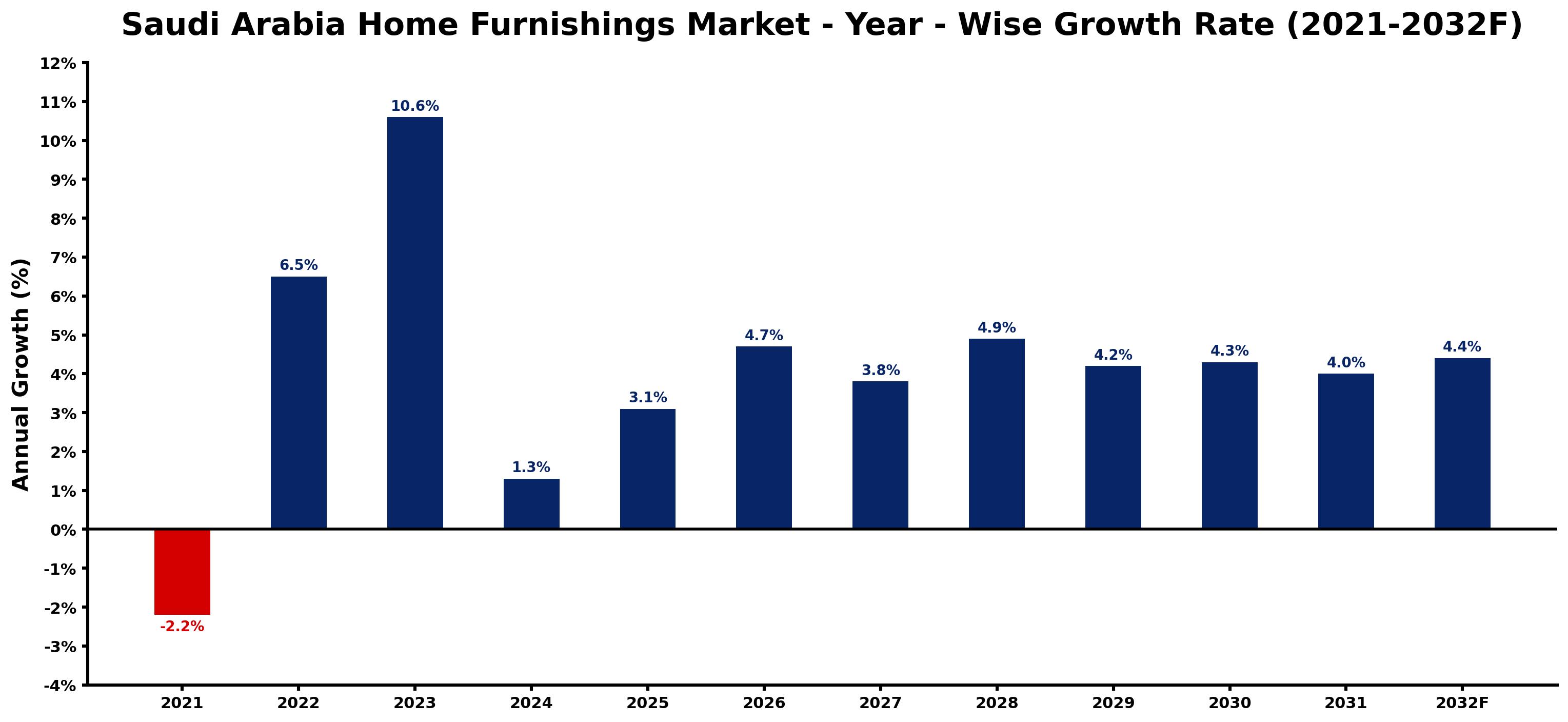
The table below presents the year wise growth rates along with the key drivers influencing the market
| Year | Growth Rate | Major Drivers |
| 2021 | -2.2% | Supply chain disruptions hindered availability of imported materials, limiting product offerings for consumers. |
| 2022 | 6.5% | Increased expatriate population combined with local spending trends propelled home décor demand. |
| 2023 | 10.6% | E-commerce platforms surged, easing access to diverse home furnishing options nationwide. |
| 2024 | 1.3% | Major construction projects fueled interior design services, enhancing market competitiveness exponentially. |
| 2025 | 3.1% | Local artisans gained traction, boosting interest in unique, culturally-inspired furnishings across demographics. |
| 2026 | 4.7% | Sustainability awareness influenced purchasing decisions, prioritizing eco-friendly materials in home products. |
| 2027 | 3.8% | Technological integration in retail, such as AR, enriched customer experience and engagement levels. |
| 2028 | 4.9% | Urbanization trends created a shift towards space-saving furniture tailored for modern lifestyles. |
| 2029 | 4.2% | Investment in tourism infrastructure indirectly increased demand for luxury home furnishings and décor. |
| 2030 | 4.3% | Smart home technologies gained popularity, leading to innovative designs in furniture and fittings. |
| 2031 | 4.0% | Consumer preferences matured, emphasizing quality and craftsmanship over generic mass-produced items. |
| 2032 | 4.4% | Collaborations between international brands and local designers fostered a unique market identity. |
Note - Market size estimations and growth projections presented in this report are based on 6Wresearch's advanced forecasting approach, validated with industry datasets as of June 2026.
Saudi Arabia Home Furnishings Market Synopsis
The Saudi Arabia Home Furnishings Market is projected to reach 4.7% and witness significant growth during the forecast period (2026-2032). This market is on a trajectory of expansion, buoyed by a series of factors including rising disposable incomes, evolving consumer lifestyles, and rapid urbanization. With the National Transformation Program (NTP) 2020 emphasizing furniture production as a developmental priority, the sector is set to attract both domestic and international investments. This evolving landscape presents lucrative opportunities for stakeholders who aim to capitalize on an increasing demand from both residential and commercial sectors.
Saudi Arabia Home Furnishings Market Growth Drivers
The Saudi Arabia Home Furnishings Market is primarily driven by a combination of economic, demographic, and social factors:
- Increasing disposable income levels among Saudi citizens are allowing consumers to invest more in home decor and furnishings, thereby driving market demand.
- Rapid urbanization is changing the way people live and interact with their spaces, leading to a greater emphasis on home aesthetics and functionality.
- Heightened tourism activities in cities like Riyadh and Jeddah are not only boosting the hospitality sector but also raising awareness and demand for high-quality home furnishings.
- Trends towards customization and personalized decor solutions resonate with the preferences of modern homeowners, enhancing consumer engagement and sales volumes.
- The proliferation of online retail platforms is making home furnishings more accessible, facilitating a shift in buying habits toward e-commerce for greater convenience.
Saudi Arabia Home Furnishings Market Challenges and Restraints
While the Saudi Arabia Home Furnishings Market shows considerable potential, it faces challenges that could impede growth:
- Fluctuations in raw material prices can affect production costs, impacting pricing strategies and profit margins for manufacturers.
- Competition from international brands may pose challenges for local producers, particularly if they struggle to match product quality and innovation.
- Changing consumer preferences can create the need for rapid adaptation in design and functionality, placing additional pressure on manufacturers.
- Supply chain disruptions can hinder timely product availability, which is crucial in a market increasingly reliant on just-in-time inventory practices.
- The volatility of economic conditions, influenced by global events, can lead to uncertain consumer spending patterns, affecting overall market performance.
Saudi Arabia Home Furnishings Market Trends and Opportunities
Several key trends are emerging within the Saudi Arabia Home Furnishings Market that present unique opportunities:
- Growing awareness of sustainable products and eco-friendly materials is driving demand for green furnishings, paving the way for innovative offerings in the market.
- The integration of smart technology into home furnishings is appealing to a tech-savvy consumer base, signaling a trend toward functionality combined with modern aesthetics.
- Home offices are becoming more common, spurring demand for multi-functional furniture solutions that cater to the remote working population.
- Collaborations between designers and manufacturers are leading to unique collections that can attract affluent consumers looking for individuality in their home decor.
- Regional design influences are being increasingly embraced, allowing opportunities for manufacturers to incorporate traditional Saudi elements into contemporary designs.
Saudi Arabia Home Furnishings Market Government Investment and Initiatives
The Saudi government is playing a pivotal role in the growth of the home furnishings market through several initiatives:
- The National Transformation Program (NTP) emphasizes furniture production as a key developmental area, promoting investments in manufacturing capabilities.
- Government incentives for small and medium enterprises (SMEs) provide financial assistance and support for local manufacturers, enhancing competitiveness.
- Public spending on infrastructure and housing projects creates demand for home furnishings, particularly in newly developed residential areas.
- Regulatory frameworks are being established to ensure quality standards in production, which can bolster consumer confidence in domestic products.
- Investment in vocational training for artisans and craftsmen aims to boost local skills and elevate the quality of products available in the market.
Saudi Arabia Home Furnishings Market Latest Developments (May 2025 - June 2026)
Recent developments in the Saudi Arabia Home Furnishings Market indicate several trends shaping its future:
- The market is witnessing an uptick in collaborations between local designers and international brands, leading to a fusion of styles that appeal to a diverse consumer base.
- Innovative retail experiences, such as immersive showrooms and augmented reality applications, are becoming more prevalent, enhancing consumer engagement.
- There has been a notable increase in investments aimed at sustainable practices in manufacturing, reflecting a shift towards environmentally conscious consumer behavior.
- Technological advancements are driving the introduction of smart home products, positioning manufacturers to better meet the demands of a tech-centric demographic.
- The rise of e-commerce platforms continues to reshape consumer purchasing patterns, with online sales channels expanding their share of the market.
Saudi Arabia Home Furnishings Market - Key Attractiveness of the Report
- 10 Years of Market Numbers
- Historical Data Starting from 2022 to 2025
- Base Year: 2025
- Forecast Data until 2032
- Key Performance Indicators Impacting the Market
- Major Upcoming Developments and Projects
- What is driving the growth of the Saudi Arabia Home Furnishings Market?
- What role does the government play in the home furnishings sector?
- What trends are influencing consumer behavior in the market?
- How is technology impacting the home furnishings market?
Key Highlights of the Report:
- Saudi Arabia Home Furnishings Market Outlook
- Market Size of Saudi Arabia Home Furnishings Market, 2025
- Forecast of Saudi Arabia Home Furnishings Market, 2032F
- Historical Data and Forecast of Saudi Arabia Home Furnishings Revenues & Volume for the Period 2022-2032F
- Saudi Arabia Home Furnishings Market Trend Evolution
- Saudi Arabia Home Furnishings Market Drivers and Challenges
- Saudi Arabia Home Furnishings Price Trends
- Saudi Arabia Home Furnishings Porter's Five Forces
- Saudi Arabia Home Furnishings Industry Life Cycle
- Historical Data and Forecast of Saudi Arabia Home Furnishings Market Revenues & Volume By Product Type for the Period 2022-2032F
- Historical Data and Forecast of Saudi Arabia Home Furnishings Market Revenues & Volume By Home furniture market for the Period 2022-2032F
- Historical Data and Forecast of Saudi Arabia Home Furnishings Market Revenues & Volume By Home textiles market for the Period 2022-2032F
- Historical Data and Forecast of Saudi Arabia Home Furnishings Market Revenues & Volume By Floor coverings market for the Period 2022-2032F
- Historical Data and Forecast of Saudi Arabia Home Furnishings Market Revenues & Volume By Distribution Channel for the Period 2022-2032F
- Historical Data and Forecast of Saudi Arabia Home Furnishings Market Revenues & Volume By Offline Retail for the Period 2022-2032F
- Historical Data and Forecast of Saudi Arabia Home Furnishings Market Revenues & Volume By Online Retail for the Period 2022-2032F
- Saudi Arabia Home Furnishings Import Export Trade Statistics
- Market Opportunity Assessment By Product Type
- Market Opportunity Assessment By Distribution Channel
- Saudi Arabia Home Furnishings Top Companies Market Share
- Saudi Arabia Home Furnishings Competitive Benchmarking By Technical and Operational Parameters
- Saudi Arabia Home Furnishings Company Profiles
- Saudi Arabia Home Furnishings Key Strategic Recommendations






































