Saudi Arabia Home Furniture and Bedding Market Size, Share & Growth Rate
The Saudi Arabia Home Furniture and Bedding Market was estimated at USD 477 Million in 2025 and is projected to reach USD 610 Million by 2032, growing at a CAGR of 3.6% from 2026 to 2032. This growth trajectory is supported by a burgeoning population and ongoing housing developments across the nation. As consumers increasingly prioritize home comfort and aesthetics, the demand for innovative and stylish furniture options is set to rise significantly.
Saudi Arabia Home Furniture and Bedding Market Year-wise Growth Rate and Key Drivers
This graph highlights how the Saudi Arabia Home Furniture and Bedding Market has steadily grown over the years, supported by major growth factors.
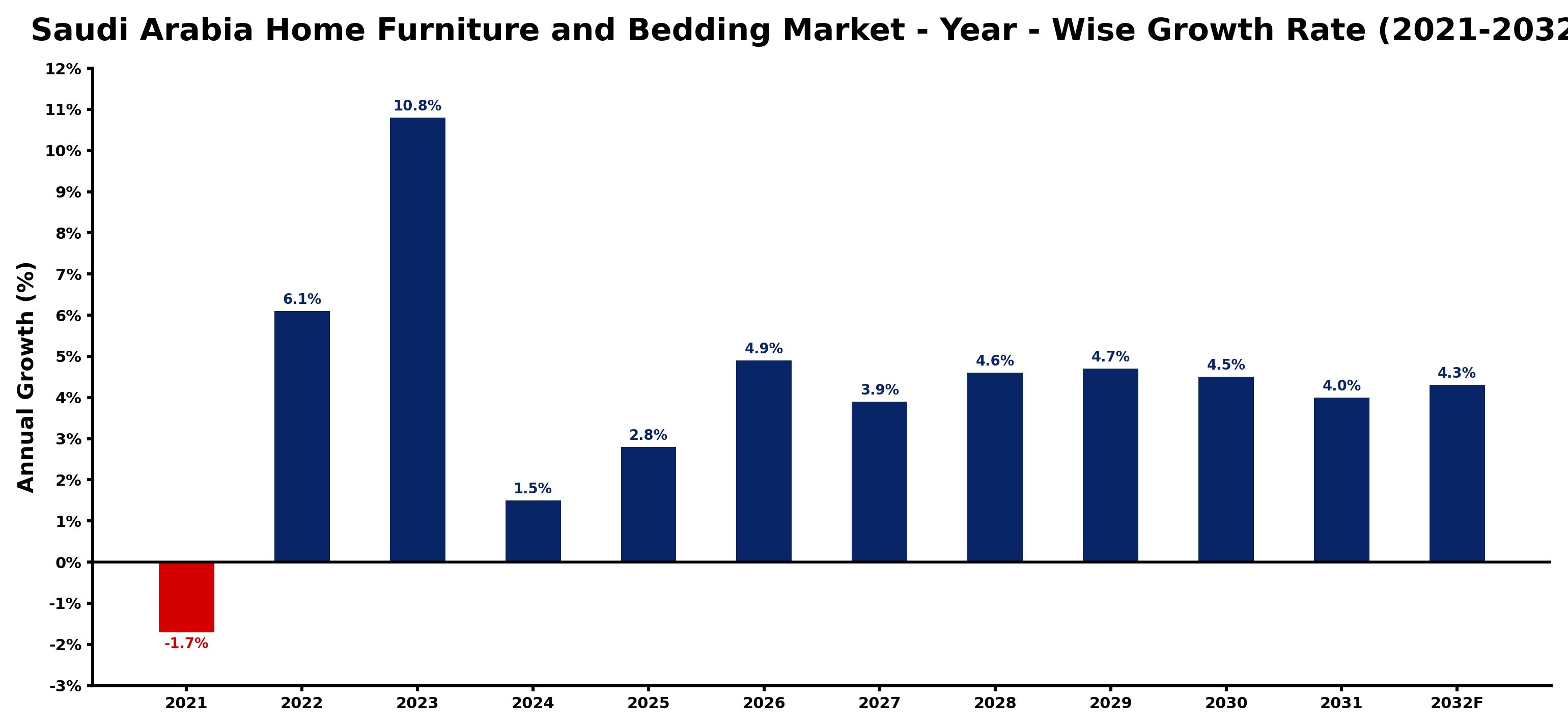
The table below presents the year‑wise growth rates along with the key drivers influencing the market
| Year | Growth Rate | Major Drivers |
| 2021 | -1.7% | Consumer spending declined significantly |
| 2022 | 6.1% | E-commerce platforms expanded rapidly |
| 2023 | 10.8% | Home renovation projects surged upward |
| 2024 | 1.5% | Sustainable furniture demand increased |
| 2025 | 2.8% | Smart home integration gained traction |
| 2026 | 4.9% | Luxury furniture market expanded significantly |
| 2027 | 3.9% | Urbanization trends boosted sales |
| 2028 | 4.6% | Customization options attracted consumers |
| 2029 | 4.7% | Health and wellness focus grew |
| 2030 | 4.5% | Collaborations with designers increased |
| 2031 | 4.0% | Retail experience enhancements attracted shoppers |
| 2032 | 4.3% | Digital marketing strategies improved reach |
Note - Market size estimations and growth projections presented in this report are based on 6Wresearch’s advanced forecasting approach, validated with industry datasets as of June 2026.
Saudi Arabia Home Furniture and Bedding Market Synopsis
In Saudi Arabia, the market for home furniture and bedding is witnessing an upsurge, primarily fueled by the demand for comfortable and well-designed living spaces. With changing lifestyles and a greater focus on interior aesthetics, consumers are on the lookout for diverse, stylish options that enhance their homes.
The increasing popularity of home decor and hospitality standards is further bolstering the market. There is a notable shift towards functional yet fashionable furniture and quality bedding that cater not only to residential needs but also to the commercial sector, thanks to the growth of real estate and hospitality industries.
Saudi Arabia Home Furniture and Bedding Market Key Takeaways
- The market is projected to experience steady growth, driven by rising consumer preferences for comfort and design.
- The demand for functional and aesthetically pleasing home furniture and bedding is on the rise.
- Shifts in consumer behavior following the COVID-19 pandemic have created new opportunities in home office furniture and wellness-focused bedding.
- Competition from international brands necessitates innovation and adherence to quality standards.
- Investment opportunities exist in the growing real estate and hospitality sectors, driving demand for both residential and commercial furnishings.
Evaluation of Restraints in Saudi Arabia Home Furniture and Bedding Market
Despite promising growth, the Saudi Arabia home furniture and bedding market faces several constraints. Consumer preferences are continually evolving, necessitating that businesses stay attuned to market demands for modern and functional designs. Furthermore, quality assurance remains critical; consumers expect durability and premium materials, which can be challenging for local manufacturers. Additionally, fierce competition from established international brands creates a complex landscape where differentiation is key, making it essential for local players to invest in design innovation and effective marketing strategies.
Saudi Arabia Home Furniture and Bedding Market Trends
The Saudi Arabia home furniture and bedding market is currently shaped by several key trends. One prominent trend is the increasing integration of smart technologies into furniture, aimed at enhancing user experience and functionality. Eco-friendly and sustainable materials are also gaining traction, as consumers become more environmentally conscious. Additionally, the rise of online shopping platforms is changing the retail landscape, offering consumers greater convenience and wider selection. These trends collectively signal a shift towards a more modern and tech-savvy market.
Saudi Arabia Home Furniture and Bedding Market Opportunities
There are considerable growth and investment opportunities within the Saudi Arabia home furniture and bedding market. The ongoing expansion of the real estate sector presents a significant opportunity for businesses to cater to new housing developments. Moreover, the evolving consumer preferences for personalization and unique design are prompting demand for bespoke furniture solutions. Companies that can effectively harness these trends and offer tailored products stand to benefit immensely. Additionally, as hospitality and tourism sectors grow, there is a parallel opportunity to meet the needs of commercial clients seeking stylish and functional furnishings.
Government Initiatives in the Saudi Arabia Home Furniture and Bedding Market
The Saudi government has undertaken several initiatives aimed at boosting the home furniture and bedding sector, particularly in alignment with its Vision 2030 objectives. Policies promoting real estate development and home ownership support demand for residential furnishings. Furthermore, government incentives for local manufacturers encourage innovation and competitiveness, fostering a conducive environment for businesses in the furniture industry to thrive.
Future Insights of the Saudi Arabia Home Furniture and Bedding Market
Looking ahead to 2026-2032, the Saudi Arabia home furniture and bedding market is poised for continued expansion. Increased urbanization and housing initiatives are likely to sustain demand for quality furniture and bedding products. Moreover, as remote work becomes a lasting trend, the market for home office solutions will likely continue to grow, driven by consumer demand for functionality and comfort. Companies that prioritize innovation, sustainability, and customer-centric designs will be well-positioned to capitalize on the evolving market landscape.
Saudi Arabia Home Furniture and Bedding Market Latest Developments (May 2025 - June 2026)
Recent developments in the Saudi Arabia home furniture and bedding market reflect a dynamic industry adapting to consumer trends and preferences. There has been a noticeable increase in the introduction of eco-friendly materials and smart furniture solutions. Retailers are also enhancing their online shopping experiences to meet the demands of a digitally-savvy consumer base, integrating augmented reality features to assist in decision-making. Collaborations between local manufacturers and international brands are also on the rise, facilitating knowledge transfer and innovation.
Saudi Arabia Home Furniture and Bedding Market - Key Attractiveness of the Report
- 10 Years of Market Numbers
- Historical Data Starting from 2022 to 2025
- Base Year: 2025
- Forecast Data until 2032
- Key Performance Indicators Impacting the Market
- Major Upcoming Developments and Projects
Key Highlights of the Report:
- Saudi Arabia Home Furniture and Bedding Market Outlook
- Market Size of Saudi Arabia Home Furniture and Bedding Market, 2025
- Forecast of Saudi Arabia Home Furniture and Bedding Market, 2032
- Historical Data and Forecast of Saudi Arabia Home Furniture and Bedding Revenues & Volume for the Period 2022-2032F
- Saudi Arabia Home Furniture and Bedding Market Trend Evolution
- Saudi Arabia Home Furniture and Bedding Market Drivers and Challenges
- Saudi Arabia Home Furniture and Bedding Price Trends
- Saudi Arabia Home Furniture and Bedding Porter's Five Forces
- Saudi Arabia Home Furniture and Bedding Industry Life Cycle
- Historical Data and Forecast of Saudi Arabia Home Furniture and Bedding Market Revenues & Volume By Product Type for the Period 2022-2032F
- Historical Data and Forecast of Saudi Arabia Home Furniture and Bedding Market Revenues & Volume By Sofa for the Period 2022-2032F
- Historical Data and Forecast of Saudi Arabia Home Furniture and Bedding Market Revenues & Volume By Bed for the Period 2022-2032F
- Historical Data and Forecast of Saudi Arabia Home Furniture and Bedding Market Revenues & Volume By Chair for the Period 2022-2032F
- Historical Data and Forecast of Saudi Arabia Home Furniture and Bedding Market Revenues & Volume By Cupboard for the Period 2022-2032F
- Historical Data and Forecast of Saudi Arabia Home Furniture and Bedding Market Revenues & Volume By Others for the Period 2022-2032F
- Historical Data and Forecast of Saudi Arabia Home Furniture and Bedding Market Revenues & Volume By Sales Channel for the Period 2022-2032F
- Historical Data and Forecast of Saudi Arabia Home Furniture and Bedding Market Revenues & Volume By Online for the Period 2022-2032F
- Historical Data and Forecast of Saudi Arabia Home Furniture and Bedding Market Revenues & Volume By Offline for the Period 2022-2032F
- Saudi Arabia Home Furniture and Bedding Import Export Trade Statistics
- Market Opportunity Assessment By Product Type
- Market Opportunity Assessment By Sales Channel
- Saudi Arabia Home Furniture and Bedding Top Companies Market Share
- Saudi Arabia Home Furniture and Bedding Competitive Benchmarking By Technical and Operational Parameters
- Saudi Arabia Home Furniture and Bedding Company Profiles
- Saudi Arabia Home Furniture and Bedding Key Strategic Recommendations






































