Saudi Arabia Industrial Dryers for Agricultural Products Market Size, Share & Growth Rate
The Saudi Arabia Industrial Dryers for Agricultural Products Market was estimated at USD 190 Million in 2025 and is projected to reach USD 244 Million by 2032, growing at a CAGR of 3.6% from 2026 to 2032. This growth trajectory is primarily driven by the country's increasing focus on enhancing food security and agricultural productivity. As the agricultural sector evolves, the demand for advanced drying solutions that ensure optimal preservation of agricultural goods is gaining momentum, spurred by the necessity for innovative post-harvest technologies.
Saudi Arabia Industrial Dryers for Agricultural Products Market Year-wise Growth Rate and Key Drivers
This graph highlights how the Saudi Arabia Industrial Dryers for Agricultural Products Market has steadily grown over the years, supported by major growth factors.
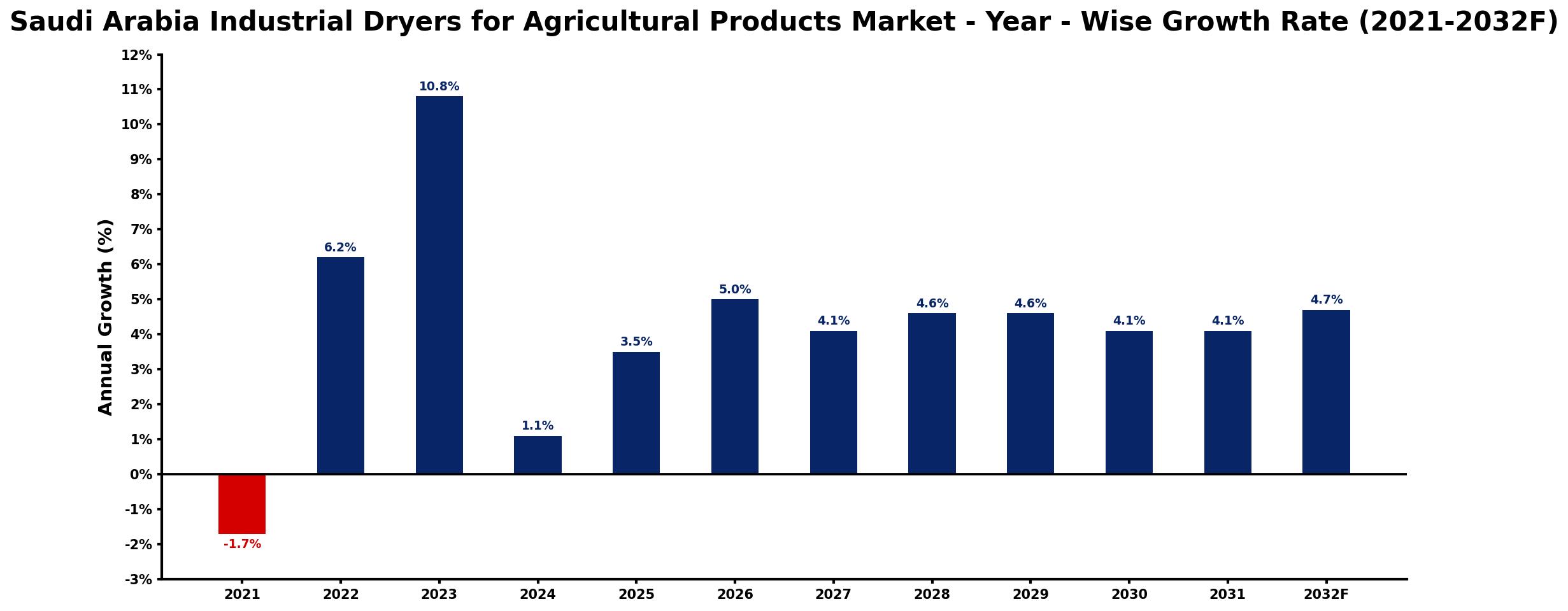
The table below presents the year‑wise growth rates along with the key drivers influencing the market
| Year | Growth Rate | Major Drivers |
| 2021 | -1.7% | Reduced demand from local farmers |
| 2022 | 6.2% | Increased investments in technology |
| 2023 | 10.8% | Growing export opportunities for produce |
| 2024 | 1.1% | Expansion of food processing facilities |
| 2025 | 3.5% | Rising consumer preference for quality |
| 2026 | 5.0% | Enhanced government support initiatives |
| 2027 | 4.1% | Surge in organic farming practices |
| 2028 | 4.6% | Development of sustainable farming methods |
| 2029 | 4.6% | stronger distribution network expansion |
| 2030 | 4.1% | Emergence of new market players |
| 2031 | 4.1% | Increased focus on food safety |
| 2032 | 4.7% | Rising demand for energy efficiency |
Note: Market size estimations and growth projections presented in this report are based on 6Wresearch's proprietary forecasting methodology, utilizing the latest available industry data, government publications, and primary research inputs.
Saudi Arabia Industrial Dryers for Agricultural Products Market Synopsis
In Saudi Arabia, the necessity for effective post-harvest management has escalated the adoption of industrial dryers in agricultural product processing. These systems are pivotal in reducing moisture content, thereby maintaining the quality and safety of various agricultural commodities, including grains and fruits.
The demand for industrial dryers is further fueled by the countrys ambitious agricultural initiatives aimed at bolstering self-sufficiency in food production. As these initiatives unfold, the emphasis on efficient drying technologies aligns with broader goals of improving storage methods and minimizing spoilage, creating a dynamic market landscape.
Saudi Arabia Industrial Dryers for Agricultural Products Market Key Takeaways
- The market for industrial dryers is experiencing steady growth, driven by heightened awareness of food preservation.
- Post-harvest management solutions are increasingly seen as critical to enhancing agricultural productivity.
- Innovations in eco-friendly drying technologies are becoming essential to address energy consumption challenges.
- The diverse range of agricultural products necessitates specialized drying equipment tailored to specific requirements.
- Investment in research and development is crucial for advancing technology and maintaining quality standards.
Evaluation of Restraints in Saudi Arabia Industrial Dryers for Agricultural Products Market
Despite the growth potential, the Saudi Arabian market for industrial dryers faces notable restraints. The arid climate presents unique challenges for preserving agricultural yields, necessitating energy-intensive solutions that could conflict with sustainability goals. Moreover, the market must contend with varying drying requirements for diverse agricultural products, complicating equipment standardization. Additionally, ensuring hygiene and quality during the drying process requires ongoing attention and innovation, as stakeholders work to uphold food safety standards. Thus, addressing these complexities remains a priority for market participants.
Saudi Arabia Industrial Dryers for Agricultural Products Market Trends
Emerging trends indicate a shift towards more energy-efficient and environmentally friendly drying technologies. The integration of automation and smart technologies is enhancing operational efficiency, enabling real-time monitoring of moisture levels and ensuring optimal drying conditions. Furthermore, there is a growing emphasis on product customization, allowing solutions to be tailored to the specific needs of various agricultural sectors. These advancements are reshaping the market landscape, as players seek to meet the evolving demands of producers and processors alike.
Saudi Arabia Industrial Dryers for Agricultural Products Market Opportunities
The landscape of the Saudi Arabia industrial dryers market offers significant growth opportunities. As the government continues to invest in agricultural advancements, there is an expanding need for innovative drying solutions that can cater to diverse product requirements while addressing sustainability concerns. Companies focusing on research and development of advanced drying technologies stand to benefit from increased demand for tailored solutions. Moreover, collaboration with local agricultural producers presents pathways to enhance product offerings and streamline post-harvest processes.
Government Initiatives in the Saudi Arabia Industrial Dryers for Agricultural Products Market
The Saudi government has implemented several initiatives aimed at enhancing food security and agricultural self-sufficiency. These policies include financial support for agricultural technology advancements and incentives for sustainable practices. Additionally, the government promotes public-private partnerships to foster innovation in agricultural processing technologies, including industrial drying solutions. Such supportive measures are vital for driving growth and attracting investment in the industrial dryers market.
Future Insights of the Saudi Arabia Industrial Dryers for Agricultural Products Market
Looking ahead to the period from 2026 to 2032, the Saudi Arabia Industrial Dryers for Agricultural Products Market is poised for substantial advancements. Continued investments in agricultural technologies and increasing emphasis on food safety are likely to propel demand for specialized drying equipment. Additionally, as market players innovate and adapt to environmental sustainability trends, we can expect a more diversified portfolio of drying solutions that effectively cater to the unique needs of the local agricultural sector.
Saudi Arabia Industrial Dryers for Agricultural Products Market Latest Developments (2025 - 2026)
Recent developments in the Saudi industrial dryers market indicate a trend towards increased innovation in drying technologies. Companies are focusing on enhancing efficiency and sustainability features in their products. Additionally, there is a noticeable shift towards collaborative approaches between manufacturers and agricultural producers to develop customized solutions that address specific processing challenges. This direction is expected to shape the competitive landscape in the coming years as stakeholders seek to align with evolving market demands.
Saudi Arabia Industrial Dryers for Agricultural Products Market - Key Attractiveness of the Report
- 10 Years of Market Numbers
- Historical Data Starting from 2022 to 2025
- Base Year: 2025
- Forecast Data until 2032
- Key Performance Indicators Impacting the Market
- Major Upcoming Developments and Projects
Key Highlights of the Report:
- Saudi Arabia Industrial Dryers for Agricultural Products Market Outlook
- Market Size of Saudi Arabia Industrial Dryers for Agricultural Products Market, 2025
- Forecast of Saudi Arabia Industrial Dryers for Agricultural Products Market, 2032
- Historical Data and Forecast of Saudi Arabia Industrial Dryers for Agricultural Products Revenues & Volume for the Period 2022-2032F
- Saudi Arabia Industrial Dryers for Agricultural Products Market Trend Evolution
- Saudi Arabia Industrial Dryers for Agricultural Products Market Drivers and Challenges
- Saudi Arabia Industrial Dryers for Agricultural Products Price Trends
- Saudi Arabia Industrial Dryers for Agricultural Products Porter's Five Forces
- Saudi Arabia Industrial Dryers for Agricultural Products Industry Life Cycle
- Historical Data and Forecast of Saudi Arabia Industrial Dryers for Agricultural Products Market Revenues & Volume By Type for the Period 2022-2032F
- Historical Data and Forecast of Saudi Arabia Industrial Dryers for Agricultural Products Market Revenues & Volume By Hot Air Drying Equipment for the Period 2022-2032F
- Historical Data and Forecast of Saudi Arabia Industrial Dryers for Agricultural Products Market Revenues & Volume By Heated Surface Drying Equipment for the Period 2022-2032F
- Historical Data and Forecast of Saudi Arabia Industrial Dryers for Agricultural Products Market Revenues & Volume By Application for the Period 2022-2032F
- Historical Data and Forecast of Saudi Arabia Industrial Dryers for Agricultural Products Market Revenues & Volume By Conveyer Drying Equipment for the Period 2022-2032F
- Historical Data and Forecast of Saudi Arabia Industrial Dryers for Agricultural Products Market Revenues & Volume By Cabinet Drying Equipment for the Period 2022-2032F
- Saudi Arabia Industrial Dryers for Agricultural Products Import Export Trade Statistics
- Market Opportunity Assessment By Type
- Market Opportunity Assessment By Application
- Saudi Arabia Industrial Dryers for Agricultural Products Top Companies Market Share
- Saudi Arabia Industrial Dryers for Agricultural Products Competitive Benchmarking By Technical and Operational Parameters
- Saudi Arabia Industrial Dryers for Agricultural Products Company Profiles
- Saudi Arabia Industrial Dryers for Agricultural Products Key Strategic Recommendations






































