Saudi Arabia Insulated Glass Market Size, Share & Growth Rate
The Saudi Arabia Insulated Glass Market was estimated at USD 407 Million in 2025 and is projected to reach USD 521 Million by 2032, growing at a CAGR of 3.6% from 2026 to 2032. This growth is largely fueled by the surge in construction activities across the nation, driven by both residential and commercial projects. Additionally, stringent energy efficiency regulations are pushing developers and builders to opt for insulated glass solutions, enhancing thermal insulation and energy savings.
Saudi Arabia Insulated Glass Market Year-wise Growth Rate and Key Drivers
This graph highlights how the Saudi Arabia Insulated Glass Market has steadily grown over the years, supported by major growth factors.
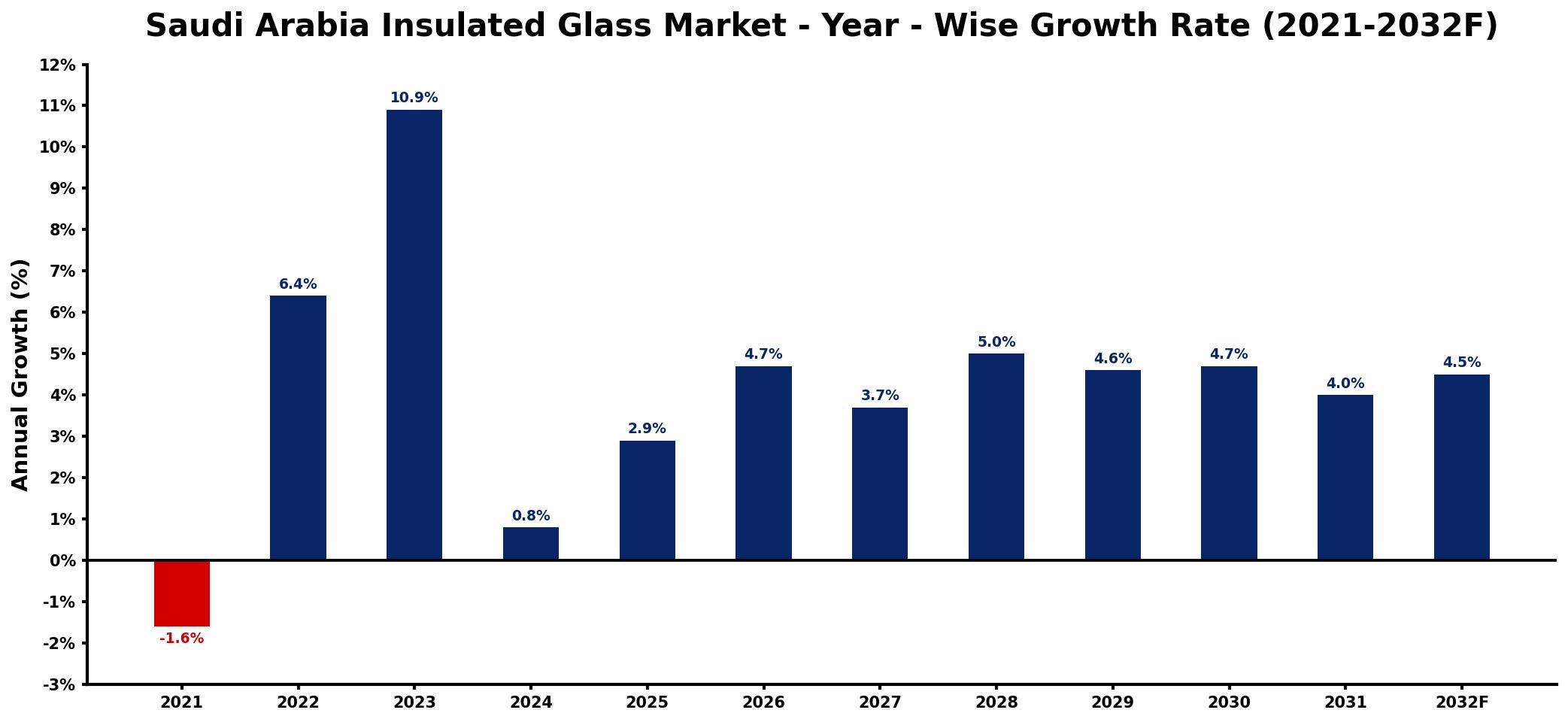
The table below presents the year‑wise growth rates along with the key drivers influencing the market
| Year | Growth Rate | Major Drivers |
| 2021 | -1.6% | construction sector facing downturn |
| 2022 | 6.4% | increased investment in construction |
| 2023 | 10.9% | growing demand for energy efficiency |
| 2024 | 0.8% | rise in urban development projects |
| 2025 | 2.9% | expansion in commercial buildings |
| 2026 | 4.7% | increased focus on sustainability |
| 2027 | 3.7% | growth in residential renovations |
| 2028 | 5.0% | surge in architectural innovations |
| 2029 | 4.6% | demand from hospitality sector |
| 2030 | 4.7% | increased government infrastructure spending |
| 2031 | 4.0% | expanding healthcare application demand |
| 2032 | 4.5% | rising consumer preference for quality |
Note: Market size estimations and growth projections presented in this report are based on 6Wresearch's proprietary forecasting methodology, utilizing the latest available industry data, government publications, and primary research inputs.
Saudi Arabia Insulated Glass Market Synopsis
The most significant force shaping the Saudi Arabia insulated glass market is the increasing emphasis on energy efficiency in construction. As the country faces extreme climate conditions, the demand for insulated glass products that provide thermal comfort and reduce energy consumption is experiencing rapid growth. This trend is further accelerated by government initiatives focused on sustainability and energy efficiency.
Insulated glass is becoming a staple in both new builds and renovations, catering to the rising expectations of consumers for comfortable and energy-efficient living and working spaces. As regulations surrounding energy use tighten, it is anticipated that the market will continue to flourish, driven by a blend of consumer demand and regulatory requirements.
Saudi Arabia Insulated Glass Market Key Takeaways
- The market is experiencing robust growth due to increased construction activities across various sectors.
- Energy efficiency and thermal insulation properties of insulated glass are key selling points for developers.
- Government regulations promoting sustainability and energy conservation are influencing market dynamics.
- High costs compared to traditional glass alternatives pose a challenge for mass adoption.
- Post-pandemic recovery is gradually boosting demand in the construction sector.
Evaluation of Restraints in Saudi Arabia Insulated Glass Market
Despite the upward trajectory, the Saudi Arabia insulated glass market faces inherent challenges that can restrain growth. The higher costs associated with insulated glass compared to conventional glass materials can deter cost-sensitive customers, particularly in a competitive market. Additionally, ensuring that insulated glass products consistently meet quality and performance standards is critical for maintaining customer trust and compliance with evolving regulations. These factors create a complex landscape that requires market participants to be strategic in their approach to product offerings and pricing.
Saudi Arabia Insulated Glass Market Trends
Several key trends are emerging in the Saudi Arabia insulated glass market. Firstly, there's a growing preference for advanced glazing technologies that enhance energy efficiency while providing superior aesthetic appeal. Innovations such as low-emissivity coatings and triple glazing are gaining traction. Additionally, as urbanization continues to rise, there is a notable shift towards smart glass solutions that can adapt to environmental changes. This trend is indicative of a broader movement towards integrating smart technologies in construction, catering to the needs of modern consumers.
Saudi Arabia Insulated Glass Market Opportunities
The market presents numerous growth and investment opportunities, particularly in green building initiatives and renewable energy projects. With the increasing push for sustainable development, theres significant potential for insulated glass manufacturers to collaborate with developers on eco-friendly projects that prioritize energy efficiency. Furthermore, expanding into the residential renovation segment could provide avenues for growth, as homeowners increasingly seek ways to improve energy efficiency in existing structures.
Government Initiatives in the Saudi Arabia Insulated Glass Market
The Saudi government has implemented various initiatives to foster energy efficiency and sustainability within the construction sector. Programs aimed at promoting green building certifications and sustainable materials are encouraging the adoption of insulated glass products. Investments in infrastructure and public buildings further underscore a commitment to modernizing the construction landscape, creating a supportive environment for insulated glass manufacturers and suppliers.
Future Insights of the Saudi Arabia Insulated Glass Market
Looking ahead to 2026-2032, the Saudi Arabia insulated glass market is poised for continued growth. As energy efficiency standards tighten and the construction industry evolves, there will be an escalating demand for innovative glazing solutions. Collaboration between manufacturers and construction firms, coupled with government support, will facilitate advancements in product technology. A focus on smart glass and sustainable practices will be critical in positioning businesses to capitalize on emerging opportunities in this dynamic market.
Saudi Arabia Insulated Glass Market Latest Developments (2025 - 2026)
The Saudi Arabia insulated glass market has seen a shift towards increased innovation, with companies exploring advanced technologies to enhance product performance. Efforts are being made to streamline supply chains to better meet the rising demand post-pandemic. Additionally, public and private sector partnerships are being emphasized to accelerate the development of energy-efficient buildings, further driving the need for high-quality insulated glass solutions in various applications.
Saudi Arabia Insulated Glass Market - Key Attractiveness of the Report
- 10 Years of Market Numbers
- Historical Data Starting from 2022 to 2025
- Base Year: 2025
- Forecast Data until 2032
- Key Performance Indicators Impacting the Market
- Major Upcoming Developments and Projects
Key Highlights of the Report:
- Saudi Arabia Insulated Glass Market Outlook
- Market Size of Saudi Arabia Insulated Glass Market, 2025
- Forecast of Saudi Arabia Insulated Glass Market, 2032
- Historical Data and Forecast of Saudi Arabia Insulated Glass Revenues & Volume for the Period 2022-2032F
- Saudi Arabia Insulated Glass Market Trend Evolution
- Saudi Arabia Insulated Glass Market Drivers and Challenges
- Saudi Arabia Insulated Glass Price Trends
- Saudi Arabia Insulated Glass Porter's Five Forces
- Saudi Arabia Insulated Glass Industry Life Cycle
- Historical Data and Forecast of Saudi Arabia Insulated Glass Market Revenues & Volume By Type for the Period 2022-2032F
- Historical Data and Forecast of Saudi Arabia Insulated Glass Market Revenues & Volume By Heated Insulating Glass for the Period 2022-2032F
- Historical Data and Forecast of Saudi Arabia Insulated Glass Market Revenues & Volume By Tempering Insulating Glass for the Period 2022-2032F
- Historical Data and Forecast of Saudi Arabia Insulated Glass Market Revenues & Volume By Custom Insulated Glass for the Period 2022-2032F
- Historical Data and Forecast of Saudi Arabia Insulated Glass Market Revenues & Volume By Other Glasses for the Period 2022-2032F
- Historical Data and Forecast of Saudi Arabia Insulated Glass Market Revenues & Volume By Application for the Period 2022-2032F
- Historical Data and Forecast of Saudi Arabia Insulated Glass Market Revenues & Volume By Doors & Partitions for the Period 2022-2032F
- Historical Data and Forecast of Saudi Arabia Insulated Glass Market Revenues & Volume By Kitchen Appliances & Cabinets for the Period 2022-2032F
- Historical Data and Forecast of Saudi Arabia Insulated Glass Market Revenues & Volume By Floors & Ceilings for the Period 2022-2032F
- Historical Data and Forecast of Saudi Arabia Insulated Glass Market Revenues & Volume By Furniture & Curtain Walls for the Period 2022-2032F
- Historical Data and Forecast of Saudi Arabia Insulated Glass Market Revenues & Volume By Railings & Bolted Structures for the Period 2022-2032F
- Historical Data and Forecast of Saudi Arabia Insulated Glass Market Revenues & Volume By Automotive Glasses for the Period 2022-2032F
- Historical Data and Forecast of Saudi Arabia Insulated Glass Market Revenues & Volume By End User for the Period 2022-2032F
- Historical Data and Forecast of Saudi Arabia Insulated Glass Market Revenues & Volume By Residential Buildings for the Period 2022-2032F
- Historical Data and Forecast of Saudi Arabia Insulated Glass Market Revenues & Volume By Commercial & Institutional Buildings for the Period 2022-2032F
- Historical Data and Forecast of Saudi Arabia Insulated Glass Market Revenues & Volume By Industrial Users for the Period 2022-2032F
- Saudi Arabia Insulated Glass Import Export Trade Statistics
- Market Opportunity Assessment By Type
- Market Opportunity Assessment By Application
- Market Opportunity Assessment By End User
- Saudi Arabia Insulated Glass Top Companies Market Share
- Saudi Arabia Insulated Glass Competitive Benchmarking By Technical and Operational Parameters
- Saudi Arabia Insulated Glass Company Profiles
- Saudi Arabia Insulated Glass Key Strategic Recommendations






































