Saudi Arabia Interior Design Market Size, Share & Growth Rate
The Saudi Arabia Interior Design Market was estimated at USD 483 Million in 2025 and is projected to reach USD 620 Million by 2032, growing at a CAGR of 3.6% from 2026 to 2032. This trajectory reflects the ongoing urban development and rising disposable income levels, driving an increasing demand for sophisticated interior spaces. Additionally, the desire for personalized environments further fuels the market, as both residential and commercial clients seek unique, tailored solutions.
Saudi Arabia Interior Design Market Year-wise Growth Rate and Key Drivers
This graph highlights how the Saudi Arabia Interior Design Market has steadily grown over the years, supported by major growth factors.
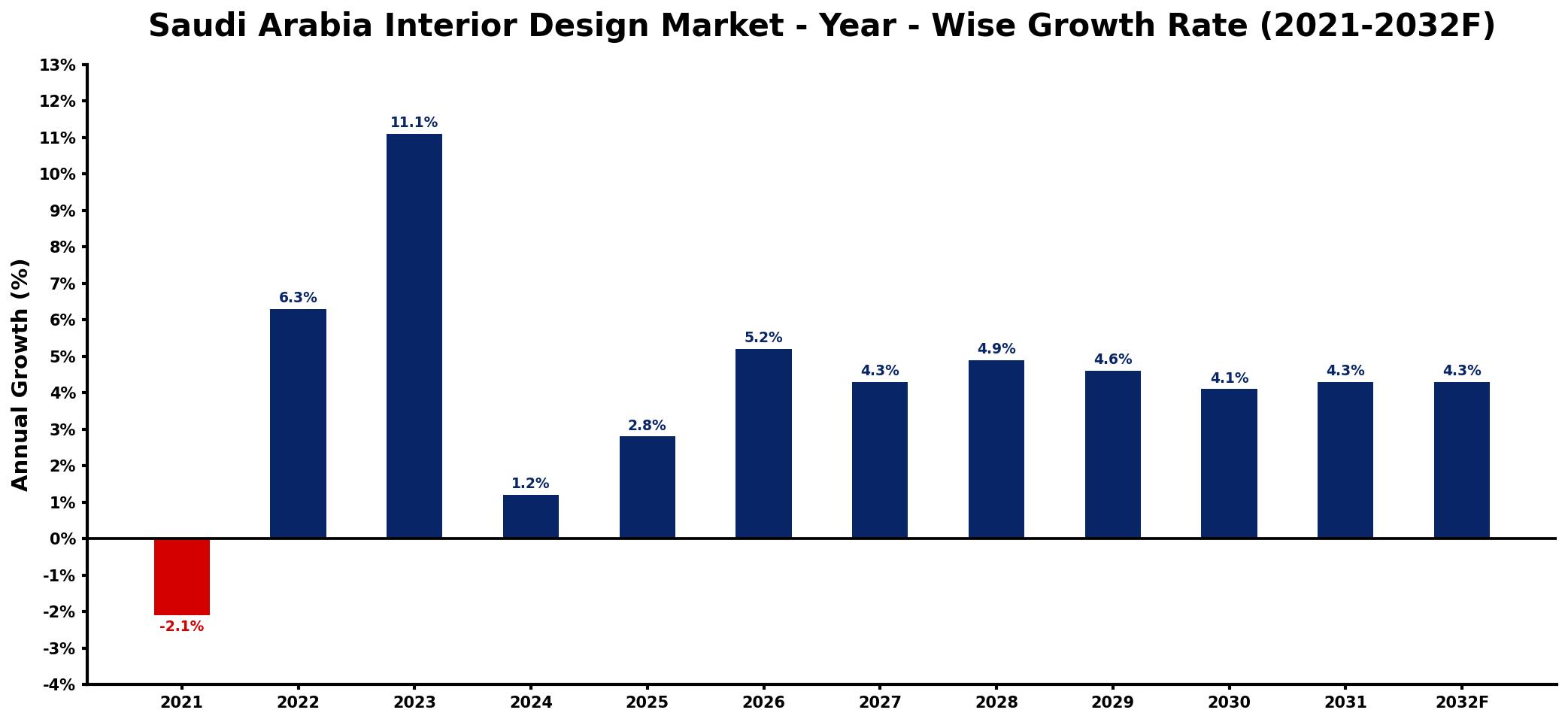
The table below presents the year‑wise growth rates along with the key drivers influencing the market
| Year | Growth Rate | Major Drivers |
| 2021 | -2.1% | Reduced construction project investments |
| 2022 | 6.3% | Increased residential renovation projects |
| 2023 | 11.1% | Growth in luxury real estate |
| 2024 | 1.2% | Expansion of commercial real estate |
| 2025 | 2.8% | Rise in hospitality sector investments |
| 2026 | 5.2% | Surge in urban development initiatives |
| 2027 | 4.3% | Boost in government infrastructure spending |
| 2028 | 4.9% | expanding manufacturing base activity |
| 2029 | 4.6% | Increase in expatriate housing demand |
| 2030 | 4.1% | expanding industrial usage applications |
| 2031 | 4.3% | growing emerging market penetration |
| 2032 | 4.3% | increased pharmaceutical industry usage |
Note: Market size estimations and growth projections presented in this report are based on 6Wresearch's proprietary forecasting methodology, utilizing the latest available industry data, government publications, and primary research inputs.
Saudi Arabia Interior Design Market Synopsis
The Saudi Arabia Interior Design Market has witnessed significant momentum in recent years, driven by urbanization and a growing inclination towards aesthetically pleasing spaces. As the country moves forward, the market is set to embrace an even broader spectrum of innovative design solutions that marry functionality with local cultural influences.
As urban centers expand and lifestyle preferences evolve, the interior design sector is adapting to meet the needs of both individual homeowners and corporate entities. This adaptability, alongside a growing emphasis on sustainability, ensures that the Saudi Arabian interior design landscape remains vibrant and forward-thinking.
Saudi Arabia Interior Design Market Key Takeaways
- The market is expanding due to increasing urbanization and rising disposable incomes.
- There is a strong demand for personalized design solutions across residential and commercial sectors.
- Innovative trends, including sustainability, are shaping the future of interior design in the country.
- The integration of traditional elements with contemporary styles is crucial for appealing to local tastes.
- Digital technology and e-commerce platforms are transforming the way interior design services are delivered.
Evaluation of Restraints in Saudi Arabia Interior Design Market
Despite its growth potential, the Saudi Arabia Interior Design Market faces certain restraints. One of the primary challenges is the need to strike a balance between traditional aesthetics and modern design preferences. Crafting interiors that embody cultural values while also catering to contemporary trends requires deep cultural insights and skillful execution. Furthermore, sourcing quality materials and decor locally can be a barrier, often leading to dependency on imports that can escalate costs and affect project timelines.
Saudi Arabia Interior Design Market Trends
Several current trends are shaping the Saudi Arabia Interior Design Market. A significant shift towards sustainable design practices is evident as consumers increasingly value eco-friendly materials and energy-efficient designs. Moreover, the blending of traditional and modern elements is gaining traction, allowing for a unique expression that resonates with the cultural heritage of the region. Digital innovations, such as virtual design consultations and the use of augmented reality, are also becoming popular, enhancing the customer experience.
Saudi Arabia Interior Design Market Opportunities
The opportunities within the Saudi Arabia Interior Design Market are both broad and inviting. As urban areas continue to develop, there is considerable demand for innovative residential and commercial design solutions that cater to modern lifestyle needs. Furthermore, the rise in tourism and hospitality projects offers a lucrative avenue for design firms looking to showcase their creativity on a larger scale. Lastly, a focus on smart home technologies presents an exciting frontier for integration into interior design, appealing to a tech-savvy consumer base.
Government Initiatives in the Saudi Arabia Interior Design Market
The Saudi government has taken significant steps to foster growth in the interior design sector. Initiatives aimed at boosting urban development, along with investments in infrastructure and public projects, are creating a fertile environment for design professionals. Government policies promoting sustainable practices and local talent development are encouraging collaboration between designers and local artisans, enhancing the richness of the design landscape. Public spending on cultural and heritage preservation also opens avenues for integrating traditional design elements in contemporary projects.
Future Insights of the Saudi Arabia Interior Design Market
Looking ahead to 2026-2032, the Saudi Arabia Interior Design Market is poised for robust growth. With ongoing urbanization and evolving consumer preferences, the demand for innovative, functional, and aesthetically pleasing spaces is expected to intensify. The focus on sustainability and the adoption of technology will likely play pivotal roles in shaping design practices. As designers embrace local cultural narratives while integrating global trends, the sector will continue to evolve and attract investments.
Saudi Arabia Interior Design Market Latest Developments (2025 - 2026)
Recent months have seen a notable shift in the Saudi Arabia Interior Design Market, with an increase in collaborations among local design firms and international brands. This trend has resulted in innovative projects that reflect a blend of local heritage and contemporary aesthetics. Furthermore, the growing acceptance of remote design consultations has changed the landscape for client interactions, paving the way for a more flexible service delivery model. The residential sector continues to flourish, driven by increased consumer interest in home renovations and upgrades.
Saudi Arabia Interior Design Market - Key Attractiveness of the Report
- 10 Years of Market Numbers
- Historical Data Starting from 2022 to 2025
- Base Year: 2025
- Forecast Data until 2032
- Key Performance Indicators Impacting the Market
- Major Upcoming Developments and Projects
Key Highlights of the Report:
- Saudi Arabia Interior Design Market Outlook
- Market Size of Saudi Arabia Interior Design Market, 2025
- Forecast of Saudi Arabia Interior Design Market, 2032
- Historical Data and Forecast of Saudi Arabia Interior Design Revenues & Volume for the Period 2022-2032F
- Saudi Arabia Interior Design Market Trend Evolution
- Saudi Arabia Interior Design Market Drivers and Challenges
- Saudi Arabia Interior Design Price Trends
- Saudi Arabia Interior Design Porter's Five Forces
- Saudi Arabia Interior Design Industry Life Cycle
- Historical Data and Forecast of Saudi Arabia Interior Design Market Revenues & Volume By End Use for the Period 2022-2032F
- Historical Data and Forecast of Saudi Arabia Interior Design Market Revenues & Volume By Commercial for the Period 2022-2032F
- Historical Data and Forecast of Saudi Arabia Interior Design Market Revenues & Volume By Residential for the Period 2022-2032F
- Historical Data and Forecast of Saudi Arabia Interior Design Market Revenues & Volume By Decoration Type for the Period 2022-2032F
- Historical Data and Forecast of Saudi Arabia Interior Design Market Revenues & Volume By New for the Period 2022-2032F
- Historical Data and Forecast of Saudi Arabia Interior Design Market Revenues & Volume By Renovations for the Period 2022-2032F
- Saudi Arabia Interior Design Import Export Trade Statistics
- Market Opportunity Assessment By End Use
- Market Opportunity Assessment By Decoration Type
- Saudi Arabia Interior Design Top Companies Market Share
- Saudi Arabia Interior Design Competitive Benchmarking By Technical and Operational Parameters
- Saudi Arabia Interior Design Company Profiles
- Saudi Arabia Interior Design Key Strategic Recommendations






































