Saudi Arabia Ladders Market Size, Share & Growth Rate
The Saudi Arabia Ladders Market was estimated at USD 440 Million in 2025 and is projected to reach USD 566 Million by 2032, growing at a CAGR of 3.7% from 2026 to 2032. This growth trajectory is largely attributed to the surge in construction and infrastructure development across the Kingdom, where ladders are indispensable for safe access to elevated areas. Additionally, the growing emphasis on safety regulations and innovative ladder designs is expected to further fuel market demand.
Saudi Arabia Ladders Market Year-wise Growth Rate and Key Drivers
This graph highlights how the Saudi Arabia Ladders Market has steadily grown over the years, supported by major growth factors.
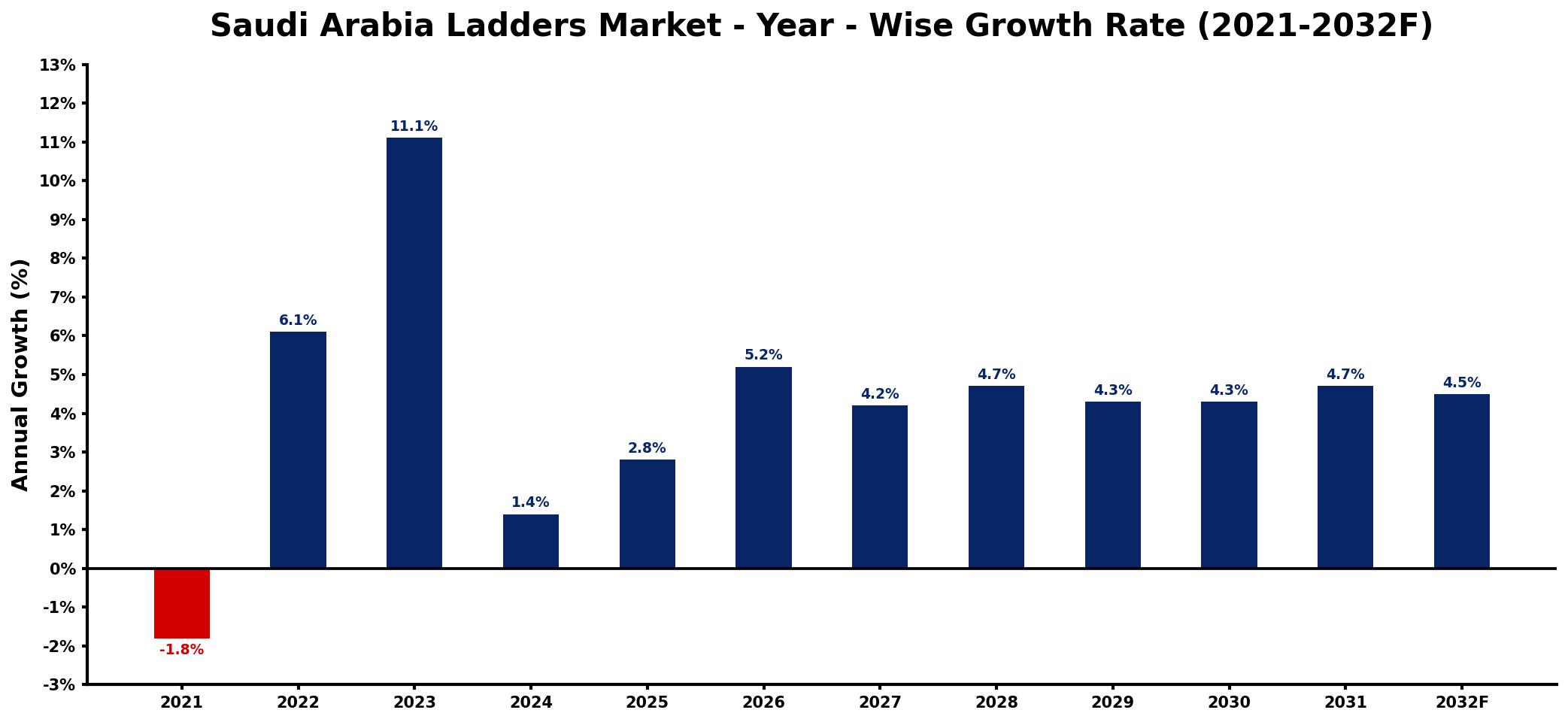
The table below presents the year‑wise growth rates along with the key drivers influencing the market
| Year | Growth Rate | Major Drivers |
| 2021 | -1.8% | Construction activity experienced downturn |
| 2022 | 6.1% | Infrastructure projects witnessed acceleration |
| 2023 | 11.1% | Residential construction demand increased |
| 2024 | 1.4% | Commercial sector investment expanded |
| 2025 | 2.8% | Industrial projects gained momentum |
| 2026 | 5.2% | Government initiatives foster growth |
| 2027 | 4.2% | Technological advancements enhanced efficiency |
| 2028 | 4.7% | Export opportunities opened new markets |
| 2029 | 4.3% | Sustainability trends drove innovation |
| 2030 | 4.3% | Maintenance services saw rising demand |
| 2031 | 4.7% | Urbanization fueled market expansion |
| 2032 | 4.5% | Home improvement projects surged upward |
Note: Market size estimations and growth projections presented in this report are based on 6Wresearch's proprietary forecasting methodology, utilizing the latest available industry data, government publications, and primary research inputs.
Saudi Arabia Ladders Market Synopsis
The ladders market in Saudi Arabia is currently experiencing a resurgence following the slowdown during the pandemic. With renewed focus on construction and ongoing maintenance projects across various sectors, the landscape is poised for significant transformation. This momentum is expected to pave the way for a diversified product offering, catering to both industrial and residential needs.
Moving forward, the market is anticipated to evolve with innovations that enhance both safety and functionality. As businesses and consumers alike become more aware of the importance of quality ladders, the market dynamics will reflect a clear shift towards higher safety standards and product reliability, aligning with global best practices.
Saudi Arabia Ladders Market Key Takeaways
- The market is benefiting from increased construction and infrastructure projects, particularly in urban development.
- Consumer awareness regarding safety and quality is driving demand for higher-end ladder products.
- Innovative designs and materials are being introduced to meet specific industry and household needs.
- Regulatory compliance is crucial, influencing purchasing decisions across various sectors.
- The market is rebounding from pandemic-related challenges, with an uptick in DIY and maintenance activities.
Evaluation of Restraints in Saudi Arabia Ladders Market
Despite the optimistic growth outlook, the Saudi Arabia ladders market faces several constraints. The primary challenge lies in ensuring product durability and adherence to stringent safety regulations. Many consumers are still unaware of the importance of investing in quality ladders, often opting for lower-cost alternatives that may compromise safety. Additionally, the competitive landscape poses difficulties in educating the market about the long-term benefits of premium products versus cheaper options.
Saudi Arabia Ladders Market Trends
Several current and emerging trends are shaping the ladders market in Saudi Arabia. Notably, a strong inclination towards lightweight and portable ladder designs is gaining traction, allowing for ease of use and transportation in various applications. Furthermore, there is a growing demand for specialty ladders, such as those designed for specific industries or tasks, driven by diverse consumer needs. Lastly, sustainability is becoming an important consideration, with manufacturers exploring eco-friendly materials and production methods to appeal to environmentally conscious consumers.
Saudi Arabia Ladders Market Opportunities
The Saudi Arabia ladders market presents numerous opportunities for growth and investment. The ongoing infrastructural development initiatives, such as Vision 2030, are set to create a surge in demand for reliable and innovative ladder solutions. Additionally, as the trend of DIY projects continues to rise among consumers, there is a corresponding opportunity for suppliers to introduce affordable yet quality household ladders. This dual focus on industrial and residential segments offers a promising avenue for companies seeking to expand their market presence.
Government Initiatives in the Saudi Arabia Ladders Market
The Saudi government has made significant strides in promoting safety standards across various sectors, which directly impacts the ladders market. Initiatives aimed at enhancing occupational safety, especially in construction and manufacturing, are encouraging companies to prioritize quality and compliance. Moreover, public spending on infrastructure projects under Vision 2030 is fostering an environment conducive to growth, with increased investment in tools and equipment, including ladders.
Future Insights of the Saudi Arabia Ladders Market
Looking ahead to 2026-2032, the Saudi Arabia ladders market is expected to witness sustained growth, driven by the convergence of construction activity and heightened safety awareness. With innovations in ladder design and materials, manufacturers are likely to respond to evolving consumer preferences and regulatory demands. Furthermore, as the economy diversifies, opportunities to explore niche markets, such as specialty ladders tailored to specific industries, will emerge, further enhancing the markets growth potential.
Saudi Arabia Ladders Market Latest Developments (2025 - 2026)
Recent developments in the Saudi ladders market indicate a shift towards advanced safety features and materials that enhance durability. Manufacturers are also actively exploring partnerships to expand distribution channels, improving accessibility for both commercial and individual consumers. Additionally, emerging technologies, including smart ladder solutions that integrate safety monitoring systems, are being introduced, indicating a forward-thinking approach to ladder design and functionality.
Saudi Arabia Ladders Market - Key Attractiveness of the Report
- 10 Years of Market Numbers
- Historical Data Starting from 2022 to 2025
- Base Year: 2025
- Forecast Data until 2032
- Key Performance Indicators Impacting the Market
- Major Upcoming Developments and Projects
Key Highlights of the Report:
- Saudi Arabia Ladders Market Outlook
- Market Size of Saudi Arabia Ladders Market, 2025
- Forecast of Saudi Arabia Ladders Market, 2032
- Historical Data and Forecast of Saudi Arabia Ladders Revenues & Volume for the Period 2022-2032F
- Saudi Arabia Ladders Market Trend Evolution
- Saudi Arabia Ladders Market Drivers and Challenges
- Saudi Arabia Ladders Price Trends
- Saudi Arabia Ladders Porter's Five Forces
- Saudi Arabia Ladders Industry Life Cycle
- Historical Data and Forecast of Saudi Arabia Ladders Market Revenues & Volume By Application for the Period 2022-2032F
- Historical Data and Forecast of Saudi Arabia Ladders Market Revenues & Volume By Industrial for the Period 2022-2032F
- Historical Data and Forecast of Saudi Arabia Ladders Market Revenues & Volume By Domestic for the Period 2022-2032F
- Historical Data and Forecast of Saudi Arabia Ladders Market Revenues & Volume By Commercial for the Period 2022-2032F
- Saudi Arabia Ladders Import Export Trade Statistics
- Market Opportunity Assessment By Application
- Saudi Arabia Ladders Top Companies Market Share
- Saudi Arabia Ladders Competitive Benchmarking By Technical and Operational Parameters
- Saudi Arabia Ladders Company Profiles
- Saudi Arabia Ladders Key Strategic Recommendations






































