Saudi Arabia Lead Chemicals Market Size, Share & Growth Rate
The Saudi Arabia Lead Chemicals Market was estimated at USD 154 Million in 2025 and is projected to reach USD 196 Million by 2032, growing at a CAGR of 3.5% from 2026 to 2032. This growth is primarily fueled by the increasing demand for lead-based products in energy storage solutions, particularly lead-acid batteries, and various industrial applications. Furthermore, as manufacturing activities expand in the Kingdom, the need for robust colorants and stabilizing agents will further drive the consumption of lead chemicals.
Saudi Arabia Lead Chemicals Market Year-wise Growth Rate and Key Drivers
This graph highlights how the Saudi Arabia Lead Chemicals Market has steadily grown over the years, supported by major growth factors.
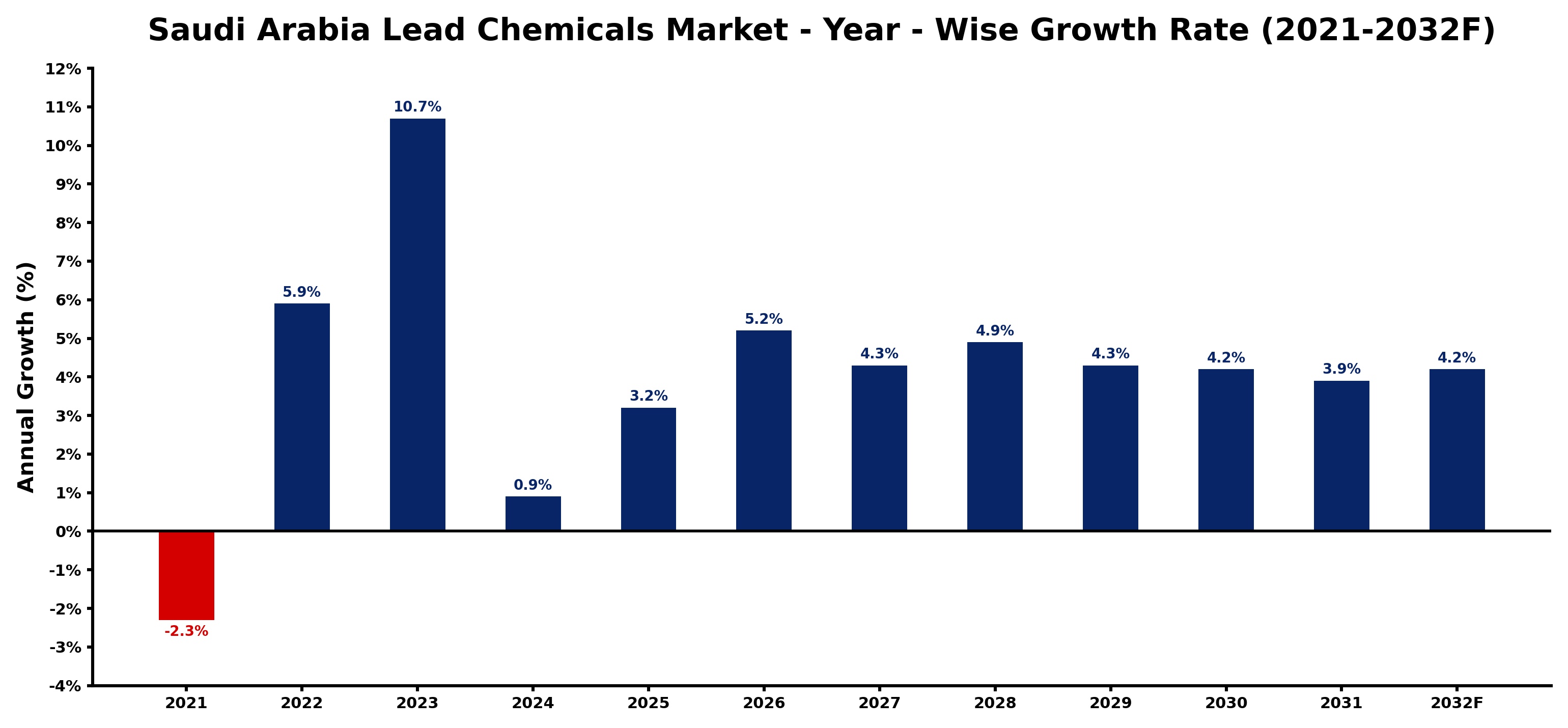
The table below presents the year‑wise growth rates along with the key drivers influencing the market
| Year | Growth Rate | Major Drivers |
| 2021 | -2.3% | Supply chain disruptions affected production |
| 2022 | 5.9% | Infrastructure investments stimulated demand |
| 2023 | 10.7% | Technological advancements enhanced efficiency |
| 2024 | 0.9% | Sustainability initiatives drove innovation |
| 2025 | 3.2% | Export opportunities expanded market reach |
| 2026 | 5.2% | Regulatory support encouraged growth |
| 2027 | 4.3% | Market diversification opened new avenues |
| 2028 | 4.9% | Consumer preferences shifted positively |
| 2029 | 4.3% | Collaborations strengthened industry partnerships |
| 2030 | 4.2% | Research initiatives fostered development |
| 2031 | 3.9% | Training programs enhanced workforce skills |
| 2032 | 4.2% | Digital transformation improved operations |
Note - Market size estimations and growth projections presented in this report are based on 6Wresearch’s advanced forecasting approach, validated with industry datasets as of June 2026.
Saudi Arabia Lead Chemicals Market Synopsis
In Saudi Arabia, lead chemicals are crucial for the burgeoning battery manufacturing sector, particularly in the production of lead-acid batteries that are essential for energy storage. The demand for these batteries continues to surge, correlating with the country's ambitions to boost energy efficiency and sustainability in industrial processes.
Additionally, the market benefits from the growing use of lead chemicals in pigments and stabilizers, integral to various products ranging from paints to PVC materials. This multifaceted application landscape underpins the sustained growth prospects for lead chemicals within the Saudi economy.
Saudi Arabia Lead Chemicals Market Key Takeaways
- The market is projected to grow at a CAGR of 3.5% from 2026 to 2032.
- Demand for lead-acid batteries is a primary growth driver.
- Lead chemicals find diverse applications in pigments and stabilizers.
- Industrial expansion and energy sector growth support market development.
- Regulatory compliance and safety measures remain crucial in market dynamics.
Evaluation of Restraints in Saudi Arabia Lead Chemicals Market
While the Saudi Arabia Lead Chemicals Market shows promising growth, several key restraints challenge its trajectory. Stringent safety regulations surrounding the production and usage of lead chemicals pose hurdles for market players. Manufacturers are increasingly pressured to adopt safer handling procedures and demonstrate regulatory compliance, particularly in light of growing environmental concerns. Additionally, competition from alternative chemical solutions, alongside the potential for imported lead chemicals, adds layers of complexity to the market dynamics, necessitating adaptive strategies from domestic players.
Saudi Arabia Lead Chemicals Market Trends
A noticeable trend in the Saudi Arabia Lead Chemicals Market is the increasing emphasis on sustainability, which pushes companies to innovate in lead chemical formulations and production processes. Additionally, the rise of electric vehicles and the growing importance of renewable energy solutions are prompting a shift towards more efficient energy storage technologies. As industries strive for cleaner practices, the demand for environmentally compliant lead chemicals will likely intensify, propelling technological advancements and market adaptation.
Saudi Arabia Lead Chemicals Market Opportunities
The Saudi Arabia Lead Chemicals Market presents substantial opportunities, particularly in the energy sector. With government initiatives aimed at enhancing energy storage capabilities, the demand for lead-acid batteries is set to increase. There is also potential for innovation in lead chemical formulations, enhancing their efficacy across different applications. Furthermore, the expansion of local manufacturing capabilities in line with the Kingdom's Vision 2030 strategy creates fertile ground for investment and development in lead chemicals.
Government Initiatives in the Saudi Arabia Lead Chemicals Market
The Saudi government has implemented several initiatives to bolster industrial growth, which, in turn, influences the lead chemicals market. Through Vision 2030, the government aims to diversify the economy and enhance local manufacturing. Incentives for sustainable energy projects and investments in technology advancements support the development of energy-efficient products, including those that rely on lead chemicals. Furthermore, regulatory frameworks are being refined to ensure environmental compliance while fostering industrial growth.
Future Insights of the Saudi Arabia Lead Chemicals Market
Looking forward to 2026-2032, the Saudi Arabia Lead Chemicals Market is likely to experience robust growth, driven by the ongoing industrialization and diversification efforts within the Kingdom. The increasing reliance on lead-acid batteries for energy storage and the consistent demand for lead-based pigments will sustain market momentum. Additionally, advancements in regulatory practices and safety measures will create a more favorable environment for market players, enhancing opportunities for sustainable growth.
Saudi Arabia Lead Chemicals Market Latest Developments (May 2025 - June 2026)
In recent months, there has been a noticeable shift in the Saudi Arabia Lead Chemicals Market, with increased focus on technological innovations aimed at improving lead chemical safety and efficiency. Industry players are investing in research to explore alternative formulations that meet both market demand and regulatory requirements. Additionally, the rebound in construction projects post-pandemic is driving the demand for lead-based products, further solidifying the market's role in supporting industrial applications.
Saudi Arabia Lead Chemicals Market - Key Attractiveness of the Report
- 10 Years of Market Numbers
- Historical Data Starting from 2022 to 2025
- Base Year: 2025
- Forecast Data until 2032
- Key Performance Indicators Impacting the Market
- Major Upcoming Developments and Projects
Key Highlights of the Report:
- Saudi Arabia Lead Chemicals Market Outlook
- Market Size of Saudi Arabia Lead Chemicals Market, 2025
- Forecast of Saudi Arabia Lead Chemicals Market, 2032
- Historical Data and Forecast of Saudi Arabia Lead Chemicals Revenues & Volume for the Period 2022-2032F
- Saudi Arabia Lead Chemicals Market Trend Evolution
- Saudi Arabia Lead Chemicals Market Drivers and Challenges
- Saudi Arabia Lead Chemicals Price Trends
- Saudi Arabia Lead Chemicals Porter's Five Forces
- Saudi Arabia Lead Chemicals Industry Life Cycle
- Historical Data and Forecast of Saudi Arabia Lead Chemicals Market Revenues & Volume By Types for the Period 2022-2032F
- Historical Data and Forecast of Saudi Arabia Lead Chemicals Market Revenues & Volume By Lead Nitrate for the Period 2022-2032F
- Historical Data and Forecast of Saudi Arabia Lead Chemicals Market Revenues & Volume By Lead Acetate for the Period 2022-2032F
- Historical Data and Forecast of Saudi Arabia Lead Chemicals Market Revenues & Volume By Lead Stabilizers for the Period 2022-2032F
- Historical Data and Forecast of Saudi Arabia Lead Chemicals Market Revenues & Volume By Lead Chloride for the Period 2022-2032F
- Historical Data and Forecast of Saudi Arabia Lead Chemicals Market Revenues & Volume By Others for the Period 2022-2032F
- Historical Data and Forecast of Saudi Arabia Lead Chemicals Market Revenues & Volume By Applications for the Period 2022-2032F
- Historical Data and Forecast of Saudi Arabia Lead Chemicals Market Revenues & Volume By Mining for the Period 2022-2032F
- Historical Data and Forecast of Saudi Arabia Lead Chemicals Market Revenues & Volume By PVC Stabilizers for the Period 2022-2032F
- Historical Data and Forecast of Saudi Arabia Lead Chemicals Market Revenues & Volume By Dyes for the Period 2022-2032F
- Historical Data and Forecast of Saudi Arabia Lead Chemicals Market Revenues & Volume By Pigment for the Period 2022-2032F
- Historical Data and Forecast of Saudi Arabia Lead Chemicals Market Revenues & Volume By Others for the Period 2022-2032F
- Saudi Arabia Lead Chemicals Import Export Trade Statistics
- Market Opportunity Assessment By Types
- Market Opportunity Assessment By Applications
- Saudi Arabia Lead Chemicals Top Companies Market Share
- Saudi Arabia Lead Chemicals Competitive Benchmarking By Technical and Operational Parameters
- Saudi Arabia Lead Chemicals Company Profiles
- Saudi Arabia Lead Chemicals Key Strategic Recommendations






































