Saudi Arabia LED Traffic Signs and Signals Market Size, Share & Growth Rate
The Saudi Arabia LED Traffic Signs and Signals Market was estimated at USD 462 Million in 2025 and is projected to reach USD 588 Million by 2032, growing at a CAGR of 3.5% from 2026 to 2032. This growth trajectory is largely fueled by increasing investments in smart city initiatives and infrastructure upgrades aimed at enhancing road safety and traffic management. The shift towards LED technology, which promises improved visibility and energy efficiency, is also playing a significant role in this development.
Saudi Arabia LED Traffic Signs and Signals Market Year-wise Growth Rate and Key Drivers
This graph highlights how the Saudi Arabia LED Traffic Signs and Signals Market has steadily grown over the years, supported by major growth factors.
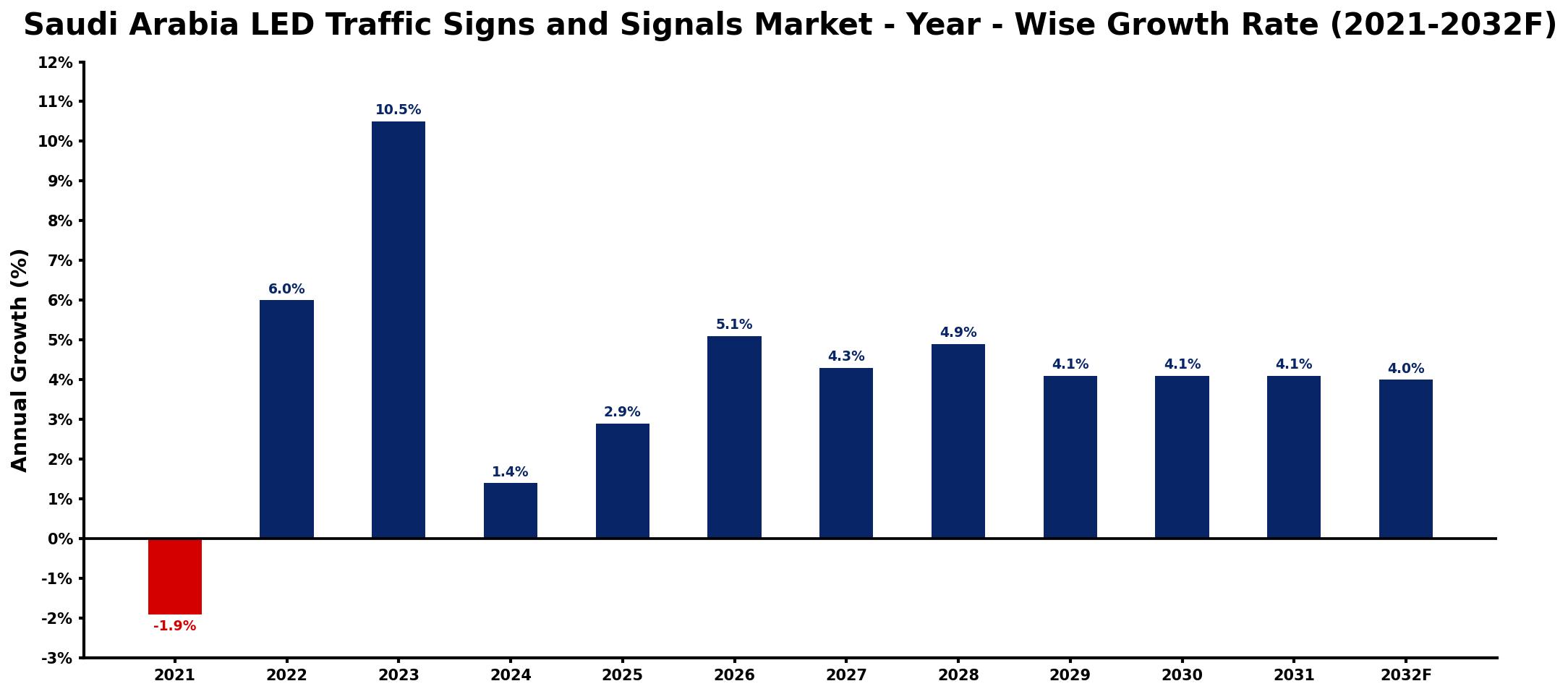
The table below presents the year‑wise growth rates along with the key drivers influencing the market
| Year | Growth Rate | Major Drivers |
| 2021 | -1.9% | decreased infrastructure spending initiatives |
| 2022 | 6.0% | increased urbanization and development |
| 2023 | 10.5% | growing demand for smart cities |
| 2024 | 1.4% | expansion of public transport systems |
| 2025 | 2.9% | rising investments in renewable energy |
| 2026 | 5.1% | enhanced focus on road safety |
| 2027 | 4.3% | growing preference for automation |
| 2028 | 4.9% | expanding industrial usage applications |
| 2029 | 4.1% | rising demand from electronics |
| 2030 | 4.1% | rising adoption of sustainable practices |
| 2031 | 4.1% | increased integration of IoT technologies |
| 2032 | 4.0% | growing emphasis on energy efficiency |
Note: Market size estimations and growth projections presented in this report are based on 6Wresearch's proprietary forecasting methodology, utilizing the latest available industry data, government publications, and primary research inputs.
Saudi Arabia LED Traffic Signs and Signals Market Synopsis
The Saudi Arabia LED Traffic Signs and Signals Market has witnessed a notable uptick, driven by the need for modern traffic management systems. As urban areas expand and vehicle numbers rise, the urgency for reliable traffic signaling solutions has become more pronounced. The transition from traditional incandescent signals to LED technology marks a significant paradigm shift in ensuring safer roads.
Looking forward, the market is poised for further growth, thanks to ongoing government initiatives and public investment in infrastructure. Additionally, the adoption of smart technologies to manage urban traffic more efficiently is expected to amplify demand, solidifying the market's trajectory toward modernization and enhanced safety measures.
Saudi Arabia LED Traffic Signs and Signals Market Key Takeaways
- The market is experiencing steady growth due to increased vehicle volumes and urbanization.
- LED technology enhances visibility, energy efficiency, and longevity compared to traditional systems.
- Government infrastructure investments are accelerating the adoption of modern traffic signaling solutions.
- Effective integration with existing traffic management systems remains a key focus for stakeholders.
- Long-term benefits of LED technology outweigh initial investments, driving municipal interest.
Evaluation of Restraints in Saudi Arabia LED Traffic Signs and Signals Market
While the market showcases promising growth, it faces significant hurdles that could impede progress. A primary concern is the integration of LED systems with existing infrastructure, which demands meticulous planning and execution. Municipalities must ensure compatibility to facilitate a seamless transition. Moreover, extreme weather conditions in Saudi Arabia, such as sandstorms and high temperatures, pose challenges for maintaining the performance of LED signage. This necessitates additional technical considerations to ensure reliability and visibility. Furthermore, the initial costs associated with upgrading to LED systems can be a deterrent for budget-constrained municipalities, making a compelling case for balancing upfront expenses with long-term savings.
Saudi Arabia LED Traffic Signs and Signals Market Trends
Current trends indicate a strong movement towards smart traffic management systems that leverage technology to optimize urban mobility. The incorporation of IoT devices and data analytics into LED traffic signs and signals is enhancing traffic monitoring and response capabilities. Additionally, the trend towards sustainable solutions continues to resonate with authorities, leading to a preference for energy-efficient LED options. As urban planners and policymakers focus on creating integrated transportation networks, LED systems are increasingly viewed as essential tools in achieving these goals.
Saudi Arabia LED Traffic Signs and Signals Market Opportunities
The future of the Saudi Arabia LED Traffic Signs and Signals Market is ripe with opportunities for growth and investment. Authorities are actively seeking innovative solutions that improve traffic management and road safety, creating a favorable environment for companies offering advanced LED systems. The ongoing development of smart city projects opens additional avenues for collaboration and investment, particularly in urban areas where traffic congestion is a pressing concern. Furthermore, as public awareness around road safety increases, there is a heightened demand for more visible and efficient traffic signaling solutions, further driving market potential.
Government Initiatives in the Saudi Arabia LED Traffic Signs and Signals Market
The Saudi government is playing an instrumental role in shaping the LED Traffic Signs and Signals Market through various initiatives aimed at bolstering public safety and enhancing urban infrastructure. Investments in road safety campaigns and smart city initiatives demonstrate a commitment to modernizing the transportation ecosystem. Additionally, public spending on infrastructure projects, which includes the upgrade and installation of LED traffic signaling systems, reflects the governments proactive stance in addressing urban mobility challenges.
Future Insights of the Saudi Arabia LED Traffic Signs and Signals Market
Looking ahead to the period from 2026 to 2032, the Saudi Arabia LED Traffic Signs and Signals Market is expected to evolve significantly. As urbanization accelerates and vehicle populations increase, the demand for advanced traffic management solutions will intensify. The integration of smart technologies will likely enhance the functionality and adaptability of LED systems, ensuring they meet the dynamic needs of modern cities. Furthermore, as municipalities increasingly prioritize sustainability, LED technology will remain central to their strategies for effective urban planning and traffic management.
Saudi Arabia LED Traffic Signs and Signals Market Latest Developments (2025 - 2026)
Recent industry developments indicate a surge in pilot projects aimed at implementing smart traffic management systems utilizing LED technology. These initiatives are focused on integrating real-time data analytics to improve traffic flow and safety. Additionally, several municipalities have announced plans to phase out traditional signals in favor of LED options, reinforcing the market's transition to energy-efficient solutions. Ongoing discussions surrounding public-private partnerships are also emerging, presenting opportunities for collaboration in developing innovative traffic solutions.
Saudi Arabia LED Traffic Signs and Signals Market - Key Attractiveness of the Report
- 10 Years of Market Numbers
- Historical Data Starting from 2022 to 2025
- Base Year: 2025
- Forecast Data until 2032
- Key Performance Indicators Impacting the Market
- Major Upcoming Developments and Projects
Key Highlights of the Report:
- Saudi Arabia LED Traffic Signs and Signals Market Outlook
- Market Size of Saudi Arabia LED Traffic Signs and Signals Market, 2025
- Forecast of Saudi Arabia LED Traffic Signs and Signals Market, 2032
- Historical Data and Forecast of Saudi Arabia LED Traffic Signs and Signals Revenues & Volume for the Period 2022-2032F
- Saudi Arabia LED Traffic Signs and Signals Market Trend Evolution
- Saudi Arabia LED Traffic Signs and Signals Market Drivers and Challenges
- Saudi Arabia LED Traffic Signs and Signals Price Trends
- Saudi Arabia LED Traffic Signs and Signals Porter's Five Forces
- Saudi Arabia LED Traffic Signs and Signals Industry Life Cycle
- Historical Data and Forecast of Saudi Arabia LED Traffic Signs and Signals Market Revenues & Volume By Product for the Period 2022-2032F
- Historical Data and Forecast of Saudi Arabia LED Traffic Signs and Signals Market Revenues & Volume By LED Traffic Signals for the Period 2022-2032F
- Historical Data and Forecast of Saudi Arabia LED Traffic Signs and Signals Market Revenues & Volume By LED Traffic Signs for the Period 2022-2032F
- Saudi Arabia LED Traffic Signs and Signals Import Export Trade Statistics
- Market Opportunity Assessment By Product
- Saudi Arabia LED Traffic Signs and Signals Top Companies Market Share
- Saudi Arabia LED Traffic Signs and Signals Competitive Benchmarking By Technical and Operational Parameters
- Saudi Arabia LED Traffic Signs and Signals Company Profiles
- Saudi Arabia LED Traffic Signs and Signals Key Strategic Recommendations






































