Saudi Arabia Livestock Market Size, Share & Growth Rate
The Saudi Arabia Livestock Market was estimated at USD 238 Million in 2025 and is projected to reach USD 303 Million by 2032, growing at a CAGR of 3.5% from 2026 to 2032. This growth trajectory is driven by a burgeoning population that is increasingly demanding meat and dairy products, alongside governmental initiatives aimed at boosting domestic food production to lessen reliance on imports. Such dynamics, coupled with advancements in livestock farming practices, underscore the market's robust expansion potential.
Saudi Arabia Livestock Market Year-wise Growth Rate and Key Drivers
This graph highlights how the Saudi Arabia Livestock Market has steadily grown over the years, supported by major growth factors.
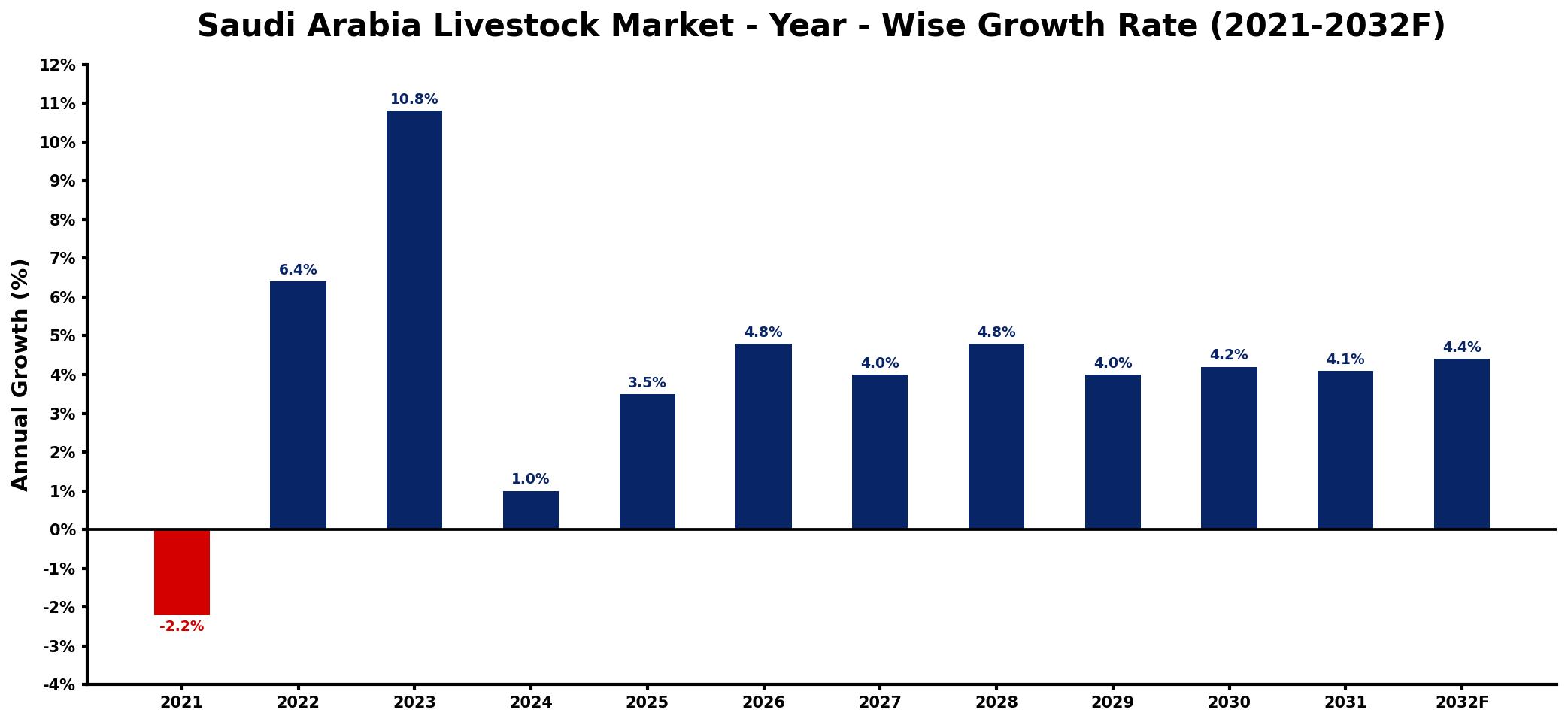
The table below presents the year‑wise growth rates along with the key drivers influencing the market
| Year | Growth Rate | Major Drivers |
| 2021 | -2.2% | decreased consumer spending on meat |
| 2022 | 6.4% | increased investment in agriculture |
| 2023 | 10.8% | growing demand for organic products |
| 2024 | 1.0% | expansion of local farming initiatives |
| 2025 | 3.5% | rising popularity of dairy consumption |
| 2026 | 4.8% | enhanced supply chain efficiencies |
| 2027 | 4.0% | growing interest in alternative proteins |
| 2028 | 4.8% | increased exports to neighboring regions |
| 2029 | 4.0% | higher disposable income levels |
| 2030 | 4.2% | emerging trends in sustainable farming |
| 2031 | 4.1% | advancements in veterinary technologies |
| 2032 | 4.4% | supportive government policies for agriculture |
Note: Market size estimations and growth projections presented in this report are based on 6Wresearch's proprietary forecasting methodology, utilizing the latest available industry data, government publications, and primary research inputs.
Saudi Arabia Livestock Market Synopsis
Recently, the Saudi Arabia livestock market has witnessed a surge in interest, reflecting a nation deeply invested in enhancing its food security and cultural practices surrounding livestock. However, as it moves forward, the sector faces an imperative to adapt to evolving consumer preferences for ethically produced meat, positioning itself at the intersection of tradition and modernity.
The market's strength is anchored not only in its cultural significance but also in the ongoing investment in modern farming techniques and animal health. The challenge remains to balance the increasing demand with sustainable practices that safeguard animal welfare and environmental integrity, a necessity that will define the future landscape of the Saudi livestock industry.
Saudi Arabia Livestock Market Key Takeaways
- The market is experiencing significant growth driven by demographic shifts and heightened meat consumption.
- Government policies are favoring enhanced domestic production capabilities to reduce import dependency.
- Technological advancements in livestock management are pivotal for improving product quality and sustainability.
- Consumer trends are shifting towards ethically sourced and environmentally sustainable meat products.
- The sector must navigate challenges related to animal welfare and sustainable feed sourcing.
Evaluation of Restraints in Saudi Arabia Livestock Market
Despite the optimistic growth prospects, the Saudi Arabia livestock market grapples with several restraints. Primary among these is the need for stringent health and welfare standards across the supply chain. Managing disease outbreaks and ensuring biosecurity are paramount, particularly as animal transport conditions come under scrutiny. Additionally, the increasing pressure to adopt sustainable feed practices complicates the nutritional needs of livestock while avoiding adverse environmental impacts. As consumer demands shift toward transparency and ethics in production, the industry faces the dual challenge of meeting these expectations while adhering to regulatory frameworks.
Saudi Arabia Livestock Market Trends
A number of current trends are shaping the livestock market in Saudi Arabia. There is a pronounced shift toward adopting advanced genetics and animal health management practices that promise to enhance productivity. Moreover, digital innovations, such as precision farming technologies, are gaining traction, enabling farmers to optimize resource use and improve overall livestock management. As awareness of sustainability issues increases, there is also a marked movement towards organic and environmentally friendly livestock production, aligning with global trends that prioritize ethical considerations in food sourcing.
Saudi Arabia Livestock Market Opportunities
Opportunities abound in the Saudi Arabia livestock market, particularly in the realm of technological innovation and sustainable practices. Investments in research and development for high-yield livestock breeds are likely to yield significant returns. Furthermore, as consumer preferences evolve, there is room for niche markets centered around organic and free-range products. Collaborative initiatives between the government and private sector can also facilitate the introduction of modern farming practices, providing pathways for enhancing productivity while ensuring animal welfare.
Government Initiatives in the Saudi Arabia Livestock Market
The Saudi government has implemented a series of initiatives aimed at strengthening the livestock sector, emphasizing the importance of food security and self-sufficiency. Programs are being launched to support local farmers through subsidies and access to advanced farming technologies. Additionally, regulatory frameworks are being established to ensure sustainable practices within the industry, reflecting a commitment to enhancing both productivity and animal welfare. Public spending in agricultural research and education further underscores the government's dedication to nurturing a resilient and innovative livestock market.
Future Insights of the Saudi Arabia Livestock Market
Looking ahead to 2026-2032, the Saudi Arabia livestock market is poised for transformative growth. Continued population increases will sustain the demand for meat and dairy, driving the need for enhanced production capabilities. With ongoing investments in modern farming practices and a strong focus on sustainability, the sector is likely to become more competitive on both regional and international fronts. As the industry adapts to consumer demand for ethical sourcing, it will be essential for market players to innovate continually, ensuring they meet the evolving expectations of the Saudi populace.
Saudi Arabia Livestock Market Latest Developments (2025 - 2026)
In recent months, the Saudi livestock market has seen several developments focusing on enhancing production efficiency and sustainability. Various stakeholders are actively collaborating on projects aimed at improving animal health standards and implementing advanced farming technologies. Additionally, there is a growing emphasis on educating farmers about sustainable practices and animal welfare, reflecting a broader societal shift towards ethical consumption. Market participants are closely monitoring changes in consumer behavior, which will undoubtedly shape future strategies.
Saudi Arabia Livestock Market - Key Attractiveness of the Report
- 10 Years of Market Numbers
- Historical Data Starting from 2022 to 2025
- Base Year: 2025
- Forecast Data until 2032
- Key Performance Indicators Impacting the Market
- Major Upcoming Developments and Projects
Key Highlights of the Report:
- Saudi Arabia Livestock Market Outlook
- Market Size of Saudi Arabia Livestock Market, 2025
- Forecast of Saudi Arabia Livestock Market, 2032
- Historical Data and Forecast of Saudi Arabia Livestock Revenues & Volume for the Period 2022-2032F
- Saudi Arabia Livestock Market Trend Evolution
- Saudi Arabia Livestock Market Drivers and Challenges
- Saudi Arabia Livestock Price Trends
- Saudi Arabia Livestock Porter's Five Forces
- Saudi Arabia Livestock Industry Life Cycle
- Historical Data and Forecast of Saudi Arabia Livestock Market Revenues & Volume By Animal Type for the Period 2022-2032F
- Historical Data and Forecast of Saudi Arabia Livestock Market Revenues & Volume By Ruminants for the Period 2022-2032F
- Historical Data and Forecast of Saudi Arabia Livestock Market Revenues & Volume By Poultry for the Period 2022-2032F
- Historical Data and Forecast of Saudi Arabia Livestock Market Revenues & Volume By Swine for the Period 2022-2032F
- Historical Data and Forecast of Saudi Arabia Livestock Market Revenues & Volume By Aquaculture for the Period 2022-2032F
- Saudi Arabia Livestock Import Export Trade Statistics
- Market Opportunity Assessment By Animal Type
- Saudi Arabia Livestock Top Companies Market Share
- Saudi Arabia Livestock Competitive Benchmarking By Technical and Operational Parameters
- Saudi Arabia Livestock Company Profiles
- Saudi Arabia Livestock Key Strategic Recommendations






































