Saudi Arabia Lubrication System Market Summary
The saudi arabia lubrication system market was estimated at USD 432 Million in 2025 and is projected to reach USD 555 Million by 2032, growing at a CAGR of 5.1% from 2026 to 2032.
Saudi Arabia Lubrication System Market Year-wise Growth Rate and Key Drivers
This graph highlights how the Saudi Arabia Lubrication System Market has steadily grown over the past five years, supported by major growth factors.
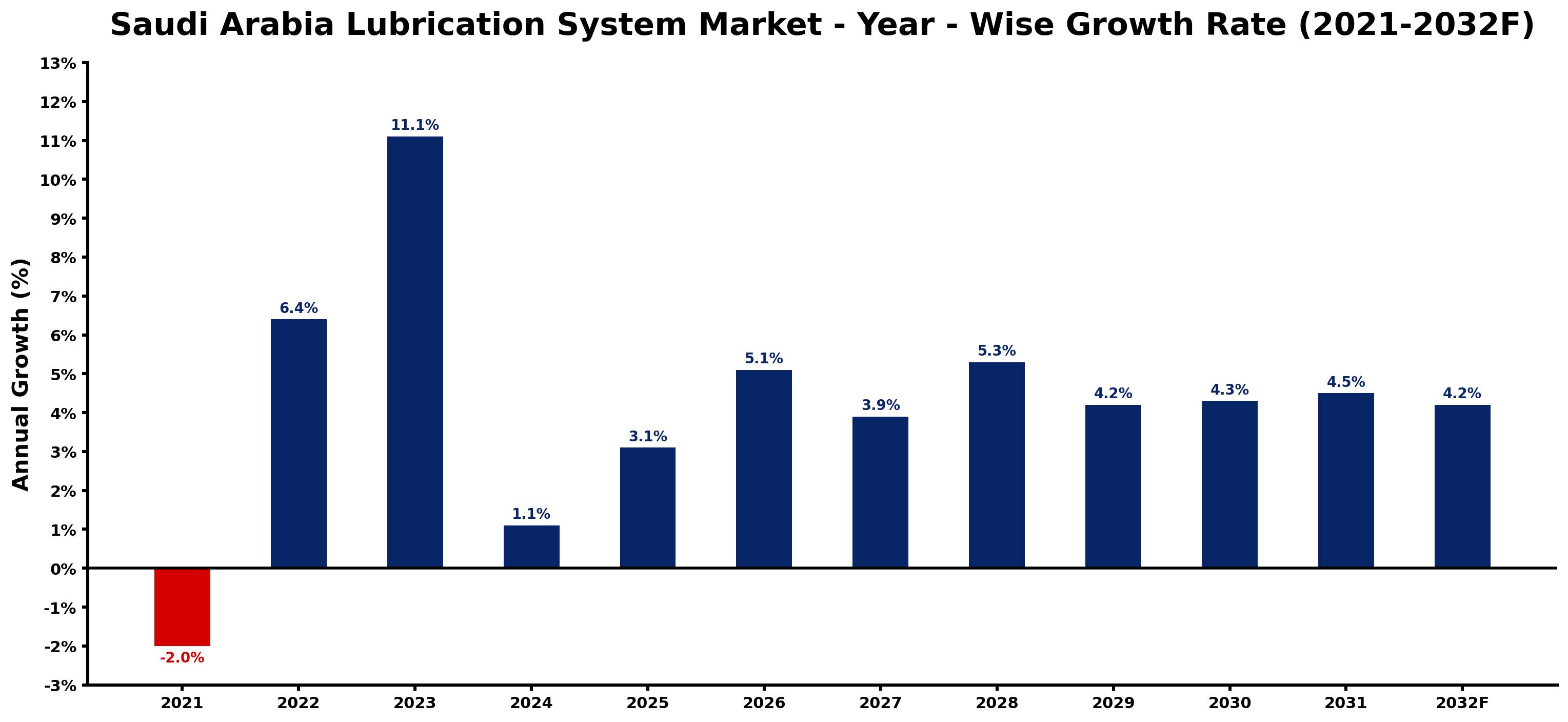
The table below presents the year wise growth rates along with the key drivers influencing the market
| Year | Growth Rate | Major Drivers |
| 2021 | -2.0% | Increased competition from alternative energy sources diminished demand for traditional lubrication solutions in various sectors. |
| 2022 | 6.4% | Local manufacturing initiatives help reduce dependence on imported lubrication systems. |
| 2023 | 11.1% | Increased construction activities related to Neom generate higher lubrication system demand. |
| 2024 | 1.1% | Technological improvements enhance lubrication system efficiency, appealing to industrial clients. |
| 2025 | 3.1% | Oil and gas sector investments drive innovation in specialized lubrication solutions. |
| 2026 | 5.1% | Sustainability commitments encourage adoption of eco-friendly lubrication products in machinery. |
| 2027 | 3.9% | Larger automotive market necessitates advanced lubrication systems for improved vehicle performance. |
| 2028 | 5.3% | Growing maintenance services sector fosters steady demand for lubrication system upgrades. |
| 2029 | 4.2% | Emerging markets within Saudi Arabia present untapped opportunities for lubrication providers. |
| 2030 | 4.3% | Increased industrial diversification encourages lubrication systems tailored to varied sector needs. |
| 2031 | 4.5% | Advanced analytics integration optimizes lubrication system applications across numerous industries. |
| 2032 | 4.2% | Digital transformation impacts lubrication monitoring, pushing toward smart lubrication systems. |
Note - Market size estimations and growth projections presented in this report are based on 6Wresearch's advanced forecasting approach, validated with industry datasets as of June 2026.
Saudi Arabia Lubrication System Market Synopsis
The Saudi Arabia Lubrication System Market is projected to reach 5.1% and witness significant growth during the forecast period (2026-2032). The market is anticipated to expand at a compound annual growth rate (CAGR) of approximately 6.1%, driven by factors such as increasing industrial automation, the rising adoption of electric vehicles, and substantial governmental initiatives aimed at enhancing the manufacturing sector. These dynamics are positioning the market for robust growth in the coming years.
Saudi Arabia Lubrication System Market Growth Drivers
Several key drivers are influencing the growth trajectory of the Saudi Arabia lubrication system market.
- The surge in industrial automation necessitates the use of various advanced systems, including robotic arms and sensors. These systems require consistent maintenance, thereby increasing the demand for high-quality lubricants to ensure optimal functioning.
- With substantial government policies aimed at promoting green technologies, the focus on electric vehicles has escalated. This shift necessitates the development of specialized lubricants that enhance efficiency and reduce friction in electric vehicle components.
- The ongoing expansion of the manufacturing sector, propelled by strategic initiatives from the government, further contributes to the growing need for reliable lubrication systems.
- The critical emphasis on operational efficiency and performance reliability in machinery has resulted in an increased focus on utilizing advanced lubrication technologies, thus bolstering market growth.
- Additionally, the integration of smart technologies within lubrication systems is facilitating more efficient operations, ultimately creating greater demand for innovative lubrication solutions across various sectors.
Saudi Arabia Lubrication System Market Challenges and Restraints
Despite the positive growth outlook, certain challenges could impede the progress of the Saudi Arabia lubrication system market.
- The high costs associated with the development and installation of advanced lubrication systems can prove to be a significant barrier. These costs often encompass extensive training and specialized laboratory requirements.
- Furthermore, the transition to more sophisticated lubrication technologies may meet resistance from operators accustomed to traditional systems, potentially slowing the adoption of new innovations.
- The impact of the Covid-19 pandemic resulted in severe disruptions across the automotive supply chain, creating lingering effects that could slow down the recovery process in the lubrication sector.
- Evolving regulations concerning environmental standards may compel manufacturers to upgrade their lubrication systems, resulting in additional financial burdens.
- The fast-paced evolution of technology necessitates continuous investment in research and development, which can be challenging for market players operating under tight profit margins.
Saudi Arabia Lubrication System Market Government Investment and Initiatives
The Saudi government has implemented various initiatives to bolster the lubrication system market as part of its broader economic diversification strategy.
- Public investments are geared toward enhancing industrial capacity, which includes advancing lubrication technologies to meet the burgeoning demand from sectors such as manufacturing and automotive.
- Government policies favoring electric mobility are complemented by initiatives that support the development of high-grade lubricants tailored for electric vehicles, creating a favorable environment for innovation.
- Strategic collaborations between governmental bodies and private enterprises are being fostered to enhance research and development in lubrication solutions, thus driving technological advancements.
- Initiatives promoting sustainability are encouraging manufacturers to adopt environmentally friendly lubrication solutions, aligning with global trends towards green technologies.
- Investment in infrastructure projects, such as manufacturing hubs, is expected to stimulate demand for lubrication systems, further supporting the growth of this market.
Saudi Arabia Lubrication System Market Latest Developments (May 2025 - June 2026)
During the period from May 2025 to June 2026, various developments in the Saudi Arabia lubrication system market have emerged, reflecting ongoing industry dynamics.
- There has been a marked increase in digitalization efforts, with many companies adopting remote monitoring and maintenance technologies to enhance operational efficiencies.
- Developments in advanced lubrication solutions that focus on sustainability have gained traction, driven by both consumer demand and regulatory pressures for greener options.
- A growing number of partnerships between technology firms and lubrication system developers have facilitated innovation and the introduction of cutting-edge products into the market.
- Enhancements in training programs have been introduced to equip workforce with the necessary skills to handle advanced lubrication technologies, thereby supporting growth in operational capabilities.
- The economic recovery post-pandemic has led to a resurgence in production activities within critical sectors, further amplifying the demand for lubrication systems.
Saudi Arabia Lubrication System Market - Key Attractiveness of the Report
- 10 Years of Market Numbers
- Historical Data Starting from 2022 to 2025
- Base Year: 2025
- Forecast Data until 2032
- Key Performance Indicators Impacting the Market
- Major Upcoming Developments and Projects
Key Highlights of the Report:
- Saudi Arabia Lubrication System Market Outlook
- Market Size of Saudi Arabia Lubrication System Market, 2025
- Forecast of Saudi Arabia Lubrication System Market, 2032
- Historical Data and Forecast of Saudi Arabia Lubrication System Revenues & Volume for the Period 2022-2032F
- Saudi Arabia Lubrication System Market Trend Evolution
- Saudi Arabia Lubrication System Market Drivers and Challenges
- Saudi Arabia Lubrication System Price Trends
- Saudi Arabia Lubrication System Porter's Five Forces
- Saudi Arabia Lubrication System Industry Life Cycle
- Historical Data and Forecast of Saudi Arabia Lubrication System Market Revenues & Volume By Line Type for the Period 2022-2032F
- Historical Data and Forecast of Saudi Arabia Lubrication System Market Revenues & Volume By Manual Lubrication Systems for the Period 2022-2032F
- Historical Data and Forecast of Saudi Arabia Lubrication System Market Revenues & Volume By Automatic Lubrication Systems for the Period 2022-2032F
- Historical Data and Forecast of Saudi Arabia Lubrication System Market Revenues & Volume By Product Type for the Period 2022-2032F
- Historical Data and Forecast of Saudi Arabia Lubrication System Market Revenues & Volume By Single-Product Lubrication Systems for the Period 2022-2032F
- Historical Data and Forecast of Saudi Arabia Lubrication System Market Revenues & Volume By Dual-Product Lubrication Systems for the Period 2022-2032F
- Historical Data and Forecast of Saudi Arabia Lubrication System Market Revenues & Volume By Multi-Product Lubrication Systems for the Period 2022-2032F
- Historical Data and Forecast of Saudi Arabia Lubrication System Market Revenues & Volume By Series Progressive for the Period 2022-2032F
- Historical Data and Forecast of Saudi Arabia Lubrication System Market Revenues & Volume By Circulating Oil for the Period 2022-2032F
- Historical Data and Forecast of Saudi Arabia Lubrication System Market Revenues & Volume By Oil & Air for the Period 2022-2032F
- Historical Data and Forecast of Saudi Arabia Lubrication System Market Revenues & Volume By Application for the Period 2022-2032F
- Historical Data and Forecast of Saudi Arabia Lubrication System Market Revenues & Volume By Cement Plants for the Period 2022-2032F
- Historical Data and Forecast of Saudi Arabia Lubrication System Market Revenues & Volume By Steel Industry for the Period 2022-2032F
- Historical Data and Forecast of Saudi Arabia Lubrication System Market Revenues & Volume By Mining & Mineral Processing for the Period 2022-2032F
- Historical Data and Forecast of Saudi Arabia Lubrication System Market Revenues & Volume By Paper & Printing for the Period 2022-2032F
- Historical Data and Forecast of Saudi Arabia Lubrication System Market Revenues & Volume By Automotive for the Period 2022-2032F
- Historical Data and Forecast of Saudi Arabia Lubrication System Market Revenues & Volume By Industrial Machine & Machine Tools for the Period 2022-2032F
- Historical Data and Forecast of Saudi Arabia Lubrication System Market Revenues & Volume By Construction Machines Machines for the Period 2022-2032F
- Saudi Arabia Lubrication System Import Export Trade Statistics
- Market Opportunity Assessment By Line Type
- Market Opportunity Assessment By Product Type
- Market Opportunity Assessment By Application
- Saudi Arabia Lubrication System Top Companies Market Share
- Saudi Arabia Lubrication System Competitive Benchmarking By Technical and Operational Parameters
- Saudi Arabia Lubrication System Company Profiles
- Saudi Arabia Lubrication System Key Strategic Recommendations






































