Saudi Arabia Machine tools Market Summary
The saudi arabia machine tools market was estimated at USD 171 Million in 2025 and is projected to reach USD 220 Million by 2032, growing at a CAGR of 5.2% from 2026 to 2032.
Saudi Arabia Machine tools Market Year-wise Growth Rate and Key Drivers
This graph highlights how the Saudi Arabia Machine tools Market has steadily grown over the past five years, supported by major growth factors.
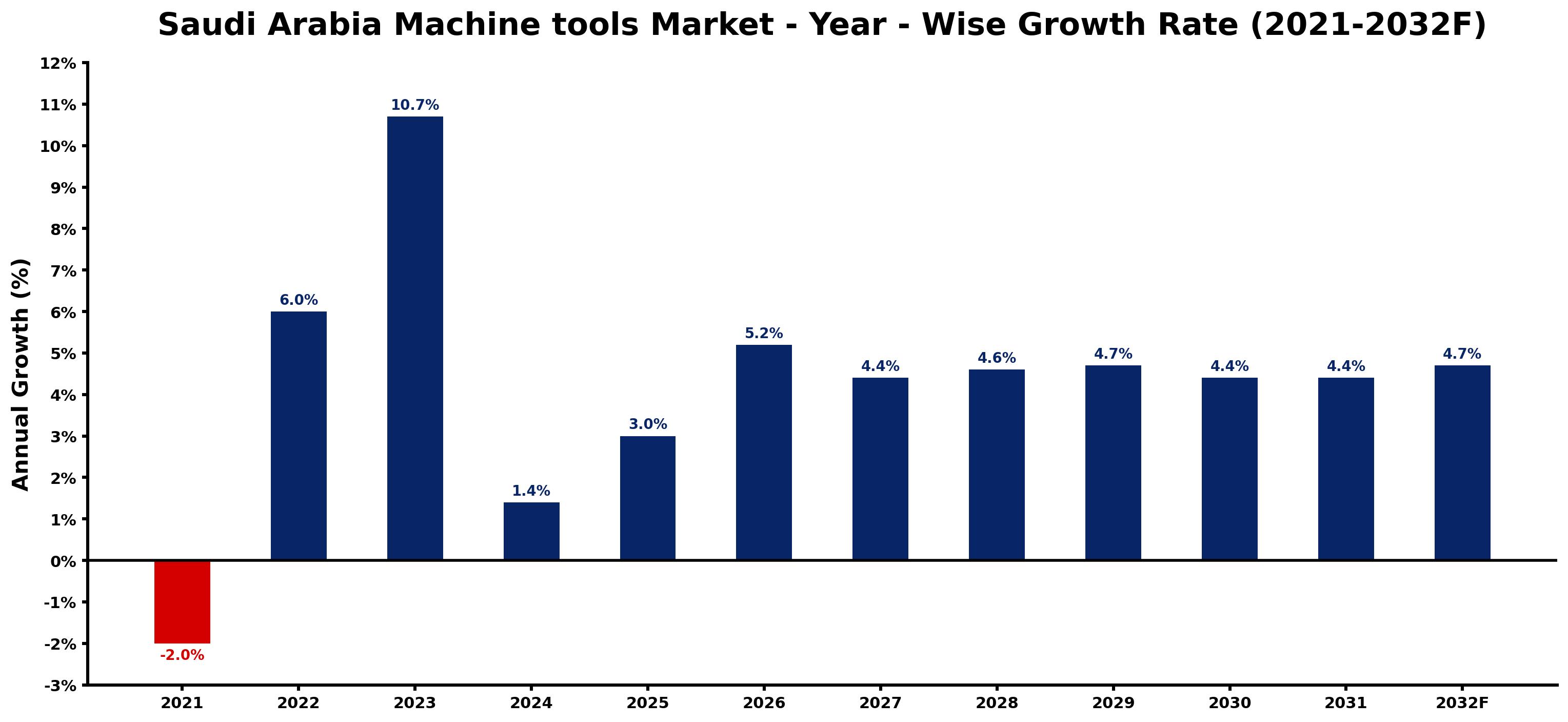
The table below presents the year wise growth rates along with the key drivers influencing the market
| Year | Growth Rate | Major Drivers |
| 2021 | -2.0% | Supply chain disruptions, exacerbated by global events, hindered manufacturing operations and stifled investment in machine tools. |
| 2022 | 6.0% | Localizing production through increased domestic machine tool manufacturing reduces import dependency. |
| 2023 | 10.7% | Major construction projects in NEOM drive demand for advanced machining capabilities. |
| 2024 | 1.4% | High temperatures necessitate specialized machine tools for efficient operations in extreme climates. |
| 2025 | 3.0% | Strong oil prices encourage petrochemical industry investment in modern machine tools. |
| 2026 | 5.2% | Emerging tech sectors, like robotics, create new opportunities for machine tool applications. |
| 2027 | 4.4% | Sustainability trends push businesses toward energy-efficient machinery and eco-friendly practices. |
| 2028 | 4.6% | Industry 4.0 initiatives lead to automation, enhancing precision and productivity in manufacturing. |
| 2029 | 4.7% | Significant foreign direct investment catalyzes partnerships and knowledge transfer in production technologies. |
| 2030 | 4.4% | Continued urbanization and population growth necessitate advanced infrastructure and manufacturing solutions. |
| 2031 | 4.4% | International trade agreements facilitate access to cutting-edge machine tools and technologies. |
| 2032 | 4.7% | Strong educational focus on technical skills supports workforce readiness for advanced manufacturing. |
Note - Market size estimations and growth projections presented in this report are based on 6Wresearch's advanced forecasting approach, validated with industry datasets as of June 2026.
Saudi Arabia Machine tools Market Synopsis
The Saudi Arabia Machine tools Market is projected to reach 5.2% and witness significant growth during the forecast period (2026-2032). With a robust industrial framework, Saudi Arabia stands as a leading player in the machine tools segment across the Middle East and North Africa (MENA) region. The nation's diverse sectors, including machinery, metals, and petrochemicals, form a solid foundation for the growth of its machine tools market. The advanced infrastructure enables not only local production but also the exportation of machine tools to neighboring regions, positioning Saudi Arabia as a pivotal hub in the industry.
Saudi Arabia Machine tools Market Growth Drivers
Several factors are propelling the Saudi Arabia machine tools market forward. Primarily, increased investments in construction projects under the Vision 2031 initiative are significantly enhancing market demand. Additionally, the rise of automation across various industries, particularly in automotive and aerospace manufacturing, has elevated the need for precision engineering machines such as CNC routers and machining centers. The government's supportive initiatives play a crucial role in fostering local manufacturing, thereby enhancing competition and benefiting domestic consumers with quality products at competitive prices. Furthermore, the flourishing oil and gas sector and a heightened focus on food security are anticipated to present new opportunities, driving the demand for machine tools in the coming years.
Saudi Arabia Machine tools Market Challenges and Restraints
Despite the promising growth, the Saudi Arabia machine tools market faces several challenges. The high cost of installation and maintenance can inhibit growth, particularly among small and medium enterprises (SMEs) that may lack the necessary financial resources. Additionally, a shortage of skilled personnel presents a significant hurdle, as many companies struggle to find adequately trained workers. Security concerns regarding safety in automated operations could also dampen market sentiment, posing further challenges. Moreover, the lingering effects of the COVID-19 pandemic, which disrupted global supply chains and business operations, may continue to affect recovery and growth prospects in the sector.
Saudi Arabia Machine tools Market Government Investment and Initiatives
The Saudi government has implemented various strategies aimed at enhancing the local machine tools market. Initiatives such as Vision 2031 aim to diversify the economy and reduce dependence on oil by promoting manufacturing and industrial activities. The General Investment Authority (GIA) has rolled out supportive measures to attract investments, which include incentives for local manufacturers and efforts to create a more conducive business environment. Public spending on infrastructure projects continues to rise, further underpinning demand for machine tools as the nation seeks to strengthen its industrial base. Moreover, educational programs and vocational training initiatives are being developed to address the skills gap, ultimately supporting the growth of the machine tools market.
Saudi Arabia Machine tools Market Latest Developments (May 2025 - June 2026)
In the period between May 2025 and June 2026, the Saudi Arabia machine tools market has shifted towards greater automation and digitalization. Industry players are increasingly adopting advanced technologies to enhance productivity and ensure high-quality outputs. Additionally, public investments in renewable energy and sustainable technologies are influencing the machine tools landscape, with increasing demand for equipment that supports these sectors. Moreover, initiatives by the government to provide financial aid for SMEs have led to a gradual recovery post-COVID-19, as businesses strive to modernize their operations. Recent trends indicate a growing collaboration between local and international firms to leverage expertise and improve product offerings across the market.
Saudi Arabia Machine tools Market - Key Attractiveness of the Report
- 10 Years of Market Numbers
- Historical Data Starting from 2022 to 2025
- Base Year: 2025
- Forecast Data until 2032
- Key Performance Indicators Impacting the Market
- Major Upcoming Developments and Projects
Key Highlights of the Report:
- Saudi Arabia Machine tools Market Outlook
- Market Size of Saudi Arabia Machine tools Market, 2025
- Forecast of Saudi Arabia Machine tools Market, 2032
- Historical Data and Forecast of Saudi Arabia Machine tools Revenues & Volume for the Period 2022-2032F
- Saudi Arabia Machine tools Market Trend Evolution
- Saudi Arabia Machine tools Market Drivers and Challenges
- Saudi Arabia Machine tools Price Trends
- Saudi Arabia Machine tools Porter's Five Forces
- Saudi Arabia Machine tools Industry Life Cycle
- Historical Data and Forecast of Saudi Arabia Machine tools Market Revenues & Volume By Product Type for the Period 2022-2032F
- Historical Data and Forecast of Saudi Arabia Machine tools Market Revenues & Volume By Milling Machines for the Period 2022-2032F
- Historical Data and Forecast of Saudi Arabia Machine tools Market Revenues & Volume By Drilling Machines for the Period 2022-2032F
- Historical Data and Forecast of Saudi Arabia Machine tools Market Revenues & Volume By Turning Machines for the Period 2022-2032F
- Historical Data and Forecast of Saudi Arabia Machine tools Market Revenues & Volume By Grinding Machines for the Period 2022-2032F
- Historical Data and Forecast of Saudi Arabia Machine tools Market Revenues & Volume By Electrical Discharge Machines for the Period 2022-2032F
- Historical Data and Forecast of Saudi Arabia Machine tools Market Revenues & Volume By Automation Type? for the Period 2022-2032F
- Historical Data and Forecast of Saudi Arabia Machine tools Market Revenues & Volume By CNC Machine Tools for the Period 2022-2032F
- Historical Data and Forecast of Saudi Arabia Machine tools Market Revenues & Volume By Conventional Machine Tools for the Period 2022-2032F
- Historical Data and Forecast of Saudi Arabia Machine tools Market Revenues & Volume By Industry Segment for the Period 2022-2032F
- Historical Data and Forecast of Saudi Arabia Machine tools Market Revenues & Volume By Automotive and Transportation for the Period 2022-2032F
- Historical Data and Forecast of Saudi Arabia Machine tools Market Revenues & Volume By Sheet Metals for the Period 2022-2032F
- Historical Data and Forecast of Saudi Arabia Machine tools Market Revenues & Volume By Capital Goods for the Period 2022-2032F
- Historical Data and Forecast of Saudi Arabia Machine tools Market Revenues & Volume By Energy for the Period 2022-2032F
- Historical Data and Forecast of Saudi Arabia Machine tools Market Revenues & Volume By Sales Channel for the Period 2022-2032F
- Historical Data and Forecast of Saudi Arabia Machine tools Market Revenues & Volume By Events and Exhibitions for the Period 2022-2032F
- Historical Data and Forecast of Saudi Arabia Machine tools Market Revenues & Volume By Dealers and Distributors for the Period 2022-2032F
- Saudi Arabia Machine tools Import Export Trade Statistics
- Market Opportunity Assessment By Product Type
- Market Opportunity Assessment By Automation Type?
- Market Opportunity Assessment By Industry Segment
- Market Opportunity Assessment By Sales Channel
- Saudi Arabia Machine tools Top Companies Market Share
- Saudi Arabia Machine tools Competitive Benchmarking By Technical and Operational Parameters
- Saudi Arabia Machine tools Company Profiles
- Saudi Arabia Machine tools Key Strategic Recommendations






































