Saudi Arabia Medical Tubing Market Size, Share & Growth Rate
The Saudi Arabia Medical Tubing Market was estimated at USD 365 Million in 2025 and is projected to reach USD 468 Million by 2032, growing at a CAGR of 3.6% from 2026 to 2032. This upward trajectory is primarily fueled by ongoing advancements in healthcare technology and an increased emphasis on patient-centered care. The rise in surgical procedures and the demand for reliable, biocompatible materials are further driving the growth of this essential market.
Saudi Arabia Medical Tubing Market Year-wise Growth Rate and Key Drivers
This graph highlights how the Saudi Arabia Medical Tubing Market has steadily grown over the years, supported by major growth factors.
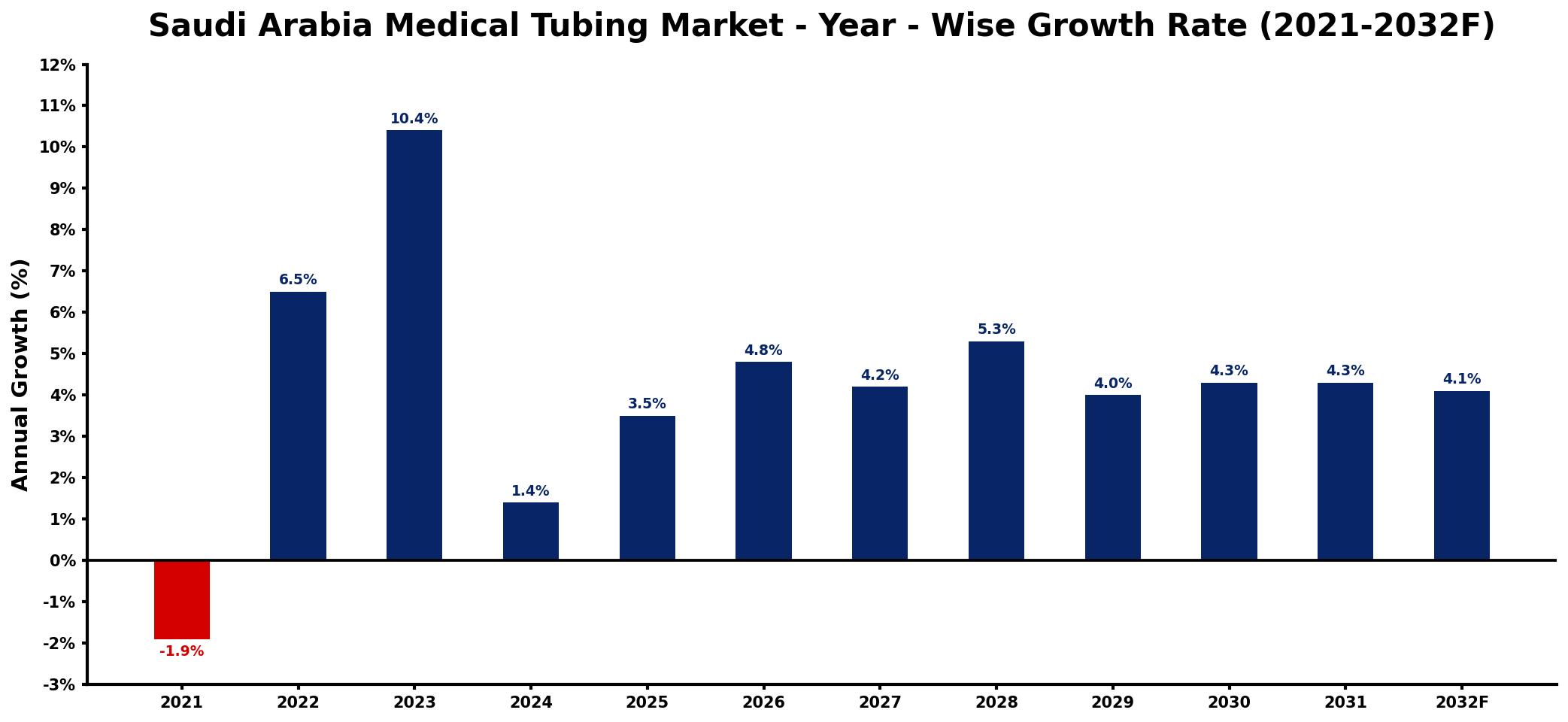
The table below presents the year‑wise growth rates along with the key drivers influencing the market
| Year | Growth Rate | Major Drivers |
| 2021 | -1.9% | decrease in healthcare investments |
| 2022 | 6.5% | expansion of healthcare facilities |
| 2023 | 10.4% | increased demand for healthcare products |
| 2024 | 1.4% | growing population health awareness |
| 2025 | 3.5% | rising prevalence of chronic diseases |
| 2026 | 4.8% | advancements in healthcare technology |
| 2027 | 4.2% | increased government healthcare funding |
| 2028 | 5.3% | growth in outpatient procedures |
| 2029 | 4.0% | emergence of new healthcare startups |
| 2030 | 4.3% | rising demand for innovative solutions |
| 2031 | 4.3% | expanding healthcare application demand |
| 2032 | 4.1% | increased focus on preventive care |
Note: Market size estimations and growth projections presented in this report are based on 6Wresearch's proprietary forecasting methodology, utilizing the latest available industry data, government publications, and primary research inputs.
Saudi Arabia Medical Tubing Market Synopsis
In recent years, the Saudi Arabia medical tubing market has witnessed significant momentum, largely attributed to the country's expanding healthcare infrastructure and technological advancements. As medical procedures evolve and the emphasis on patient safety and comfort increases, the demand for specialized medical tubing continues to rise.
Looking ahead, the market is set to experience further growth propelled by continuous innovation in materials and manufacturing processes. Stakeholders are increasingly focused on enhancing product quality and compliance with strict regulatory standards, ensuring the viability and effectiveness of medical tubing in a variety of applications.
Saudi Arabia Medical Tubing Market Key Takeaways
- The market is characterized by robust growth driven by advancements in healthcare technologies.
- Increasing surgical procedures and healthcare investments are key contributors to demand for medical tubing.
- Manufacturers prioritize biocompatibility and stringent quality controls to enhance patient safety.
- The COVID-19 pandemic impacted market dynamics, influencing demand patterns in various segments.
- Government initiatives are likely to bolster market growth through public spending and regulatory support.
Evaluation of Restraints in Saudi Arabia Medical Tubing Market
Despite the promising growth trajectory, the Saudi Arabia medical tubing market faces notable restraints. Ensuring the sterile condition and biocompatibility of materials is a persistent challenge that impacts product development. Manufacturers must adhere to stringent quality and safety regulations, which can constrain operational flexibility and increase production costs. Furthermore, the need for precision engineering to meet specific functional requirements adds complexity to the manufacturing process, potentially hindering rapid market responsiveness.
Saudi Arabia Medical Tubing Market Trends
Several key trends are shaping the Saudi Arabia medical tubing market landscape. The shift towards minimally invasive procedures is boosting the demand for specialized tubing that supports advanced surgical techniques. Additionally, the integration of smart technologies in medical devices is generating interest in innovative tubing solutions with enhanced functionalities. Moreover, sustainability initiatives are prompting manufacturers to explore eco-friendly materials, aiming to align with global environmental standards.
Saudi Arabia Medical Tubing Market Opportunities
There are significant growth and investment opportunities within the Saudi Arabia medical tubing market. The ongoing development of healthcare infrastructure presents avenues for manufacturers to establish partnerships and expand their product offerings. Innovations in polymer science provide the potential to create superior medical tubing solutions. Furthermore, the increasing prevalence of chronic diseases necessitates advanced medical treatments, driving demand for reliable and high-quality medical tubing.
Government Initiatives in the Saudi Arabia Medical Tubing Market
The Saudi government is actively promoting healthcare advancements through various initiatives aimed at enhancing medical services and infrastructure. Public spending on healthcare is increasing, with a focus on improving medical technologies and devices. Regulatory frameworks are evolving to support innovation while ensuring patient safety. These initiatives are designed to foster a favorable environment for the growth of the medical tubing market and related sectors.
Future Insights of the Saudi Arabia Medical Tubing Market
Looking forward to 2026-2032, the Saudi Arabia medical tubing market is poised for sustained growth. The increasing emphasis on personalized medicine and advanced healthcare solutions will create additional demand for specialized tubing products. Furthermore, as manufacturers innovate and improve the performance of medical tubing through enhanced materials and manufacturing techniques, market prospects appear bright. Collaboration between healthcare providers and manufacturers will likely play a crucial role in addressing evolving medical needs.
Saudi Arabia Medical Tubing Market Latest Developments (2025 - 2026)
Recent developments in the Saudi Arabia medical tubing market reflect a proactive industry adjusting to post-pandemic needs. Manufacturers are launching new product lines that incorporate advanced materials to meet evolving regulatory standards. Innovations in manufacturing processes are leading to enhanced production efficiencies. Additionally, partnerships between healthcare providers and tubing manufacturers are becoming more common, aimed at addressing specific patient needs and improving overall care quality.
Saudi Arabia Medical Tubing Market - Key Attractiveness of the Report
- 10 Years of Market Numbers
- Historical Data Starting from 2022 to 2025
- Base Year: 2025
- Forecast Data until 2032
- Key Performance Indicators Impacting the Market
- Major Upcoming Developments and Projects
Key Highlights of the Report:
- Saudi Arabia Medical Tubing Market Outlook
- Market Size of Saudi Arabia Medical Tubing Market, 2025
- Forecast of Saudi Arabia Medical Tubing Market, 2032
- Historical Data and Forecast of Saudi Arabia Medical Tubing Revenues & Volume for the Period 2022-2032F
- Saudi Arabia Medical Tubing Market Trend Evolution
- Saudi Arabia Medical Tubing Market Drivers and Challenges
- Saudi Arabia Medical Tubing Price Trends
- Saudi Arabia Medical Tubing Porter's Five Forces
- Saudi Arabia Medical Tubing Industry Life Cycle
- Historical Data and Forecast of Saudi Arabia Medical Tubing Market Revenues & Volume By Material for the Period 2022-2032F
- Historical Data and Forecast of Saudi Arabia Medical Tubing Market Revenues & Volume By Plastics for the Period 2022-2032F
- Historical Data and Forecast of Saudi Arabia Medical Tubing Market Revenues & Volume By Rubbers for the Period 2022-2032F
- Historical Data and Forecast of Saudi Arabia Medical Tubing Market Revenues & Volume By Specialty Polymers for the Period 2022-2032F
- Historical Data and Forecast of Saudi Arabia Medical Tubing Market Revenues & Volume By Structure for the Period 2022-2032F
- Historical Data and Forecast of Saudi Arabia Medical Tubing Market Revenues & Volume By Single-lumen for the Period 2022-2032F
- Historical Data and Forecast of Saudi Arabia Medical Tubing Market Revenues & Volume By Co-extruded for the Period 2022-2032F
- Historical Data and Forecast of Saudi Arabia Medical Tubing Market Revenues & Volume By Multi-lumen for the Period 2022-2032F
- Historical Data and Forecast of Saudi Arabia Medical Tubing Market Revenues & Volume By Tapered Or Bump Tubing for the Period 2022-2032F
- Historical Data and Forecast of Saudi Arabia Medical Tubing Market Revenues & Volume By Braided Tubing for the Period 2022-2032F
- Historical Data and Forecast of Saudi Arabia Medical Tubing Market Revenues & Volume By Application for the Period 2022-2032F
- Historical Data and Forecast of Saudi Arabia Medical Tubing Market Revenues & Volume By Bulk Disposable Tubing for the Period 2022-2032F
- Historical Data and Forecast of Saudi Arabia Medical Tubing Market Revenues & Volume By Catheters & Cannulas for the Period 2022-2032F
- Historical Data and Forecast of Saudi Arabia Medical Tubing Market Revenues & Volume By Drug Delivery System for the Period 2022-2032F
- Historical Data and Forecast of Saudi Arabia Medical Tubing Market Revenues & Volume By Special Applications for the Period 2022-2032F
- Saudi Arabia Medical Tubing Import Export Trade Statistics
- Market Opportunity Assessment By Material
- Market Opportunity Assessment By Structure
- Market Opportunity Assessment By Application
- Saudi Arabia Medical Tubing Top Companies Market Share
- Saudi Arabia Medical Tubing Competitive Benchmarking By Technical and Operational Parameters
- Saudi Arabia Medical Tubing Company Profiles
- Saudi Arabia Medical Tubing Key Strategic Recommendations






































