Saudi Arabia Metal Recycling Market Summary
The saudi arabia metal recycling market was estimated at USD 337 Million in 2025 and is projected to reach USD 427 Million by 2032, growing at a CAGR of 4.6% from 2026 to 2032.
Saudi Arabia Metal Recycling Market Year-wise Growth Rate and Key Drivers
This graph highlights how the Saudi Arabia Metal Recycling Market has steadily grown over the past five years, supported by major growth factors.
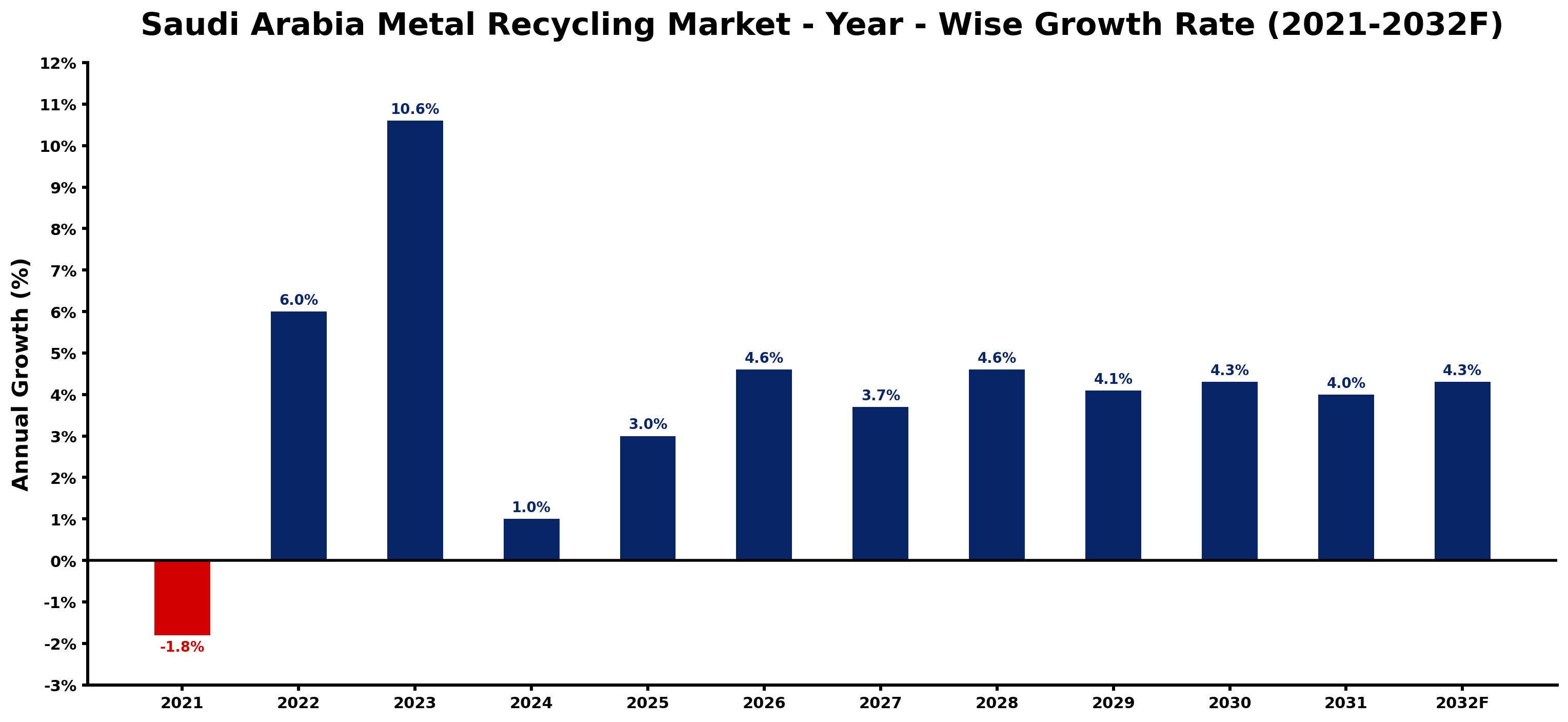
The table below presents the year wise growth rates along with the key drivers influencing the market
| Year | Growth Rate | Major Drivers |
| 2021 | -1.8% | Decreased construction activities hindered metal scrap supply, leading to reduced recycling operations and market contraction. |
| 2022 | 6.0% | Real estate development stimulated local metal scrap collection and processing efforts significantly. |
| 2023 | 10.6% | Integration of advanced recycling technologies improved operational efficiencies across the sector. |
| 2024 | 1.0% | Public awareness campaigns on recycling benefits fostered community participation in metal collection. |
| 2025 | 3.0% | Increased urbanization created higher demand for metal in construction and renovation projects. |
| 2026 | 4.6% | Major infrastructure projects, including Neom, heightened the need for recycled materials. |
| 2027 | 3.7% | Local startups began innovating in metal sorting and processing technologies, boosting sector competitiveness. |
| 2028 | 4.6% | Partnerships between private and public sectors enhanced recycling capabilities and logistics efficiency. |
| 2029 | 4.1% | Emergence of circular economy principles reshaped strategies within the metal recycling industry. |
| 2030 | 4.3% | International collaborations introduced best practices in sustainability and waste reduction initiatives. |
| 2031 | 4.0% | Investment in green technologies aimed at reducing emissions drove market evolution forward. |
| 2032 | 4.3% | Enhanced recycling regulations prompted companies to adopt more sustainable operational methodologies. |
Note - Market size estimations and growth projections presented in this report are based on 6Wresearch's advanced forecasting approach, validated with industry datasets as of June 2026.
Saudi Arabia Metal Recycling Market Synopsis
The Saudi Arabia Metal Recycling Market is projected to reach 4.6% and witness significant growth during the forecast period (2026-2032). This market dynamics is primarily driven by the increasing demand for metals in various sectors, notably in automotive and construction industries. The push towards economic diversification as articulated in the Vision 2030 initiative further enhances the market potential. As infrastructure projects gain momentum, the demand for recycled metals is anticipated to rise, bolstering the market's expansion.
Saudi Arabia Metal Recycling Market Growth Drivers
The growth of the Saudi Arabia Metal Recycling Market is underpinned by several key drivers:
- Increasing Demand from the Automotive Sector: The automotive industry in Saudi Arabia is experiencing robust growth, leading to a heightened demand for recycled metals, which align with sustainability goals and cost efficiency.
- Infrastructure Development: The government's ambitious infrastructure projects, part of the Vision 2030 plan, necessitate significant quantities of metals, thereby driving demand for recycling operations.
- Government Policies: Regulatory frameworks encouraging the use of recycled metals in manufacturing processes boost overall market efficiency and reduce costs for companies.
- Environmental Awareness: Increasing public and corporate focus on sustainability and waste management enhances the appeal of metal recycling as a viable alternative.
- Technological Advancements: Innovations in recycling technologies improve the quality and efficiency of recycling processes, fostering greater adoption in various industries.
Saudi Arabia Metal Recycling Market Trends and Opportunities
The Saudi Arabia Metal Recycling Market is poised for significant transformation owing to emerging trends and opportunities:
- Integration of Advanced Recycling Techniques: The introduction of cutting-edge technologies, such as AI and automation, is streamlining recycling processes, thus enhancing efficiency and output.
- Expansion of Collection and Sorting Facilities: Investment in facilities dedicated to the collection and sorting of recyclable metals is imperative to meet the growing demand and improve recycling rates.
- Collaboration with International Recycling Firms: Partnerships with global recycling entities can leverage expertise and technology to bolster local recycling capabilities.
- Growing Market for Recycled Products: The rise in market acceptance of products made from recycled metals opens new avenues for revenue generation and business expansion.
- Awareness Programs on Recycling: Initiatives aimed at educating businesses and consumers on the benefits of metal recycling can enhance community engagement and participation.
Saudi Arabia Metal Recycling Market Challenges and Restraints
Despite the promising outlook, the Saudi Arabia Metal Recycling Market faces several challenges:
- Market Competition: Increasing competition among local and international players may pressure profit margins and compel companies to innovate consistently.
- Quality Control Issues: Maintaining the quality of recycled metals can be challenging, particularly in the absence of stringent standards.
- Economic Fluctuations: Variability in economic conditions and metal prices can adversely impact the recycling sector's profitability.
- Public Perception: Misconceptions surrounding the quality and reliability of recycled metals may hinder market growth.
- Regulatory Hurdles: Compliance with evolving environmental and safety regulations can pose significant operational challenges for recycling firms.
Saudi Arabia Metal Recycling Market Government Investment and Initiatives
The Saudi government is actively fostering the growth of the metal recycling sector through various initiatives and investments. Under the Vision 2030 framework, there is an emphasis on sustainable practices and economic diversification. Notable government efforts include:
- Incentives for Recycling Companies: Financial incentives are provided to companies engaging in metal recycling to encourage investment and operational expansion.
- Public-Private Partnerships: Collaborations between government entities and private sector players are encouraged to enhance infrastructure and recycling capabilities.
- Development of Recycling Infrastructure: Government initiatives aim to improve the infrastructure necessary for efficient collection and processing of recyclable materials.
- Support for Research and Development: Investment in R&D for innovative recycling technologies is a priority to enhance efficiency and sustainability.
- Environmental Regulations: The establishment of clearer regulations and guidelines for metal recycling promotes better compliance and higher standards in the industry.
Saudi Arabia Metal Recycling Market Latest Developments (May 2025 - June 2026)
In the period from May 2025 to June 2026, the Saudi Arabia Metal Recycling Market has witnessed several notable developments. The emphasis on sustainability has prompted increased efforts in metal collection and recycling processes. There has been a rise in investments by both public and private sectors to enhance recycling capabilities and infrastructure. Companies are increasingly adopting advanced technologies to improve efficiency, reduce costs, and improve the quality of recycled materials. Moreover, collaborations with international recycling firms have become more common, facilitating the transfer of knowledge and practices necessary for modern recycling operations.
Saudi Arabia Metal Recycling Market - Key Attractiveness of the Report
- 10 Years of Market Numbers
- Historical Data Starting from 2022 to 2025
- Base Year: 2025
- Forecast Data until 2032
- Key Performance Indicators Impacting the Market
- Major Upcoming Developments and Projects
Key Highlights of the Report:
- Saudi Arabia Metal Recycling Market Outlook
- Market Size of Saudi Arabia Metal Recycling Market, 2025
- Forecast of Saudi Arabia Metal Recycling Market, 2032F
- Historical Data and Forecast of Saudi Arabia Metal Recycling Revenues & Volume for the Period 2022-2032F
- Saudi Arabia Metal Recycling Market Trend Evolution
- Saudi Arabia Metal Recycling Market Drivers and Challenges
- Saudi Arabia Metal Recycling Price Trends
- Saudi Arabia Metal Recycling Porter's Five Forces
- Saudi Arabia Metal Recycling Industry Life Cycle
- Historical Data and Forecast of Saudi Arabia Metal Recycling Market Revenues & Volume By Metal Type for the Period 2022-2032F
- Historical Data and Forecast of Saudi Arabia Metal Recycling Market Revenues & Volume By Ferrous Metal for the Period 2022-2032F
- Historical Data and Forecast of Saudi Arabia Metal Recycling Market Revenues & Volume By Non-ferrous Metal for the Period 2022-2032F
- Historical Data and Forecast of Saudi Arabia Metal Recycling Market Revenues & Volume By Scrap Types for the Period 2022-2032F
- Historical Data and Forecast of Saudi Arabia Metal Recycling Market Revenues & Volume By Old Scrap for the Period 2022-2032F
- Historical Data and Forecast of Saudi Arabia Metal Recycling Market Revenues & Volume By New Scrap for the Period 2022-2032F
- Historical Data and Forecast of Saudi Arabia Metal Recycling Market Revenues & Volume By Equipment Types for the Period 2022-2032F
- Historical Data and Forecast of Saudi Arabia Metal Recycling Market Revenues & Volume By Shears for the Period 2022-2032F
- Historical Data and Forecast of Saudi Arabia Metal Recycling Market Revenues & Volume By Shredders for the Period 2022-2032F
- Historical Data and Forecast of Saudi Arabia Metal Recycling Market Revenues & Volume By Briquette Machines for the Period 2022-2032F
- Historical Data and Forecast of Saudi Arabia Metal Recycling Market Revenues & Volume By Granulating Machines for the Period 2022-2032F
- Historical Data and Forecast of Saudi Arabia Metal Recycling Market Revenues & Volume By Others for the Period 2022-2032F
- Historical Data and Forecast of Saudi Arabia Metal Recycling Market Revenues & Volume By End-users for the Period 2022-2032F
- Historical Data and Forecast of Saudi Arabia Metal Recycling Market Revenues & Volume By Building & Construction for the Period 2022-2032F
- Historical Data and Forecast of Saudi Arabia Metal Recycling Market Revenues & Volume By Packaging for the Period 2022-2032F
- Historical Data and Forecast of Saudi Arabia Metal Recycling Market Revenues & Volume By Automotive for the Period 2022-2032F
- Historical Data and Forecast of Saudi Arabia Metal Recycling Market Revenues & Volume By Industrial Machinery for the Period 2022-2032F
- Historical Data and Forecast of Saudi Arabia Metal Recycling Market Revenues & Volume By Electronics & Electrical Equipment for the Period 2022-2032F
- Historical Data and Forecast of Saudi Arabia Metal Recycling Market Revenues & Volume By Shipbuilding for the Period 2022-2032F
- Historical Data and Forecast of Saudi Arabia Metal Recycling Market Revenues & Volume By Others for the Period 2022-2032F
- Saudi Arabia Metal Recycling Import Export Trade Statistics
- Market Opportunity Assessment By Metal Type
- Market Opportunity Assessment By Scrap Types
- Market Opportunity Assessment By Equipment Types
- Market Opportunity Assessment By End-users
- Saudi Arabia Metal Recycling Top Companies Market Share
- Saudi Arabia Metal Recycling Competitive Benchmarking By Technical and Operational Parameters
- Saudi Arabia Metal Recycling Company Profiles
- Saudi Arabia Metal Recycling Key Strategic Recommendations






































