Saudi Arabia Microbial Products Market Size, Share & Growth Rate
The Saudi Arabia Microbial Products Market was estimated at USD 294 Million in 2025 and is projected to reach USD 375 Million by 2032, growing at a CAGR of 3.5% from 2026 to 2032. This growth trajectory is propelled by increasing governmental support for sustainable agricultural practices, which drives the adoption of biofertilizers and biopesticides. Additionally, advancements in microbial biotechnology continue to broaden the application spectrum, meeting the needs of various sectors, including agriculture and healthcare.
Saudi Arabia Microbial Products Market Year-wise Growth Rate and Key Drivers
This graph highlights how the Saudi Arabia Microbial Products Market has steadily grown over the years, supported by major growth factors.
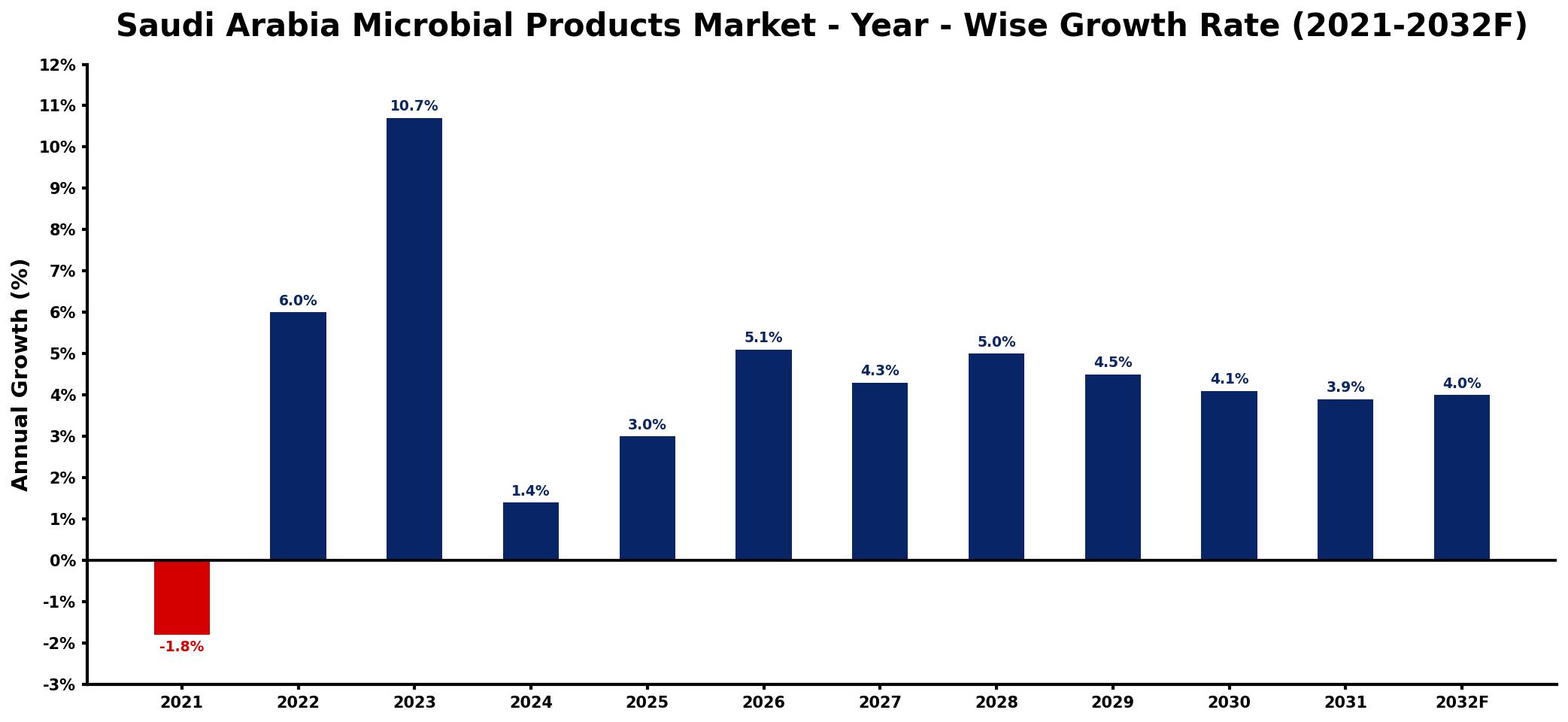
The table below presents the year‑wise growth rates along with the key drivers influencing the market
| Year | Growth Rate | Major Drivers |
| 2021 | -1.8% | decreased industrial production activities |
| 2022 | 6.0% | increased demand for biotechnologies |
| 2023 | 10.7% | growing investments in R&D |
| 2024 | 1.4% | expansion of agricultural applications |
| 2025 | 3.0% | rising consumer health awareness |
| 2026 | 5.1% | enhanced focus on sustainability |
| 2027 | 4.3% | growth in food safety regulations |
| 2028 | 5.0% | development of eco-friendly solutions |
| 2029 | 4.5% | increased funding for innovation |
| 2030 | 4.1% | stronger distribution network expansion |
| 2031 | 3.9% | growing interest in bioengineering |
| 2032 | 4.0% | rising adoption of green technologies |
Note: Market size estimations and growth projections presented in this report are based on 6Wresearch's proprietary forecasting methodology, utilizing the latest available industry data, government publications, and primary research inputs.
Saudi Arabia Microbial Products Market Synopsis
The strong momentum of sustainability in agricultural practices is the defining force currently shaping the Saudi Arabia Microbial Products Market. As farmers seek alternatives to chemical inputs, microbial products provide viable solutions that enhance crop yields and promote soil health while minimizing environmental impact.
Moreover, the convergence of biotechnology and agricultural policy has catalyzed innovative product developments. The emphasis on eco-friendly solutions resonates well with stakeholders, ensuring that microbial products are increasingly viewed as vital components of the agricultural ecosystem.
Saudi Arabia Microbial Products Market Key Takeaways
- The market is witnessing a shift towards sustainable agricultural practices, driving demand for microbial solutions.
- Government initiatives are significantly influencing the growth of the microbial products sector in Saudi Arabia.
- Innovations in microbial strain development are expanding application areas across various industries.
- Awareness of environmental conservation is increasing the adoption of eco-friendly microbial products.
- Supply chain disruptions from the COVID-19 pandemic have created opportunities for market recovery and growth.
Evaluation of Restraints in Saudi Arabia Microbial Products Market
While the Saudi Arabia Microbial Products Market shows promising growth, several challenges impede its full potential. The intricate regulatory landscape surrounding the use of microorganisms in agriculture necessitates stringent compliance, often leading to increased operational costs for companies. This regulatory complexity can delay market entry for new products, affecting overall competitiveness. Additionally, traditional agricultural practices may resist the adoption of microbial solutions, posing a cultural barrier to innovation. Economic uncertainties, particularly linked to fluctuations in oil prices, can also limit investment capabilities within the agricultural sector.
Saudi Arabia Microbial Products Market Trends
Emerging trends in the Saudi Arabia Microbial Products Market include a growing focus on bio-based products and integrated pest management systems. This shift aligns with global trends toward sustainability, as consumers and businesses increasingly demand environmentally friendly agricultural practices. Furthermore, advancements in genetic engineering and microbial strain customization are enhancing product efficacy, thereby expanding the commercial appeal of microbial solutions. The market is also witnessing an upsurge in research collaborations aimed at developing next-generation biopesticides and biofertilizers, reflecting a strong commitment to innovation.
Saudi Arabia Microbial Products Market Opportunities
The potential for growth in the Saudi Arabia Microbial Products Market is robust. As environmental regulations tighten globally, businesses are prompted to seek out sustainable alternatives, presenting an opportune moment for microbial products to gain a foothold. The agricultural sector's growing interest in sustainable practices opens new avenues for biofertilizers and biopesticides, particularly as farmers strive to enhance productivity while minimizing chemical use. Additionally, cross-industry applications, including pharmaceuticals and waste management, provide further growth opportunities as the demand for eco-friendly solutions expands.
Government Initiatives in the Saudi Arabia Microbial Products Market
The Saudi government has been proactive in promoting the agricultural sector, particularly through initiatives aimed at enhancing sustainability. Policies encouraging research and development in biotechnology are fostering innovation in microbial products, while various funding programs aim to support companies focusing on environmentally friendly agricultural solutions. These initiatives not only help in cultivating a competitive landscape but also align with broader national goals of economic diversification and environmental stewardship.
Future Insights of the Saudi Arabia Microbial Products Market
Looking ahead to 2026-2032, the Saudi Arabia Microbial Products Market is positioned for continued growth, driven by a robust focus on sustainable practices within agriculture and industry. As environmental challenges intensify, the demand for effective microbial solutions will likely escalate. Ongoing advancements in biotechnology will further catalyze the emergence of innovative products, ensuring that microbial solutions remain at the forefront of industry initiatives aimed at efficiency and sustainability. This period will also witness an increase in collaborative efforts across sectors, enhancing the visibility and accessibility of microbial products.
Saudi Arabia Microbial Products Market Latest Developments (2025 - 2026)
Recent developments in the Saudi Arabia Microbial Products Market highlight a significant focus on research collaborations and product innovations. Numerous partnerships between academia and industry players are emerging, aimed at accelerating the development of advanced microbial solutions. Additionally, there is a growing trend towards the commercialization of biopesticides, with several products set to launch in the upcoming months, reflecting the market's commitment to sustainable agricultural practices.
Saudi Arabia Microbial Products Market - Key Attractiveness of the Report
- 10 Years of Market Numbers
- Historical Data Starting from 2022 to 2025
- Base Year: 2025
- Forecast Data until 2032
- Key Performance Indicators Impacting the Market
- Major Upcoming Developments and Projects
Key Highlights of the Report:
- Saudi Arabia Microbial Products Market Outlook
- Market Size of Saudi Arabia Microbial Products Market, 2025
- Forecast of Saudi Arabia Microbial Products Market, 2032
- Historical Data and Forecast of Saudi Arabia Microbial Products Revenues & Volume for the Period 2022-2032F
- Saudi Arabia Microbial Products Market Trend Evolution
- Saudi Arabia Microbial Products Market Drivers and Challenges
- Saudi Arabia Microbial Products Price Trends
- Saudi Arabia Microbial Products Porter's Five Forces
- Saudi Arabia Microbial Products Industry Life Cycle
- Historical Data and Forecast of Saudi Arabia Microbial Products Market Revenues & Volume By Types for the Period 2022-2032F
- Historical Data and Forecast of Saudi Arabia Microbial Products Market Revenues & Volume By Enzymes for the Period 2022-2032F
- Historical Data and Forecast of Saudi Arabia Microbial Products Market Revenues & Volume By Polysaccharides for the Period 2022-2032F
- Historical Data and Forecast of Saudi Arabia Microbial Products Market Revenues & Volume By Nutrients for the Period 2022-2032F
- Historical Data and Forecast of Saudi Arabia Microbial Products Market Revenues & Volume By Chemotherapeutic Agents for the Period 2022-2032F
- Historical Data and Forecast of Saudi Arabia Microbial Products Market Revenues & Volume By Antibiotics for the Period 2022-2032F
- Historical Data and Forecast of Saudi Arabia Microbial Products Market Revenues & Volume By Vaccines for the Period 2022-2032F
- Historical Data and Forecast of Saudi Arabia Microbial Products Market Revenues & Volume By Source for the Period 2022-2032F
- Historical Data and Forecast of Saudi Arabia Microbial Products Market Revenues & Volume By Bacterial for the Period 2022-2032F
- Historical Data and Forecast of Saudi Arabia Microbial Products Market Revenues & Volume By Viral for the Period 2022-2032F
- Historical Data and Forecast of Saudi Arabia Microbial Products Market Revenues & Volume By Fungi for the Period 2022-2032F
- Historical Data and Forecast of Saudi Arabia Microbial Products Market Revenues & Volume By Applications for the Period 2022-2032F
- Historical Data and Forecast of Saudi Arabia Microbial Products Market Revenues & Volume By Pharmaceutical for the Period 2022-2032F
- Historical Data and Forecast of Saudi Arabia Microbial Products Market Revenues & Volume By Diagnostic for the Period 2022-2032F
- Historical Data and Forecast of Saudi Arabia Microbial Products Market Revenues & Volume By Biotechnology for the Period 2022-2032F
- Historical Data and Forecast of Saudi Arabia Microbial Products Market Revenues & Volume By End Users for the Period 2022-2032F
- Historical Data and Forecast of Saudi Arabia Microbial Products Market Revenues & Volume By Pharmaceutical And Biotechnological Industries for the Period 2022-2032F
- Historical Data and Forecast of Saudi Arabia Microbial Products Market Revenues & Volume By Hospitals And Clinics for the Period 2022-2032F
- Historical Data and Forecast of Saudi Arabia Microbial Products Market Revenues & Volume By Diagnostic Labs for the Period 2022-2032F
- Historical Data and Forecast of Saudi Arabia Microbial Products Market Revenues & Volume By Research And Academics for the Period 2022-2032F
- Saudi Arabia Microbial Products Import Export Trade Statistics
- Market Opportunity Assessment By Types
- Market Opportunity Assessment By Source
- Market Opportunity Assessment By Applications
- Market Opportunity Assessment By End Users
- Saudi Arabia Microbial Products Top Companies Market Share
- Saudi Arabia Microbial Products Competitive Benchmarking By Technical and Operational Parameters
- Saudi Arabia Microbial Products Company Profiles
- Saudi Arabia Microbial Products Key Strategic Recommendations






































