Saudi Arabia Military Radar Market Size, Share & Growth Rate
The Saudi Arabia Military Radar Market was estimated at USD 370 Million in 2025 and is projected to reach USD 473 Million by 2032, growing at a CAGR of 3.6% from 2026 to 2032. This growth trajectory is largely driven by the kingdom's strategic imperative to strengthen its defense capabilities in the face of escalating regional tensions and evolving security threats. Continued investments in modern radar technologies are expected as the government focuses on improving situational awareness and air defense capabilities.
Saudi Arabia Military Radar Market Year-wise Growth Rate and Key Drivers
This graph highlights how the Saudi Arabia Military Radar Market has steadily grown over the years, supported by major growth factors.
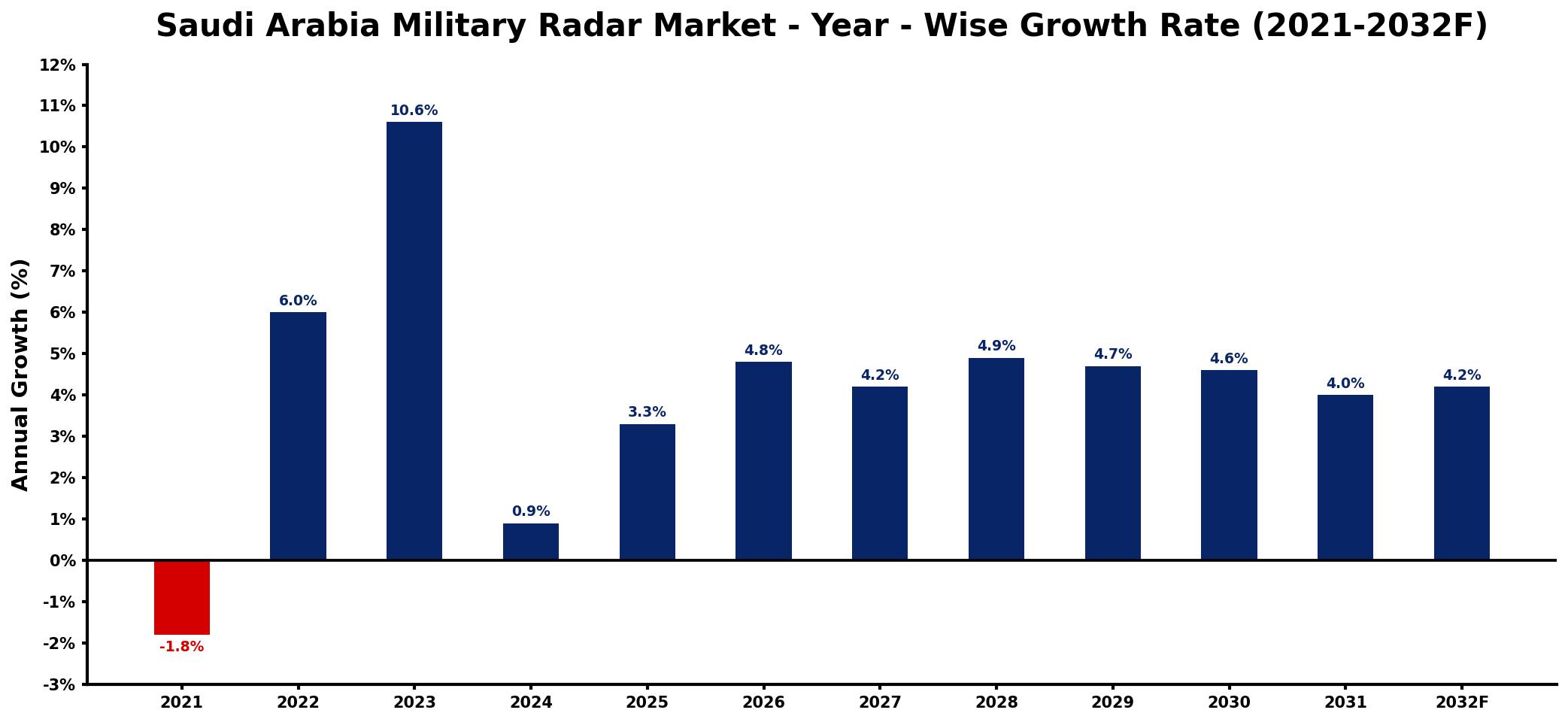
The table below presents the year‑wise growth rates along with the key drivers influencing the market
| Year | Growth Rate | Major Drivers |
| 2021 | -1.8% | Decreased defense spending initiatives |
| 2022 | 6.0% | Increased regional security investments |
| 2023 | 10.6% | Expansion of defense technology partnerships |
| 2024 | 0.9% | Growing demand for surveillance systems |
| 2025 | 3.3% | Rising geopolitical tensions driving needs |
| 2026 | 4.8% | Enhanced focus on border protection |
| 2027 | 4.2% | Strengthening defense modernization programs |
| 2028 | 4.9% | Boosting domestic production capabilities |
| 2029 | 4.7% | Growing interest in advanced technologies |
| 2030 | 4.6% | rising export shipment volumes |
| 2031 | 4.0% | Heightened investments in defense infrastructure |
| 2032 | 4.2% | Growing emphasis on national security |
Note: Market size estimations and growth projections presented in this report are based on 6Wresearch's proprietary forecasting methodology, utilizing the latest available industry data, government publications, and primary research inputs.
Saudi Arabia Military Radar Market Synopsis
The military radar market in Saudi Arabia is evolving rapidly, influenced by both geopolitical dynamics and technological advancements. With a robust focus on enhancing its national defense, the Saudi government is prioritizing the development and integration of advanced radar systems, vital for effective surveillance and threat detection.
Recent advancements such as phased-array radar systems have become increasingly relevant, reflecting the nation's dedication to maintaining a competitive edge in defense. Collaborations with international defense firms further emphasize the importance of this market in ensuring the security of the Saudi state.
Saudi Arabia Military Radar Market Key Takeaways
- The market is projected to grow steadily, driven by rising regional security concerns.
- Investments in advanced radar technologies are a priority for the Saudi government.
- International collaborations are crucial for technology transfer and defense capabilities.
- Modernization efforts in defense systems underscore the significance of military radar.
- Regulatory frameworks and technology integration pose ongoing challenges in the market.
Evaluation of Restraints in Saudi Arabia Military Radar Market
Despite the promising growth prospects, the Saudi Arabia Military Radar Market faces significant restraints. Key among these are stringent regulatory frameworks that govern defense procurement and technology transfer, potentially hindering timely implementation of new systems. Furthermore, the market's reliance on the integration of sophisticated radar technologies demands a skilled workforce, which can be difficult to cultivate in a region facing varied operational conditions. These challenges necessitate that industry players navigate a complex landscape to deliver effective and secure radar solutions.
Saudi Arabia Military Radar Market Trends
Emerging trends in the Saudi Arabia Military Radar Market include a significant shift towards the deployment of integrated radar systems that combine surveillance, tracking, and targeting capabilities. Phased-array radar technology is gaining traction, offering enhanced accuracy and quicker response times, critical for national defense. Additionally, the integration of artificial intelligence and machine learning into radar systems is beginning to reshape operational strategies, improving threat detection and response efficiency.
Saudi Arabia Military Radar Market Opportunities
The landscape of the Saudi Arabia Military Radar Market is rife with opportunities, particularly in the realm of local defense manufacturing. The government's commitment to diversify its economy presents a chance for domestic firms to engage in the development of radar systems, potentially reducing dependency on foreign technology. Moreover, with increasing focus on enhancing cybersecurity within military operations, there is a burgeoning demand for radar systems that ensure secure communication and information integrity.
Government Initiatives in the Saudi Arabia Military Radar Market
The Saudi government has undertaken several initiatives aimed at bolstering its military capabilities, including substantial public spending on defense technologies. Through its Vision 2030 plan, there is a clear directive to invest in local industries, enhance defense manufacturing, and promote research and development in advanced technologies, including radar systems. These initiatives are designed to establish a more self-sufficient and strategically autonomous defense infrastructure.
Future Insights of the Saudi Arabia Military Radar Market
Looking ahead to the years 2026-2032, the Saudi Arabia Military Radar Market is poised for growth as the nation continues its commitment to modernizing defense capabilities. The increasing complexity of regional security threats will necessitate ongoing investments in advanced radar technology. Additionally, as the country seeks to enhance its domestic defense manufacturing capabilities, collaborations with global defense firms will likely remain vital in fostering innovation and ensuring the deployment of state-of-the-art radar systems.
Saudi Arabia Military Radar Market Latest Developments (2025 - 2026)
Recent developments in the Saudi Arabia Military Radar Market indicate a continued emphasis on modernizing radar systems in line with national defense strategies. The government has been actively engaging in partnerships with international defense firms to upgrade existing radar technologies while also exploring opportunities for domestic production. As geopolitical dynamics evolve, there has been a noticeable uptick in research activities aimed at enhancing situational awareness and threat detection capabilities across the region.
Saudi Arabia Military Radar Market - Key Attractiveness of the Report
- 10 Years of Market Numbers
- Historical Data Starting from 2022 to 2025
- Base Year: 2025
- Forecast Data until 2032
- Key Performance Indicators Impacting the Market
- Major Upcoming Developments and Projects
Key Highlights of the Report:
- Saudi Arabia Military Radar Market Outlook
- Market Size of Saudi Arabia Military Radar Market, 2025
- Forecast of Saudi Arabia Military Radar Market, 2032
- Historical Data and Forecast of Saudi Arabia Military Radar Revenues & Volume for the Period 2022-2032F
- Saudi Arabia Military Radar Market Trend Evolution
- Saudi Arabia Military Radar Market Drivers and Challenges
- Saudi Arabia Military Radar Price Trends
- Saudi Arabia Military Radar Porter's Five Forces
- Saudi Arabia Military Radar Industry Life Cycle
- Historical Data and Forecast of Saudi Arabia Military Radar Market Revenues & Volume By Platform for the Period 2022-2032F
- Historical Data and Forecast of Saudi Arabia Military Radar Market Revenues & Volume By Airborne Radar for the Period 2022-2032F
- Historical Data and Forecast of Saudi Arabia Military Radar Market Revenues & Volume By Land Radar for the Period 2022-2032F
- Historical Data and Forecast of Saudi Arabia Military Radar Market Revenues & Volume By Naval Radar for the Period 2022-2032F
- Historical Data and Forecast of Saudi Arabia Military Radar Market Revenues & Volume By Range for the Period 2022-2032F
- Historical Data and Forecast of Saudi Arabia Military Radar Market Revenues & Volume By Long for the Period 2022-2032F
- Historical Data and Forecast of Saudi Arabia Military Radar Market Revenues & Volume By Medium for the Period 2022-2032F
- Historical Data and Forecast of Saudi Arabia Military Radar Market Revenues & Volume By Short for the Period 2022-2032F
- Historical Data and Forecast of Saudi Arabia Military Radar Market Revenues & Volume By Very Short for the Period 2022-2032F
- Historical Data and Forecast of Saudi Arabia Military Radar Market Revenues & Volume By Application for the Period 2022-2032F
- Historical Data and Forecast of Saudi Arabia Military Radar Market Revenues & Volume By Weapon Guidance for the Period 2022-2032F
- Historical Data and Forecast of Saudi Arabia Military Radar Market Revenues & Volume By Airspace Monitoring & Traffic Management for the Period 2022-2032F
- Historical Data and Forecast of Saudi Arabia Military Radar Market Revenues & Volume By Airborne Mapping for the Period 2022-2032F
- Historical Data and Forecast of Saudi Arabia Military Radar Market Revenues & Volume By Ground Surveillance & Intruder Detection for the Period 2022-2032F
- Historical Data and Forecast of Saudi Arabia Military Radar Market Revenues & Volume By Navigation for the Period 2022-2032F
- Historical Data and Forecast of Saudi Arabia Military Radar Market Revenues & Volume By Others for the Period 2022-2032F
- Historical Data and Forecast of Saudi Arabia Military Radar Market Revenues & Volume By Frequency for the Period 2022-2032F
- Historical Data and Forecast of Saudi Arabia Military Radar Market Revenues & Volume By C-Band for the Period 2022-2032F
- Historical Data and Forecast of Saudi Arabia Military Radar Market Revenues & Volume By S-Band for the Period 2022-2032F
- Historical Data and Forecast of Saudi Arabia Military Radar Market Revenues & Volume By X-Band for the Period 2022-2032F
- Historical Data and Forecast of Saudi Arabia Military Radar Market Revenues & Volume By L-Band for the Period 2022-2032F
- Historical Data and Forecast of Saudi Arabia Military Radar Market Revenues & Volume By UHF/VHF for the Period 2022-2032F
- Historical Data and Forecast of Saudi Arabia Military Radar Market Revenues & Volume By Ku/K/Ka-Band for the Period 2022-2032F
- Historical Data and Forecast of Saudi Arabia Military Radar Market Revenues & Volume By Component for the Period 2022-2032F
- Historical Data and Forecast of Saudi Arabia Military Radar Market Revenues & Volume By Transmitter for the Period 2022-2032F
- Historical Data and Forecast of Saudi Arabia Military Radar Market Revenues & Volume By Antenna for the Period 2022-2032F
- Historical Data and Forecast of Saudi Arabia Military Radar Market Revenues & Volume By Receiver for the Period 2022-2032F
- Historical Data and Forecast of Saudi Arabia Military Radar Market Revenues & Volume By Duplexer for the Period 2022-2032F
- Historical Data and Forecast of Saudi Arabia Military Radar Market Revenues & Volume By Others for the Period 2022-2032F
- Saudi Arabia Military Radar Import Export Trade Statistics
- Market Opportunity Assessment By Platform
- Market Opportunity Assessment By Range
- Market Opportunity Assessment By Application
- Market Opportunity Assessment By Frequency
- Market Opportunity Assessment By Component
- Saudi Arabia Military Radar Top Companies Market Share
- Saudi Arabia Military Radar Competitive Benchmarking By Technical and Operational Parameters
- Saudi Arabia Military Radar Company Profiles
- Saudi Arabia Military Radar Key Strategic Recommendations






































