Saudi Arabia Mortar Market Summary
The saudi arabia mortar market was estimated at USD 251 Million in 2025 and is projected to reach USD 323 Million by 2032, growing at a CAGR of 4.9% from 2026 to 2032.
Saudi Arabia Mortar Market Year-wise Growth Rate and Key Drivers
This graph highlights how the Saudi Arabia Mortar Market has steadily grown over the past five years, supported by major growth factors.
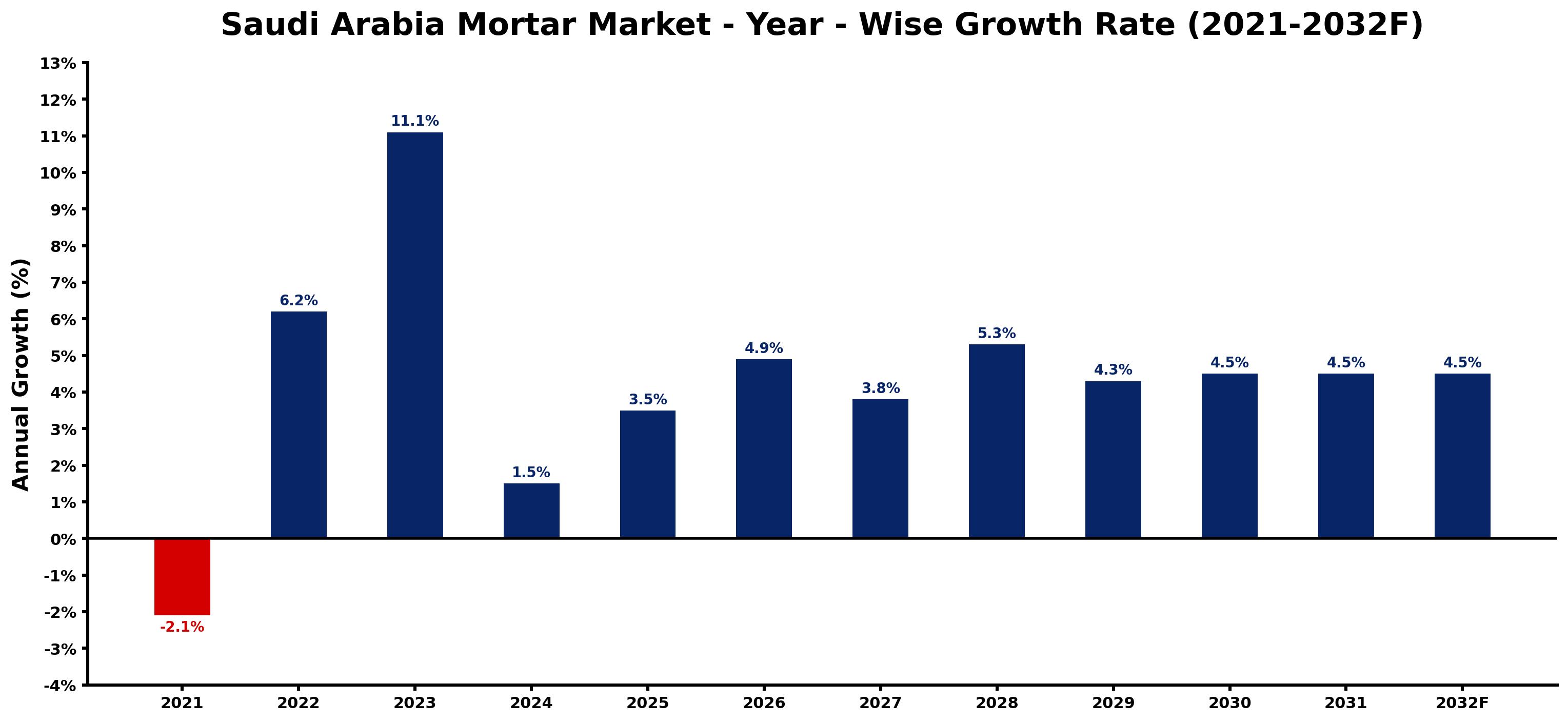
The table below presents the year wise growth rates along with the key drivers influencing the market
| Year | Growth Rate | Major Drivers |
| 2021 | -2.1% | Heightened competition from alternative construction materials decreased demand for traditional mortar products in 2021. |
| 2022 | 6.2% | Ongoing urban development projects laid the groundwork for increased mortar requirements. |
| 2023 | 11.1% | Major investments in infrastructure align with Vision 2030 objectives, boosting market growth. |
| 2024 | 1.5% | Local manufacturers ramped up production to meet emerging construction sector demands. |
| 2025 | 3.5% | High-profile projects in Neom are expected to drive demand for specialized mortar solutions. |
| 2026 | 4.9% | Expansion of residential developments underscores the need for durable construction materials. |
| 2027 | 3.8% | Technological innovations in mortar formulation enhance performance in extreme climates. |
| 2028 | 5.3% | Public-private partnerships are enabling large-scale investments in construction projects. |
| 2029 | 4.3% | Sustainability trends prompt shifts toward eco-friendly mortar production methods. |
| 2030 | 4.5% | Increased foreign investments reflect confidence in the stability of the construction sector. |
| 2031 | 4.5% | Emerging construction techniques necessitate new mortar applications for specialized projects. |
| 2032 | 4.5% | A robust supply chain network ensures timely delivery of materials across the region. |
Note - Market size estimations and growth projections presented in this report are based on 6Wresearch's advanced forecasting approach, validated with industry datasets as of June 2026.
Saudi Arabia Mortar Market Synopsis
The Saudi Arabia Mortar Market is projected to reach 4.9% and witness significant growth during the forecast period (2026-2032). The expansion of this market is largely driven by a combination of factors, including a rising population, increased construction projects, and advancements in infrastructure development. These elements are fostering a robust environment conducive to the increased demand for mortar products throughout the country.
Saudi Arabia Mortar Market Growth Drivers
The growth trajectory of the Saudi Arabia Mortar Market is bolstered by several key drivers:
- The consistent growth of the Saudi Arabian population reflects its ongoing economic activities, leading to higher disposable income levels among households. This dynamic fosters an increased demand for residential buildings and, consequently, mortar products.
- With the government's Vision 2031 program, there is a clear push towards enhancing domestic investments across various sectors, especially construction. This initiative is projected to significantly elevate the demand for mortars in both residential and non-residential projects.
- The expansion of urban development projects creates an urgent requirement for high-quality construction materials, including mortars, which are critical for infrastructure undertakings such as roads and hospitals.
- Technological advancements in the manufacturing processes of mortar have improved product quality and operational efficiency, further expanding the applications and competitive edge of mortar products in the construction sector.
- Private sector investment in housing and commercial real estate continues to escalate, providing a substantial boost to market demand as developers increasingly seek reliable mortar solutions for their projects.
Saudi Arabia Mortar Market Challenges and Restraints
Despite its robust growth, the Saudi Arabia Mortar Market faces several challenges that can hinder progress:
- Installation processes for mortar can be complex and costly. High labor costs associated with skilled installation often deter smaller contractors from fully leveraging the opportunities in this market.
- There is a notable shortage of skilled professionals adept in mortar installation, leading to inefficiencies and potential project delays. The gap between the required expertise and current availability poses a significant challenge.
- The fluctuating prices of raw materials used in the production of mortar can contribute to unpredictable market dynamics, complicating budgeting for construction projects.
- COVID-19 has had lingering effects on the supply chain and production capabilities, leading to short-term disruptions. Although recovery is anticipated, these impacts may still resonate in the near term.
- Market saturation in some segments could lead to fierce competition among suppliers, impacting pricing strategies and market entry for new players.
Saudi Arabia Mortar Market Government Investment and Initiatives
The government's active engagement in infrastructure development illustrates its commitment to enhancing the Saudi Arabia Mortar Market:
- Vision 2031 is a comprehensive roadmap aiming to diversify the economy beyond oil, encouraging investments in construction and urban development that bolster demand for mortars.
- Substantial public spending plans are in place to modernize transportation networks, housing, and communal facilities, all of which directly influence the demand for various types of mortars.
- The introduction of favorable policies and incentives for construction firms is fostering a competitive landscape, encouraging local manufacturers to innovate and enhance product offerings.
- Public-private partnerships are being promoted to stimulate investment in infrastructure projects, further driving the need for quality construction materials, including mortars.
- Improved regulatory frameworks aim to facilitate smoother project approvals, thus expediting construction timelines and increasing mortar demand in the short term.
Saudi Arabia Mortar Market Latest Developments (May 2025 - June 2026)
In the period from May 2025 to June 2026, several significant developments have influenced the Saudi Arabia Mortar Market:
- Increased collaboration between government agencies and private sector companies has been observed, aimed at expanding infrastructure projects and improving urban living standards.
- There has been a noticeable shift towards more sustainable mortar solutions, with manufacturers focusing on eco-friendly materials that align with the country's environmental goals.
- Innovations in mortar formulations have emerged, catering to the need for products that accommodate the country's diverse climate and geological conditions.
- Enhanced logistics and supply chain management practices are being adopted to mitigate previous disruptions experienced during the pandemic, ensuring timely delivery of mortar products to construction sites.
- Market dynamics have shifted, with a greater emphasis on digitalization in procurement processes, enabling construction firms to source materials more efficiently, thereby boosting overall market activity.
Saudi Arabia Mortar Market - Key Attractiveness of the Report
- 10 Years of Market Numbers
- Historical Data Starting from 2022 to 2025
- Base Year: 2025
- Forecast Data until 2032
- Key Performance Indicators Impacting the Market
- Major Upcoming Developments and Projects
Key Highlights of the Report:
- Saudi Arabia Mortar Market Outlook
- Market Size of Saudi Arabia Mortar Market, 2025
- Forecast of Saudi Arabia Mortar Market, 2032
- Historical Data and Forecast of Saudi Arabia Mortar Revenues & Volume for the Period 2022-2032F
- Saudi Arabia Mortar Market Trend Evolution
- Saudi Arabia Mortar Market Drivers and Challenges
- Saudi Arabia Mortar Price Trends
- Saudi Arabia Mortar Porter's Five Forces
- Saudi Arabia Mortar Industry Life Cycle
- Historical Data and Forecast of Saudi Arabia Mortar Market Revenues & Volume By Type for the Period 2022-2032F
- Historical Data and Forecast of Saudi Arabia Mortar Market Revenues & Volume By Wet Mixed Mortar for the Period 2022-2032F
- Historical Data and Forecast of Saudi Arabia Mortar Market Revenues & Volume By Dry Mortar for the Period 2022-2032F
- Historical Data and Forecast of Saudi Arabia Mortar Market Revenues & Volume By Application for the Period 2022-2032F
- Historical Data and Forecast of Saudi Arabia Mortar Market Revenues & Volume By Construction Industry for the Period 2022-2032F
- Historical Data and Forecast of Saudi Arabia Mortar Market Revenues & Volume By Home Decoration Industry for the Period 2022-2032F
- Historical Data and Forecast of Saudi Arabia Mortar Market Revenues & Volume By Others for the Period 2022-2032F
- Saudi Arabia Mortar Import Export Trade Statistics
- Market Opportunity Assessment By Type
- Market Opportunity Assessment By Application
- Saudi Arabia Mortar Top Companies Market Share
- Saudi Arabia Mortar Competitive Benchmarking By Technical and Operational Parameters
- Saudi Arabia Mortar Company Profiles
- Saudi Arabia Mortar Key Strategic Recommendations






































