Saudi Arabia Motorcycle Saddle Market Size, Share & Growth Rate
The Saudi Arabia Motorcycle Saddle Market was estimated at USD 308 Million in 2025 and is projected to reach USD 396 Million by 2032, growing at a CAGR of 3.7% from 2026 to 2032. This growth trajectory is driven by a rising demand for comfortable and ergonomic motorcycle accessories as motorcycling gains traction among both commuting and leisure riders. Furthermore, the increasing focus on enhancing rider experience and posture is propelling manufacturers to innovate in saddle design and materials.
Saudi Arabia Motorcycle Saddle Market Year-wise Growth Rate and Key Drivers
This graph highlights how the Saudi Arabia Motorcycle Saddle Market has steadily grown over the years, supported by major growth factors.
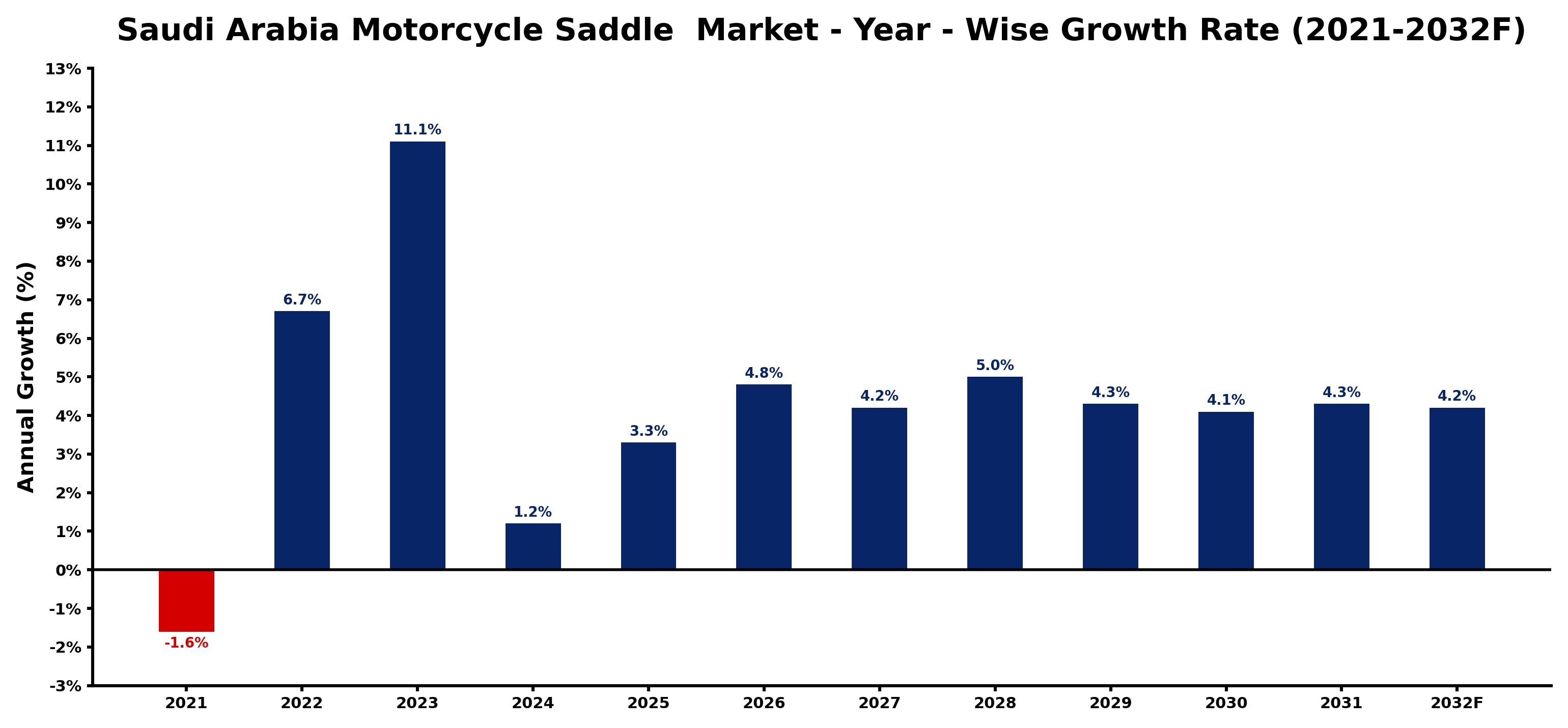
The table below presents the year‑wise growth rates along with the key drivers influencing the market
| Year | Growth Rate | Major Drivers |
| 2021 | -1.6% | Supply chain disruptions hindered motorcycle component availability and production |
| 2022 | 6.7% | Refinery upgrades enhanced demand for durable motorcycle saddle materials |
| 2023 | 11.1% | Vision 2030 initiatives stimulate motorcycle production and local assembly investments |
| 2024 | 1.2% | Increased motorcycle manufacturing capacity supports local supply chain growth |
| 2025 | 3.3% | Modernized supply chain logistics optimize motorcycle saddle manufacturing efficiency |
| 2026 | 4.8% | Vision 2030 projects drive motorcycle saddle manufacturing capacity upgrades |
| 2027 | 4.2% | Manufacturing investments boost domestic production of motorcycle components |
| 2028 | 5.0% | New motorcycle manufacturing facilities boost local parts supply chain |
| 2029 | 4.3% | Capacity utilization advancements boosted motorcycle saddle manufacturing output |
| 2030 | 4.1% | Smart manufacturing integration drives motorcycle saddle production efficiency |
| 2031 | 4.3% | Petrochemical sector growth drives demand for motorcycle component manufacturing |
| 2032 | 4.2% | Motorcycle saddle manufacturing aligns with petrochemical production capacity boosts |
Note - Market size estimations and growth projections presented in this report are based on 6Wresearch’s advanced forecasting approach, validated with industry datasets as of June 2026.
Saudi Arabia Motorcycle Saddle Market Synopsis
The Saudi Arabia motorcycle saddle market is undergoing a notable transformation, driven by a growing appreciation for the comfort and ergonomics that quality saddles provide. As motorcycling continues to gain popularity as both a practical mode of transport and a recreational activity, the significance of well-designed saddles becomes ever more apparent.
Notably, manufacturers are increasingly focusing on developing saddles that enhance rider comfort and align with various motorcycle models. The burgeoning interest in outdoor and leisure activities, particularly in the post-pandemic era, has fueled the demand for innovative products that cater to the evolving needs of riders in Saudi Arabia.
Saudi Arabia Motorcycle Saddle Market Key Takeaways
- The market is poised for growth due to the rising demand for ergonomic and comfortable motorcycle accessories.
- Post-pandemic recovery is leading to increased recreational motorcycling, enhancing saddle demand.
- Innovation in materials and design is essential for manufacturers to capture market share.
- The consumer shift towards outdoor activities is driving new product development in motorcycle saddles.
- Strong emphasis on rider comfort and experience is becoming a key market differentiator.
Evaluation of Restraints in Saudi Arabia Motorcycle Saddle Market
While the Saudi Arabia motorcycle saddle market presents numerous growth opportunities, it is not without its challenges. The COVID-19 pandemic severely impacted the motorcycle and automotive industries, leading to disrupted supply chains and decreased consumer spending on non-essential items. Additionally, fluctuating raw material prices can hinder manufacturers' ability to deliver competitively priced products. A cautious approach to investment and product development is necessary as the market rebounds and adapts to new consumer expectations in terms of comfort and design.
Saudi Arabia Motorcycle Saddle Market Trends
Emerging trends in the Saudi Arabia motorcycle saddle market reflect a growing emphasis on customization and personalization. Riders are increasingly seeking saddles that not only meet comfort standards but also resonate with their unique styles and preferences. Moreover, advancements in materials technology, such as memory foam and gel cushioning, are enhancing the overall riding experience, addressing long-term comfort concerns.
Sustainability is another key trend influencing market dynamics. As environmental consciousness rises, manufacturers are exploring eco-friendly materials and sustainable production processes, appealing to a more eco-aware consumer base.
Saudi Arabia Motorcycle Saddle Market Opportunities
The growth potential in the Saudi Arabian motorcycle saddle market lies in the ability to innovate and adapt to consumer demands. Opportunities for manufacturers include developing saddles that incorporate smart technology for enhanced comfort and safety features. Additionally, there is a significant market for aftermarket saddles, which can be tailored to improve the performance of existing motorcycles. Targeting diverse demographics, from commuters to recreational riders, can further expand market reach.
Government Initiatives in the Saudi Arabia Motorcycle Saddle Market
The Saudi government is actively promoting motorcycling as a sustainable and efficient mode of transportation within its Vision 2030 framework. Initiatives include enhancing road safety and infrastructure to accommodate two-wheeled vehicles, thus indirectly supporting the motorcycle saddle market. Public spending on recreational facilities is also encouraging more people to engage in motorcycling, which can boost demand for high-quality saddles.
Future Insights of the Saudi Arabia Motorcycle Saddle Market
Looking ahead, the Saudi Arabia motorcycle saddle market is expected to flourish between 2026 and 2032 as motorcycling continues to gain popularity. The focus on rider comfort and health will push manufacturers towards more innovative, ergonomic designs. As outdoor activities become more integrated into lifestyle choices, the motorcycle saddle market is poised to adapt swiftly, catering to the evolving expectations of a diverse rider base.
Saudi Arabia Motorcycle Saddle Market Latest Developments (May 2025 - June 2026)
Recent developments in the Saudi Arabia motorcycle saddle market indicate a shift towards greater emphasis on customization and rider engagement. Companies are increasingly engaging with consumers to gather feedback and preferences, leading to more personalized product offerings. The integration of technology in saddle design, such as temperature control and smart cushioning, is becoming a focus area, driving innovation and excitement within the market.
Saudi Arabia Motorcycle Saddle Market - Key Attractiveness of the Report
- 10 Years of Market Numbers
- Historical Data Starting from 2022 to 2025
- Base Year: 2025
- Forecast Data until 2032
- Key Performance Indicators Impacting the Market
- Major Upcoming Developments and Projects
Key Highlights of the Report:
- Saudi Arabia Motorcycle Saddle Market Outlook
- Market Size of Saudi Arabia Motorcycle Saddle Market, 2025
- Forecast of Saudi Arabia Motorcycle Saddle Market, 2032
- Historical Data and Forecast of Saudi Arabia Motorcycle Saddle Revenues & Volume for the Period 2022-2032F
- Saudi Arabia Motorcycle Saddle Market Trend Evolution
- Saudi Arabia Motorcycle Saddle Market Drivers and Challenges
- Saudi Arabia Motorcycle Saddle Price Trends
- Saudi Arabia Motorcycle Saddle Porter's Five Forces
- Saudi Arabia Motorcycle Saddle Industry Life Cycle
- Historical Data and Forecast of Saudi Arabia Motorcycle Saddle Market Revenues & Volume By Type for the Period 2022-2032F
- Historical Data and Forecast of Saudi Arabia Motorcycle Saddle Market Revenues & Volume By Foam Seat for the Period 2022-2032F
- Historical Data and Forecast of Saudi Arabia Motorcycle Saddle Market Revenues & Volume By Gel Seat for the Period 2022-2032F
- Historical Data and Forecast of Saudi Arabia Motorcycle Saddle Market Revenues & Volume By Application for the Period 2022-2032F
- Historical Data and Forecast of Saudi Arabia Motorcycle Saddle Market Revenues & Volume By OEM for the Period 2022-2032F
- Historical Data and Forecast of Saudi Arabia Motorcycle Saddle Market Revenues & Volume By Aftermarket for the Period 2022-2032F
- Saudi Arabia Motorcycle Saddle Import Export Trade Statistics
- Market Opportunity Assessment By Type
- Market Opportunity Assessment By Application
- Saudi Arabia Motorcycle Saddle Top Companies Market Share
- Saudi Arabia Motorcycle Saddle Competitive Benchmarking By Technical and Operational Parameters
- Saudi Arabia Motorcycle Saddle Company Profiles
- Saudi Arabia Motorcycle Saddle Key Strategic Recommendations






































