Saudi Arabia Perchloroethylene Market Size, Share & Growth Rate
The Saudi Arabia Perchloroethylene Market was estimated at USD 286 Million in 2025 and is projected to reach USD 368 Million by 2032, growing at a CAGR of 3.7% from 2026 to 2032. This growth trajectory is largely driven by the expanding textile and dry-cleaning industries, where perchloroethylene continues to be the solvent of choice for effective cleaning and degreasing. Additionally, as consumer demand for high-quality and well-maintained clothing rises, the market is expected to benefit significantly.
Saudi Arabia Perchloroethylene Market Year-wise Growth Rate and Key Drivers
This graph highlights how the Saudi Arabia Perchloroethylene Market has steadily grown over the years, supported by major growth factors.
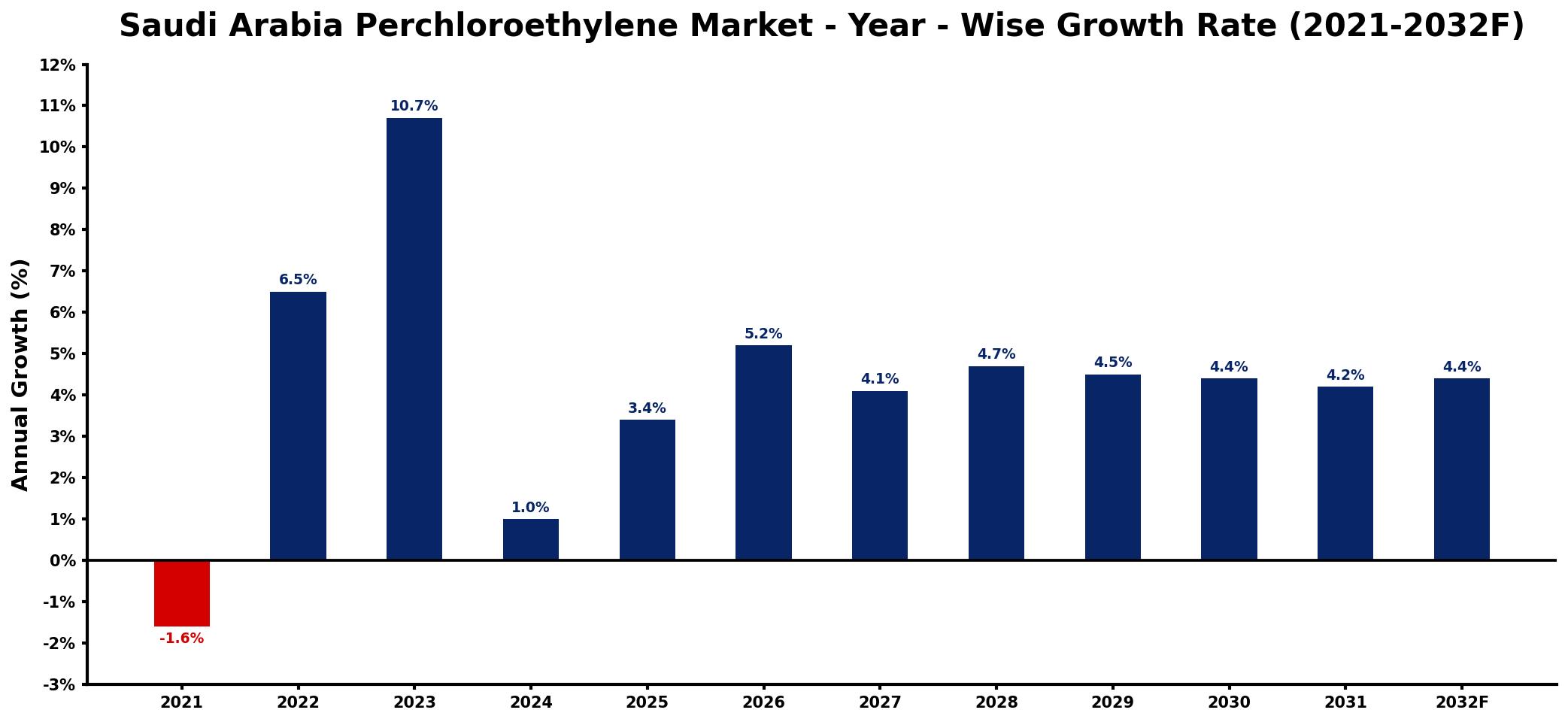
The table below presents the year‑wise growth rates along with the key drivers influencing the market
| Year | Growth Rate | Major Drivers |
| 2021 | -1.6% | Decreased industrial cleaning activities |
| 2022 | 6.5% | Rising demand from textile industry |
| 2023 | 10.7% | Increased investments in manufacturing |
| 2024 | 1.0% | Growth in automotive maintenance services |
| 2025 | 3.4% | Expansion of dry cleaning sector |
| 2026 | 5.2% | Surge in electronics production needs |
| 2027 | 4.1% | Growing focus on environmental regulations |
| 2028 | 4.7% | Increased production in chemical sector |
| 2029 | 4.5% | improved raw material availability |
| 2030 | 4.4% | enhanced product quality standards |
| 2031 | 4.2% | growing regional consumption patterns |
| 2032 | 4.4% | Increased usage in paint formulations |
Note: Market size estimations and growth projections presented in this report are based on 6Wresearch's proprietary forecasting methodology, utilizing the latest available industry data, government publications, and primary research inputs.
Saudi Arabia Perchloroethylene Market Synopsis
The most significant force shaping the Saudi Arabia perchloroethylene market is the dual pressure of demand from the textile sector and increasing environmental regulations. This dynamic creates a complex landscape, where traditional practices are being scrutinized for their ecological impacts, yet the need for reliable and efficient cleaning solutions persists.
As the dry-cleaning industry seeks to adapt to regulatory changes, the market reflects a shift towards exploring sustainable practices and alternatives to traditional solvents. While perchloroethylene remains indispensable in current operations, industry players are increasingly motivated to innovate and comply with stricter environmental standards.
Saudi Arabia Perchloroethylene Market Key Takeaways
- The growth of the textile and dry-cleaning industries is a primary driver for the market.
- Environmental regulations are compelling companies to seek alternatives to perchloroethylene.
- The COVID-19 pandemic temporarily reduced demand but also highlighted the need for market resilience.
- Key players are investing in sustainable practices to align with regulatory changes.
- Despite challenges, the market is set for a steady recovery and growth through 2032.
Evaluation of Restraints in Saudi Arabia Perchloroethylene Market
The market is currently facing significant restraints, primarily stemming from the tightening of environmental regulations regarding perchloroethylenes usage. Classified as a hazardous air pollutant, this solvent poses risks that are increasingly recognized by regulators and the public alike. The need for compliance and the pressure to transition towards more sustainable alternatives could hinder the growth potential for businesses relying on traditional processes. Furthermore, the market's historical dependency on perchloroethylene may delay the integration of greener technologies, presenting a dual challenge of innovation and regulatory adaptation.
Saudi Arabia Perchloroethylene Market Trends
Current trends indicate a shift towards sustainable practices as companies within the perchloroethylene market respond to both consumer and regulatory demands for greener solutions. Innovations in the dry-cleaning sector are emerging, with businesses exploring non-toxic and environmentally friendly solvents. Additionally, the rise of advanced cleaning technologies is paving the way for more efficient and less harmful applications in industrial contexts, highlighting an increasing commitment to sustainability.
Saudi Arabia Perchloroethylene Market Opportunities
Opportunities for growth within the Saudi Arabia perchloroethylene market lie predominantly in the development of alternative solvents and cleaning methods. As manufacturers and service providers invest in research and development, there is potential for new products that can meet both cleaning efficacy and safety standards. Furthermore, the expanding textile industry presents a continuous demand for perchloroethylene, especially in regions undergoing economic diversification and growth.
Government Initiatives in the Saudi Arabia Perchloroethylene Market
The Saudi government is actively promoting initiatives to address environmental concerns associated with hazardous substances like perchloroethylene. Regulatory frameworks are evolving to encourage cleaner technologies and practices, incentivizing industries to adopt alternative solvents. Such government policies not only aim to safeguard public health and the environment but also foster innovation and competitive growth within the market, aligning with national sustainability goals.
Future Insights of the Saudi Arabia Perchloroethylene Market
Looking ahead to 2026-2032, the Saudi Arabia perchloroethylene market is expected to navigate a landscape characterized by increased regulatory scrutiny and environmental consciousness. Companies that proactively adapt to these changes and invest in sustainable technologies will likely gain a competitive edge. As the industry moves toward greener practices, the need for effective alternatives will shape market dynamics, ultimately leading to a more diversified and resilient operational framework.
Saudi Arabia Perchloroethylene Market Latest Developments (2025 - 2026)
Recent developments in the Saudi Arabia perchloroethylene market have emphasized sustainability and innovation. Various industry players are exploring advanced cleaning technologies and eco-friendly alternatives, signaling a shift in focus that aligns with regulatory mandates. Additionally, collaborations among businesses and research institutions are gaining traction, aimed at accelerating the transition towards greener practices while maintaining operational efficacy. These directional shifts underscore a commitment to both environmental stewardship and market resilience.
Saudi Arabia Perchloroethylene Market - Key Attractiveness of the Report
- 10 Years of Market Numbers
- Historical Data Starting from 2022 to 2025
- Base Year: 2025
- Forecast Data until 2032
- Key Performance Indicators Impacting the Market
- Major Upcoming Developments and Projects
Key Highlights of the Report:
- Saudi Arabia Perchloroethylene Market Outlook
- Market Size of Saudi Arabia Perchloroethylene Market, 2025
- Forecast of Saudi Arabia Perchloroethylene Market, 2032
- Historical Data and Forecast of Saudi Arabia Perchloroethylene Revenues & Volume for the Period 2022-2032F
- Saudi Arabia Perchloroethylene Market Trend Evolution
- Saudi Arabia Perchloroethylene Market Drivers and Challenges
- Saudi Arabia Perchloroethylene Price Trends
- Saudi Arabia Perchloroethylene Porter's Five Forces
- Saudi Arabia Perchloroethylene Industry Life Cycle
- Historical Data and Forecast of Saudi Arabia Perchloroethylene Market Revenues & Volume By Type for the Period 2022-2032F
- Historical Data and Forecast of Saudi Arabia Perchloroethylene Market Revenues & Volume By Ethylene Oxychlorination for the Period 2022-2032F
- Historical Data and Forecast of Saudi Arabia Perchloroethylene Market Revenues & Volume By Acetylene Method for the Period 2022-2032F
- Historical Data and Forecast of Saudi Arabia Perchloroethylene Market Revenues & Volume By Ethylene Direct Chlorination for the Period 2022-2032F
- Historical Data and Forecast of Saudi Arabia Perchloroethylene Market Revenues & Volume By End-use for the Period 2022-2032F
- Historical Data and Forecast of Saudi Arabia Perchloroethylene Market Revenues & Volume By Dry Cleaning Agent for the Period 2022-2032F
- Historical Data and Forecast of Saudi Arabia Perchloroethylene Market Revenues & Volume By Solvent for the Period 2022-2032F
- Historical Data and Forecast of Saudi Arabia Perchloroethylene Market Revenues & Volume By Others for the Period 2022-2032F
- Saudi Arabia Perchloroethylene Import Export Trade Statistics
- Market Opportunity Assessment By Type
- Market Opportunity Assessment By End-use
- Saudi Arabia Perchloroethylene Top Companies Market Share
- Saudi Arabia Perchloroethylene Competitive Benchmarking By Technical and Operational Parameters
- Saudi Arabia Perchloroethylene Company Profiles
- Saudi Arabia Perchloroethylene Key Strategic Recommendations






































