Saudi Arabia Piperonal Market Size, Share & Growth Rate
The Saudi Arabia Piperonal Market was estimated at USD 357 Million in 2025 and is projected to reach USD 456 Million by 2032, growing at a CAGR of 3.6% from 2026 to 2032. This growth trajectory is driven by the increasing demand for innovative fragrances and flavors in personal care products, alongside the rising popularity of natural and synthetic piperonal in food and cosmetic applications. Moreover, advancements in manufacturing technologies are ensuring a steady supply of high-quality piperonal to meet diverse market needs.
Saudi Arabia Piperonal Market Year-wise Growth Rate and Key Drivers
This graph highlights how the Saudi Arabia Piperonal Market has steadily grown over the years, supported by major growth factors.
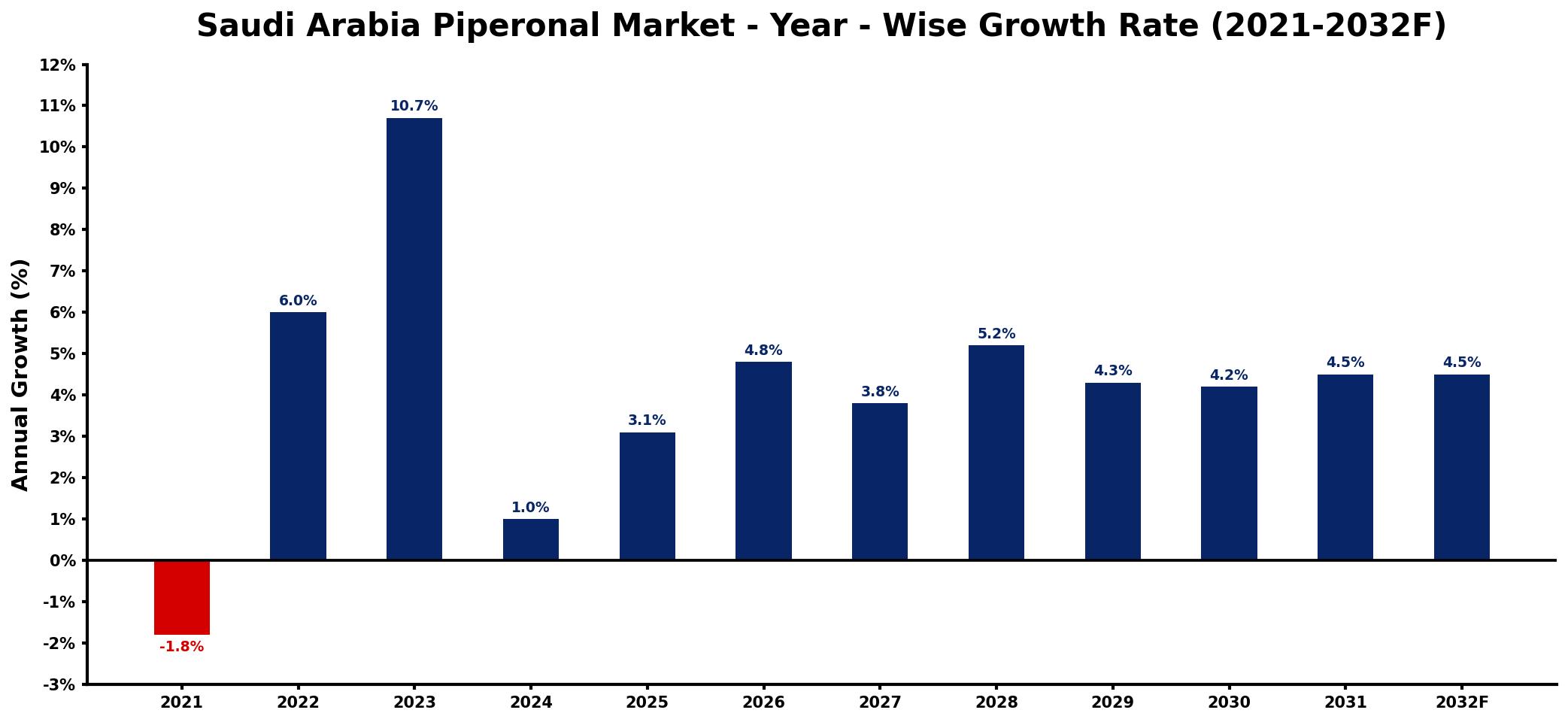
The table below presents the year‑wise growth rates along with the key drivers influencing the market
| Year | Growth Rate | Major Drivers |
| 2021 | -1.8% | decreased consumer interest in fragrances |
| 2022 | 6.0% | rising demand for natural ingredients |
| 2023 | 10.7% | expansion of personal care market |
| 2024 | 1.0% | increased investments in R&D |
| 2025 | 3.1% | growing popularity of aromatherapy |
| 2026 | 4.8% | emergence of sustainable sourcing practices |
| 2027 | 3.8% | increased production capacity initiatives |
| 2028 | 5.2% | diversification of application sectors |
| 2029 | 4.3% | enhanced distribution network efficiency |
| 2030 | 4.2% | growing trend of eco-friendly products |
| 2031 | 4.5% | expanding global market reach |
| 2032 | 4.5% | increased consumer awareness on health |
Note: Market size estimations and growth projections presented in this report are based on 6Wresearch's proprietary forecasting methodology, utilizing the latest available industry data, government publications, and primary research inputs.
Saudi Arabia Piperonal Market Synopsis
In Saudi Arabia, piperonal is emerging as a critical component within the fragrance and flavoring sectors. Its desirable aromatic properties make it an attractive choice for both personal care formulations and food flavoring applications. As the market grows, producers are increasingly focusing on refining their synthesis processes to enhance quality and sustainability.
The expanding cosmetics industry in the Kingdom is further amplifying the demand for piperonal. Consumers are gravitating towards unique and sophisticated scents, compelling manufacturers to innovate continuously. Additionally, this upward trend aligns with the country's broader economic objectives to diversify and strengthen its industrial base.
Saudi Arabia Piperonal Market Key Takeaways
- The market is driven by the expanding fragrance and flavor sectors, particularly in cosmetics and personal care.
- Technological advancements are improving the quality and availability of piperonal for manufacturers.
- Consumer preferences are shifting towards unique and innovative aromatic products, influencing market dynamics.
- Regulatory scrutiny around synthetic chemicals is a critical consideration for industry players.
- The COVID-19 pandemic reshaped consumer behavior, leading to increased demand for personal care products.
Evaluation of Restraints in Saudi Arabia Piperonal Market
Despite its promising growth prospects, the Saudi Arabia piperonal market is contending with certain restraints. Evolving consumer preferences, particularly regarding natural ingredients, pose challenges for the synthetic piperonal segment. Furthermore, increasing regulatory frameworks concerning synthetic chemicals may impact market operations and product formulations. Manufacturers must navigate these hurdles while ensuring compliance with health and safety standards, which adds complexity to production processes.
Saudi Arabia Piperonal Market Trends
Currently, the Saudi Arabia piperonal market is witnessing a notable trend towards the integration of natural ingredients in fragrance and flavor formulations. Consumers are increasingly prioritizing eco-friendly and sustainable products, pushing companies to adapt their sourcing and manufacturing strategies. Additionally, the rise of digital marketing channels has transformed how businesses engage with consumers, enhancing brand visibility and consumer interaction in the fragrance and cosmetics space.
Saudi Arabia Piperonal Market Opportunities
Investors and manufacturers in the Saudi Arabia piperonal market stand to gain significantly from the expanding personal care and cosmetics sectors. With increasing disposable incomes and a growing middle class, there is a unique opportunity to introduce innovative and high-quality piperonal-based products. Furthermore, leveraging advancements in extraction techniques can lead to cost-effective and efficient production methods, providing a competitive edge.
Government Initiatives in the Saudi Arabia Piperonal Market
The Saudi government is actively supporting industrial diversification and the growth of the chemicals sector through various initiatives. Investments in research and development are being encouraged, promoting innovation in aromatic compound production. Moreover, programs aimed at enhancing local manufacturing capabilities align with the national vision for economic sustainability, potentially benefiting the piperonal market in the long run.
Future Insights of the Saudi Arabia Piperonal Market
Looking ahead to 2026-2032, the Saudi Arabia piperonal market is poised for substantial growth driven by rising consumer demand for personalized products. As trends continue to favor distinctive fragrances and flavors, industry players will need to innovate consistently to stay relevant. Moreover, the increasing focus on sustainability will likely shape product development, encouraging manufacturers to explore eco-friendly production methods and materials.
Saudi Arabia Piperonal Market Latest Developments (2025 - 2026)
Recent developments in the Saudi Arabia piperonal market highlight a shift towards more innovative and sustainable production techniques. Companies are increasingly investing in research to refine extraction methods, aiming to enhance the quality of piperonal while reducing environmental impact. Furthermore, collaborations between local manufacturers and international players are emerging, aimed at exploring new applications and expanding market reach.
Saudi Arabia Piperonal Market - Key Attractiveness of the Report
- 10 Years of Market Numbers
- Historical Data Starting from 2022 to 2025
- Base Year: 2025
- Forecast Data until 2032
- Key Performance Indicators Impacting the Market
- Major Upcoming Developments and Projects
Key Highlights of the Report:
- Saudi Arabia Piperonal Market Outlook
- Market Size of Saudi Arabia Piperonal Market, 2025
- Forecast of Saudi Arabia Piperonal Market, 2032
- Historical Data and Forecast of Saudi Arabia Piperonal Revenues & Volume for the Period 2022-2032F
- Saudi Arabia Piperonal Market Trend Evolution
- Saudi Arabia Piperonal Market Drivers and Challenges
- Saudi Arabia Piperonal Price Trends
- Saudi Arabia Piperonal Porter's Five Forces
- Saudi Arabia Piperonal Industry Life Cycle
- Historical Data and Forecast of Saudi Arabia Piperonal Market Revenues & Volume By Type for the Period 2022-2032F
- Historical Data and Forecast of Saudi Arabia Piperonal Market Revenues & Volume By Natural Piperonal for the Period 2022-2032F
- Historical Data and Forecast of Saudi Arabia Piperonal Market Revenues & Volume By Synthetic Piperonal for the Period 2022-2032F
- Historical Data and Forecast of Saudi Arabia Piperonal Market Revenues & Volume By Application for the Period 2022-2032F
- Historical Data and Forecast of Saudi Arabia Piperonal Market Revenues & Volume By Flavors and Fragrances for the Period 2022-2032F
- Historical Data and Forecast of Saudi Arabia Piperonal Market Revenues & Volume By Food Industry for the Period 2022-2032F
- Historical Data and Forecast of Saudi Arabia Piperonal Market Revenues & Volume By Others for the Period 2022-2032F
- Saudi Arabia Piperonal Import Export Trade Statistics
- Market Opportunity Assessment By Type
- Market Opportunity Assessment By Application
- Saudi Arabia Piperonal Top Companies Market Share
- Saudi Arabia Piperonal Competitive Benchmarking By Technical and Operational Parameters
- Saudi Arabia Piperonal Company Profiles
- Saudi Arabia Piperonal Key Strategic Recommendations






































