Saudi Arabia Planting Equipment Market Size, Share & Growth Rate
The Saudi Arabia Planting Equipment Market was estimated at USD 375 Million in 2025 and is projected to reach USD 483 Million by 2032, growing at a CAGR of 3.7% from 2026 to 2032. This growth is fueled by significant investments from the government to modernize the agricultural sector, focusing on infrastructure and mechanization. The increased adoption of innovative planting technologies, driven by efficiency and cost-effectiveness, will further support this upward trajectory.
Saudi Arabia Planting Equipment Market Year-wise Growth Rate and Key Drivers
This graph highlights how the Saudi Arabia Planting Equipment Market has steadily grown over the years, supported by major growth factors.
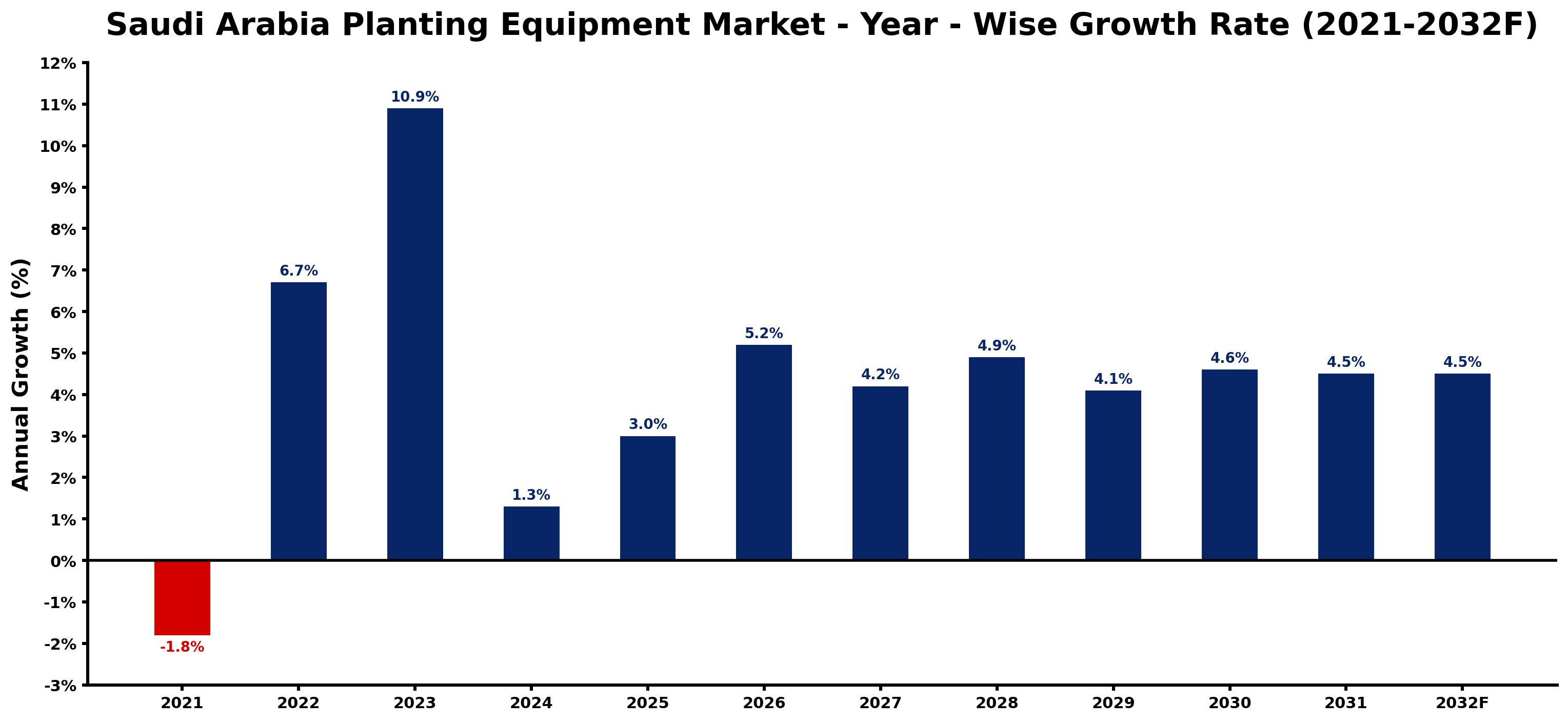
The table below presents the year‑wise growth rates along with the key drivers influencing the market
| Year | Growth Rate | Major Drivers |
| 2021 | -1.8% | Increasing adoption of advanced technologies |
| 2022 | 6.7% | Increasing adoption of advanced technologies |
| 2023 | 10.9% | Government infrastructure modernization initiatives |
| 2024 | 1.3% | Expansion of transportation and logistics networks |
| 2025 | 3.0% | Increasing adoption of advanced technologies |
| 2026 | 5.2% | Rising electricity demand across industries |
| 2027 | 4.2% | Expansion of manufacturing activities |
| 2028 | 4.9% | Growing urbanization and commercial development |
| 2029 | 4.1% | Rapid growth in telecom and data center sectors |
| 2030 | 4.6% | Expansion of commercial construction activities |
| 2031 | 4.5% | Expansion of transportation and logistics networks |
| 2032 | 4.5% | Growing renewable energy integration projects |
Note - Market size estimations and growth projections presented in this report are based on 6Wresearch’s advanced forecasting approach, validated with industry datasets as of June 2026.
Saudi Arabia Planting Equipment Market Synopsis
In recent years, the Saudi Arabia Planting Equipment Market has witnessed a transformative shift as agricultural practices evolve with technology integration. With agriculture accounting for over 13% of the GDP and employing nearly 15% of the workforce, the sector is vital to the kingdom's economic strategy.
Government initiatives aimed at boosting food security and enhancing agricultural productivity are pivotal in shaping market dynamics. As a result, the demand for advanced planting equipment is expected to surge, particularly as farmers embrace modern tools that enhance operational efficiency and adaptability.
Saudi Arabia Planting Equipment Market Key Takeaways
- Market projected to grow from USD 375 Million in 2025 to USD 483 Million by 2032.
- Government investments under Vision 2031 are accelerating mechanization in agriculture.
- Technological advancements, including autonomous planting equipment, are gaining traction.
- Rising adoption of mobile-based machines is reshaping operational practices among farmers.
- Challenges related to high costs and skilled labor availability could temper growth rates.
Evaluation of Restraints in Saudi Arabia Planting Equipment Market
Despite promising growth prospects, the Saudi Arabia Planting Equipment Market faces notable restraints. One significant barrier is the high cost of advanced farming equipment, which can be prohibitive for many farmers, especially smaller-scale operations. Furthermore, a scarcity of skilled labor familiar with modern agricultural techniques can limit the effective implementation of new technologies. Additionally, the region's challenging climate, characterized by limited water resources, poses an ongoing obstacle that hampers overall crop production, further complicating the market landscape.
Saudi Arabia Planting Equipment Market Trends
The market is witnessing a shift toward precision agriculture, where data-driven technologies such as drones and IoT-enabled devices are becoming increasingly popular. Farmers are leveraging these tools to enhance yield predictions and optimize planting strategies. Furthermore, the growing interest in sustainable agricultural practices is steering demand toward equipment that promotes resource efficiency and environmental stewardship. As the market evolves, collaborations between technology providers and agricultural producers will likely yield innovative solutions aimed at addressing regional challenges.
Saudi Arabia Planting Equipment Market Opportunities
Opportunities for growth in the Saudi Arabia Planting Equipment Market lie in the increasing shift towards mechanization and the adoption of smart farming practices. Investment in R&D to develop cost-effective and efficient planting technologies can create a competitive edge for manufacturers. Additionally, partnerships with government initiatives aimed at sustainable farming can open avenues for funding and support. There is also potential for expansion into underdeveloped regions of the kingdom, where mechanization can significantly boost productivity.
Government Initiatives in the Saudi Arabia Planting Equipment Market
The Saudi Arabian government has launched several initiatives aimed at transforming the agricultural landscape, as outlined in its Vision 2031 plan. These include substantial investments in infrastructure and irrigation systems, designed to enhance agricultural productivity. Furthermore, programs that offer subsidies for acquiring modern farming equipment are encouraging local farmers to embrace mechanization. The government is also focusing on sustainable agricultural practices, promoting technologies that optimize water usage and improve overall efficiency in crop production.
Future Insights of the Saudi Arabia Planting Equipment Market
Looking ahead to the period between 2026 and 2032, the Saudi Arabia Planting Equipment Market is positioned for steady growth, driven by ongoing government support and technological advancements. As local farmers continue to adopt new machinery, the overall productivity of the agricultural sector is likely to improve significantly. Moreover, the combination of robust investment in agricultural innovation and the demand for sustainable practices will pave the way for new market entrants and increased competition, ultimately benefiting the sector as a whole.
Saudi Arabia Planting Equipment Market Latest Developments (May 2025 - June 2026)
Recent developments in the Saudi Arabia Planting Equipment Market highlight the industry's responsiveness to changing agricultural demands. Companies are increasingly showcasing advancements in autonomous farming equipment and precision planting technologies at trade exhibitions. Collaborative efforts between public and private sectors are fostering innovation, particularly in mobile machinery that enhances accessibility for farmers. Additionally, increased awareness of sustainable practices is driving equipment manufacturers to integrate eco-friendly solutions into their product offerings.
Saudi Arabia Planting Equipment Market - Key Attractiveness of the Report
- 10 Years of Market Numbers
- Historical Data Starting from 2022 to 2025
- Base Year: 2025
- Forecast Data until 2032
- Key Performance Indicators Impacting the Market
- Major Upcoming Developments and Projects
Key Highlights of the Report:
- Saudi Arabia Planting Equipment Market Outlook
- Market Size of Saudi Arabia Planting Equipment Market, 2025
- Forecast of Saudi Arabia Planting Equipment Market, 2032
- Historical Data and Forecast of Saudi Arabia Planting Equipment Revenues & Volume for the Period 2022-2032F
- Saudi Arabia Planting Equipment Market Trend Evolution
- Saudi Arabia Planting Equipment Market Drivers and Challenges
- Saudi Arabia Planting Equipment Price Trends
- Saudi Arabia Planting Equipment Porter's Five Forces
- Saudi Arabia Planting Equipment Industry Life Cycle
- Historical Data and Forecast of Saudi Arabia Planting Equipment Market Revenues & Volume By Type for the Period 2022-2032F
- Historical Data and Forecast of Saudi Arabia Planting Equipment Market Revenues & Volume By Air seeders for the Period 2022-2032F
- Historical Data and Forecast of Saudi Arabia Planting Equipment Market Revenues & Volume By Seed drills for the Period 2022-2032F
- Historical Data and Forecast of Saudi Arabia Planting Equipment Market Revenues & Volume By Planters for the Period 2022-2032F
- Historical Data and Forecast of Saudi Arabia Planting Equipment Market Revenues & Volume By Others for the Period 2022-2032F
- Historical Data and Forecast of Saudi Arabia Planting Equipment Market Revenues & Volume By Design for the Period 2022-2032F
- Historical Data and Forecast of Saudi Arabia Planting Equipment Market Revenues & Volume By Mechanical for the Period 2022-2032F
- Historical Data and Forecast of Saudi Arabia Planting Equipment Market Revenues & Volume By Automatic for the Period 2022-2032F
- Historical Data and Forecast of Saudi Arabia Planting Equipment Market Revenues & Volume By Crop Type for the Period 2022-2032F
- Historical Data and Forecast of Saudi Arabia Planting Equipment Market Revenues & Volume By Cereals & grains for the Period 2022-2032F
- Historical Data and Forecast of Saudi Arabia Planting Equipment Market Revenues & Volume By Oilseeds & pulses for the Period 2022-2032F
- Historical Data and Forecast of Saudi Arabia Planting Equipment Market Revenues & Volume By Fruits & vegetables for the Period 2022-2032F
- Historical Data and Forecast of Saudi Arabia Planting Equipment Market Revenues & Volume By Others for the Period 2022-2032F
- Saudi Arabia Planting Equipment Import Export Trade Statistics
- Market Opportunity Assessment By Type
- Market Opportunity Assessment By Design
- Market Opportunity Assessment By Crop Type
- Saudi Arabia Planting Equipment Top Companies Market Share
- Saudi Arabia Planting Equipment Competitive Benchmarking By Technical and Operational Parameters
- Saudi Arabia Planting Equipment Company Profiles
- Saudi Arabia Planting Equipment Key Strategic Recommendations






































