Saudi Arabia Ploughing and Cultivating Machinery Market Size, Share & Growth Rate
The Saudi Arabia Ploughing and Cultivating Machinery Market was estimated at USD 489 Million in 2025 and is projected to reach USD 626 Million by 2032, growing at a CAGR of 3.6% from 2026 to 2032. This upward trajectory is fueled by a renewed focus on agricultural modernization and efficiency, driven by both domestic demand and government initiatives aimed at bolstering food security. Furthermore, an increasing trend towards mechanization among farmers is poised to enhance productivity significantly.
Saudi Arabia Ploughing and Cultivating Machinery Market Year-wise Growth Rate and Key Drivers
This graph highlights how the Saudi Arabia Ploughing and Cultivating Machinery Market has steadily grown over the years, supported by major growth factors.
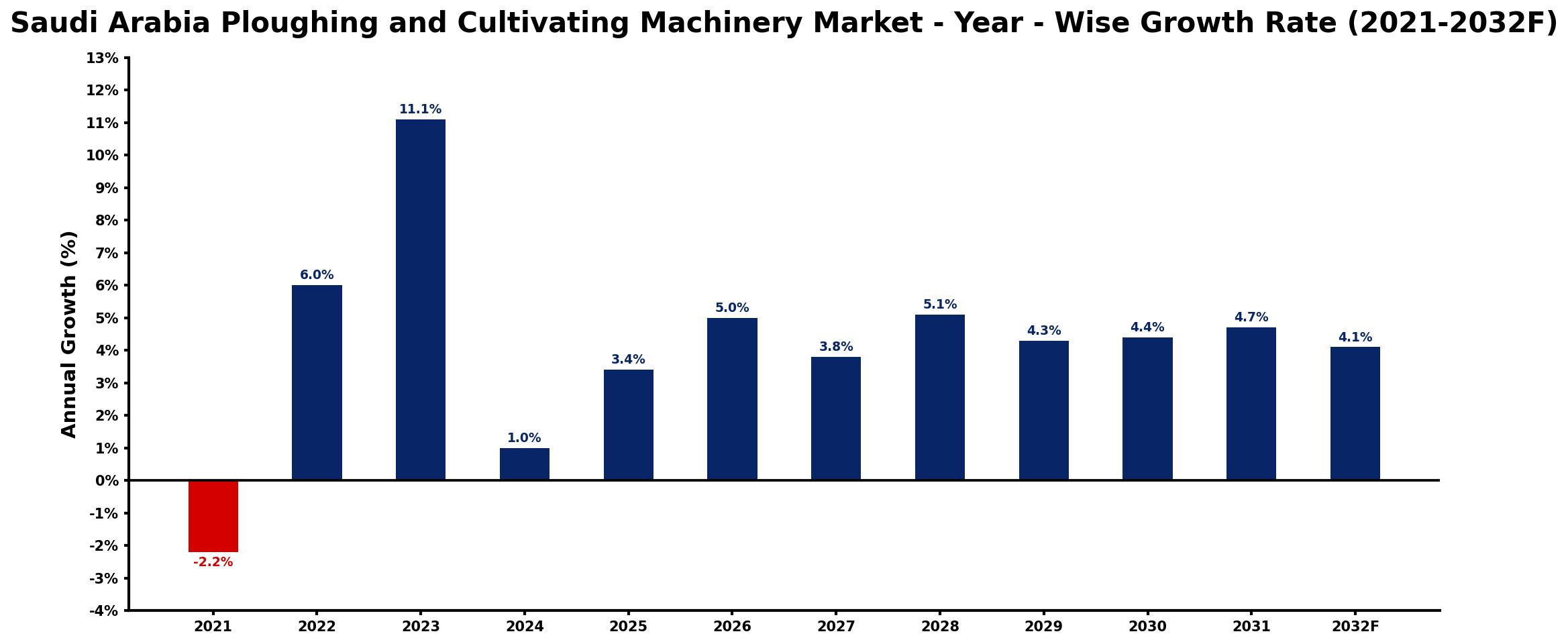
The table below presents the year‑wise growth rates along with the key drivers influencing the market
| Year | Growth Rate | Major Drivers |
| 2021 | -2.2% | Supply chain disruptions impact production |
| 2022 | 6.0% | Increased agricultural investment initiatives |
| 2023 | 11.1% | Rising demand for modern equipment |
| 2024 | 1.0% | Government subsidies for farmers |
| 2025 | 3.4% | Technological advancements drive adoption |
| 2026 | 5.0% | Expansion of farming operations nationwide |
| 2027 | 3.8% | Growing focus on sustainable practices |
| 2028 | 5.1% | Enhanced export opportunities for farmers |
| 2029 | 4.3% | Increased crop diversity and yields |
| 2030 | 4.4% | Rising consumer demand for food |
| 2031 | 4.7% | Investment in rural infrastructure projects |
| 2032 | 4.1% | Growing awareness of efficiency benefits |
Note: Market size estimations and growth projections presented in this report are based on 6Wresearch's proprietary forecasting methodology, utilizing the latest available industry data, government publications, and primary research inputs.
Saudi Arabia Ploughing and Cultivating Machinery Market Synopsis
The primary force shaping the Saudi Arabia Ploughing and Cultivating Machinery Market today is the governments commitment to agricultural advancement. With policies that encourage innovation and investment in the farming sector, the market is witnessing a shift toward more sophisticated machinery tailored to local conditions. The increasing understanding among farmers of the advantages of mechanization is also creating a robust demand for advanced equipment.
Alongside these developments, international and domestic manufacturers are responding by offering a diverse array of machinery designed to meet the specific needs of Saudi Arabias unique soil and climatic conditions. This adaptability is crucial as farmers seek solutions that not only optimize land preparation but also enhance overall crop yields.
Saudi Arabia Ploughing and Cultivating Machinery Market Key Takeaways
- The market is projected to grow steadily, reflecting the increasing importance of agriculture in the Saudi economy.
- Government initiatives aimed at enhancing food security are crucial drivers of market expansion.
- There is an ongoing trend towards modernization, with farmers increasingly adopting advanced machinery.
- Economic fluctuations may impact the purchasing power of farmers, influencing market dynamics.
- The emphasis on mechanization is transforming traditional farming practices, leading to improved productivity.
Evaluation of Restraints in Saudi Arabia Ploughing and Cultivating Machinery Market
Despite the promising outlook, the Saudi Arabia Ploughing and Cultivating Machinery Market faces specific restraints. Chief among these is the challenging arid climate, which necessitates the development of machinery specifically suited for local agricultural conditions. Additionally, economic volatility can directly impact farmers ability to invest in new machinery, creating uncertainty in demand. To thrive in this market, it is vital for manufacturers to focus on affordability and ensure comprehensive after-sales support to maintain customer loyalty.
Saudi Arabia Ploughing and Cultivating Machinery Market Trends
Current trends indicate a shift towards more sustainable agricultural practices, prompting farmers to seek machinery that is not only efficient but also environmentally friendly. The integration of advanced technologies, such as precision agriculture and smart farming techniques, is becoming increasingly common. This evolution is set to reshape the machinery landscape, as farmers look for equipment that supports data-driven decision-making and maximizes resource utilization.
Saudi Arabia Ploughing and Cultivating Machinery Market Opportunities
There are considerable growth opportunities within the Saudi Arabia Ploughing and Cultivating Machinery Market. The governments push for enhanced agricultural productivity opens doors for manufacturers who can deliver innovative, efficient, and cost-effective solutions. Moreover, as more farmers recognize the benefits of mechanization, particularly in increasing yield and reducing labor costs, the potential for investment in modern machinery continues to rise.
Government Initiatives in the Saudi Arabia Ploughing and Cultivating Machinery Market
The Saudi government has introduced various initiatives aimed at modernizing the agricultural sector, which directly impacts the ploughing and cultivating machinery market. These initiatives include subsidies for agricultural equipment, financial support programs, and training programs to enhance farmers' skills in operating advanced machinery. By fostering an environment conducive to innovation and technological adoption, these measures are essential for driving future growth in this critical sector.
Future Insights of the Saudi Arabia Ploughing and Cultivating Machinery Market
Looking ahead to 2026-2032, the Saudi Arabia Ploughing and Cultivating Machinery Market is poised for significant advancement. As farmers increasingly embrace automation and smart technologies, manufacturers that can provide tailored solutions to meet specific agricultural challenges will gain a competitive edge. Continuous government support coupled with a growing awareness of the need for efficient farming practices will further enhance market potential, creating a dynamic environment for growth.
Saudi Arabia Ploughing and Cultivating Machinery Market Latest Developments (2025 - 2026)
In recent months, the industry has seen notable momentum towards modernization, with increasing collaborations between local farmers and machinery manufacturers to address specific agricultural challenges. Developments have also included the introduction of new, more efficient models of ploughing and cultivating machinery that are better suited to local climates. Additionally, initiatives to enhance supply chain efficiency are gaining traction, addressing previous logistical hurdles.
Saudi Arabia Ploughing and Cultivating Machinery Market - Key Attractiveness of the Report
- 10 Years of Market Numbers
- Historical Data Starting from 2022 to 2025
- Base Year: 2025
- Forecast Data until 2032
- Key Performance Indicators Impacting the Market
- Major Upcoming Developments and Projects
Key Highlights of the Report:
- Saudi Arabia Ploughing and Cultivating Machinery Market Outlook
- Market Size of Saudi Arabia Ploughing and Cultivating Machinery Market, 2025
- Forecast of Saudi Arabia Ploughing and Cultivating Machinery Market, 2032
- Historical Data and Forecast of Saudi Arabia Ploughing and Cultivating Machinery Revenues & Volume for the Period 2022-2032F
- Saudi Arabia Ploughing and Cultivating Machinery Market Trend Evolution
- Saudi Arabia Ploughing and Cultivating Machinery Market Drivers and Challenges
- Saudi Arabia Ploughing and Cultivating Machinery Price Trends
- Saudi Arabia Ploughing and Cultivating Machinery Porter's Five Forces
- Saudi Arabia Ploughing and Cultivating Machinery Industry Life Cycle
- Historical Data and Forecast of Saudi Arabia Ploughing and Cultivating Machinery Market Revenues & Volume By Type for the Period 2022-2032F
- Historical Data and Forecast of Saudi Arabia Ploughing and Cultivating Machinery Market Revenues & Volume By Ploughs for the Period 2022-2032F
- Historical Data and Forecast of Saudi Arabia Ploughing and Cultivating Machinery Market Revenues & Volume By Harrows for the Period 2022-2032F
- Historical Data and Forecast of Saudi Arabia Ploughing and Cultivating Machinery Market Revenues & Volume By Others for the Period 2022-2032F
- Historical Data and Forecast of Saudi Arabia Ploughing and Cultivating Machinery Market Revenues & Volume By Application for the Period 2022-2032F
- Historical Data and Forecast of Saudi Arabia Ploughing and Cultivating Machinery Market Revenues & Volume By Soil Loosening for the Period 2022-2032F
- Historical Data and Forecast of Saudi Arabia Ploughing and Cultivating Machinery Market Revenues & Volume By Clod Size Reduction for the Period 2022-2032F
- Historical Data and Forecast of Saudi Arabia Ploughing and Cultivating Machinery Market Revenues & Volume By Clod Sorting for the Period 2022-2032F
- Historical Data and Forecast of Saudi Arabia Ploughing and Cultivating Machinery Market Revenues & Volume By Others for the Period 2022-2032F
- Saudi Arabia Ploughing and Cultivating Machinery Import Export Trade Statistics
- Market Opportunity Assessment By Type
- Market Opportunity Assessment By Application
- Saudi Arabia Ploughing and Cultivating Machinery Top Companies Market Share
- Saudi Arabia Ploughing and Cultivating Machinery Competitive Benchmarking By Technical and Operational Parameters
- Saudi Arabia Ploughing and Cultivating Machinery Company Profiles
- Saudi Arabia Ploughing and Cultivating Machinery Key Strategic Recommendations






































