Saudi Arabia Policy Management in Telecom Market Size & Growth Rate (2026-2032)
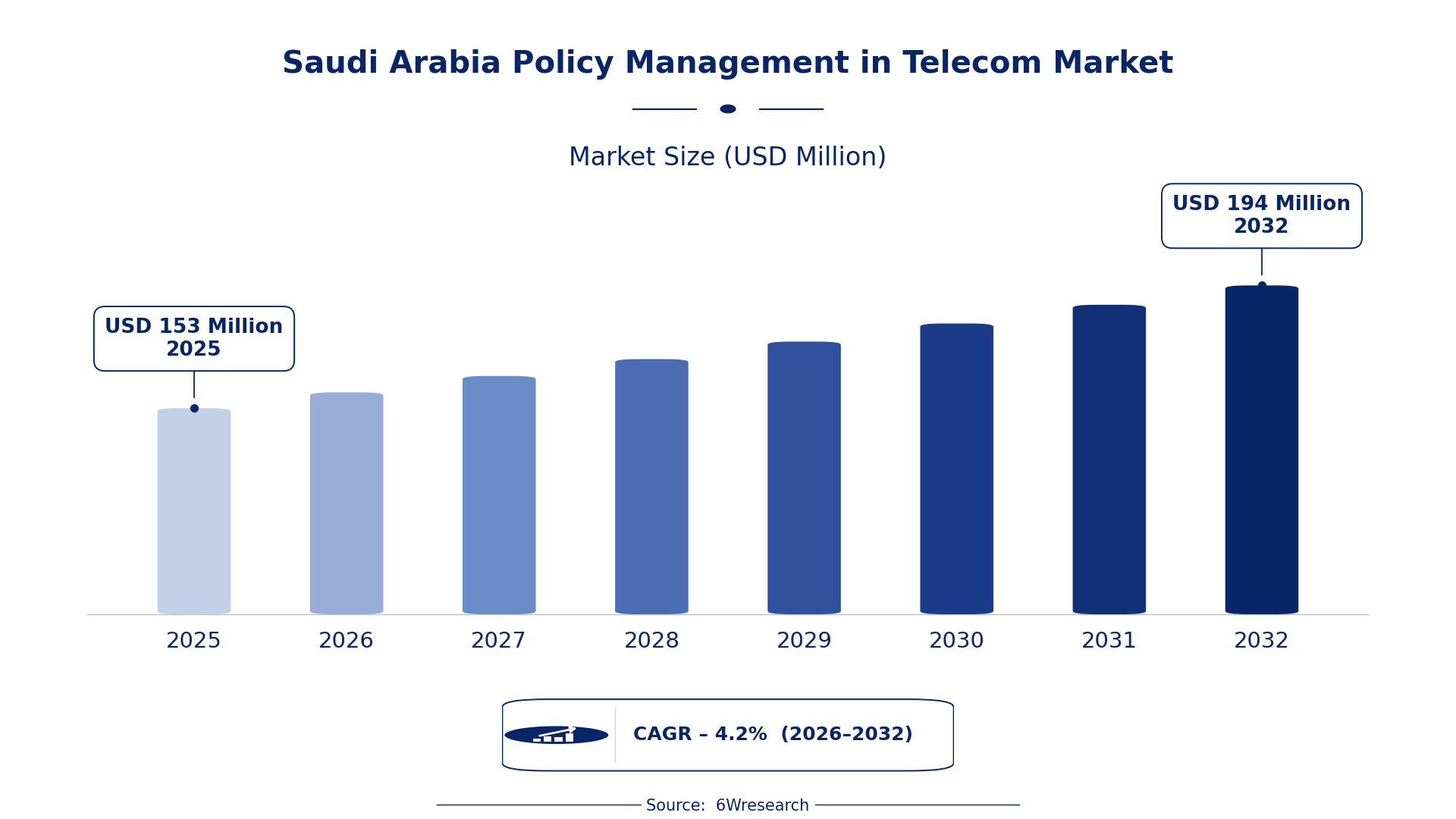
The Saudi Arabia Policy Management in Telecom Market was estimated at USD 153 Million in 2025 and is projected to reach USD 194 Million by 2032, growing at a CAGR of 4.2% from 2026 to 2032.
Saudi Arabia Policy Management in Telecom Market Synopsis
The Saudi Arabia Policy Management in Telecom Market has seen significant momentum due to a surge in data consumption and an increasing need for streamlined network management solutions. As operators enhance service delivery and customer experience, the focus is shifting toward innovative policy management technologies that can meet these evolving demands.
Looking ahead, the market is expected to grow as telecommunications companies intensify their investments in policy management systems. This will not only improve resource allocation but also empower operators to deliver personalized services in line with the changing consumer preferences in Saudi Arabia.
Saudi Arabia Policy Management in Telecom Market Year-wise Growth Rate and Key Drivers
This graph illustrates the annual growth rates of the Saudi Arabia Policy Management in Telecom Market from 2021 to 2032, highlighting a steady upward trajectory and projected expansion over the forecast period.
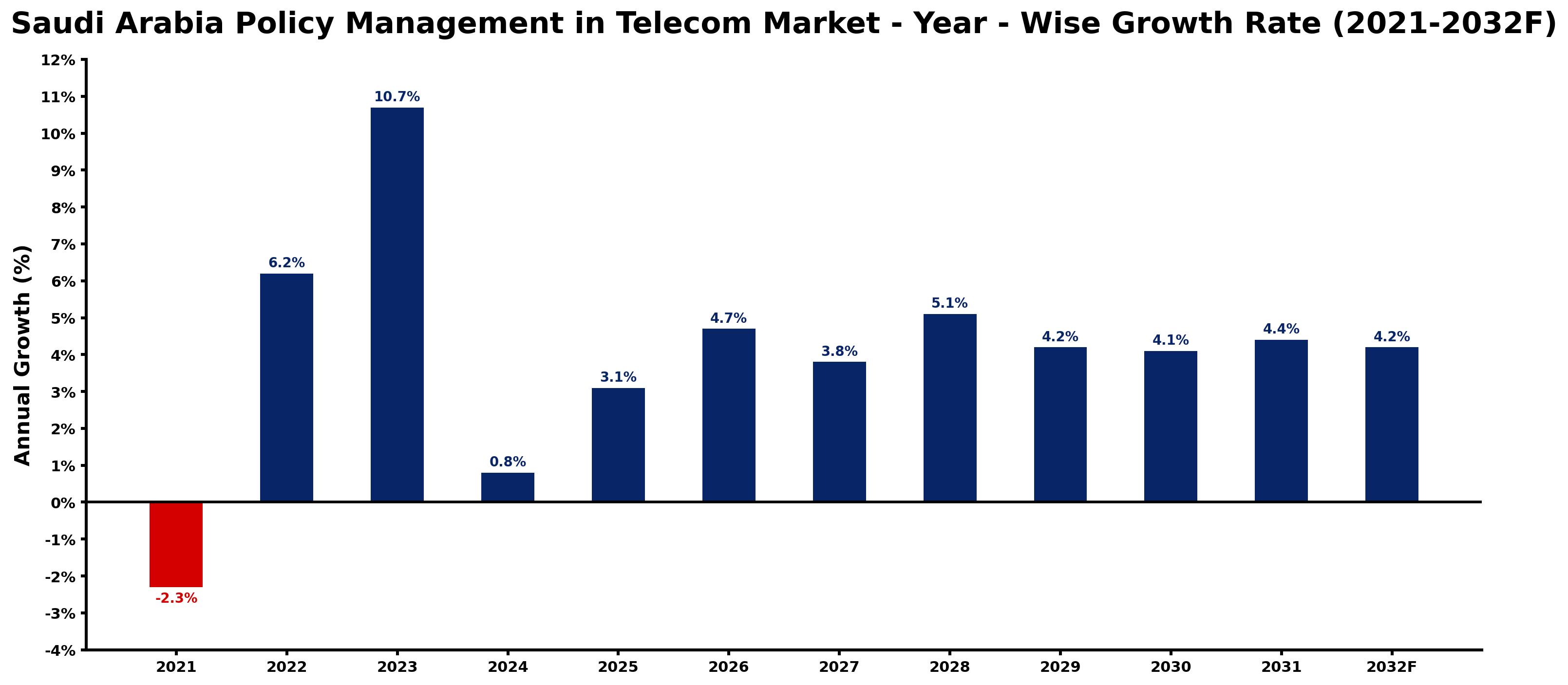
The table below presents the year‑wise growth rates along with the key drivers influencing the market
| Year | Growth Rate | Major Drivers |
| 2021 | -2.3% | Saudi Communications and Media Commission policy delays implementation. |
| 2022 | 6.2% | National Digital Transformation Strategy boosting telecom regulations |
| 2023 | 10.7% | 5G deployment accelerated by Communications and IT Commission |
| 2024 | 0.8% | Increased focus on digital identity verification regulations |
| 2025 | 3.1% | Rise in remote working driving telecom policy updates |
| 2026 | 4.7% | Growth in IoT demands policy adaptations in telecommunications |
| 2027 | 3.8% | Regulatory support for telecom networks in smart cities |
| 2028 | 5.1% | Local content regulations enhancing telecom service offerings |
| 2029 | 4.2% | Government incentives for expanding rural telecom infrastructure |
| 2030 | 4.1% | Enhanced data privacy laws promoting telecom service improvements |
| 2031 | 4.4% | Integration of fintech regulations enhancing telecom and payments |
| 2032 | 4.2% | Sustainability initiatives influencing telecom regulatory framework |
Note: Market size estimations and growth projections presented in this report are based on 6Wresearch's proprietary forecasting methodology, utilizing the latest available industry data, government publications, and primary research inputs.
Saudi Arabia Policy Management in Telecom Market Key Takeaways
Below are some of the specific key takeaways from the market, including:
- Telecom operators are increasingly adopting policy management solutions to optimize network resource utilization.
- The demand for real-time network control is becoming a pivotal driver in the telecom sector.
- Government initiatives are enhancing the overall telecom infrastructure, promoting a better environment for market growth.
- Privacy concerns are presenting significant challenges that operators must navigate while implementing policy frameworks.
- Emerging technologies are creating new avenues for personalized service offerings and improved customer experience.
Evaluation of Restraints in Saudi Arabia Policy Management in Telecom Market
The main obstacles stifling growth in the Saudi Arabia Policy Management in Telecom Market include complexities surrounding policy implementation and enforcement. Many telecom operators struggle with crafting policies that adequately address the diverse needs of users while ensuring compliance with data privacy regulations. Additionally, the intricate nature of modern networks demands advanced solutions to avoid service interruptions and optimize resource allocation.
Saudi Arabia Policy Management in Telecom Market Trends
A noticeable trend is the shift towards AI-driven policy management tools that enhance predictive analytics for network management. This advancement allows operators to foresee network issues and address them proactively. Furthermore, the integration of cloud-based solutions is being recognized as a way to streamline operations and reduce costs. The focus on customer personalization and quality of service is leading to tailored policy frameworks that cater to individual subscriber needs.
Saudi Arabia Policy Management in Telecom Market Opportunities
With a continuously growing demand for data services, operators have significant opportunities to innovate policy management solutions. The government's commitment to improving digital infrastructure will also open doors for partnerships and collaboration in the technology sector. Investing in scalable and adaptable policy management systems will empower telecom companies to better serve their customers while maximizing profitability.
Government Initiatives in the Saudi Arabia Policy Management in Telecom Market
The Saudi government is actively shaping the Policy Management in Telecom Market through various initiatives aimed at enhancing service quality and regulatory compliance. These initiatives reflect a strong commitment to improving telecom services while addressing customer concerns over privacy and network quality. With a focus on establishing a comprehensive regulatory framework, the government is laying the groundwork for a more efficient telecom sector.
- A regulatory framework introduced in 2025 mandating billing transparency to enhance consumer trust and operational accountability.
- A national digital infrastructure upgrade programme now in its rollout phase, aimed at expanding network accessibility across urban and rural areas.
- A public-private initiative focused on improving mobile network coverage and quality, expected to commence in late 2026.
- Recent collaborations with technology providers to develop innovative policy management solutions to enhance customer experience.
- Future plans for a digital services regulatory body that will oversee policy implementation and ensure compliance with international standards.
Future Insights of the Saudi Arabia Policy Management in Telecom Market
From 2026 to 2032, the Saudi Arabia Policy Management in Telecom Market is likely to witness a significant transformation. Increased data consumption will continue to drive demand for effective policy management solutions. As telecom companies seek to enhance customer satisfaction and engagement, those that prioritize innovative technology and adaptive policies will thrive. Collaboration between government and private sector initiatives will further cement the foundations for sustained market growth.
Saudi Arabia Policy Management in Telecom Market Latest Developments
In the past year, the Saudi Arabia Policy Management in Telecom Market has experienced considerable activity, marked by advancements in technology and strategic partnerships. Operators are focusing on upgrading their policy management systems to cater to the increasing demands of consumers while improving service delivery. These developments signal a proactive approach in the sector.
- Recently launched upgrades in mid-2025 for policy management systems designed to optimize data usage and enhance user experience.
- An initiative that began in early 2025 focusing on integrating AI technologies into existing policy frameworks, enhancing predictive capabilities for network management.
- A planned rollout expected to begin in Q1 2026, introducing new guidelines for quality of service and user privacy regulations.
- Completion of a pilot program in late 2025 that evaluated new policy management solutions, providing insights for further improvements.
- Ongoing collaborations with international technology vendors to explore advanced policy management solutions and strengthen service delivery.
Saudi Arabia Policy Management in Telecom Market - Key Attractiveness of the Report
- 10 Years of Market Numbers
- Historical Data Starting from 2022 to 2025
- Base Year: 2025
- Forecast Data until 2032
- Key Performance Indicators Impacting the Market
- Major Upcoming Developments and Projects
Key Highlights of the Report:
- Saudi Arabia Policy Management in Telecom Market Outlook
- Market Size of Saudi Arabia Policy Management in Telecom Market, 2025
- Forecast of Saudi Arabia Policy Management in Telecom Market, 2032
- Historical Data and Forecast of Saudi Arabia Policy Management in Telecom Revenues & Volume for the Period 2022-2032F
- Saudi Arabia Policy Management in Telecom Market Trend Evolution
- Saudi Arabia Policy Management in Telecom Market Drivers and Challenges
- Saudi Arabia Policy Management in Telecom Price Trends
- Saudi Arabia Policy Management in Telecom Porter's Five Forces
- Saudi Arabia Policy Management in Telecom Industry Life Cycle
- Historical Data and Forecast of Saudi Arabia Policy Management in Telecom Market Revenues & Volume By Network for the Period 2022-2032F
- Historical Data and Forecast of Saudi Arabia Policy Management in Telecom Market Revenues & Volume By Fixed for the Period 2022-2032F
- Historical Data and Forecast of Saudi Arabia Policy Management in Telecom Market Revenues & Volume By Wireless for the Period 2022-2032F
- Historical Data and Forecast of Saudi Arabia Policy Management in Telecom Market Revenues & Volume By Component for the Period 2022-2032F
- Historical Data and Forecast of Saudi Arabia Policy Management in Telecom Market Revenues & Volume By Solutions for the Period 2022-2032F
- Historical Data and Forecast of Saudi Arabia Policy Management in Telecom Market Revenues & Volume By Services for the Period 2022-2032F
- Historical Data and Forecast of Saudi Arabia Policy Management in Telecom Market Revenues & Volume By Deployment for the Period 2022-2032F
- Historical Data and Forecast of Saudi Arabia Policy Management in Telecom Market Revenues & Volume By Cloud for the Period 2022-2032F
- Historical Data and Forecast of Saudi Arabia Policy Management in Telecom Market Revenues & Volume By On-Premises for the Period 2022-2032F
- Saudi Arabia Policy Management in Telecom Import Export Trade Statistics
- Market Opportunity Assessment By Network
- Market Opportunity Assessment By Component
- Market Opportunity Assessment By Deployment
- Saudi Arabia Policy Management in Telecom Top Companies Market Share
- Saudi Arabia Policy Management in Telecom Competitive Benchmarking By Technical and Operational Parameters
- Saudi Arabia Policy Management in Telecom Company Profiles
- Saudi Arabia Policy Management in Telecom Key Strategic Recommendations






































