Saudi Arabia Power Rental Market Growth Rate
According to 6Wresearch internal database and industry insights, the Saudi Arabia Power Rental Market is projected to grow at a compound annual growth rate (CAGR) of 7.6% during the forecast period (2026-2032).
Saudi Arabia Power Rental Market Year-wise Growth Rate and Key Drivers
This graph highlights how the Saudi Arabia Power Rental Market has steadily grown over the past five years, supported by major growth factors.
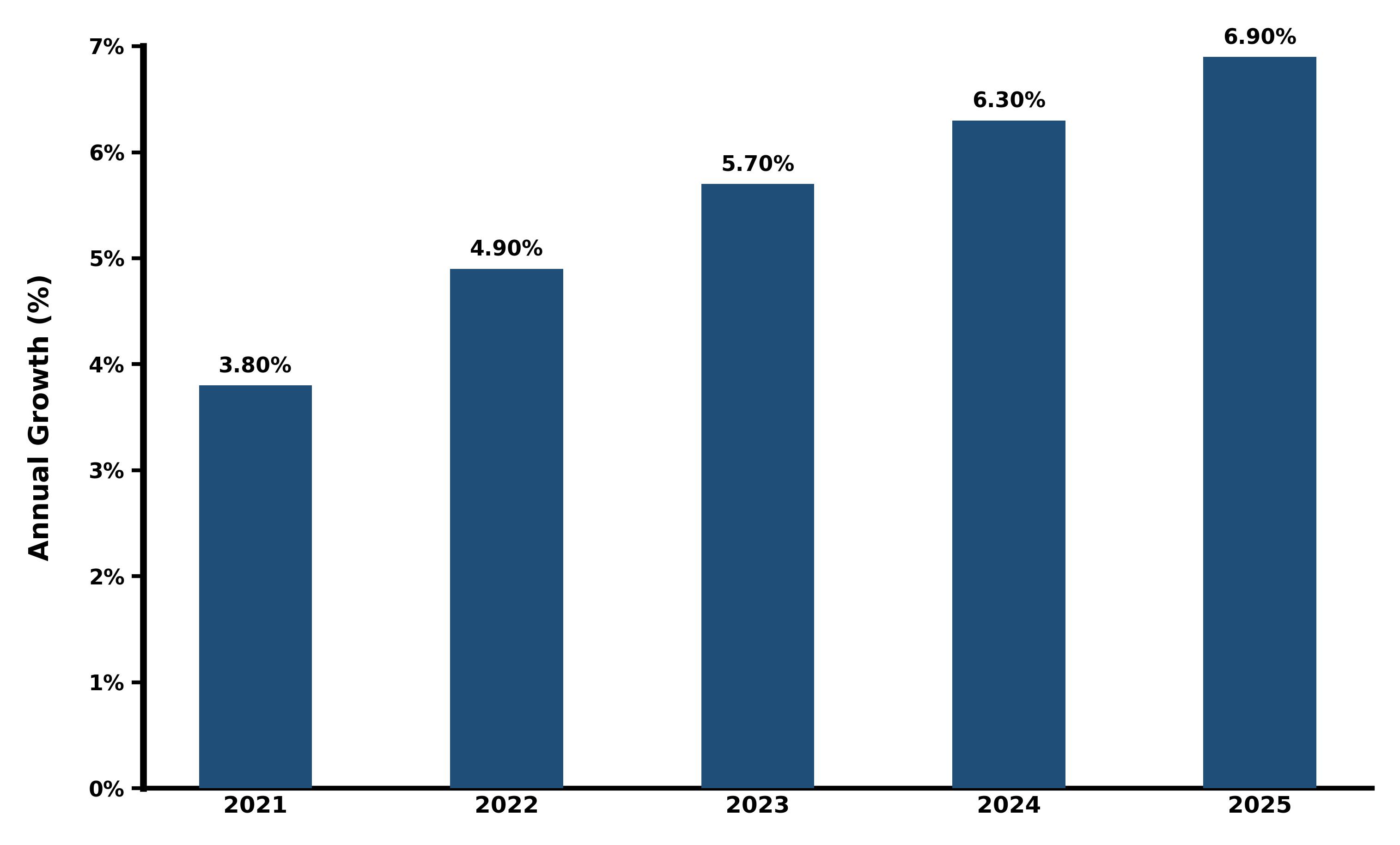
The table below presents the year‑wise growth rates along with the key drivers influencing the market
| Years | Est. Annual Growth (%) | Growth Drivers |
| 2021 | 3.8% | Reliability needs for remote oilfield sites and Brownfield maintenance. |
| 2022 | 4.9% | Construction restarts and mega-project mobilization under Vision 2030. |
| 2023 | 5.7% | Data center build-outs and utility peak-load support in summer. |
| 2024 | 6.3% | Industrial expansion and tighter grid redundancy requirements. |
| 2025 | 6.9% | NEOM/Red Sea project phases and growing demand for gas-fueled rentals. |
Topics Covered in the Saudi Arabia Power Rental Market Report
Saudi Arabia Power Rental Market report thoroughly covers the market by fuel type, equipment, power rating, application, and end user. The market report provides an unbiased and detailed analysis of ongoing market trends, opportunities/high growth areas, and market drivers, which would help stakeholders devise and align their market strategies according to the current and future market dynamics.
Saudi Arabia Power Rental Market Highlights
| Report Name | Saudi Arabia Power Rental Market |
| Forecast period | 2026-2032 |
| CAGR | 7.6% |
| Growing Sector | Energy & Utilities |
Growing Sector-Saudi Arabia Power Rental Market Synopsis
Significant growth is on the horizon for the Saudi Arabia Power Rental Market fueled by continued investment in giga-projects, activity in oil & gas fields, and growth in industrial development. The desire for seasonal peak demand, activities in extreme operating conditions, and the necessity for fast-tracked power has led to adoption across segments such as utilities, construction and critical facilities. Economic diversification and localization initiatives led by the government are supporting greater in-kingdom service capability. Additionally, improving operating economics and emissions profiles due to increased preference will also be gas and hybrid rental solutions will lead to stable market growth in the Kingdom.
Evaluation of Growth Drivers in the Saudi Arabia Power Rental Market
Below mentioned some growth drivers and their impact on market dynamics:
| Drivers | Primary Segments Affected | Why It Matters |
| Mega-Projects & Infrastructure (NEOM, Red Sea, Qiddiya) | Generators, 501–2500 kW, Construction | Drives long-duration, multi-megawatt deployments. |
| Oil & Gas Field Requirements | Utilities, Oil & Gas, 51–500 kW and 501–2500 kW | Needs reliable prime and standby power in remote sites. |
| Utility Peak Shaving & Outage Support | Standby & Peak Shaving, Utilities | Stabilizes grid during summer peaks and maintenance. |
| Data Center & ICT Growth | IT & Data Centers, Base Load | Requires high-availability power with rapid mobilization. |
| Shift to Gas/Hybrid Sets | Natural Gas, Hybrid Controls | Reduces fuel cost and emissions, improving TCO for rentals. |
Saudi Arabia Power Rental Market is expected to grow significantly, with a CAGR of 7.6% during the forecast period of 2026-2032. The Saudi Arabia Power Rental Market is seeing strong growth due to large scale infrastructure developments for projects, like NEOM, Red Sea, and Qiddiya, and the overall uptick in energy consumption for industrial and oil and gas usages. The growing emphasis on reliable standby power and peak-shaving power solution resulting from abnormal weather patterns and over consumption of energy are also driving the Saudi Arabia Power Rental Market Growth. The rapid upscaling of the data center industry in Saudi Arabia is enabling additional growth as well along with the expanding use of natural gas and hybrid power systems that promote efficiency, emissions reductions and provide sustainable energy usage in critical sectors.
Evaluation of Restraints in the Saudi Arabia Power Rental Market
Below mentioned are some major restraints and their influence on market dynamics:
| Restraints | Primary Segments Affected | What This Means |
| Fuel Price Variability & Logistics | Diesel Fleets, Remote Sites | Impacts OPEX and project budgeting for long runs. |
| Procurement Cycles & Compliance | All Segments | Extended approvals can delay deployments. |
| High Ambient & Dust Conditions | Generators, Load Banks | Increases maintenance frequency and derating. |
| OEM Lead Times & Parts Availability | 501–2500 kW, Above 2500 kW | May constrain large fleet readiness. |
| Emissions & Noise Requirements | Urban Projects, Data Centers | Drives need for gas/hybrid and advanced muffling. |
Saudi Arabia Power Rental Market Challenges
Despite significant demand, the Saudi Arabia Power Rental Industry is experiencing challenges from inordinate extreme heat and dust, resulting in frequent maintenance and derating. The logistics to remote sites and the need for uptime certainty for those critical users makes it harder to operate. Other considerations like fuel efficiency, emissions compliance, and noise control in urban areas add to operating costs. Furthermore, sector-specific competition with capital equipment purchases impacts utilization for rental fleets across various environments affecting profitability and fleet readiness.
Saudi Arabia Power Rental Market Trends
Some major trends contributing to the development of the Saudi Arabia Power Rental Market growth are:
- Shift Toward Natural Gas & Hybrid Fleets: Operators expand gas-fired and hybrid sets to reduce fuel cost, extend maintenance intervals, and lower emissions.
- Digitization & Remote Monitoring: Telematics and predictive maintenance improve uptime, optimize fuel burn, and reduce unplanned downtime.
- Long-Term Project Contracts: Multi-year frameworks for giga-projects enhance fleet visibility and encourage investment in larger kW classes.
- High-Capacity Modular Deployments: Containerized 1–2.5 MW blocks enable rapid scaling for utilities and data centers.
- Sound Attenuation & Low-Emission Packages: Urban sites adopt advanced enclosures, SCRs, and filtration to meet site-specific limits.
Investment Opportunities in the Saudi Arabia Power Rental Market
Here are some investment opportunities in the Saudi Arabia Power Rental Industry:
- Gas-Fired Rental Capacity: Expand gas genset fleets and dual-fuel capability to win long-duration base-load contracts.
- Hybrid/Battery Integration: Add battery energy storage with smart controls to cut diesel runtime and fuel cost.
- Data Center Power Solutions: Develop Tier-ready rental packages with redundancy, load banks, and rapid switchgear.
- Desert-Hardened Fleets: Invest in high-ambient-rated units, advanced filtration, and service hubs near remote corridors.
- Local Service & IKTVA Alignment: Build in-kingdom overhaul, parts, and training to improve bid competitiveness.
Top 5 Leading Players in the Saudi Arabia Power Rental Market
Here are some top companies contributing to Saudi Arabia Power Rental Market Share:
1. Aggreko Middle East
| Company Name | Aggreko Middle East |
| Established Year | 1962 |
| Headquarters | Riyadh, Saudi Arabia |
| Official Website | Click Here |
Provider of temporary power and temperature control solutions with large multi-MW fleets supporting utilities, data centers, and mega-projects across the Kingdom.
2. Altaaqa Alternative Solutions (Zahid Group)
| Company Name | Altaaqa Alternative Solutions (Zahid Group) |
| Established Year | 2004 |
| Headquarters | Jeddah, Saudi Arabia |
| Official Website | Click Here |
Saudi leader in distributed power solutions offering diesel and gas rentals, turnkey EPC, and long-term O&M aligned with IKTVA goals.
3. Byrne Equipment Rental
| Company Name | Byrne Equipment Rental |
| Established Year | 1992 |
| Headquarters | Al Khobar, Saudi Arabia |
| Official Website | Click Here |
Integrated equipment and power rental provider with strong presence in oil & gas and construction, offering high-ambient-rated fleets and site services.
4. Saudi Diesel Equipment Co.
| Company Name | Saudi Diesel Equipment Co. |
| Established Year | 1978 |
| Headquarters | Dammam, Saudi Arabia |
| Official Website | Click Here |
Local manufacturer/distributor with rental offerings for generators and power systems, providing maintenance, parts, and rapid-response support.
5. Jubaili Bros
| Company Name | Jubaili Bros |
| Established Year | 1977 |
| Headquarters | Al Khobar, Saudi Arabia |
| Official Website | Click Here |
Regional generator specialist supplying and renting diesel/gas sets, switchgear, and load banks for industrial and utility applications.
Government Regulations Introduced in the Saudi Arabia Power Rental Market
According to Saudi Arabian government data, the Kingdom advances power availability and localization through Vision 2030 and the National Renewable Energy Program (NREP). Policies promoting in-kingdom value addition include Saudi Aramco’s IKTVA initiative, encouraging local manufacturing, service hubs, and workforce development. Grid reliability projects via the Saudi Electricity Company (SEC) and GCC Interconnection Authority enhance peak support and contingency readiness. Giga-projects such as NEOM and the Red Sea Project require strict environmental, noise, and safety standards, steering rentals toward gas/hybrid solutions and advanced attenuation packages, while public procurement frameworks favor vendors with strong in-kingdom service capabilities.
Future Insights of the Saudi Arabia Power Rental Market
The Saudi Arabia Power Rental Market is expected to undergo substantial growth throughout the duration of the forecast. Strong demand for utility peak shaving, the power requirements for various giga-projects, and the demand for high-uptime industrial operations will fuel this growth and rental providers will utilize equipment, with improved efficiencies and profits, using gas and hybrid systems, along with digitized fleet management and modular multi-megawatt blocks. In addition, localization efforts and the creation of strategic service hubs across the Kingdom will allow Saudi power rental providers to become more competitive, creating growth opportunities for the power rental providers and OEMs.
Market Segmentation Analysis
The report offers a comprehensive study of the subsequent market segments and their leading categories.
Diesel to Dominate the Market – By Fuel Type
According to Ritika Kalra, Senior Research Analyst, 6Wresearch, Diesel remains the dominant fuel type owing to its rapid availability, robust logistics, and flexibility for short-notice mobilizations across construction and oilfield operations. While gas penetration is rising, diesel fleets continue to secure the majority of short- to medium-duration standby and prime contracts, particularly in remote or shifting sites where pipeline access is limited.
2Generators to Dominate the Market – By Equipment
Generators account for the largest share as they form the core of temporary power packages across utilities, construction, and industrial users. Their modularity, availability in high-ambient-rated enclosures, and compatibility with advanced control systems make them the preferred equipment, with transformers and load banks deployed as supporting assets.
501–2500 kW to Dominate the Market – By Power Rating
The 501–2500 kW range leads demand due to large construction clusters, utility peak support, and multi-MW data center requirements that favor containerized 1–2.5 MW blocks. This rating balances fast mobilization with lower installed cost per kW and integrates easily with switchgear, paralleling, and load management systems.
Standby Power to Dominate the Market – By Application
Standby power holds the leading share driven by seasonal peak demand, outage coverage during maintenance, and redundancy mandates for critical loads. Rapid deployment and high reliability make rental standby packages the first choice for utilities, healthcare, and commercial hubs, while base-load sets grow in long-duration project sites.
Utilities to Dominate the Market By End User
Utilities remain the dominant end user as the Saudi Electricity Company and municipal utilities increasingly deploy rental fleets for peak shaving, maintenance outages, and contingency plans. Their need for scalable, quickly dispatchable power positions rental solutions as a strategic tool, with oil & gas and data centers growing as high-value niches.
Key attractiveness of the report
- 10 Years Market Numbers.
- Historical Data Starting from 2022 to 2025.
- Base Year: 2025
- Forecast Data until 2032.
- Key Performance Indicators Impacting the Market.
- Major Upcoming Developments and Projects.
Key Highlights of the Report:
- Saudi Arabia Power Rental Market Outlook
- Market Size of Saudi Arabia Power Rental Market, 2025
- Forecast of Saudi Arabia Power Rental Market, 2032
- Historical Data and Forecast of Saudi Arabia Power Rental Revenues & Volume for the Period 2022-2032
- Saudi Arabia Power Rental Market Trend Evolution
- Saudi Arabia Power Rental Market Drivers and Challenges
- Saudi Arabia Power Rental Price Trends
- Saudi Arabia Power Rental Porter's Five Forces
- Saudi Arabia Power Rental Industry Life Cycle
- Historical Data and Forecast of Saudi Arabia Power Rental Market Revenues & Volume By Fuel Type for the Period 2022-2032
- Historical Data and Forecast of Saudi Arabia Power Rental Market Revenues & Volume By Diesel for the Period 2022-2032
- Historical Data and Forecast of Saudi Arabia Power Rental Market Revenues & Volume By Natural Gas for the Period 2022-2032
- Historical Data and Forecast of Saudi Arabia Power Rental Market Revenues & Volume By Equipment for the Period 2022-2032
- Historical Data and Forecast of Saudi Arabia Power Rental Market Revenues & Volume By Generators for the Period 2022-2032
- Historical Data and Forecast of Saudi Arabia Power Rental Market Revenues & Volume By Transformers for the Period 2022-2032
- Historical Data and Forecast of Saudi Arabia Power Rental Market Revenues & Volume By Load Banks for the Period 2022-2032
- Historical Data and Forecast of Saudi Arabia Power Rental Market Revenues & Volume By Power Rating for the Period 2022-2032
- Historical Data and Forecast of Saudi Arabia Power Rental Market Revenues & Volume By Up to 50 kW for the Period 2022-2032
- Historical Data and Forecast of Saudi Arabia Power Rental Market Revenues & Volume By 51??500 kW for the Period 2022-2032
- Historical Data and Forecast of Saudi Arabia Power Rental Market Revenues & Volume By 501-2500 kW for the Period 2022-2032
- Historical Data and Forecast of Saudi Arabia Power Rental Market Revenues & Volume By Above 2500 kW for the Period 2022-2032
- Historical Data and Forecast of Saudi Arabia Power Rental Market Revenues & Volume By Application for the Period 2022-2032
- Historical Data and Forecast of Saudi Arabia Power Rental Market Revenues & Volume By Standby power for the Period 2022-2032
- Historical Data and Forecast of Saudi Arabia Power Rental Market Revenues & Volume By Peak shaving for the Period 2022-2032
- Historical Data and Forecast of Saudi Arabia Power Rental Market Revenues & Volume By Base load/ continuous power for the Period 2022-2032
- Historical Data and Forecast of Saudi Arabia Power Rental Market Revenues & Volume By End User for the Period 2022-2032
- Historical Data and Forecast of Saudi Arabia Power Rental Market Revenues & Volume By Utilities for the Period 2022-2032
- Historical Data and Forecast of Saudi Arabia Power Rental Market Revenues & Volume By Oil & gas for the Period 2022-2032
- Historical Data and Forecast of Saudi Arabia Power Rental Market Revenues & Volume By Construction for the Period 2022-2032
- Historical Data and Forecast of Saudi Arabia Power Rental Market Revenues & Volume By Manufacturing for the Period 2022-2032
- Historical Data and Forecast of Saudi Arabia Power Rental Market Revenues & Volume By Metal & Mining for the Period 2022-2032
- Historical Data and Forecast of Saudi Arabia Power Rental Market Revenues & Volume By IT and Data centers for the Period 2022-2032
- Historical Data and Forecast of Saudi Arabia Power Rental Market Revenues & Volume By Corporate & Retail for the Period 2022-2032
- Saudi Arabia Power Rental Import Export Trade Statistics
- Market Opportunity Assessment By Fuel Type
- Market Opportunity Assessment By Equipment
- Market Opportunity Assessment By Power Rating
- Market Opportunity Assessment By Application
- Market Opportunity Assessment By End User
- Saudi Arabia Power Rental Top Companies Market Share
- Saudi Arabia Power Rental Competitive Benchmarking By Technical and Operational Parameters
- Saudi Arabia Power Rental Company Profiles
- Saudi Arabia Power Rental Key Strategic Recommendations
Market Covered
The report subsequently covers the market by following segments and subsegments:
By Fuel Type
- Diesel
- Natural Gas
By Equipment
- Generators
- Transformers
- Load Banks
By Power Rating
- Up to 50 kW
- 51–500 kW
- 501–2500 kW
- Above 2500 kW
By Application
- Standby power
- Peak shaving
- Base load/ continuous power
By End User
- Utilities
- Oil & gas
- Construction
- Manufacturing
- Metal & Mining
- IT and Data centers
- Corporate & Retail






































