Saudi Arabia Radio Broadcast Receivers Market Size, Share & Growth Rate
The Saudi Arabia Radio Broadcast Receivers Market was estimated at USD 368 Million in 2025 and is projected to reach USD 471 Million by 2032, growing at a CAGR of 3.6% from 2026 to 2032. This growth trajectory is primarily driven by the enduring popularity of radio as a key source of information and entertainment in Saudi Arabia. Furthermore, advancements in technology, such as digital tuning and smart device integration, are enhancing the consumer experience and spurring demand for high-quality receivers.
Saudi Arabia Radio Broadcast Receivers Market Year-wise Growth Rate and Key Drivers
This graph highlights how the Saudi Arabia Radio Broadcast Receivers Market has steadily grown over the years, supported by major growth factors.
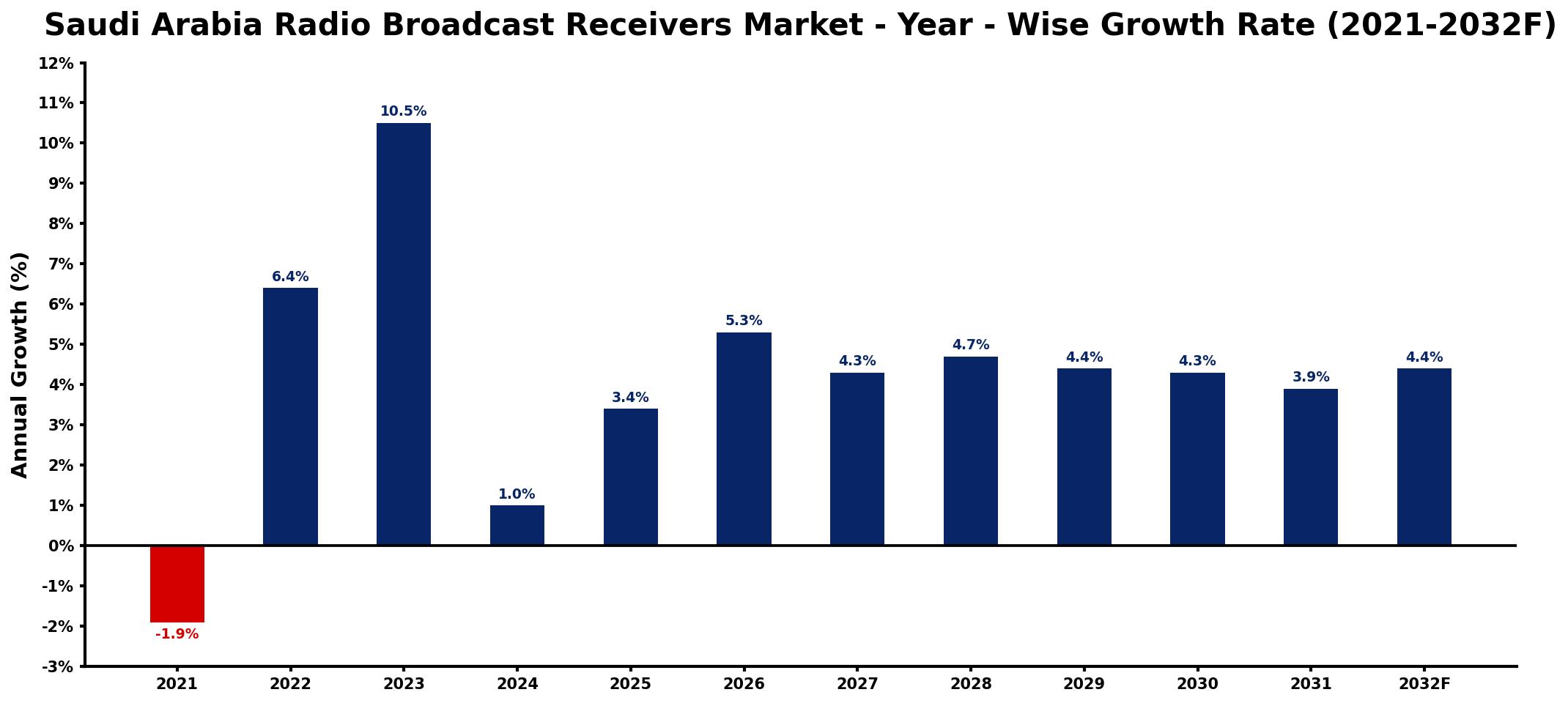
The table below presents the year‑wise growth rates along with the key drivers influencing the market
| Year | Growth Rate | Major Drivers |
| 2021 | -1.9% | decreased consumer spending on electronics |
| 2022 | 6.4% | increased interest in digital media |
| 2023 | 10.5% | growing demand for portable devices |
| 2024 | 1.0% | rising investments in entertainment sectors |
| 2025 | 3.4% | expansion of streaming services popularity |
| 2026 | 5.3% | enhanced technological advancements in audio |
| 2027 | 4.3% | growing preference for smart technology |
| 2028 | 4.7% | increased adoption of wireless audio |
| 2029 | 4.4% | rising consumer interest in personalization |
| 2030 | 4.3% | expanding market for home entertainment |
| 2031 | 3.9% | increased awareness of audio quality |
| 2032 | 4.4% | growing integration with smart homes |
Note: Market size estimations and growth projections presented in this report are based on 6Wresearch's proprietary forecasting methodology, utilizing the latest available industry data, government publications, and primary research inputs.
Saudi Arabia Radio Broadcast Receivers Market Synopsis
The strongest force currently shaping the Saudi Arabia Radio Broadcast Receivers Market is the continuous evolution of consumer preferences towards advanced broadcasting features. Listeners are increasingly seeking products that offer superior reception quality, internet connectivity, and the convenience of smart device integration, thereby reinforcing their engagement with radio as a medium.
In addition, government initiatives aimed at promoting local content and cultural programming have significantly fueled the demand for radio broadcast receivers. As the Saudi population increasingly tunes in to local radio stations that cater to diverse interests, the market is poised for sustained growth in the coming years.
Saudi Arabia Radio Broadcast Receivers Market Key Takeaways
- The market is witnessing a solid growth trajectory fueled by a blend of technological advancement and increased consumer interest.
- Government support for local content is acting as a catalyst for increased radio listenership and receiver demand.
- Hybrid solutions that incorporate traditional radio with modern streaming are becoming essential for market players.
- Quality reception and user-friendly interfaces are paramount to attracting todays tech-savvy consumers.
- The market's resilience during the COVID-19 pandemic highlighted its adaptability to changing consumer habits.
Evaluation of Restraints in Saudi Arabia Radio Broadcast Receivers Market
Despite its growth, the Saudi Arabia Radio Broadcast Receivers Market faces notable constraints, particularly from the ever-increasing competition posed by digital streaming platforms. As consumer habits shift towards on-demand content, traditional radio broadcasting must evolve to stay relevant. Innovations are crucial, as market players strive to create products that not only deliver excellent audio quality but also seamlessly integrate modern functionalities. Moreover, maintaining high production standards while keeping prices competitive poses an ongoing challenge that requires strategic planning and market adaptation.
Saudi Arabia Radio Broadcast Receivers Market Trends
A notable trend in the Saudi Arabia Radio Broadcast Receivers Market is the integration of internet connectivity features into radio devices, which provides listeners with access to a broader array of content and functionalities. Additionally, the rise of smart home technologies has led to increased demand for receivers that can connect with other smart devices. The growing trend towards user customization, where consumers can tailor their listening experiences, is also gaining traction, encouraging manufacturers to innovate their offerings.
Saudi Arabia Radio Broadcast Receivers Market Opportunities
There are significant opportunities for growth within the Saudi Arabia Radio Broadcast Receivers Market, particularly in developing hybrid models that combine traditional radio with internet streaming capabilities. Collaborations between local broadcasters and receiver manufacturers present unique avenues for product innovation, specifically tailored to meet local preferences. Additionally, targeting younger demographics with features appealing to their digital lifestyles could yield substantial market gains.
Government Initiatives in the Saudi Arabia Radio Broadcast Receivers Market
The Saudi government has implemented various initiatives to bolster the radio broadcasting sector, focusing on promoting local content and cultural programming. By encouraging local production and distribution of radio content, these initiatives enhance listener engagement and satisfaction. Investments in improving broadcasting infrastructure are also anticipated, which will indirectly support the radio broadcast receivers market by improving reception quality across the nation.
Future Insights of the Saudi Arabia Radio Broadcast Receivers Market
Looking ahead to the 2026-2032 timeframe, the Saudi Arabia Radio Broadcast Receivers Market is expected to continue its upward trajectory as technology evolves and consumer preferences shift. The market will likely witness a greater integration of advanced features such as voice control and AI-driven personalized content recommendations. Furthermore, as the government remains committed to fostering local broadcasting, the continuous influx of regional content will keep radio broadcasting relevant and engaging for Saudi consumers.
Saudi Arabia Radio Broadcast Receivers Market Latest Developments (2025 - 2026)
Recent developments in the Saudi Arabia Radio Broadcast Receivers Market indicate a strong focus on technological innovations and improved user interfaces. Manufacturers are increasingly releasing products that combine cutting-edge technology with user-friendly designs. Additionally, there have been discussions among industry stakeholders about enhancing collaboration to develop unique radio experiences tailored to local audiences, reflecting a commitment to elevating the overall quality of radio broadcasting.
Saudi Arabia Radio Broadcast Receivers Market - Key Attractiveness of the Report
- 10 Years of Market Numbers
- Historical Data Starting from 2022 to 2025
- Base Year: 2025
- Forecast Data until 2032
- Key Performance Indicators Impacting the Market
- Major Upcoming Developments and Projects
Key Highlights of the Report:
- Saudi Arabia Radio Broadcast Receivers Market Outlook
- Market Size of Saudi Arabia Radio Broadcast Receivers Market, 2025
- Forecast of Saudi Arabia Radio Broadcast Receivers Market, 2032
- Historical Data and Forecast of Saudi Arabia Radio Broadcast Receivers Revenues & Volume for the Period 2022-2032F
- Saudi Arabia Radio Broadcast Receivers Market Trend Evolution
- Saudi Arabia Radio Broadcast Receivers Market Drivers and Challenges
- Saudi Arabia Radio Broadcast Receivers Price Trends
- Saudi Arabia Radio Broadcast Receivers Porter's Five Forces
- Saudi Arabia Radio Broadcast Receivers Industry Life Cycle
- Historical Data and Forecast of Saudi Arabia Radio Broadcast Receivers Market Revenues & Volume By Equipment for the Period 2022-2032F
- Historical Data and Forecast of Saudi Arabia Radio Broadcast Receivers Market Revenues & Volume By Modulators for the Period 2022-2032F
- Historical Data and Forecast of Saudi Arabia Radio Broadcast Receivers Market Revenues & Volume By Transmitters And Receivers for the Period 2022-2032F
- Historical Data and Forecast of Saudi Arabia Radio Broadcast Receivers Market Revenues & Volume By Encoders for the Period 2022-2032F
- Historical Data and Forecast of Saudi Arabia Radio Broadcast Receivers Market Revenues & Volume By Switches for the Period 2022-2032F
- Historical Data and Forecast of Saudi Arabia Radio Broadcast Receivers Market Revenues & Volume By Filters for the Period 2022-2032F
- Historical Data and Forecast of Saudi Arabia Radio Broadcast Receivers Market Revenues & Volume By Amplifiers for the Period 2022-2032F
- Historical Data and Forecast of Saudi Arabia Radio Broadcast Receivers Market Revenues & Volume By Frequency for the Period 2022-2032F
- Historical Data and Forecast of Saudi Arabia Radio Broadcast Receivers Market Revenues & Volume By Low Frequency for the Period 2022-2032F
- Historical Data and Forecast of Saudi Arabia Radio Broadcast Receivers Market Revenues & Volume By Medium Frequency for the Period 2022-2032F
- Historical Data and Forecast of Saudi Arabia Radio Broadcast Receivers Market Revenues & Volume By High Frequency for the Period 2022-2032F
- Saudi Arabia Radio Broadcast Receivers Import Export Trade Statistics
- Market Opportunity Assessment By Equipment
- Market Opportunity Assessment By Frequency
- Saudi Arabia Radio Broadcast Receivers Top Companies Market Share
- Saudi Arabia Radio Broadcast Receivers Competitive Benchmarking By Technical and Operational Parameters
- Saudi Arabia Radio Broadcast Receivers Company Profiles
- Saudi Arabia Radio Broadcast Receivers Key Strategic Recommendations






































