Saudi Arabia Recycled Textiles Market Size, Share & Growth Rate
The Saudi Arabia Recycled Textiles Market was estimated at USD 469 Million in 2025 and is projected to reach USD 601 Million by 2032, growing at a CAGR of 3.6% from 2026 to 2032. This growth trajectory is driven by increasing consumer demand for sustainable fashion and a growing commitment among local businesses to adopt eco-friendly practices. Furthermore, rising awareness of environmental issues has spurred interest in circular fashion, positioning recycled textiles as a viable alternative in the ever-evolving landscape of the textile industry.
Saudi Arabia Recycled Textiles Market Year-wise Growth Rate and Key Drivers
This graph highlights how the Saudi Arabia Recycled Textiles Market has steadily grown over the years, supported by major growth factors.
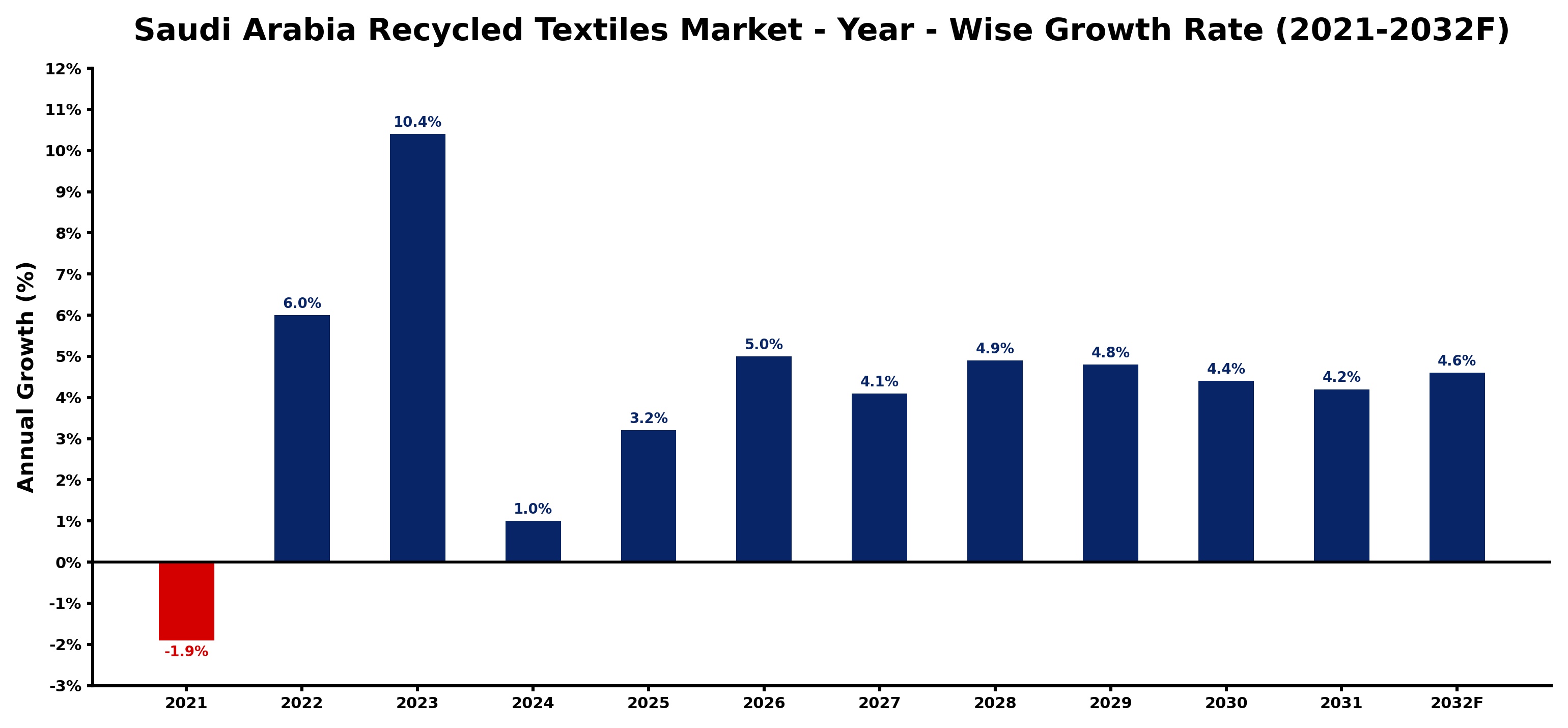
The table below presents the year‑wise growth rates along with the key drivers influencing the market
| Year | Growth Rate | Major Drivers |
| 2021 | -1.9% | Consumer awareness hindered purchases |
| 2022 | 6.0% | Sustainability initiatives drove demand |
| 2023 | 10.4% | Government regulations encouraged recycling |
| 2024 | 1.0% | Local production increased market supply |
| 2025 | 3.2% | Fashion trends embraced recycled textiles |
| 2026 | 5.0% | Technological advancements improved processes |
| 2027 | 4.1% | Collaboration with NGOs expanded outreach |
| 2028 | 4.9% | E-commerce platforms enhanced accessibility |
| 2029 | 4.8% | Corporate responsibility initiatives gained traction |
| 2030 | 4.4% | Circular economy models gained popularity |
| 2031 | 4.2% | Educational campaigns raised awareness |
| 2032 | 4.6% | Global partnerships strengthened market presence |
Note - Market size estimations and growth projections presented in this report are based on 6Wresearch’s advanced forecasting approach, validated with industry datasets as of June 2026.
Saudi Arabia Recycled Textiles Market Synopsis
In recent years, the Saudi Arabia recycled textiles market has gained momentum, buoyed by a shift in consumer attitudes towards sustainability. As more businesses embrace eco-friendly alternatives, this market is set to flourish, showcasing significant potential for innovative applications in clothing and home furnishings. Despite these positive trends, the sector still faces challenges that need addressing to fully realize its capabilities.
The outlook for the Saudi Arabia recycled textiles market remains optimistic, with a clear focus on reducing textile waste and promoting ethical fashion. Companies are increasingly incorporating recycled materials into their offerings, indicating a robust alignment with global sustainability goals. This evolution not only enhances brand appeal but also caters to an expanding consumer base that prioritizes environmental responsibility.
Saudi Arabia Recycled Textiles Market Key Takeaways
- The market is projected to grow significantly, reflecting a shift towards sustainable fashion choices.
- Increasing consumer awareness of environmental issues is driving demand for recycled textiles.
- Innovations in recycling technologies are crucial for improving the quality and sustainability of recycled materials.
- The focus on circular fashion practices is reshaping the textile industry landscape in Saudi Arabia.
- Public initiatives and consumer education are essential for overcoming market challenges and fostering growth.
Evaluation of Restraints in Saudi Arabia Recycled Textiles Market
The Saudi Arabia recycled textiles market is held back by a combination of factors that hinder its full potential. One significant restraint is the underdeveloped recycling infrastructure, which limits the ability to process and convert textiles efficiently. Additionally, consumer awareness remains low in some segments, posing challenges for market penetration. Competition from low-cost virgin textiles and imported products adds another layer of complexity, necessitating strategic positioning and robust marketing efforts from local players to carve out market share.
Saudi Arabia Recycled Textiles Market Trends
Several trends are shaping the Saudi Arabia recycled textiles market, particularly the rise of ethical fashion and environmentally conscious consumerism. Brands are increasingly showcasing recycled textiles in their collections, promoting transparency and sustainability in their supply chains. Moreover, collaborations between textile manufacturers and recycling companies are gaining traction, as businesses seek to enhance their sustainability credentials while also diversifying their product offerings.
The integration of advanced recycling technologies is also emerging as a key trend, enabling the production of high-quality recycled fibers that meet consumer expectations. Additionally, digital platforms are facilitating consumer education about the benefits of recycled textiles, thereby increasing their acceptance and demand.
Saudi Arabia Recycled Textiles Market Opportunities
There are considerable opportunities for investment and growth within the Saudi Arabia recycled textiles market. As the demand for sustainable products continues to rise, businesses can capitalize on developing innovative recycling techniques to enhance material quality. Moreover, partnerships with local governments and NGOs focused on sustainability can provide a framework for expanding recycling programs and infrastructure. Engaging in community education initiatives can also foster greater consumer loyalty and drive market expansion, as more individuals seek to make environmentally responsible purchasing decisions.
Government Initiatives in the Saudi Arabia Recycled Textiles Market
The Saudi Arabian government has been proactive in promoting sustainability initiatives, emphasizing the importance of environmental stewardship. Policies encouraging the use of recycled materials in various industries are being developed, alongside incentives for companies that adopt sustainable practices. Public spending on waste management and recycling infrastructure further supports the growth of the recycled textiles market. Through various programs, the government aims to increase awareness of sustainability, encouraging both businesses and consumers to participate actively in this transformative sector.
Future Insights of the Saudi Arabia Recycled Textiles Market
Looking ahead to 2026-2032, the Saudi Arabia recycled textiles market is poised for significant growth. As sustainability becomes a core focus for both consumers and businesses, the integration of recycled textiles will likely expand beyond traditional applications. Innovations in recycling methods and increased investment in related technologies will enhance product quality, making recycled textiles more appealing. With ongoing support from government initiatives and rising consumer demand for sustainable products, the market is set to establish itself as a vital segment of the broader textile industry.
Saudi Arabia Recycled Textiles Market Latest Developments (May 2025 - June 2026)
Recent developments in the Saudi Arabia recycled textiles market indicate a growing commitment to sustainability among local manufacturers. Companies have begun investing in advanced recycling technologies, leading to enhanced capabilities in processing and converting used textiles into high-quality fibers. Additionally, partnerships between textile firms and environmental organizations are emerging, aimed at promoting awareness and driving adoption of recycled materials. As consumer sentiment continues to evolve, businesses are increasingly showcasing their eco-friendly initiatives, responding to the demand for transparency and sustainability in the fashion industry.
Saudi Arabia Recycled Textiles Market - Key Attractiveness of the Report
- 10 Years of Market Numbers
- Historical Data Starting from 2022 to 2025
- Base Year: 2025
- Forecast Data until 2032
- Key Performance Indicators Impacting the Market
- Major Upcoming Developments and Projects
Key Highlights of the Report:
- Saudi Arabia Recycled Textiles Market Outlook
- Market Size of Saudi Arabia Recycled Textiles Market, 2025
- Forecast of Saudi Arabia Recycled Textiles Market, 2032
- Historical Data and Forecast of Saudi Arabia Recycled Textiles Revenues & Volume for the Period 2022-2032F
- Saudi Arabia Recycled Textiles Market Trend Evolution
- Saudi Arabia Recycled Textiles Market Drivers and Challenges
- Saudi Arabia Recycled Textiles Price Trends
- Saudi Arabia Recycled Textiles Porter's Five Forces
- Saudi Arabia Recycled Textiles Industry Life Cycle
- Historical Data and Forecast of Saudi Arabia Recycled Textiles Market Revenues & Volume By Type for the Period 2022-2032F
- Historical Data and Forecast of Saudi Arabia Recycled Textiles Market Revenues & Volume By Recycled Cotton for the Period 2022-2032F
- Historical Data and Forecast of Saudi Arabia Recycled Textiles Market Revenues & Volume By Recycled Wool for the Period 2022-2032F
- Historical Data and Forecast of Saudi Arabia Recycled Textiles Market Revenues & Volume By Recycled Polyester for the Period 2022-2032F
- Historical Data and Forecast of Saudi Arabia Recycled Textiles Market Revenues & Volume By Recycled Nylon for the Period 2022-2032F
- Historical Data and Forecast of Saudi Arabia Recycled Textiles Market Revenues & Volume By Others for the Period 2022-2032F
- Historical Data and Forecast of Saudi Arabia Recycled Textiles Market Revenues & Volume By End-use Industry for the Period 2022-2032F
- Historical Data and Forecast of Saudi Arabia Recycled Textiles Market Revenues & Volume By Automotive for the Period 2022-2032F
- Historical Data and Forecast of Saudi Arabia Recycled Textiles Market Revenues & Volume By Retail for the Period 2022-2032F
- Historical Data and Forecast of Saudi Arabia Recycled Textiles Market Revenues & Volume By Mining for the Period 2022-2032F
- Historical Data and Forecast of Saudi Arabia Recycled Textiles Market Revenues & Volume By Building & Construction for the Period 2022-2032F
- Historical Data and Forecast of Saudi Arabia Recycled Textiles Market Revenues & Volume By Others for the Period 2022-2032F
- Saudi Arabia Recycled Textiles Import Export Trade Statistics
- Market Opportunity Assessment By Type
- Market Opportunity Assessment By End-use Industry
- Saudi Arabia Recycled Textiles Top Companies Market Share
- Saudi Arabia Recycled Textiles Competitive Benchmarking By Technical and Operational Parameters
- Saudi Arabia Recycled Textiles Company Profiles
- Saudi Arabia Recycled Textiles Key Strategic Recommendations






































