Saudi Arabia Renewable Chemicals Market Size, Share & Growth Rate
The Saudi Arabia Renewable Chemicals Market was estimated at USD 241 Million in 2025 and is projected to reach USD 309 Million by 2032, growing at a CAGR of 3.6% from 2026 to 2032. This growth trajectory reflects a significant shift in the industrial landscape, driven largely by increasing environmental concerns and a national agenda that prioritizes sustainable practices. With the governments focus on diversifying the economy away from fossil fuels, the demand for renewable alternatives in various applications is poised to enhance market dynamics considerably.
Saudi Arabia Renewable Chemicals Market Year-wise Growth Rate and Key Drivers
This graph highlights how the Saudi Arabia Renewable Chemicals Market has steadily grown over the years, supported by major growth factors.
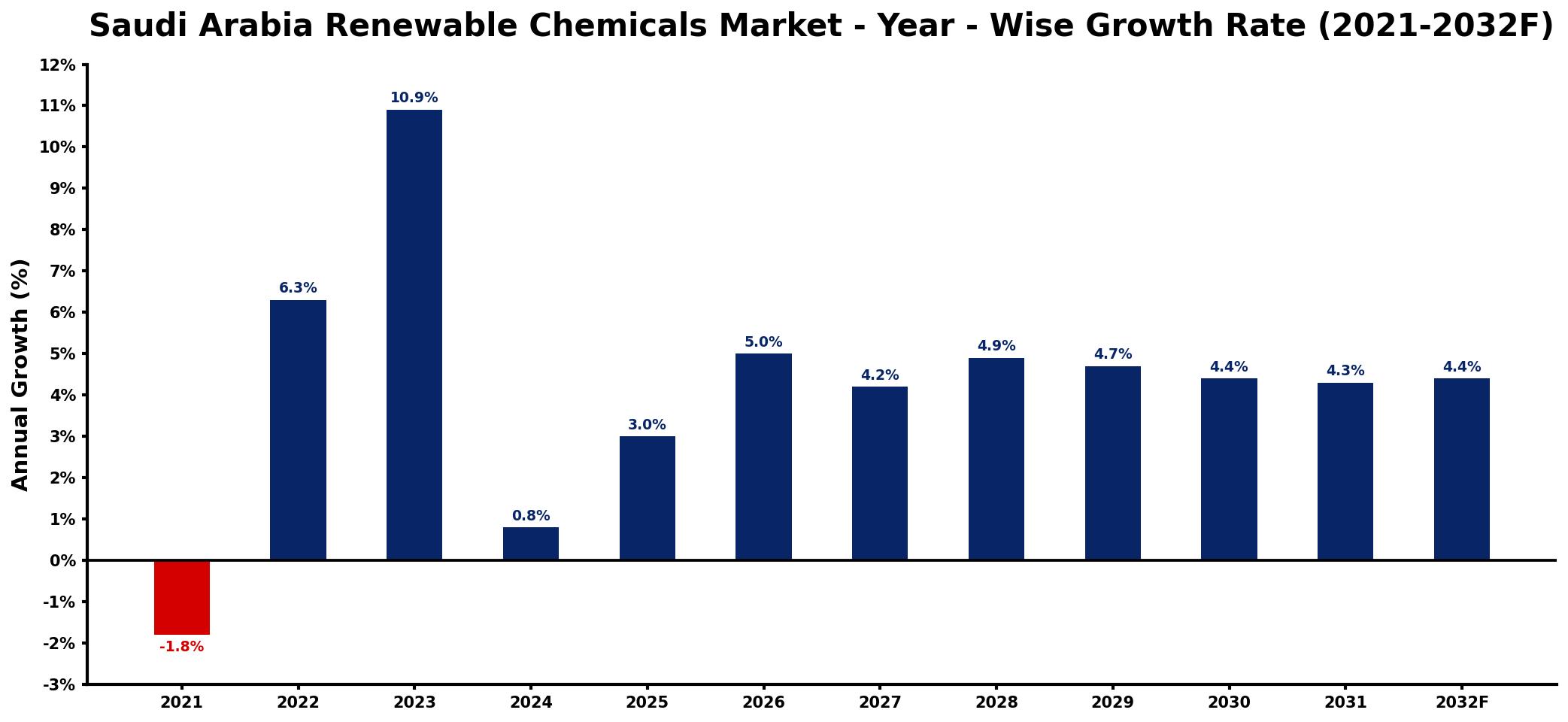
The table below presents the year‑wise growth rates along with the key drivers influencing the market
| Year | Growth Rate | Major Drivers |
| 2021 | -1.8% | decrease in investment projects |
| 2022 | 6.3% | increased demand for sustainability |
| 2023 | 10.9% | expansion of green technology |
| 2024 | 0.8% | growth in bio-based alternatives |
| 2025 | 3.0% | stronger distribution network expansion |
| 2026 | 5.0% | enhanced government policy support |
| 2027 | 4.2% | development of circular economy |
| 2028 | 4.9% | advancements in production efficiency |
| 2029 | 4.7% | increased collaboration among industries |
| 2030 | 4.4% | growing global market opportunities |
| 2031 | 4.3% | emergence of innovative startups |
| 2032 | 4.4% | strengthened supply chain partnerships |
Note: Market size estimations and growth projections presented in this report are based on 6Wresearch's proprietary forecasting methodology, utilizing the latest available industry data, government publications, and primary research inputs.
Saudi Arabia Renewable Chemicals Market Synopsis
Recently, the Saudi Arabia Renewable Chemicals Market has gained momentum as industries increasingly pivot toward greener solutions. As eco-consciousness takes root, the demand for renewable chemicals is expected to surge, fostering innovations and investments in this sector.
Looking ahead, the market is positioned for robust expansion, propelled by regulatory incentives and a rising commitment from businesses to embrace sustainable practices. The interplay of local and global trends suggests that the Saudi renewable chemicals landscape will not only evolve but thrive amidst a backdrop of changing consumer preferences and regulatory frameworks.
Saudi Arabia Renewable Chemicals Market Key Takeaways
- The market is projected to grow from USD 241 Million in 2025 to USD 309 Million by 2032.
- Increasing environmental awareness and regulatory support are driving the shift towards renewable chemicals.
- Emerging technologies and production methods are vital for maintaining cost competitiveness.
- COVID-19 has accelerated the need for sustainable practices within industries across Saudi Arabia.
- Strategic investments aligned with the Saudi Vision 2031 are enhancing market prospects.
Evaluation of Restraints in Saudi Arabia Renewable Chemicals Market
The Saudi Arabia Renewable Chemicals Market faces several restraints that hinder its expansion. One significant limitation is the challenge of scaling up production to meet burgeoning demand. Additionally, achieving cost competitiveness relative to traditional petrochemical products remains a hurdle. As investments in research and innovative production technologies are essential, the path forward involves overcoming these barriers to maximize the potential of renewable chemicals across various applications.
Saudi Arabia Renewable Chemicals Market Trends
A notable trend in the Saudi Arabia Renewable Chemicals Market is the increasing adoption of bioplastics across various sectors, including packaging and textiles. Innovations in enzyme technology and fermentation processes are enhancing the production capabilities and functionalities of renewable chemicals. Furthermore, consumer demand for transparency and sustainability is leading companies to prioritize bio-based ingredients, fostering a competitive edge in market positioning.
Saudi Arabia Renewable Chemicals Market Opportunities
Emerging opportunities abound within the Saudi Arabia Renewable Chemicals Market, particularly in the development of bio-based alternatives for conventional chemicals. As sectors such as agriculture and consumer goods seek sustainable inputs, partnerships between research institutions and industry players can drive innovation. Additionally, government support for startups focused on renewable technologies presents a promising avenue for investment and growth.
Government Initiatives in the Saudi Arabia Renewable Chemicals Market
The Saudi government has undertaken several initiatives to stimulate the growth of the renewable chemicals sector as part of its broader economic diversification strategy. Policies that promote investment in sustainable practices, along with subsidies for research and development, are critical to nurturing innovation. Furthermore, regulatory frameworks aimed at reducing carbon emissions align closely with the objectives of the Saudi Vision 2031, underscoring the governments commitment to fostering a green economy.
Future Insights of the Saudi Arabia Renewable Chemicals Market
The outlook for the Saudi Arabia Renewable Chemicals Market from 2026 to 2032 appears increasingly optimistic. As production technologies become more refined, the potential for cost-effective renewable chemical solutions will likely catalyze broader industry adoption. With a sustained focus on sustainability and innovative practices, the market is expected to position itself as a leader in the global transition towards greener alternatives, creating a resilient and eco-friendly chemical landscape.
Saudi Arabia Renewable Chemicals Market Latest Developments (2025 - 2026)
Recent developments in the Saudi Arabia Renewable Chemicals Market highlight a surge in collaborative efforts between industry players and research institutions to enhance production capabilities. Notably, innovations in bioengineering and a renewed focus on circular economy practices are becoming increasingly prevalent. Additionally, key industry conferences have set the stage for discussions surrounding sustainable practices, reflecting a growing consensus on the importance of integrating renewable chemicals into mainstream production processes.
Saudi Arabia Renewable Chemicals Market - Key Attractiveness of the Report
- 10 Years of Market Numbers
- Historical Data Starting from 2022 to 2025
- Base Year: 2025
- Forecast Data until 2032
- Key Performance Indicators Impacting the Market
- Major Upcoming Developments and Projects
Key Highlights of the Report:
- Saudi Arabia Renewable Chemicals Market Outlook
- Market Size of Saudi Arabia Renewable Chemicals Market, 2025
- Forecast of Saudi Arabia Renewable Chemicals Market, 2032
- Historical Data and Forecast of Saudi Arabia Renewable Chemicals Revenues & Volume for the Period 2022-2032F
- Saudi Arabia Renewable Chemicals Market Trend Evolution
- Saudi Arabia Renewable Chemicals Market Drivers and Challenges
- Saudi Arabia Renewable Chemicals Price Trends
- Saudi Arabia Renewable Chemicals Porter's Five Forces
- Saudi Arabia Renewable Chemicals Industry Life Cycle
- Historical Data and Forecast of Saudi Arabia Renewable Chemicals Market Revenues & Volume By Product Type for the Period 2022-2032F
- Historical Data and Forecast of Saudi Arabia Renewable Chemicals Market Revenues & Volume By Alcohols for the Period 2022-2032F
- Historical Data and Forecast of Saudi Arabia Renewable Chemicals Market Revenues & Volume By Organic Acids for the Period 2022-2032F
- Historical Data and Forecast of Saudi Arabia Renewable Chemicals Market Revenues & Volume By Ketones for the Period 2022-2032F
- Historical Data and Forecast of Saudi Arabia Renewable Chemicals Market Revenues & Volume By Platform Chemicals for the Period 2022-2032F
- Historical Data and Forecast of Saudi Arabia Renewable Chemicals Market Revenues & Volume By Biopolymers for the Period 2022-2032F
- Historical Data and Forecast of Saudi Arabia Renewable Chemicals Market Revenues & Volume By Others for the Period 2022-2032F
- Historical Data and Forecast of Saudi Arabia Renewable Chemicals Market Revenues & Volume By Applications for the Period 2022-2032F
- Historical Data and Forecast of Saudi Arabia Renewable Chemicals Market Revenues & Volume By Transportation for the Period 2022-2032F
- Historical Data and Forecast of Saudi Arabia Renewable Chemicals Market Revenues & Volume By Textiles for the Period 2022-2032F
- Historical Data and Forecast of Saudi Arabia Renewable Chemicals Market Revenues & Volume By Food safety for the Period 2022-2032F
- Historical Data and Forecast of Saudi Arabia Renewable Chemicals Market Revenues & Volume By Environment for the Period 2022-2032F
- Historical Data and Forecast of Saudi Arabia Renewable Chemicals Market Revenues & Volume By Communication for the Period 2022-2032F
- Historical Data and Forecast of Saudi Arabia Renewable Chemicals Market Revenues & Volume By Housing for the Period 2022-2032F
- Historical Data and Forecast of Saudi Arabia Renewable Chemicals Market Revenues & Volume By Recreation for the Period 2022-2032F
- Historical Data and Forecast of Saudi Arabia Renewable Chemicals Market Revenues & Volume By Other Applications for the Period 2022-2032F
- Saudi Arabia Renewable Chemicals Import Export Trade Statistics
- Market Opportunity Assessment By Product Type
- Market Opportunity Assessment By Applications
- Saudi Arabia Renewable Chemicals Top Companies Market Share
- Saudi Arabia Renewable Chemicals Competitive Benchmarking By Technical and Operational Parameters
- Saudi Arabia Renewable Chemicals Company Profiles
- Saudi Arabia Renewable Chemicals Key Strategic Recommendations






































