Saudi Arabia Retail Industry Market Size, Share & Growth Rate
The Saudi Arabia Retail Industry Market was estimated at USD 1087 Million in 2025 and is projected to reach USD 1613 Million by 2032, growing at a CAGR of 5.8% from 2026 to 2032. This impressive trajectory is propelled by a combination of rapid urbanization and an increasingly affluent young population that is eager to embrace both local and international brands. Additionally, the ongoing integration of technology within retail, particularly through e-commerce platforms, continues to redefine consumer shopping behaviors.
Saudi Arabia Retail Industry Market Year-wise Growth Rate and Key Drivers
This graph highlights how the Saudi Arabia Retail Industry Market has steadily grown over the years, supported by major growth factors.
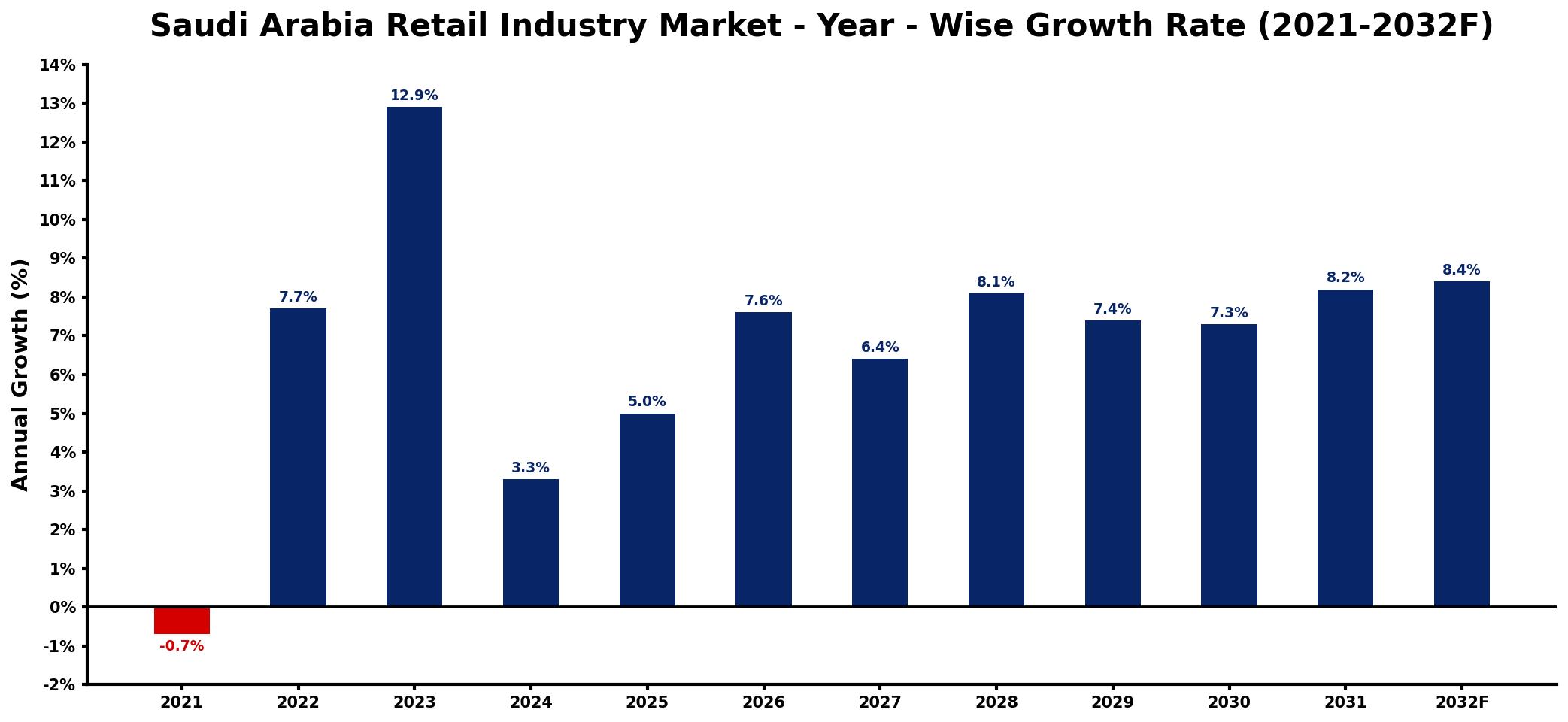
The table below presents the year‑wise growth rates along with the key drivers influencing the market
| Year | Growth Rate | Major Drivers |
| 2021 | -0.7% | decreased consumer spending power |
| 2022 | 7.7% | rising disposable income levels |
| 2023 | 12.9% | expansion of e-commerce platforms |
| 2024 | 3.3% | increased foreign investment inflow |
| 2025 | 5.0% | growth in tourism sector demand |
| 2026 | 7.6% | enhanced logistics and distribution |
| 2027 | 6.4% | development of new shopping centers |
| 2028 | 8.1% | adoption of digital payment solutions |
| 2029 | 7.4% | growing demand for sustainable products |
| 2030 | 7.3% | rising population and urbanization |
| 2031 | 8.2% | increased focus on local brands |
| 2032 | 8.4% | increased domestic production output |
Note: Market size estimations and growth projections presented in this report are based on 6Wresearch's proprietary forecasting methodology, utilizing the latest available industry data, government publications, and primary research inputs.
Saudi Arabia Retail Industry Market Synopsis
Saudi Arabia's retail landscape is uniquely characterized by a blend of traditional souks and cutting-edge shopping malls, appealing to a wide array of consumer preferences. With a young population, the demand for diverse products, especially in electronics and fashion, is on the rise, highlighting the market's vibrant nature.
The retail sector is witnessing a noteworthy shift toward e-commerce, accelerated by the pandemic's impact on shopping behaviors. This change has prompted retailers to enhance their digital presence while also adapting brick-and-mortar stores to create more immersive customer experiences.
Saudi Arabia Retail Industry Market Key Takeaways
- Population growth and urbanization are primary drivers of retail demand.
- Digital transformation is reshaping the retail landscape, with e-commerce gaining traction.
- A robust economic outlook supports increased consumer spending power.
- Adapting to changing consumer preferences is crucial for traditional retailers.
- Safety and convenience, heightened by the pandemic, are pivotal in shaping customer experiences.
Evaluation of Restraints in Saudi Arabia Retail Industry Market
Despite the promising growth trajectory, the Saudi Arabia retail industry faces significant restraints. The shift to online shopping has created intense competition, with traditional retailers struggling to keep up. Many brick-and-mortar stores are challenged by their inability to effectively integrate omnichannel strategies. Additionally, fluctuations in the economy and geopolitical factors can impact consumer confidence and spending habits, posing ongoing challenges for retailers aiming to maintain relevance.
Saudi Arabia Retail Industry Market Trends
Several trends are emerging in the Saudi Arabia retail industry, driven largely by technological advancements and shifting consumer expectations. Personalization through data analytics is becoming vital, with retailers tailoring offers based on individual consumer preferences. Furthermore, sustainability is rising in importance, as more consumers demand environmentally friendly products. The emphasis on seamless omnichannel experiences also grows as retailers look to create cohesive shopping journeys across platforms.
Saudi Arabia Retail Industry Market Opportunities
The Saudi Arabia retail market presents lucrative opportunities, particularly for those willing to invest in e-commerce and technological integration. As consumers become more comfortable with online shopping, companies can leverage this shift by enhancing their digital platforms. Additionally, tapping into the health and wellness sector, along with local products, can cater to evolving consumer preferences, driving further growth in this competitive environment.
Government Initiatives in the Saudi Arabia Retail Industry Market
The Saudi government has taken substantial steps to boost the retail sector as part of its Vision 2030 initiative. Investment in infrastructure, such as the development of new shopping complexes and transportation links, aims to enhance consumer access. Furthermore, government policies encouraging foreign investment and supporting local businesses are driving innovation in the retail space, fostering a more competitive market.
Future Insights of the Saudi Arabia Retail Industry Market
Looking forward to 2026-2032, the Saudi Arabia retail industry is expected to continue evolving dramatically. As technology further integrates into consumer experiences, retailers will prioritize agility and adaptability. E-commerce will become an indispensable component of retail strategies, while physical stores will innovate to enhance the in-store experience. Sustainability and customer-centric approaches will also be paramount, shaping the future landscape of the industry.
Saudi Arabia Retail Industry Market Latest Developments (2025 - 2026)
In recent months, the Saudi retail industry has seen a notable shift towards more integrated digital solutions, with many retailers enhancing their e-commerce capabilities. Additionally, partnerships between tech companies and retail chains are becoming increasingly common, aimed at enriching the customer journey through improved digital experiences. Furthermore, the recovery from the pandemic has led to a resurgence in foot traffic, prompting retailers to balance online and offline strategies more effectively.
Saudi Arabia Retail Industry Market - Key Attractiveness of the Report
- 10 Years of Market Numbers
- Historical Data Starting from 2022 to 2025
- Base Year: 2025
- Forecast Data until 2032
- Key Performance Indicators Impacting the Market
- Major Upcoming Developments and Projects
Key Highlights of the Report:
- Saudi Arabia Retail Industry Market Outlook
- Market Size of Saudi Arabia Retail Industry Market, 2025
- Forecast of Saudi Arabia Retail Industry Market, 2032
- Historical Data and Forecast of Saudi Arabia Retail Industry Revenues & Volume for the Period 2022-2032F
- Saudi Arabia Retail Industry Market Trend Evolution
- Saudi Arabia Retail Industry Market Drivers and Challenges
- Saudi Arabia Retail Industry Price Trends
- Saudi Arabia Retail Industry Porter's Five Forces
- Saudi Arabia Retail Industry Industry Life Cycle
- Historical Data and Forecast of Saudi Arabia Retail Industry Market Revenues & Volume By Product for the Period 2022-2032F
- Historical Data and Forecast of Saudi Arabia Retail Industry Market Revenues & Volume By Food and Beverages for the Period 2022-2032F
- Historical Data and Forecast of Saudi Arabia Retail Industry Market Revenues & Volume By Personal and Household Care for the Period 2022-2032F
- Historical Data and Forecast of Saudi Arabia Retail Industry Market Revenues & Volume By Apparel, Footwear, and Accessories for the Period 2022-2032F
- Historical Data and Forecast of Saudi Arabia Retail Industry Market Revenues & Volume By Furniture, Toys, and Hobby for the Period 2022-2032F
- Historical Data and Forecast of Saudi Arabia Retail Industry Market Revenues & Volume By Electronic and Household Appliances for the Period 2022-2032F
- Historical Data and Forecast of Saudi Arabia Retail Industry Market Revenues & Volume By Other Products for the Period 2022-2032F
- Historical Data and Forecast of Saudi Arabia Retail Industry Market Revenues & Volume By Distribution Channel for the Period 2022-2032F
- Historical Data and Forecast of Saudi Arabia Retail Industry Market Revenues & Volume By Supermarkets/Hypermarkets for the Period 2022-2032F
- Historical Data and Forecast of Saudi Arabia Retail Industry Market Revenues & Volume By Convenience Stores for the Period 2022-2032F
- Historical Data and Forecast of Saudi Arabia Retail Industry Market Revenues & Volume By Department Stores for the Period 2022-2032F
- Historical Data and Forecast of Saudi Arabia Retail Industry Market Revenues & Volume By Specialty Stores for the Period 2022-2032F
- Historical Data and Forecast of Saudi Arabia Retail Industry Market Revenues & Volume By Online for the Period 2022-2032F
- Historical Data and Forecast of Saudi Arabia Retail Industry Market Revenues & Volume By Other Distribution Channels for the Period 2022-2032F
- Saudi Arabia Retail Industry Import Export Trade Statistics
- Market Opportunity Assessment By Product
- Market Opportunity Assessment By Distribution Channel
- Saudi Arabia Retail Industry Top Companies Market Share
- Saudi Arabia Retail Industry Competitive Benchmarking By Technical and Operational Parameters
- Saudi Arabia Retail Industry Company Profiles
- Saudi Arabia Retail Industry Key Strategic Recommendations






































