Saudi Arabia Scissors and Shears Market Summary
The saudi arabia scissors and shears market was estimated at USD 253 Million in 2025 and is projected to reach USD 323 Million by 2032, growing at a CAGR of 5.2% from 2026 to 2032.
Saudi Arabia Scissors and Shears Market Year-wise Growth Rate and Key Drivers
This graph highlights how the Saudi Arabia Scissors and Shears Market has steadily grown over the past five years, supported by major growth factors.
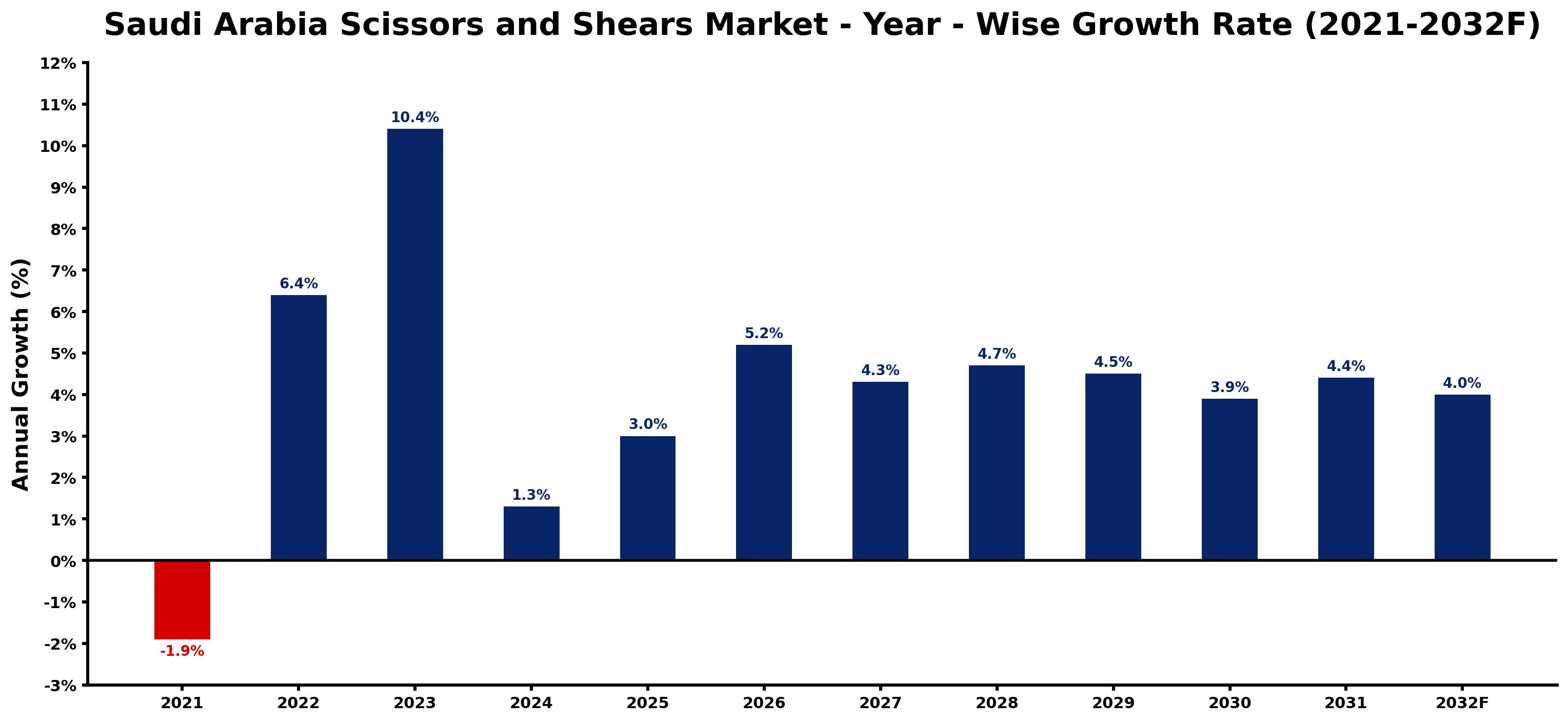
The table below presents the year wise growth rates along with the key drivers influencing the market
| Year | Growth Rate | Major Drivers |
| 2021 | -1.9% | Supply chain disruptions hindered availability of highquality materials, impacting production efficiency in the scissors and shears market. |
| 2022 | 6.4% | Increased DIY projects among households reflected a growing interest in home improvement. |
| 2023 | 10.4% | Local manufacturers began introducing innovative designs to meet unique market needs. |
| 2024 | 1.3% | Workforce training initiatives supported skilled craftsmanship in traditional cutting tools. |
| 2025 | 3.0% | Construction sector expansion required specialized shears for landscaping and architectural needs. |
| 2026 | 5.2% | E-commerce platforms emerged, facilitating easier access to diverse scissor options. |
| 2027 | 4.3% | Urbanization trends in cities like Riyadh spurred demand for specialized hairdressing tools. |
| 2028 | 4.7% | Sustainability practices encouraged the use of eco-friendly materials in scissors production. |
| 2029 | 4.5% | Cultural events highlighted the importance of quality shears in various traditional practices. |
| 2030 | 3.9% | Investment in smart home technologies led to interest in advanced cutting tools. |
| 2031 | 4.4% | Competitive pricing strategies by local brands attracted consumer interest and loyalty. |
| 2032 | 4.0% | Global brand collaborations introduced high-end shears, appealing to upscale consumers. |
Note - Market size estimations and growth projections presented in this report are based on 6Wresearch's advanced forecasting approach, validated with industry datasets as of June 2026.
Saudi Arabia Scissors and Shears Market Synopsis
The Saudi Arabia Scissors and Shears Market is projected to reach 5.2% and witness significant growth during the forecast period (2026-2032). The market is anticipated to expand at a compound annual growth rate (CAGR) of 7.5% as the demand for hairdressing and beauty services continues to rise across the region. Coupled with increasing consumer purchasing power, these factors are expected to drive a robust market growth trajectory.
Saudi Arabia Scissors and Shears Market Growth Drivers
The Saudi Arabia scissors and shears market is significantly influenced by the thriving beauty and grooming industry. Specifically, the following drivers are pivotal in propelling market growth:
- The popularity of hair beauty services such as cutting, coloring, and styling is surging. Reports indicate that these services contribute up to 40% of salon revenues in the Kingdom, underscoring a booming demand for high-quality tools for professionals.
- With approximately half of the Saudi Arabian population under 25 years old, a young and fashion-conscious demographic is emerging, eager to invest in personal grooming. This trend generates a higher demand for professional-grade scissors and shears among hairstylists and barbers.
- The increasing purchasing power of consumers is evident as more individuals seek customized grooming products, available through local shops and online platforms. This shift is creating additional sales opportunities within the scissors and shears market.
- Advancements in scissor technology, particularly from international manufacturers, are attracting a clientele that values high-performance and specialized tools. As awareness builds, professionals are inclined to adopt advanced products, fostering market expansion.
- The growing emphasis on aesthetics and personal grooming in the younger population is also leading to an increase in demand for DIY grooming tools, further stimulating market growth.
Saudi Arabia Scissors and Shears Market Challenges and Restraints
While the market presents numerous growth opportunities, it also faces several challenges that may hinder progress:
- High costs associated with advanced scissor technologies remain a significant barrier. Although prices of specialized tools have seen some reductions, the initial investment can still be too steep for some consumers and professionals, limiting broader market penetration.
- Market accessibility is affected by the availability of lower-priced alternatives, which may deter potential buyers from investing in higher-end products. This situation often leads to an inclination towards budget-friendly local options rather than premium, durable tools.
- The impact of the COVID-19 pandemic has left a lasting mark on the market, with production halts and supply chain disruptions. As businesses temporarily closed during the crisis, demand from various sectors dwindled, affecting revenue generation significantly.
- Some consumers remain hesitant to invest in upscale products due to economic uncertainties. Market players must adapt by offering a diverse range of pricing and product quality to cater to different consumer segments.
- Continued sensitivity towards fluctuations in raw material prices can challenge manufacturers, as increased costs might need to be passed onto consumers or absorbed by businesses, which could influence overall market health.
Saudi Arabia Scissors and Shears Market Covid-19 Impact
The COVID-19 pandemic led to significant challenges in the Saudi Arabia scissors and shears market. Many businesses halted operations, leading to a marked decline in demand, particularly from sectors such as hospitality where grooming services are integral. The temporary shutdown of manufacturing operations also resulted in supply chain disruptions, inhibiting the availability of scissors and shears in the market. Consequently, manufacturers experienced reduced revenue generation during the pandemic's peak, heightening pressure on operational models and strategic planning.
Saudi Arabia Scissors and Shears Market Government Investment and Initiatives
The Saudi government is increasingly investing in initiatives aimed at bolstering the local beauty and grooming industry. Policies focused on diversification of the economy under Vision 2030 include support for small businesses and investments in infrastructure that can benefit the scissors and shears market. Improvements in training programs for hairdressing and beauty professionals are being prioritized, enhancing skill sets and professionalism in the sector. Additionally, there are efforts to promote local manufacturing of grooming tools to decrease reliance on imports, thus positively impacting the scissors and shears market.
Saudi Arabia Scissors and Shears Market Latest Developments (May 2025 - June 2026)
Recent developments in the Saudi Arabia scissors and shears market have focused on innovating product offerings and enhancing market accessibility. Companies have begun embracing cutting-edge technology to create ergonomic and efficient tools tailored for aggressive consumer demand. The period has seen increased collaborations between local retailers and international suppliers, aimed at expanding product lines. E-commerce platforms have also become pivotal channels for sales, facilitating easier access to quality grooming tools across different demographics. Additionally, beauty professionals increasingly leverage social media for marketing their services and tools, further driving market awareness and growth.
Saudi Arabia Scissors and Shears Market - Key Attractiveness of the Report
- 10 Years of Market Numbers
- Historical Data Starting from 2022 to 2025
- Base Year: 2025
- Forecast Data until 2032
- Key Performance Indicators Impacting the Market
- Major Upcoming Developments and Projects
Key Highlights of the Report:
- Saudi Arabia Scissors and Shears Market Outlook
- Market Size of Saudi Arabia Scissors and Shears Market, 2025
- Forecast of Saudi Arabia Scissors and Shears Market, 2032
- Historical Data and Forecast of Saudi Arabia Scissors and Shears Revenues & Volume for the Period 2022-2032F
- Saudi Arabia Scissors and Shears Market Trend Evolution
- Saudi Arabia Scissors and Shears Market Drivers and Challenges
- Saudi Arabia Scissors and Shears Price Trends
- Saudi Arabia Scissors and Shears Porter's Five Forces
- Saudi Arabia Scissors and Shears Industry Life Cycle
- Historical Data and Forecast of Saudi Arabia Scissors and Shears Market Revenues & Volume By Type for the Period 2022-2032F
- Historical Data and Forecast of Saudi Arabia Scissors and Shears Market Revenues & Volume By Scissors for the Period 2022-2032F
- Historical Data and Forecast of Saudi Arabia Scissors and Shears Market Revenues & Volume By Shears for the Period 2022-2032F
- Historical Data and Forecast of Saudi Arabia Scissors and Shears Market Revenues & Volume By Application for the Period 2022-2032F
- Historical Data and Forecast of Saudi Arabia Scissors and Shears Market Revenues & Volume By Residential for the Period 2022-2032F
- Historical Data and Forecast of Saudi Arabia Scissors and Shears Market Revenues & Volume By Non-Residential for the Period 2022-2032F
- Saudi Arabia Scissors and Shears Import Export Trade Statistics
- Market Opportunity Assessment By Type
- Market Opportunity Assessment By Application
- Saudi Arabia Scissors and Shears Top Companies Market Share
- Saudi Arabia Scissors and Shears Competitive Benchmarking By Technical and Operational Parameters
- Saudi Arabia Scissors and Shears Company Profiles
- Saudi Arabia Scissors and Shears Key Strategic Recommendations






































