Saudi Arabia Service Virtualization Market Size & Growth Rate (2026-2032)
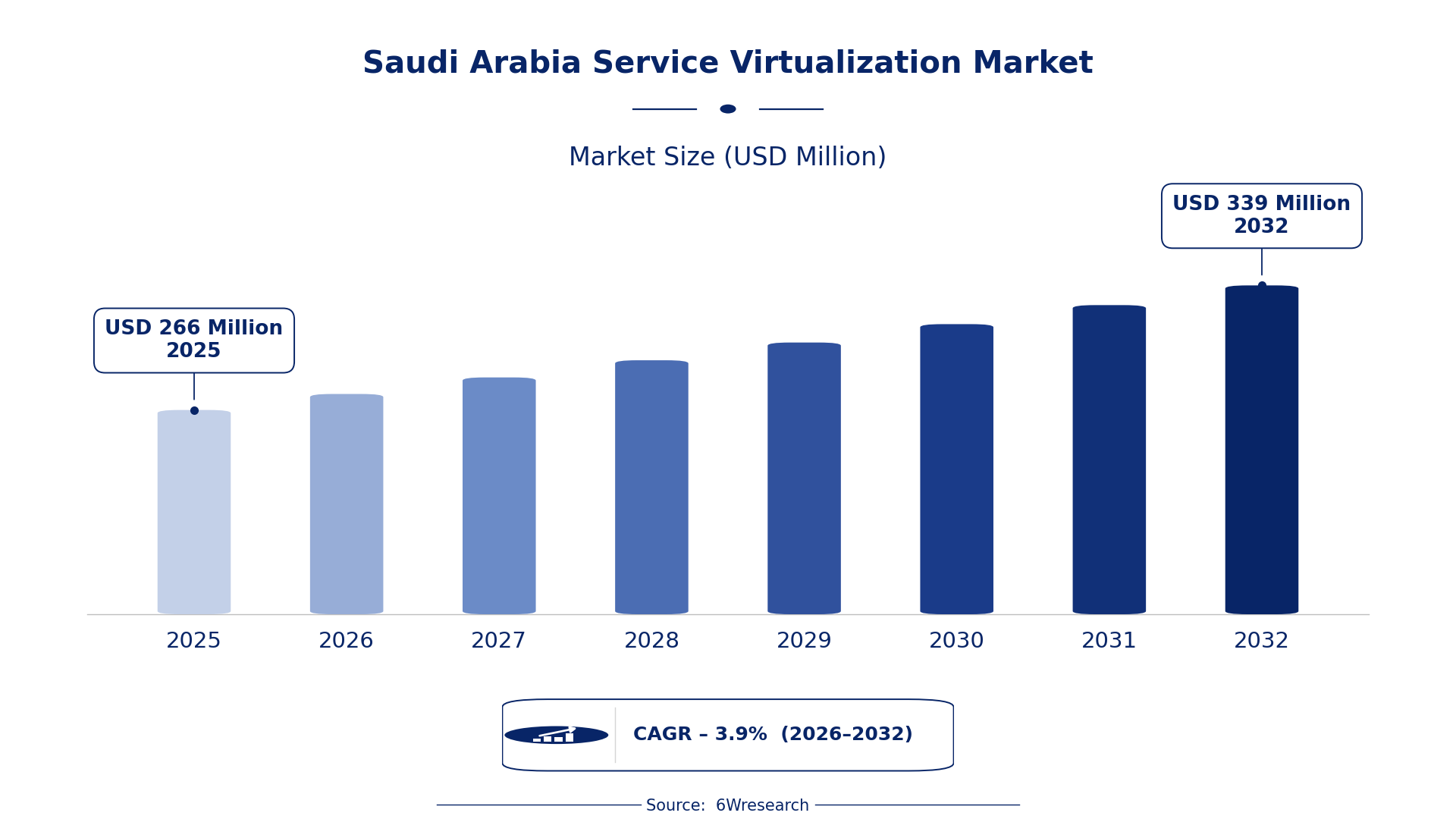
The Saudi Arabia Service Virtualization Market was estimated at USD 266 Million in 2025 and is projected to reach USD 339 Million by 2032, growing at a CAGR of 3.9% from 2026 to 2032.
Saudi Arabia Service Virtualization Market Synopsis
The Saudi Arabia Service Virtualization Market has witnessed a surge in demand driven by organizations striving to enhance efficiency in software development. As businesses grow increasingly reliant on agile methodologies, the ability to simulate services in virtual environments is becoming essential for timely delivery and quality assurance.
However, this momentum is juxtaposed with challenges related to the complexity of service environments and the need for compatibility across diverse platforms. Companies must navigate these hurdles to capitalize on emerging opportunities, particularly as they adapt to shifting consumer expectations and rapid technological advances.
Saudi Arabia Service Virtualization Market Year-wise Growth Rate and Key Drivers
This graph illustrates the annual growth rates of the Saudi Arabia Service Virtualization Market from 2021 to 2032, highlighting a steady upward trajectory and projected expansion over the forecast period.
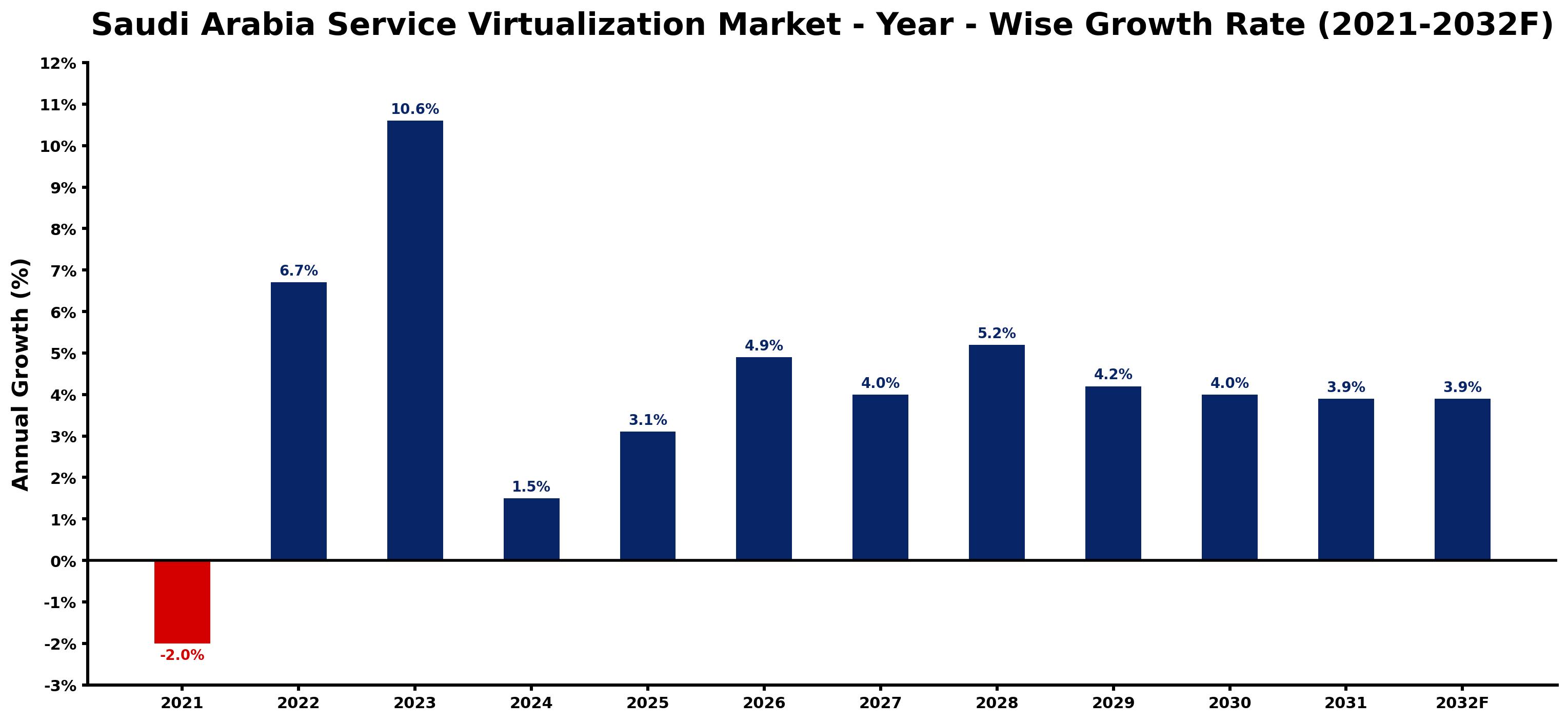
The table below presents the year‑wise growth rates along with the key drivers influencing the market
| Year | Growth Rate | Major Drivers |
| 2021 | -2.0% | Limited adoption due to conservative local IT spending habits. |
| 2022 | 6.7% | Vision 2030 enhancing digital transformation in enterprises |
| 2023 | 10.6% | Increased demand for cloud-native applications in startups |
| 2024 | 1.5% | Growing reliance on secure remote development solutions |
| 2025 | 3.1% | Financial sector adopting virtualization for compliance mandates |
| 2026 | 4.9% | Increase in educational institutions requiring virtual lab environments |
| 2027 | 4.0% | Telecom sector's push for enhanced service delivery models |
| 2028 | 5.2% | Government regulations supporting hybrid cloud solutions |
| 2029 | 4.2% | Rise in e-commerce driving virtualization needs for scalability |
| 2030 | 4.0% | Healthcare sector modernizing through digital service solutions |
| 2031 | 3.9% | Large enterprises migrating legacy systems to virtual platforms |
| 2032 | 3.9% | Incentives for tech startups enhancing virtualization adoption |
Note: Market size estimations and growth projections presented in this report are based on 6Wresearch's proprietary forecasting methodology, utilizing the latest available industry data, government publications, and primary research inputs.
Saudi Arabia Service Virtualization Market Key Takeaways
Below are some of the specific key takeaways from the market, including:
- Increased focus on reducing development and testing costs through service virtualization.
- Growing demand for agile development practices to meet evolving customer requirements.
- Enhancements in testing capabilities due to simulated environments, allowing parallel development.
- Significant interest from organizations in integrating virtualization with existing software frameworks.
- Shift towards remote testing solutions accelerated by the COVID-19 pandemic.
Evaluation of Restraints in Saudi Arabia Service Virtualization Market
Despite the promising growth trajectory, the Saudi Arabia Service Virtualization Market is not without its restraints. One significant issue is the challenge of accurately simulating complex network environments, which can lead to discrepancies between test results and real-world performance. Additionally, ensuring compatibility across various software platforms complicates the development process, often creating bottlenecks. These factors, combined with the rapid pace of technology advancement, necessitate continuous investment in training and infrastructure to keep pace.
Saudi Arabia Service Virtualization Market Trends
Several trends are currently shaping the service virtualization market in Saudi Arabia. Firstly, there is a rising preference for cloud-based virtualization solutions, which offer scalability and flexibility to organizations. Secondly, the integration of artificial intelligence and machine learning into service virtualization tools is gaining traction, enabling smarter testing and automation capabilities. Lastly, an increasing emphasis on DevOps practices is compelling organizations to adopt service virtualization as part of their continuous integration and delivery pipelines.
Saudi Arabia Service Virtualization Market Opportunities
The market holds significant opportunities for growth and investment. Companies that can offer innovative solutions tailored to the specific needs of telecom operators and IT service providers are likely to gain a competitive edge. Additionally, the focus on digital transformation initiatives across various sectors presents a unique chance for service virtualization vendors to position their products as essential tools for enhancing service delivery and operational efficiency. Strategic partnerships with technology providers can also pave the way for accelerated growth.
Government Initiatives in the Saudi Arabia Service Virtualization Market
The Saudi Arabian government is increasingly recognizing the role of technology in boosting economic diversification and digital transformation. Public policy is focused on enhancing the telecom sector, with service virtualization being a key component in achieving these goals. By supporting initiatives that improve infrastructure and regulatory frameworks, the government aims to create a conducive environment for innovation and growth within the service virtualization market.
- A national digital infrastructure upgrade programme launched in early 2025 to enhance telecommunications services.
- Ongoing initiatives aimed at fostering public-private partnerships to expand access to virtualization technologies.
- A regulatory framework expected to be introduced in 2026 to encourage transparency in service testing and validation.
- Plans for a dedicated task force to support research and development in service virtualization, slated for rollout by late 2027.
Future Insights of the Saudi Arabia Service Virtualization Market
Looking ahead, the Saudi Arabia Service Virtualization Market is set for steady growth through 2032. Organizations will increasingly adopt virtualization as a core strategy to remain competitive. The demand for rapid development cycles and the necessity to ensure high-quality service delivery will drive further innovation in this space. As technological advancements continue to evolve, companies that embrace and integrate these changes into their operations will likely thrive.
Saudi Arabia Service Virtualization Market Latest Developments
In the past year, the Saudi Arabia Service Virtualization Market has seen considerable developments that highlight its rapid evolution. Organizations are actively seeking solutions that enhance their testing capabilities and improve service delivery. A noticeable trend has been the commitment to adopting advanced technologies to streamline operations and reduce costs.
- A major technology vendor launched a new service virtualization platform in early 2025 designed to simplify complex testing scenarios.
- Several regional telecom operators initiated partnerships in mid-2025 to integrate service virtualization solutions into their existing systems.
- Current ongoing pilot projects focused on AI-driven testing solutions are expected to revolutionize testing processes by early 2026.
- An upcoming conference set for Q3 2026 will showcase innovative service virtualization technologies and best practices.
Saudi Arabia Service Virtualization Market - Key Attractiveness of the Report
- 10 Years of Market Numbers
- Historical Data Starting from 2022 to 2025
- Base Year: 2025
- Forecast Data until 2032
- Key Performance Indicators Impacting the Market
- Major Upcoming Developments and Projects
Key Highlights of the Report:
- Saudi Arabia Service Virtualization Market Outlook
- Market Size of Saudi Arabia Service Virtualization Market, 2025
- Forecast of Saudi Arabia Service Virtualization Market, 2032
- Historical Data and Forecast of Saudi Arabia Service Virtualization Revenues & Volume for the Period 2022-2032F
- Saudi Arabia Service Virtualization Market Trend Evolution
- Saudi Arabia Service Virtualization Market Drivers and Challenges
- Saudi Arabia Service Virtualization Price Trends
- Saudi Arabia Service Virtualization Porter's Five Forces
- Saudi Arabia Service Virtualization Industry Life Cycle
- Historical Data and Forecast of Saudi Arabia Service Virtualization Market Revenues & Volume By Component for the Period 2022-2032F
- Historical Data and Forecast of Saudi Arabia Service Virtualization Market Revenues & Volume By Software/Tools for the Period 2022-2032F
- Historical Data and Forecast of Saudi Arabia Service Virtualization Market Revenues & Volume By Services for the Period 2022-2032F
- Historical Data and Forecast of Saudi Arabia Service Virtualization Market Revenues & Volume By Deployment Type for the Period 2022-2032F
- Historical Data and Forecast of Saudi Arabia Service Virtualization Market Revenues & Volume By On-Premises for the Period 2022-2032F
- Historical Data and Forecast of Saudi Arabia Service Virtualization Market Revenues & Volume By Cloud for the Period 2022-2032F
- Historical Data and Forecast of Saudi Arabia Service Virtualization Market Revenues & Volume By Verticals for the Period 2022-2032F
- Historical Data and Forecast of Saudi Arabia Service Virtualization Market Revenues & Volume By IT Services for the Period 2022-2032F
- Historical Data and Forecast of Saudi Arabia Service Virtualization Market Revenues & Volume By Telecommunication for the Period 2022-2032F
- Historical Data and Forecast of Saudi Arabia Service Virtualization Market Revenues & Volume By BFSI for the Period 2022-2032F
- Historical Data and Forecast of Saudi Arabia Service Virtualization Market Revenues & Volume By Retail and eCommerce for the Period 2022-2032F
- Historical Data and Forecast of Saudi Arabia Service Virtualization Market Revenues & Volume By Media and Entertainment for the Period 2022-2032F
- Historical Data and Forecast of Saudi Arabia Service Virtualization Market Revenues & Volume By Healthcare for the Period 2022-2032F
- Historical Data and Forecast of Saudi Arabia Service Virtualization Market Revenues & Volume By Automotive for the Period 2022-2032F
- Historical Data and Forecast of Saudi Arabia Service Virtualization Market Revenues & Volume By Others for the Period 2022-2032F
- Historical Data and Forecast of Saudi Arabia Service Virtualization Market Revenues & Volume By s for the Period 2022-2032F
- Saudi Arabia Service Virtualization Import Export Trade Statistics
- Market Opportunity Assessment By Component
- Market Opportunity Assessment By Deployment Type
- Market Opportunity Assessment By Verticals
- Market Opportunity Assessment By s
- Saudi Arabia Service Virtualization Top Companies Market Share
- Saudi Arabia Service Virtualization Competitive Benchmarking By Technical and Operational Parameters
- Saudi Arabia Service Virtualization Company Profiles
- Saudi Arabia Service Virtualization Key Strategic Recommendations






































