Saudi Arabia Sharpening Stone Market Size, Share & Growth Rate
The Saudi Arabia Sharpening Stone Market was estimated at USD 293 Million in 2025 and is projected to reach USD 374 Million by 2032, growing at a CAGR of 3.5% from 2026 to 2032. This positive trajectory is largely driven by the robust growth of the culinary sector, where the need for precision cutting tools in restaurants and food services is paramount. Additionally, the increasing interest in woodworking and DIY projects among consumers further fuels demand, as hobbyists seek high-quality sharpening solutions to enhance their crafting experiences.
Saudi Arabia Sharpening Stone Market Year-wise Growth Rate and Key Drivers
This graph highlights how the Saudi Arabia Sharpening Stone Market has steadily grown over the years, supported by major growth factors.
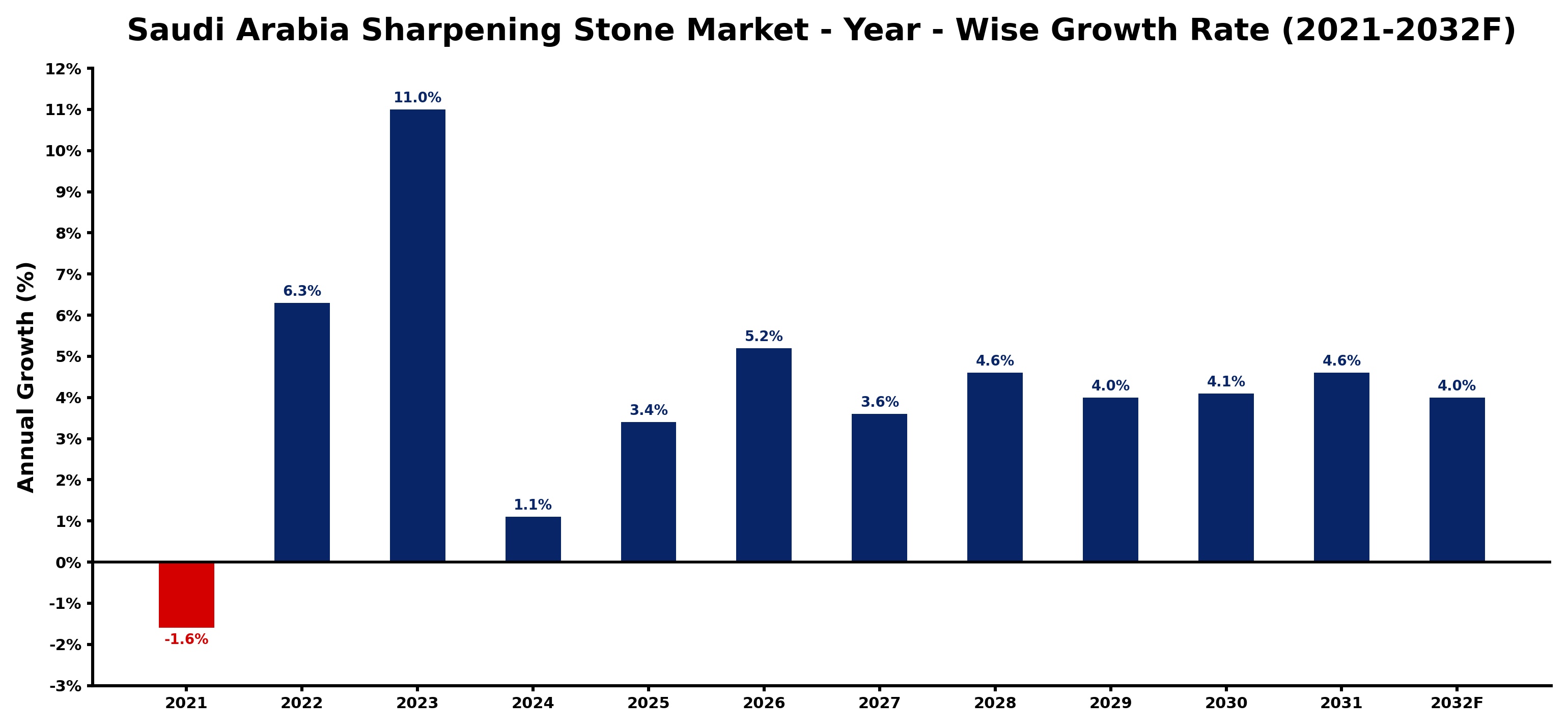
The table below presents the year‑wise growth rates along with the key drivers influencing the market
| Year | Growth Rate | Major Drivers |
| 2021 | -1.6% | Government infrastructure modernization initiatives |
| 2022 | 6.3% | Increasing smart city development projects |
| 2023 | 11.0% | Increasing adoption of advanced technologies |
| 2024 | 1.1% | Rising electricity demand across industries |
| 2025 | 3.4% | Growing renewable energy integration projects |
| 2026 | 5.2% | Increasing industrial infrastructure investments |
| 2027 | 3.6% | Increasing adoption of advanced technologies |
| 2028 | 4.6% | Increasing adoption of advanced technologies |
| 2029 | 4.0% | Increasing adoption of advanced technologies |
| 2030 | 4.1% | Expansion of transportation and logistics networks |
| 2031 | 4.6% | Expansion of commercial construction activities |
| 2032 | 4.0% | Increasing industrial automation investments |
Note - Market size estimations and growth projections presented in this report are based on 6Wresearch's advanced forecasting approach, validated with industry datasets as of June 2026.
Saudi Arabia Sharpening Stone Market Synopsis
In recent years, the Saudi Arabia Sharpening Stone Market has experienced a noticeable uptick, propelled by the culinary industry's ongoing expansion and the rising engagement of DIY enthusiasts. While the market has witnessed a surge in demand, it is now on a steady path toward sustained growth, poised to respond to evolving consumer needs and technological advancements.
However, the landscape is not without its challenges. Increased competition from electric sharpening alternatives and the necessity for skilled use of traditional stones may deter some potential users. Nevertheless, as awareness of quality and craftsmanship grows, the market shows promise for innovation and adaptation.
Saudi Arabia Sharpening Stone Market Key Takeaways
- Significant growth anticipated in the culinary sector, driving sharpening stone demand.
- Woodworking and DIY trends are reinforcing the relevance of manual sharpening methods.
- Market challenges include competition from electric sharpeners and the need for expertise.
- Quality sourcing remains critical for suppliers to ensure customer satisfaction.
- Covid-19's aftermath has reshaped consumer behaviors, boosting home cooking and related hobbies.
Evaluation of Restraints in Saudi Arabia Sharpening Stone Market
Several restraints are present in the Saudi Arabia Sharpening Stone Market. First and foremost is the growing preference for electric sharpening tools, which, while convenient, may overshadow the traditional stone options. Additionally, the proper use of sharpening stones requires a level of technical skill that not all consumers possess, posing a barrier to entry for those unfamiliar with manual sharpening techniques. Suppliers also face challenges in maintaining consistent access to high-quality stones, essential for catering to discerning customers who prioritize performance and durability in their sharpening solutions.
Saudi Arabia Sharpening Stone Market Trends
Current trends indicate a rising awareness among consumers about the importance of maintaining sharp tools for both professional and personal use. The culinary industry is increasingly emphasizing quality and precision, leading to greater reliance on traditional sharpening stones. Moreover, the resurgence of interest in artisanal skills and handcrafts, particularly in woodworking, further drives demand. Sustainability considerations are also influencing consumer choices, with an inclination toward natural and locally sourced sharpening stones gaining momentum.
Saudi Arabia Sharpening Stone Market Opportunities
Opportunities for growth in the Saudi Arabia Sharpening Stone Market are abundant. As the culinary scene continues to flourish, there is a substantial market for specialized sharpening stones designed for different types of culinary tools. Additionally, engaging educational initiatives around the proper use of sharpening stones could enhance user confidence and adoption. Collaborations with woodworking schools and DIY workshops can also create avenues for reaching potential customers eager to improve their skills and invest in quality tools.
Government Initiatives in the Saudi Arabia Sharpening Stone Market
The Saudi government has shown a commitment to enhancing local manufacturing capabilities and promoting small to medium-sized enterprises, which indirectly benefits the sharpening stone market. Public spending on culinary training programs and woodworking schools encourages skill development, fostering a market environment where high-quality sharpening tools are in demand. Moreover, initiatives aimed at supporting local artisans and craftsmen align with the growing emphasis on traditional skills and hand-made products.
Future Insights of the Saudi Arabia Sharpening Stone Market
Looking ahead to 2026-2032, the Saudi Arabia Sharpening Stone Market is anticipated to evolve alongside changing consumer preferences and technological advancements. As consumers increasingly appreciate the craftsmanship involved in manual sharpening, a robust market for quality stones will likely develop. The culinary and woodworking industries will continue to be key drivers, and suppliers that adapt to changing needs—such as offering customized solutions and comprehensive usage education—will thrive in this competitive landscape.
Saudi Arabia Sharpening Stone Market Latest Developments (May 2025 - June 2026)
In the latest developments of the Saudi Arabia Sharpening Stone Market, several industry players are focusing on product innovation and quality enhancements. New partnerships have emerged between suppliers and culinary institutions, aiming to promote high-quality sharpening practices among aspiring chefs. Additionally, workshops and seminars centered on manual sharpening techniques are gaining traction, fostering a deeper appreciation for traditional tools in a rapidly modernizing environment.
Saudi Arabia Sharpening Stone Market - Key Attractiveness of the Report
- 10 Years of Market Numbers
- Historical Data Starting from 2022 to 2025
- Base Year: 2025
- Forecast Data until 2032
- Key Performance Indicators Impacting the Market
- Major Upcoming Developments and Projects
Key Highlights of the Report:
- Saudi Arabia Sharpening Stone Market Outlook
- Market Size of Saudi Arabia Sharpening Stone Market, 2025
- Forecast of Saudi Arabia Sharpening Stone Market, 2032
- Historical Data and Forecast of Saudi Arabia Sharpening Stone Revenues & Volume for the Period 2022-2032F
- Saudi Arabia Sharpening Stone Market Trend Evolution
- Saudi Arabia Sharpening Stone Market Drivers and Challenges
- Saudi Arabia Sharpening Stone Price Trends
- Saudi Arabia Sharpening Stone Porter's Five Forces
- Saudi Arabia Sharpening Stone Industry Life Cycle
- Historical Data and Forecast of Saudi Arabia Sharpening Stone Market Revenues & Volume By Types for the Period 2022-2032F
- Historical Data and Forecast of Saudi Arabia Sharpening Stone Market Revenues & Volume By Natural Stone for the Period 2022-2032F
- Historical Data and Forecast of Saudi Arabia Sharpening Stone Market Revenues & Volume By Synthetic Stone for the Period 2022-2032F
- Historical Data and Forecast of Saudi Arabia Sharpening Stone Market Revenues & Volume By Applications for the Period 2022-2032F
- Historical Data and Forecast of Saudi Arabia Sharpening Stone Market Revenues & Volume By Home Use for the Period 2022-2032F
- Historical Data and Forecast of Saudi Arabia Sharpening Stone Market Revenues & Volume By Commercial Use for the Period 2022-2032F
- Saudi Arabia Sharpening Stone Import Export Trade Statistics
- Market Opportunity Assessment By Types
- Market Opportunity Assessment By Applications
- Saudi Arabia Sharpening Stone Top Companies Market Share
- Saudi Arabia Sharpening Stone Competitive Benchmarking By Technical and Operational Parameters
- Saudi Arabia Sharpening Stone Company Profiles
- Saudi Arabia Sharpening Stone Key Strategic Recommendations






































