Saudi Arabia Smart Doorbell Market Size, Share & Growth Rate
The Saudi Arabia Smart Doorbell Market was estimated at USD 340 Million in 2025 and is projected to reach USD 480 Million by 2032, growing at a CAGR of 5.0% from 2026 to 2032. This growth trajectory is driven by increasing consumer concerns over home security, particularly in urban areas, where theft and property crimes are more prevalent. Additionally, the rising adoption of smart home technology is prompting homeowners to incorporate smart doorbells as essential components of their home security systems.
Saudi Arabia Smart Doorbell Market Year-wise Growth Rate and Key Drivers
This graph highlights how the Saudi Arabia Smart Doorbell Market has steadily grown over the years, supported by major growth factors.
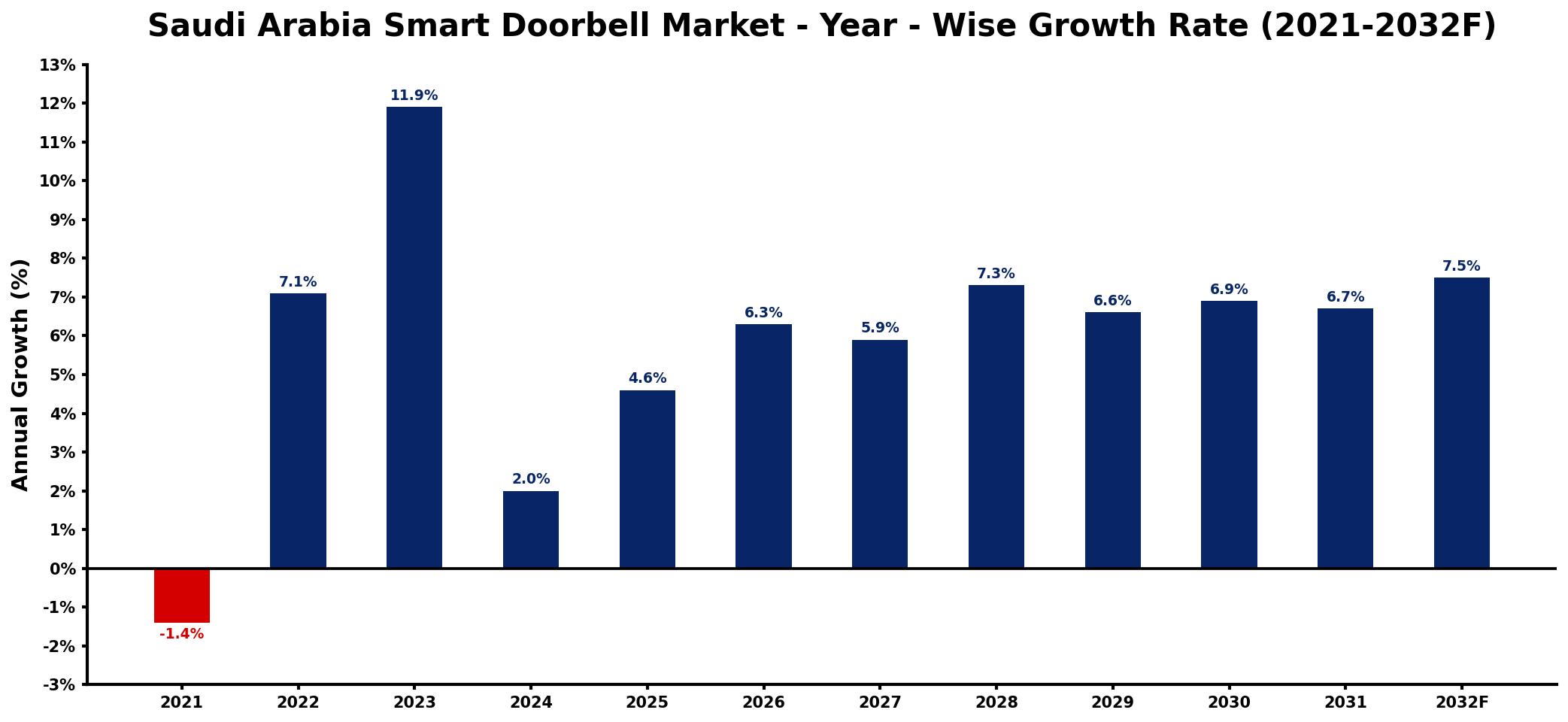
The table below presents the year‑wise growth rates along with the key drivers influencing the market
| Year | Growth Rate | Major Drivers |
| 2021 | -1.4% | Consumer tech spending declined significantly |
| 2022 | 7.1% | Increased home automation investments rise |
| 2023 | 11.9% | Growing demand for security solutions |
| 2024 | 2.0% | Rising awareness of home safety |
| 2025 | 4.6% | Expansion of IoT integration trends |
| 2026 | 6.3% | enhanced product quality standards |
| 2027 | 5.9% | Increasing consumer preference for convenience |
| 2028 | 7.3% | Technological advancements drive adoption |
| 2029 | 6.6% | Enhanced connectivity options attract users |
| 2030 | 6.9% | Rising interest in remote monitoring |
| 2031 | 6.7% | Growing focus on energy efficiency |
| 2032 | 7.5% | Emerging technologies enhance user experience |
Note: Market size estimations and growth projections presented in this report are based on 6Wresearch's proprietary forecasting methodology, utilizing the latest available industry data, government publications, and primary research inputs.
Saudi Arabia Smart Doorbell Market Synopsis
In Saudi Arabia, the smart doorbell market has gained notable traction as technology continues to reshape home security dynamics. Homeowners increasingly value the ability to monitor their properties in real-time and communicate directly with visitors, enhancing both safety and convenience. This trend is further propelled by urbanization and a growing emphasis on modern living standards.
The integration of smart doorbells within the broader smart home ecosystem solidifies their role as a pivotal element in contemporary residential security solutions. With features such as video streaming and remote access via mobile applications, these devices cater to the demands of a tech-savvy population eager to enhance their home safety measures.
Saudi Arabia Smart Doorbell Market Key Takeaways
- The market is witnessing robust growth due to heightened concerns over home security and increased adoption of smart home technologies.
- Real-time monitoring and two-way communication are the primary features driving consumer interest in smart doorbells.
- COVID-19 has accelerated the shift towards contactless interactions, further boosting demand for smart home devices.
- Privacy concerns and compatibility with existing infrastructure present significant challenges that need addressing.
- Key international players are focused on expanding their product offerings to meet the growing demand in the region.
Evaluation of Restraints in Saudi Arabia Smart Doorbell Market
Despite the promising growth trajectory of the smart doorbell market in Saudi Arabia, several constraints hinder its full potential. Consumer privacy concerns remain at the forefront; many potential buyers are wary of how their data is handled and the implications of having recording devices at their doorsteps. Additionally, compatibility issues with existing home infrastructure can deter consumers from adopting these technologies. Educating the market on the benefits of smart doorbells and addressing security concerns will be vital to overcoming these hurdles and encouraging broader adoption.
Saudi Arabia Smart Doorbell Market Trends
A notable trend shaping the Saudi Arabia smart doorbell market is the increasing integration of artificial intelligence (AI) to enhance user experience. Smart doorbells equipped with AI capabilities can distinguish between familiar visitors and strangers, offering advanced alerts and functionality. Furthermore, the rise of IoT (Internet of Things) devices is promoting seamless connectivity within smart home ecosystems. As the technology evolves, features such as package tracking and facial recognition are gaining traction, making these devices indispensable for modern homeowners.
Saudi Arabia Smart Doorbell Market Opportunities
The smart doorbell market in Saudi Arabia presents numerous opportunities for growth and investment. As urban areas continue to expand and the demand for advanced security solutions increases, there is significant potential for new product innovations that address specific consumer needs. Additionally, partnerships between technology companies and local security firms can facilitate a more tailored approach to the Saudi market, further enhancing the appeal of smart doorbells.
Government Initiatives in the Saudi Arabia Smart Doorbell Market
The Saudi government has been proactive in promoting smart technologies as part of its Vision 2030 initiative. Public investments aimed at enhancing urban infrastructure and increasing public safety are likely to support the growth of the smart doorbell market. Furthermore, the government encourages the adoption of innovative technologies in residential sectors, which could lead to favorable regulations and incentives for companies operating in the smart home space.
Future Insights of the Saudi Arabia Smart Doorbell Market
Looking ahead to 2026-2032, the Saudi Arabia smart doorbell market is expected to evolve significantly. As technology becomes even more intertwined with everyday life, homeowners are likely to demand smarter, more integrated solutions that offer enhanced security features. The projected growth indicates a favorable environment for investments and innovations tailored to meet the specific preferences of the Saudi consumer, reinforcing the smart doorbells position as a cornerstone of modern home security.
Saudi Arabia Smart Doorbell Market Latest Developments (2025 - 2026)
Recent months have seen several noteworthy developments in the Saudi Arabia smart doorbell market. Companies are increasingly focusing on product enhancement by integrating advanced technologies such as AI and machine learning to deliver more personalized user experiences. Furthermore, marketing strategies are shifting towards highlighting privacy and security features to build consumer trust. As competition intensifies, innovation and differentiation will become crucial factors for success in this evolving landscape.
Saudi Arabia Smart Doorbell Market - Key Attractiveness of the Report
- 10 Years of Market Numbers
- Historical Data Starting from 2022 to 2025
- Base Year: 2025
- Forecast Data until 2032
- Key Performance Indicators Impacting the Market
- Major Upcoming Developments and Projects
Key Highlights of the Report:
- Saudi Arabia Smart Doorbell Market Outlook
- Market Size of Saudi Arabia Smart Doorbell Market, 2025
- Forecast of Saudi Arabia Smart Doorbell Market, 2032
- Historical Data and Forecast of Saudi Arabia Smart Doorbell Revenues & Volume for the Period 2022-2032F
- Saudi Arabia Smart Doorbell Market Trend Evolution
- Saudi Arabia Smart Doorbell Market Drivers and Challenges
- Saudi Arabia Smart Doorbell Price Trends
- Saudi Arabia Smart Doorbell Porter's Five Forces
- Saudi Arabia Smart Doorbell Industry Life Cycle
- Historical Data and Forecast of Saudi Arabia Smart Doorbell Market Revenues & Volume By Product Type for the Period 2022-2032F
- Historical Data and Forecast of Saudi Arabia Smart Doorbell Market Revenues & Volume By Wired Doorbell for the Period 2022-2032F
- Historical Data and Forecast of Saudi Arabia Smart Doorbell Market Revenues & Volume By Wireless Doorbell for the Period 2022-2032F
- Historical Data and Forecast of Saudi Arabia Smart Doorbell Market Revenues & Volume By Distribution Channel for the Period 2022-2032F
- Historical Data and Forecast of Saudi Arabia Smart Doorbell Market Revenues & Volume By Online for the Period 2022-2032F
- Historical Data and Forecast of Saudi Arabia Smart Doorbell Market Revenues & Volume By Offline for the Period 2022-2032F
- Historical Data and Forecast of Saudi Arabia Smart Doorbell Market Revenues & Volume By End User for the Period 2022-2032F
- Historical Data and Forecast of Saudi Arabia Smart Doorbell Market Revenues & Volume By Residential for the Period 2022-2032F
- Historical Data and Forecast of Saudi Arabia Smart Doorbell Market Revenues & Volume By Commercial for the Period 2022-2032F
- Saudi Arabia Smart Doorbell Import Export Trade Statistics
- Market Opportunity Assessment By Product Type
- Market Opportunity Assessment By Distribution Channel
- Market Opportunity Assessment By End User
- Saudi Arabia Smart Doorbell Top Companies Market Share
- Saudi Arabia Smart Doorbell Competitive Benchmarking By Technical and Operational Parameters
- Saudi Arabia Smart Doorbell Company Profiles
- Saudi Arabia Smart Doorbell Key Strategic Recommendations






































