Saudi Arabia Smart Toilet Market Size, Share & Growth Rate
The Saudi Arabia Smart Toilet Market was estimated at USD 1448 Million in 2025 and is projected to reach USD 2056 Million by 2032, growing at a CAGR of 5.1% from 2026 to 2032. This growth trajectory is significantly influenced by a rising consumer preference for enhanced hygiene and comfort, alongside technological advancements that introduce innovative features. Moreover, the expansion of the hospitality sector further fuels demand, as luxurious establishments increasingly seek to offer top-tier amenities, including smart toilets.
Saudi Arabia Smart Toilet Market Year-wise Growth Rate and Key Drivers
This graph highlights how the Saudi Arabia Smart Toilet Market has steadily grown over the years, supported by major growth factors.
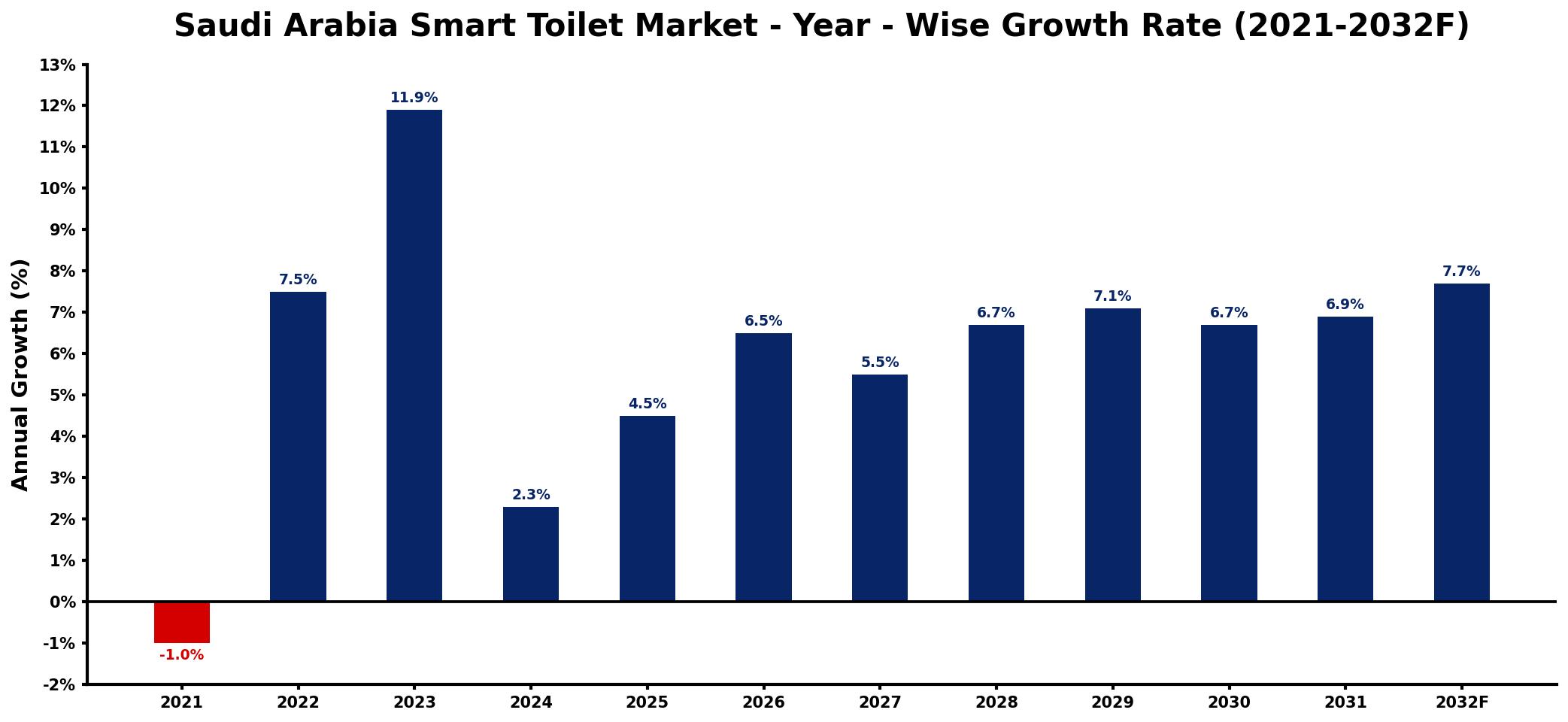
The table below presents the year‑wise growth rates along with the key drivers influencing the market
| Year | Growth Rate | Major Drivers |
| 2021 | -1.0% | lower industrial activity overall |
| 2022 | 7.5% | Increased urbanization and infrastructure growth |
| 2023 | 11.9% | Rising awareness of health benefits |
| 2024 | 2.3% | Growing demand for luxury amenities |
| 2025 | 4.5% | Expansion of eco-friendly technologies |
| 2026 | 6.5% | Increase in disposable income levels |
| 2027 | 5.5% | Higher focus on home automation |
| 2028 | 6.7% | Emergence of innovative design trends |
| 2029 | 7.1% | strengthening underlying market demand |
| 2030 | 6.7% | Enhanced marketing and brand awareness |
| 2031 | 6.9% | Rising number of high-end developments |
| 2032 | 7.7% | Growing emphasis on sustainability practices |
Note: Market size estimations and growth projections presented in this report are based on 6Wresearch's proprietary forecasting methodology, utilizing the latest available industry data, government publications, and primary research inputs.
Saudi Arabia Smart Toilet Market Synopsis
In recent years, the adoption of smart toilets has surged in Saudi Arabia, reflecting a broader societal shift towards integrated technology in everyday living spaces. With features like touchless flushing, heated seats, and integrated bidets, these toilets are reshaping expectations around bathroom experiences.
The ongoing developments in the smart toilet market align with a growing emphasis on health and hygiene, especially in the wake of the COVID-19 pandemic. Consumers are increasingly prioritizing solutions that enhance sanitation, leading to greater interest and demand for smart toilet technologies.
Saudi Arabia Smart Toilet Market Key Takeaways
- The market is witnessing a shift towards premium bathroom solutions, particularly in luxury sectors.
- Technological innovations are crucial for driving consumer interest in smart toilet features.
- The hospitality sector plays a significant role in the market's growth, demanding modern amenities.
- Consumer education on the benefits of smart toilets is essential for increased acceptance.
- Ongoing developments in hygiene-related technologies continue to shape consumer preferences.
Evaluation of Restraints in Saudi Arabia Smart Toilet Market
Despite the promising growth of the smart toilet market in Saudi Arabia, certain restraints hinder its full potential. One prominent challenge is consumer acceptance of advanced toilet technologies, as many potential buyers remain skeptical about the functionality and reliability of these products. Furthermore, privacy and security concerns related to the integration of smart features can deter users from making purchases. There is an ongoing need for education and awareness campaigns to inform consumers about the benefits and ease of use associated with smart toilets, which could mitigate these apprehensions.
Saudi Arabia Smart Toilet Market Trends
Several key trends are currently shaping the Saudi Arabia smart toilet market. Firstly, the emphasis on touchless technology has gained momentum, driven by heightened hygiene awareness post-pandemic. Additionally, eco-friendly features such as water-saving mechanisms and energy-efficient systems are becoming increasingly sought after as consumers prioritize sustainability. The rise of smart home ecosystems also facilitates the integration of smart toilets with other connected devices, further enhancing convenience and user experience.
Saudi Arabia Smart Toilet Market Opportunities
The Saudi Arabia smart toilet market presents numerous opportunities for growth and investment. As consumer lifestyles evolve, there is a notable shift towards luxury and comfort in everyday products. Innovative manufacturers that develop user-friendly, reliable technologies can capture significant market share. Additionally, partnerships with hospitality businesses looking to enhance their offerings can provide strategic avenues for expansion and market penetration. Furthermore, tapping into the growing online retail space can facilitate wider reach and accessibility for these products.
Government Initiatives in the Saudi Arabia Smart Toilet Market
The Saudi government has been actively promoting advancements in technology and infrastructure, which indirectly benefits the smart toilet market. Initiatives aimed at enhancing public health, improving sanitation standards, and encouraging the adoption of innovative technologies align with the goals of smart toilet manufacturers. Moreover, public spending on infrastructure projects, including the development of modern residential and commercial spaces, is likely to bolster demand for smart amenities, creating a supportive environment for the growth of this market.
Future Insights of the Saudi Arabia Smart Toilet Market
Looking ahead to 2026-2032, the Saudi Arabia smart toilet market is poised for robust growth. As technology continues to advance, consumers can expect even more sophisticated features, driving further interest and acceptance. Increased health consciousness and a focus on hygiene will continue to push demand, particularly in public spaces and high-end residences. Additionally, the anticipated growth in tourism and the hospitality sector will likely sustain a strong demand for premium bathroom solutions, ensuring a dynamic and evolving market landscape.
Saudi Arabia Smart Toilet Market Latest Developments (2025 - 2026)
Recent developments within the Saudi Arabia smart toilet market have focused on enhancing product features and addressing consumer needs. Innovations in touchless technology and increased integration with smart home systems have been key areas of focus for manufacturers. Additionally, there has been a notable increase in collaborations between technology companies and hospitality providers aimed at elevating customer experiences through upgraded bathroom amenities.
Saudi Arabia Smart Toilet Market - Key Attractiveness of the Report
- 10 Years of Market Numbers
- Historical Data Starting from 2022 to 2025
- Base Year: 2025
- Forecast Data until 2032
- Key Performance Indicators Impacting the Market
- Major Upcoming Developments and Projects
Key Highlights of the Report:
- Saudi Arabia Smart Toilet Market Outlook
- Market Size of Saudi Arabia Smart Toilet Market, 2025
- Forecast of Saudi Arabia Smart Toilet Market, 2032
- Historical Data and Forecast of Saudi Arabia Smart Toilet Revenues & Volume for the Period 2022-2032F
- Saudi Arabia Smart Toilet Market Trend Evolution
- Saudi Arabia Smart Toilet Market Drivers and Challenges
- Saudi Arabia Smart Toilet Price Trends
- Saudi Arabia Smart Toilet Porter's Five Forces
- Saudi Arabia Smart Toilet Industry Life Cycle
- Historical Data and Forecast of Saudi Arabia Smart Toilet Market Revenues & Volume By Technology for the Period 2022-2032F
- Historical Data and Forecast of Saudi Arabia Smart Toilet Market Revenues & Volume By Mobile Application for the Period 2022-2032F
- Historical Data and Forecast of Saudi Arabia Smart Toilet Market Revenues & Volume By Non-Mobile Application for the Period 2022-2032F
- Historical Data and Forecast of Saudi Arabia Smart Toilet Market Revenues & Volume By Type for the Period 2022-2032F
- Historical Data and Forecast of Saudi Arabia Smart Toilet Market Revenues & Volume By Wall Hung Toilet for the Period 2022-2032F
- Historical Data and Forecast of Saudi Arabia Smart Toilet Market Revenues & Volume By Close-Coupled for the Period 2022-2032F
- Historical Data and Forecast of Saudi Arabia Smart Toilet Market Revenues & Volume By Single Floor Standing Toilet for the Period 2022-2032F
- Historical Data and Forecast of Saudi Arabia Smart Toilet Market Revenues & Volume By One-Piece Toilet for the Period 2022-2032F
- Historical Data and Forecast of Saudi Arabia Smart Toilet Market Revenues & Volume By Others for the Period 2022-2032F
- Historical Data and Forecast of Saudi Arabia Smart Toilet Market Revenues & Volume By Usage for the Period 2022-2032F
- Historical Data and Forecast of Saudi Arabia Smart Toilet Market Revenues & Volume By Residential for the Period 2022-2032F
- Historical Data and Forecast of Saudi Arabia Smart Toilet Market Revenues & Volume By Commercial for the Period 2022-2032F
- Historical Data and Forecast of Saudi Arabia Smart Toilet Market Revenues & Volume By Distribution Channel for the Period 2022-2032F
- Historical Data and Forecast of Saudi Arabia Smart Toilet Market Revenues & Volume By Online Stores for the Period 2022-2032F
- Historical Data and Forecast of Saudi Arabia Smart Toilet Market Revenues & Volume By Offline Stores for the Period 2022-2032F
- Saudi Arabia Smart Toilet Import Export Trade Statistics
- Market Opportunity Assessment By Technology
- Market Opportunity Assessment By Type
- Market Opportunity Assessment By Usage
- Market Opportunity Assessment By Distribution Channel
- Saudi Arabia Smart Toilet Top Companies Market Share
- Saudi Arabia Smart Toilet Competitive Benchmarking By Technical and Operational Parameters
- Saudi Arabia Smart Toilet Company Profiles
- Saudi Arabia Smart Toilet Key Strategic Recommendations






































