Saudi Arabia Spun Yarn Market Size, Share & Growth Rate
The Saudi Arabia Spun Yarn Market was estimated at USD 455 Million in 2025 and is projected to reach USD 576 Million by 2032, growing at a CAGR of 3.4% from 2026 to 2032. This growth trajectory is primarily propelled by the robust expansion of the textile sector within the country. As the local industry diversifies and innovates, the demand for versatile spun yarn applications in both fashion and home textiles continues to surge.
Saudi Arabia Spun Yarn Market Year-wise Growth Rate and Key Drivers
This graph highlights how the Saudi Arabia Spun Yarn Market has steadily grown over the years, supported by major growth factors.
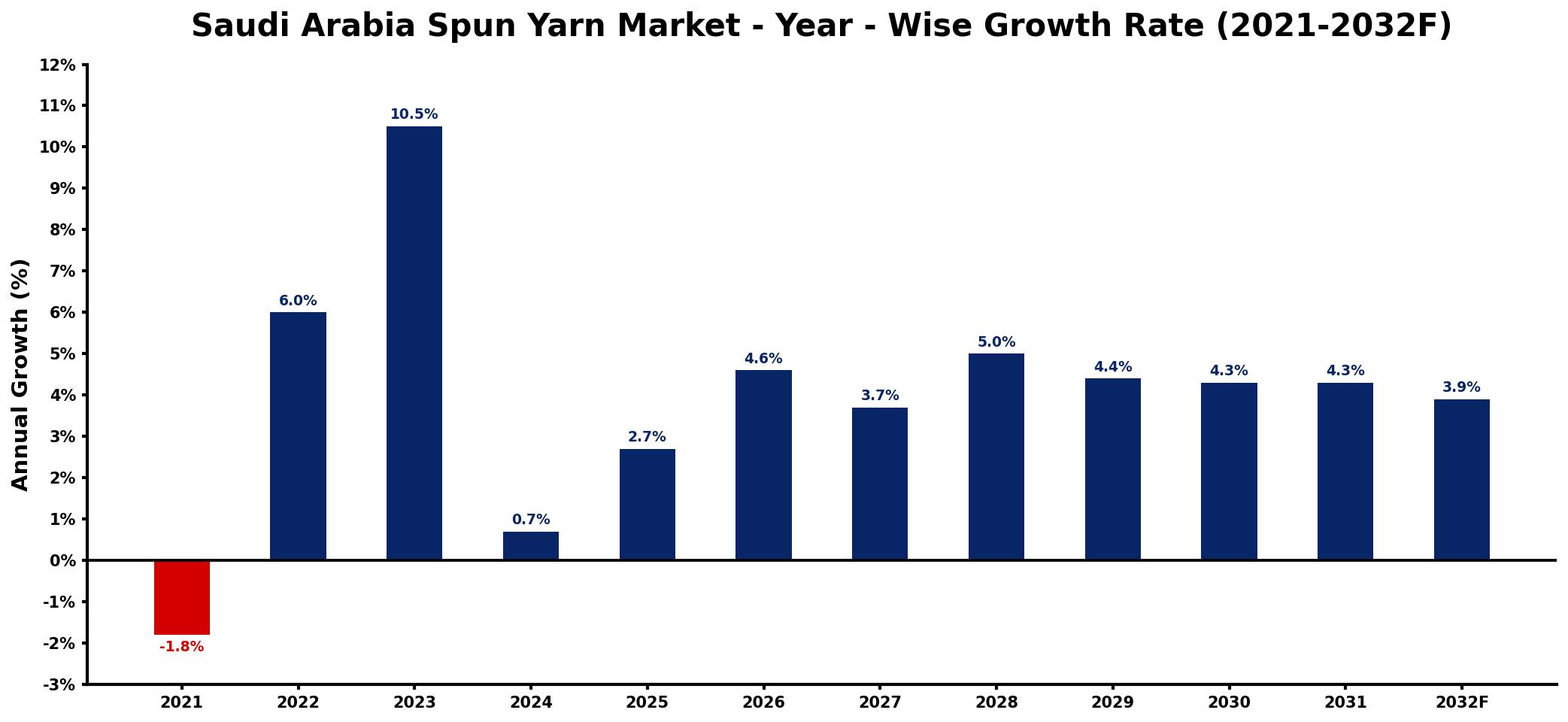
The table below presents the year‑wise growth rates along with the key drivers influencing the market
| Year | Growth Rate | Major Drivers |
| 2021 | -1.8% | decreased industrial textile production |
| 2022 | 6.0% | rising demand for sustainable textiles |
| 2023 | 10.5% | expansion of apparel manufacturing sector |
| 2024 | 0.7% | increased investment in textile technology |
| 2025 | 2.7% | growing popularity of eco-friendly products |
| 2026 | 4.6% | emerging markets driving textile consumption |
| 2027 | 3.7% | stronger retail performance boosting orders |
| 2028 | 5.0% | enhanced supply chain efficiencies realized |
| 2029 | 4.4% | growing demand for home textiles |
| 2030 | 4.3% | increased exports to regional markets |
| 2031 | 4.3% | greater focus on quality standards |
| 2032 | 3.9% | rising consumer interest in customization |
Note: Market size estimations and growth projections presented in this report are based on 6Wresearch's proprietary forecasting methodology, utilizing the latest available industry data, government publications, and primary research inputs.
Saudi Arabia Spun Yarn Market Synopsis
Currently, the spun yarn market in Saudi Arabia is undergoing a phase of stable growth, supported by the increasing demand from various segments of the textile industry. This market is characterized by a significant reliance on cotton and synthetic fibers, which are essential for producing a wide range of textile products.
As consumer preferences evolve, there is a marked increase in the use of spun yarn for home textiles, indicating a shift in purchasing behavior towards sustainable and quality fabric products. This trend is fostering a favorable market environment for spun yarn manufacturers in the region.
Saudi Arabia Spun Yarn Market Key Takeaways
- The market is benefiting from the growth of the domestic textile industry and increasing demand for high-quality fabrics.
- Versatility in applications drives consistent demand across fashion and home textile segments.
- Market dynamics are influenced by global cotton price fluctuations, impacting production and pricing strategies.
- Sustainability initiatives are reshaping production processes, prompting investments in eco-friendly materials.
- Post-COVID recovery strategies are paving the way for new opportunities in product innovation and market reach.
Evaluation of Restraints in Saudi Arabia Spun Yarn Market
The Saudi Arabia spun yarn market faces significant constraints primarily due to market volatility and external economic factors. Fluctuating global cotton prices present challenges for manufacturers, affecting their profit margins and pricing stability. Additionally, trade tensions can lead to uncertainties in raw material supply chains, compelling companies to adopt more flexible sourcing strategies. Sustainability concerns also impose financial pressures, as companies must invest in eco-friendly practices to meet growing consumer demand for responsible production.
Saudi Arabia Spun Yarn Market Trends
Several emerging trends are actively shaping the Saudi Arabia spun yarn market. A notable shift towards sustainable production practices is being observed, as brands prioritize eco-friendly sourcing and manufacturing methods to cater to environmentally-conscious consumers. Moreover, advancements in textile technology are leading to innovative yarn solutions that enhance fabric durability and aesthetic appeal. The growing popularity of home textiles, propelled by increased domestic spending on home decor, is creating new avenues for spun yarn applications.
Saudi Arabia Spun Yarn Market Opportunities
Opportunities for growth in the Saudi Arabia spun yarn market lie in the burgeoning demand for specialty yarns and niche textile applications. As local manufacturers invest in research and development, they can create unique, value-added products that differentiate them in a competitive landscape. Additionally, expanding e-commerce platforms present a chance for brands to reach a broader audience, facilitating consumer access to high-quality spun yarn products. The diversification of the textile sector further opens doors for strategic partnerships and collaborations aimed at innovation and market penetration.
Government Initiatives in the Saudi Arabia Spun Yarn Market
The Saudi government is actively promoting initiatives to bolster the textile industry as part of its Vision 2030 objectives. This includes investments in infrastructure and incentives for manufacturers to adopt sustainable practices. Programs aimed at enhancing vocational training in textile production are also being rolled out, ensuring a skilled workforce capable of supporting industry growth. Such governmental support is crucial for fostering innovation and competitiveness in the spun yarn market.
Future Insights of the Saudi Arabia Spun Yarn Market
Looking ahead to the period from 2026 to 2032, the Saudi Arabia spun yarn market is set to experience sustained growth driven by ongoing investments in the textile sector. Consumer trends towards customization and quality will likely propel the demand for diverse spun yarn applications. Moreover, as sustainability becomes a non-negotiable factor in consumer choices, companies that adapt quickly to eco-friendly practices will be well-positioned for success. The competitive landscape will continue to evolve, with innovative manufacturing techniques and product offerings becoming key differentiators.
Saudi Arabia Spun Yarn Market Latest Developments (2025 - 2026)
Recent developments in the spun yarn market indicate a shift towards increased automation and efficiency in production processes. Companies are exploring new technologies to enhance productivity while reducing environmental impact. Furthermore, collaborative efforts among industry stakeholders are emerging, focusing on sustainable practices and product innovation to cater to changing consumer preferences. The ongoing recovery from the pandemic is also motivating manufacturers to adapt their supply chains and diversify their offerings to meet the evolving demands of the market.
Saudi Arabia Spun Yarn Market - Key Attractiveness of the Report
- 10 Years of Market Numbers
- Historical Data Starting from 2022 to 2025
- Base Year: 2025
- Forecast Data until 2032
- Key Performance Indicators Impacting the Market
- Major Upcoming Developments and Projects
Key Highlights of the Report:
- Saudi Arabia Spun Yarn Market Outlook
- Market Size of Saudi Arabia Spun Yarn Market, 2025
- Forecast of Saudi Arabia Spun Yarn Market, 2032
- Historical Data and Forecast of Saudi Arabia Spun Yarn Revenues & Volume for the Period 2022-2032F
- Saudi Arabia Spun Yarn Market Trend Evolution
- Saudi Arabia Spun Yarn Market Drivers and Challenges
- Saudi Arabia Spun Yarn Price Trends
- Saudi Arabia Spun Yarn Porter's Five Forces
- Saudi Arabia Spun Yarn Industry Life Cycle
- Historical Data and Forecast of Saudi Arabia Spun Yarn Market Revenues & Volume By Application for the Period 2022-2032F
- Historical Data and Forecast of Saudi Arabia Spun Yarn Market Revenues & Volume By Textile for the Period 2022-2032F
- Historical Data and Forecast of Saudi Arabia Spun Yarn Market Revenues & Volume By Healthcare for the Period 2022-2032F
- Historical Data and Forecast of Saudi Arabia Spun Yarn Market Revenues & Volume By Home Furnishing for the Period 2022-2032F
- Historical Data and Forecast of Saudi Arabia Spun Yarn Market Revenues & Volume By Others for the Period 2022-2032F
- Saudi Arabia Spun Yarn Import Export Trade Statistics
- Market Opportunity Assessment By Application
- Saudi Arabia Spun Yarn Top Companies Market Share
- Saudi Arabia Spun Yarn Competitive Benchmarking By Technical and Operational Parameters
- Saudi Arabia Spun Yarn Company Profiles
- Saudi Arabia Spun Yarn Key Strategic Recommendations






































