Saudi Arabia Stuffed Toys Market Size, Share & Growth Rate
The Saudi Arabia Stuffed Toys Market was estimated at USD 211 Million in 2025 and is projected to reach USD 270 Million by 2032, growing at a CAGR of 3.6% from 2026 to 2032. This anticipated growth is primarily driven by rising disposable incomes and an expanding middle-class population, which are reshaping consumer spending habits. Additionally, an increase in birth rates in the region is fueling the demand for stuffed toys, creating a favorable environment for market expansion.
Saudi Arabia Stuffed Toys Market Year-wise Growth Rate and Key Drivers
This graph highlights how the Saudi Arabia Stuffed Toys Market has steadily grown over the years, supported by major growth factors.
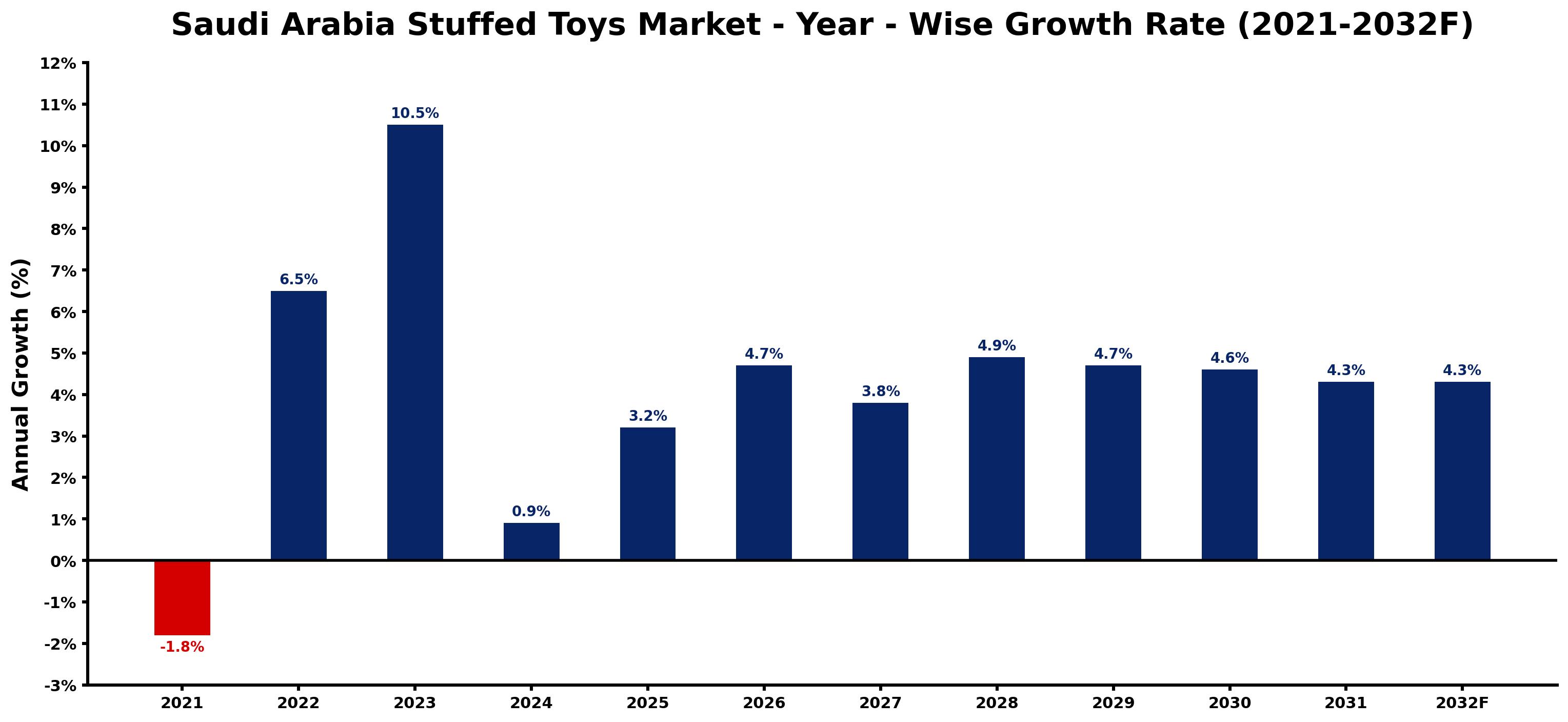
The table below presents the year‑wise growth rates along with the key drivers influencing the market
| Year | Growth Rate | Major Drivers |
| 2021 | -1.8% | Increasing smart city development projects |
| 2022 | 6.5% | Expansion of transportation and logistics networks |
| 2023 | 10.5% | Growing urbanization and commercial development |
| 2024 | 0.9% | Increasing industrial automation investments |
| 2025 | 3.2% | Increasing adoption of advanced technologies |
| 2026 | 4.7% | Increasing adoption of advanced technologies |
| 2027 | 3.8% | Rising electricity demand across industries |
| 2028 | 4.9% | Increasing industrial infrastructure investments |
| 2029 | 4.7% | Rising electricity demand across industries |
| 2030 | 4.6% | Increasing adoption of advanced technologies |
| 2031 | 4.3% | Increasing industrial automation investments |
| 2032 | 4.3% | Increasing smart city development projects |
Note - Market size estimations and growth projections presented in this report are based on 6Wresearch's advanced forecasting approach, validated with industry datasets as of June 2026.
Saudi Arabia Stuffed Toys Market Synopsis
The strongest force currently shaping the Saudi Arabia Stuffed Toys Market is the increasing disposable income among families, which is leading to greater expenditure on children's products. As parents become more willing to invest in premium stuffed toys, manufacturers are responding with innovative designs that appeal to young consumers.
Moreover, the demand for educational and entertaining toys has intensified, particularly in the wake of the COVID-19 pandemic, which encouraged parents to seek engaging toys for their children during extended periods at home. This has led to a surge in the popularity of stuffed toys, particularly those featuring interactive elements or popular character designs.
Saudi Arabia Stuffed Toys Market Key Takeaways
- The market is experiencing robust growth driven by rising disposable incomes and a growing middle-class demographic.
- Innovation in design and technology, particularly with interactive features, is enhancing consumer appeal.
- The COVID-19 pandemic catalyzed a shift towards purchasing educational and comforting toys for children.
- Manufacturers are competing on product variety to attract a broad spectrum of consumers.
- The overall landscape is marked by a steady increase in birth rates, contributing to sustained demand for stuffed toys.
Evaluation of Restraints in Saudi Arabia Stuffed Toys Market
Despite the promising growth trajectory, the Saudi Arabia Stuffed Toys Market faces notable challenges. One significant restraint is the limited availability of high-quality raw materials due to global trade restrictions. This scarcity can hinder production and inflate costs, thereby impacting pricing strategies. Additionally, price sensitivity among parents, particularly those in lower-income brackets, may restrict potential sales, as many consumers prioritize essential items over non-essential stuffed toys.
Saudi Arabia Stuffed Toys Market Trends
Emerging trends in the Saudi Arabia Stuffed Toys Market include a growing emphasis on sustainability, with consumers increasingly favoring eco-friendly materials for plush toys. Brands are responding by incorporating sustainable practices into their production processes. Furthermore, the integration of technology in stuffed toys—such as sound features and educational content—has gained traction, appealing to tech-savvy parents looking for more than just traditional play. These trends are redefining consumer expectations and shaping the future direction of the market.
Saudi Arabia Stuffed Toys Market Opportunities
There are significant growth and investment opportunities in the Saudi Arabia Stuffed Toys Market. With a notable increase in the younger population, companies can tap into diverse consumer segments by developing products that cater to specific age groups and preferences. There is also potential for partnerships with local educational institutions to promote toys that support learning through play. Additionally, leveraging online sales channels presents an avenue for reaching wider audiences, enhancing market penetration.
Government Initiatives in the Saudi Arabia Stuffed Toys Market
The Saudi government has initiated several policies aimed at bolstering the local toy manufacturing industry, including incentives for businesses that prioritize domestic production. Public spending on child welfare and education is also increasing, indirectly supporting the market for children's products, including stuffed toys. These initiatives create a conducive environment for manufacturers to innovate and expand their offerings, ensuring a vibrant market landscape.
Future Insights of the Saudi Arabia Stuffed Toys Market
Looking ahead to 2026-2032, the Saudi Arabia Stuffed Toys Market is poised for continued growth, driven by evolving consumer preferences and demographic shifts. As the middle class expands, so will the demand for premium and innovative toys. Manufacturers that prioritize sustainability and technology integration will likely lead the market. Moreover, leveraging digital channels for marketing and distribution will be critical for reaching tech-savvy consumers. Overall, a favorable outlook suggests ongoing opportunities for investment and development within this dynamic industry.
Saudi Arabia Stuffed Toys Market Latest Developments (May 2025 - June 2026)
In recent months, the Saudi Arabia Stuffed Toys Market has seen a notable shift toward incorporating educational elements in plush toys, with several manufacturers launching products designed to enhance early childhood learning. Moreover, the rise of e-commerce has encouraged brands to diversify their distribution strategies, focusing on online sales platforms to reach a broader audience. This trend reflects changing consumer behaviors and preferences, particularly among tech-savvy parents.
Saudi Arabia Stuffed Toys Market - Key Attractiveness of the Report
- 10 Years of Market Numbers
- Historical Data Starting from 2022 to 2025
- Base Year: 2025
- Forecast Data until 2032
- Key Performance Indicators Impacting the Market
- Major Upcoming Developments and Projects
Key Highlights of the Report:
- Saudi Arabia Stuffed Toys Market Outlook
- Market Size of Saudi Arabia Stuffed Toys Market, 2025
- Forecast of Saudi Arabia Stuffed Toys Market, 2032
- Historical Data and Forecast of Saudi Arabia Stuffed Toys Revenues & Volume for the Period 2022-2032F
- Saudi Arabia Stuffed Toys Market Trend Evolution
- Saudi Arabia Stuffed Toys Market Drivers and Challenges
- Saudi Arabia Stuffed Toys Price Trends
- Saudi Arabia Stuffed Toys Porter's Five Forces
- Saudi Arabia Stuffed Toys Industry Life Cycle
- Historical Data and Forecast of Saudi Arabia Stuffed Toys Market Revenues & Volume By Product Type for the Period 2022-2032F
- Historical Data and Forecast of Saudi Arabia Stuffed Toys Market Revenues & Volume By Cartoon Characters for the Period 2022-2032F
- Historical Data and Forecast of Saudi Arabia Stuffed Toys Market Revenues & Volume By Animals for the Period 2022-2032F
- Historical Data and Forecast of Saudi Arabia Stuffed Toys Market Revenues & Volume By Dolls for the Period 2022-2032F
- Historical Data and Forecast of Saudi Arabia Stuffed Toys Market Revenues & Volume By Playsets for the Period 2022-2032F
- Historical Data and Forecast of Saudi Arabia Stuffed Toys Market Revenues & Volume By Others for the Period 2022-2032F
- Historical Data and Forecast of Saudi Arabia Stuffed Toys Market Revenues & Volume By Raw Material for the Period 2022-2032F
- Historical Data and Forecast of Saudi Arabia Stuffed Toys Market Revenues & Volume By Pellets for the Period 2022-2032F
- Historical Data and Forecast of Saudi Arabia Stuffed Toys Market Revenues & Volume By Fabric for the Period 2022-2032F
- Historical Data and Forecast of Saudi Arabia Stuffed Toys Market Revenues & Volume By Bamboo for the Period 2022-2032F
- Historical Data and Forecast of Saudi Arabia Stuffed Toys Market Revenues & Volume By Others for the Period 2022-2032F
- Saudi Arabia Stuffed Toys Import Export Trade Statistics
- Market Opportunity Assessment By Product Type
- Market Opportunity Assessment By Raw Material
- Saudi Arabia Stuffed Toys Top Companies Market Share
- Saudi Arabia Stuffed Toys Competitive Benchmarking By Technical and Operational Parameters
- Saudi Arabia Stuffed Toys Company Profiles
- Saudi Arabia Stuffed Toys Key Strategic Recommendations






































