Saudi Arabia Sugar Refinery Machinery and Equipment Market Summary
The saudi arabia sugar refinery machinery and equipment market was estimated at USD 203 Million in 2025 and is projected to reach USD 259 Million by 2032, growing at a CAGR of 5.3% from 2026 to 2032.
Saudi Arabia Sugar Refinery Machinery and Equipment Market Year-wise Growth Rate and Key Drivers
This graph highlights how the Saudi Arabia Sugar Refinery Machinery and Equipment Market has steadily grown over the past five years, supported by major growth factors.
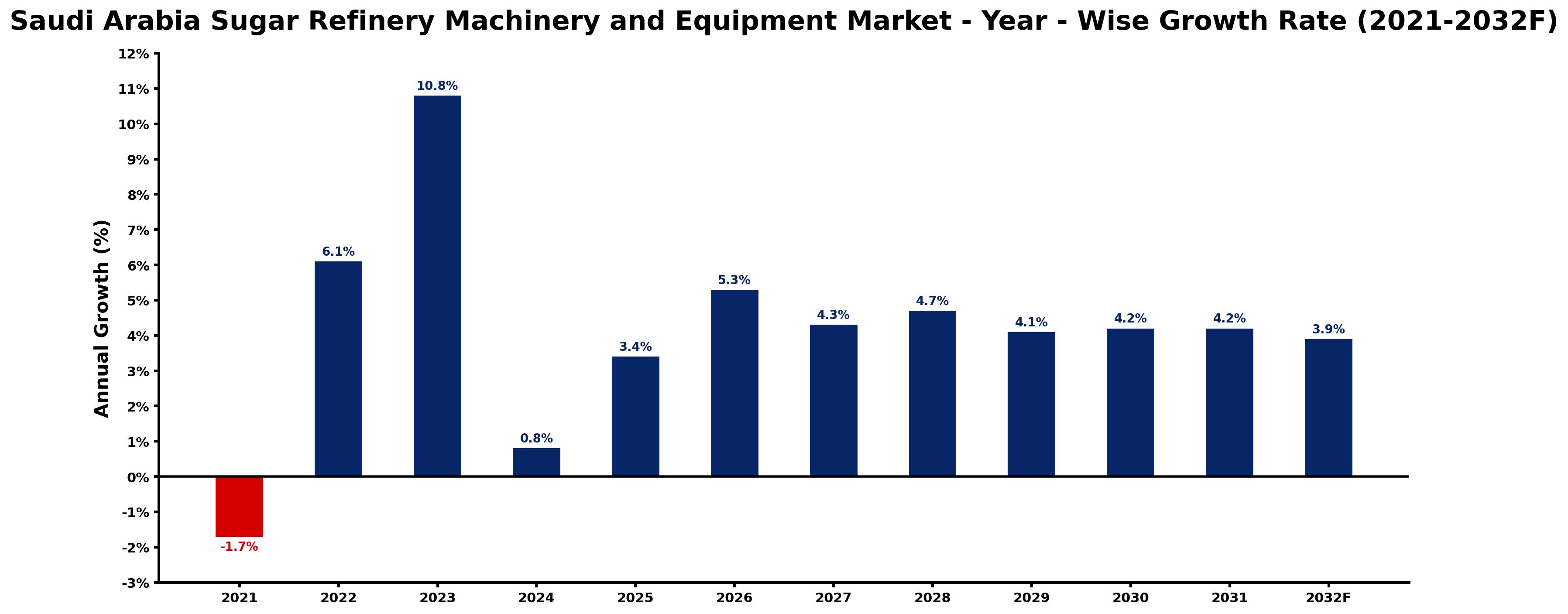
The table below presents the year wise growth rates along with the key drivers influencing the market
| Year | Growth Rate | Major Drivers |
| 2021 | -1.7% | Persistent supply chain disruptions hindered machinery availability, leading to decreased investment in refinery upgrades. |
| 2022 | 6.1% | Investment in modern machinery began as companies sought efficiency and lower operational costs. |
| 2023 | 10.8% | Increased focus on sustainability prompted refiners to consider energy-efficient equipment. |
| 2024 | 0.8% | Partnerships with international machinery manufacturers expanded local capabilities and technology access. |
| 2025 | 3.4% | Emerging food processing hubs in Neom created new opportunities for advanced sugar refining. |
| 2026 | 5.3% | Major construction projects throughout the region required reliable sugar supply chains. |
| 2027 | 4.3% | Upgrades to aging equipment became necessary to meet higher output and quality standards. |
| 2028 | 4.7% | Emerging local brands demanded more competitive refining technologies and innovation. |
| 2029 | 4.1% | Market volatility pushed refiners to invest in automation for better resource management. |
| 2030 | 4.2% | Increased sugar consumption trends drove the need for scalable refining solutions. |
| 2031 | 4.2% | Local regulations began prioritizing energy-efficient machinery to combat climate change impacts. |
| 2032 | 3.9% | Technological advancements in refining processes enabled higher purity levels at lower costs. |
Note - Market size estimations and growth projections presented in this report are based on 6Wresearch's advanced forecasting approach, validated with industry datasets as of June 2026.
Saudi Arabia Sugar Refinery Machinery and Equipment Market Synopsis
The Saudi Arabia Sugar Refinery Machinery and Equipment Market is projected to reach 5.3% and witness significant growth during the forecast period (2026-2032). The market is expected to register a compound annual growth rate (CAGR) of 4.3%, driven primarily by the surging demand for packaged food products, including bakery items and confectioneries. This trend has resulted in an escalated production of these goods, which in turn fuels the necessity for advanced sugar refining machinery and equipment, given that refined sugar remains a fundamental ingredient. Additionally, heightened investments from both government and private sectors to satisfy domestic requirements further contribute to the market's expansion.
Saudi Arabia Sugar Refinery Machinery and Equipment Market Growth Drivers
Several factors are driving the growth of the Saudi Arabia Sugar Refinery Machinery and Equipment Market. The following are the primary growth drivers:
- An increasing demand for convenience among consumers has led to a dramatic rise in food and beverage packaging. This includes a variety of goods, from household consumables to pharmaceuticals, which drives overall sales volume higher than ever before.
- Population growth in the region, coupled with a rising Gross Domestic Product (GDP) per capita exceeding $21,000, primarily due to oil exports, is creating greater economic capacity for consumers to purchase processed foods that require refined sugar.
- A growing awareness about health benefits has prompted consumers to shift from traditional unrefined sugars to refined sugars, spurring an increase in the demand for sugar refining machinery.
- Investments aimed at boosting domestic production of refined sugar are intensifying, as manufacturers adapt to the rising market demand for high-quality processed food products.
- Advancements in technology within the sugar refining sector have improved equipment efficiency and output quality, thereby attracting further investments.
Saudi Arabia Sugar Refinery Machinery and Equipment Market Challenges and Restraints
Despite the optimistic growth outlook, the Saudi Arabia Sugar Refinery Machinery and Equipment Market faces several challenges:
- The initial capital investment required for the installation of sugar refining machinery is substantial, often prohibiting smaller companies from entering the market.
- Regular maintenance and support for sophisticated machinery can lead to ongoing expenses, creating financial strain for small-scale refiners.
- Market players encounter fluctuating prices for raw materials, which can impact profitability and pricing strategies within the industry.
- The recent disruptions caused by global events, such as the COVID-19 pandemic, have hampered supply chains, affecting the availability of machinery and components.
- The complex regulatory landscape governing food safety and manufacturing standards can pose additional compliance challenges, particularly for newer entrants in the market.
Saudi Arabia Sugar Refinery Machinery and Equipment Market Government Investment and Initiatives
The Saudi government has taken proactive measures to bolster its agricultural and manufacturing sectors, including the sugar industry. Various policy frameworks and development plans have been introduced to encourage investment in sugar refining processes. These initiatives are designed to boost food security and enhance local production capabilities. Specifically:
- Government policies have emphasized the importance of domestic food production, including sugar, to reduce dependency on imports and stimulate rural economies.
- Incentives and support programs have been launched to provide financial assistance to manufacturers and investors interested in upgrading their facilities and technologies.
- Investment in infrastructure, such as transportation and logistics networks, is being prioritized to facilitate the efficient distribution of sugar and related products.
- Training and development programs aimed at improving operational efficiency and skills within the sugar refining sector are being implemented.
- Public-private partnerships are being encouraged to foster innovation and drive the development of modern refining technologies and equipment.
Saudi Arabia Sugar Refinery Machinery and Equipment Market Latest Developments (May 2025 - June 2026)
In the period between May 2025 and June 2026, the Saudi Arabia Sugar Refinery Machinery and Equipment Market has witnessed several notable trends and developments:
- The market has observed a surge in investments in advanced refining technologies aimed at enhancing production efficiency and product quality.
- New strategic partnerships have been formed between local manufacturers and international technology providers to bring innovative solutions to the market.
- Research and development efforts have been heightened to improve sustainability practices within the sector, emphasizing energy-efficient processes.
- The impact of government initiatives has become evident, with a steady increase in domestic production capacity catering to rising local demand.
- Changes in consumer preferences have driven the introduction of new sugar products, prompting refiners to adapt their machinery for diverse applications.
Saudi Arabia Sugar Refinery Machinery and Equipment Market - Key Attractiveness of the Report
- 10 Years of Market Numbers
- Historical Data Starting from 2022 to 2025
- Base Year: 2025
- Forecast Data until 2032
- Key Performance Indicators Impacting the Market
- Major Upcoming Developments and Projects
Key Highlights of the Report:
- Saudi Arabia Sugar Refinery Machinery and Equipment Market Outlook
- Market Size of Saudi Arabia Sugar Refinery Machinery and Equipment Market, 2025
- Forecast of Saudi Arabia Sugar Refinery Machinery and Equipment Market, 2032
- Historical Data and Forecast of Saudi Arabia Sugar Refinery Machinery and Equipment Revenues & Volume for the Period 2022-2032F
- Saudi Arabia Sugar Refinery Machinery and Equipment Market Trend Evolution
- Saudi Arabia Sugar Refinery Machinery and Equipment Market Drivers and Challenges
- Saudi Arabia Sugar Refinery Machinery and Equipment Price Trends
- Saudi Arabia Sugar Refinery Machinery and Equipment Porter's Five Forces
- Saudi Arabia Sugar Refinery Machinery and Equipment Industry Life Cycle
- Historical Data and Forecast of Saudi Arabia Sugar Refinery Machinery and Equipment Market Revenues & Volume By Refineries Type for the Period 2022-2032F
- Historical Data and Forecast of Saudi Arabia Sugar Refinery Machinery and Equipment Market Revenues & Volume By Front End Refineries for the Period 2022-2032F
- Historical Data and Forecast of Saudi Arabia Sugar Refinery Machinery and Equipment Market Revenues & Volume By Back End Refineries for the Period 2022-2032F
- Historical Data and Forecast of Saudi Arabia Sugar Refinery Machinery and Equipment Market Revenues & Volume By Machinery and Equipment Type for the Period 2022-2032F
- Historical Data and Forecast of Saudi Arabia Sugar Refinery Machinery and Equipment Market Revenues & Volume By Cane Handling Equipment for the Period 2022-2032F
- Historical Data and Forecast of Saudi Arabia Sugar Refinery Machinery and Equipment Market Revenues & Volume By Cutting & Grinding Equipment for the Period 2022-2032F
- Historical Data and Forecast of Saudi Arabia Sugar Refinery Machinery and Equipment Market Revenues & Volume By Processing Equipment for the Period 2022-2032F
- Historical Data and Forecast of Saudi Arabia Sugar Refinery Machinery and Equipment Market Revenues & Volume By Packaging Equipment for the Period 2022-2032F
- Saudi Arabia Sugar Refinery Machinery and Equipment Import Export Trade Statistics
- Market Opportunity Assessment By Refineries Type
- Market Opportunity Assessment By Machinery and Equipment Type
- Saudi Arabia Sugar Refinery Machinery and Equipment Top Companies Market Share
- Saudi Arabia Sugar Refinery Machinery and Equipment Competitive Benchmarking By Technical and Operational Parameters
- Saudi Arabia Sugar Refinery Machinery and Equipment Company Profiles
- Saudi Arabia Sugar Refinery Machinery and Equipment Key Strategic Recommendations






































