Saudi Arabia Tea Market: Import Trend Analysis
In 2024, Saudi Arabia`s tea market saw a notable increase in imports, driven by rising consumer demand for a diverse range of tea products. The market experienced a shift towards premium and specialty teas, reflecting changing consumer preferences and increasing disposable incomes.
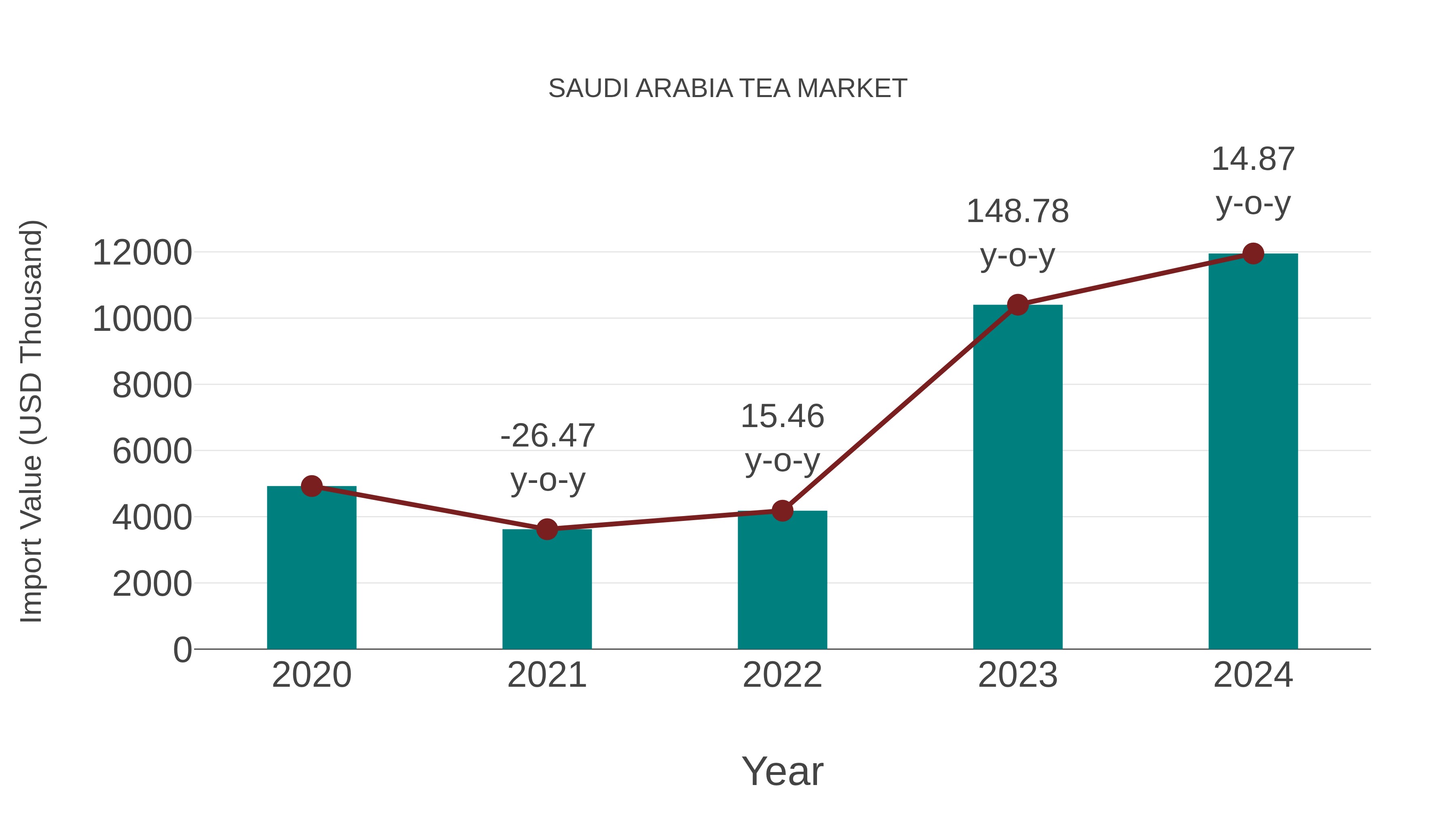
Saudi Arabia Tea Market Growth Rate
According to 6Wresearch internal database and industry insights, the Saudi Arabia Tea Market is growing at a compound annual growth rate (CAGR) of 5.5% during the forecast period (2026-2032).
Topics Covered in the Saudi Arabia Tea Market Report
The Saudi Arabia Tea Market report thoroughly covers the market by product types, distribution channels, and applications. The market report provides an unbiased and detailed analysis of ongoing market trends, opportunities, and growth drivers, which would help stakeholders devise and align their market strategies according to the current and future market dynamics.
Saudi Arabia Tea Market Highlights
| Report Name | Saudi Arabia Tea Market |
| Forecast Period | 2026–2032 |
| CAGR | 5.5% |
| Growing Sector | Residential |
Saudi Arabia Tea Market Synopsis
The Saudi Arabia Tea Market is expected to experience steady growth. The market exists as consumers demand premium tea options which include health-conscious tea products and especially green and herbal teas. The expansion of e-commerce platforms empowers consumers to find and purchase various tea products which are now accessible through online platforms. The market expansion receives support from two trends which include the rising demand for artisanal tea blends and Saudi Arabia's increasing tea export business to its Gulf neighbouring countries. The Saudi health-conscious consumer market shows increasing interest in organic tea products which match their sustainable product preferences.
Evaluation of Growth Drivers in the Saudi Arabia Tea Market
Below mentioned are some growth drivers and their impact on market dynamics:
| Drivers | Primary Segments Affected | Why It Matters |
| Health-Conscious Trends | Tea Types (Green Tea, Herbal Tea) | Increased health awareness boosts demand for green tea, herbal, and functional teas. |
| E-Commerce Growth | Distribution Channels (Online Channel) | The online retail platforms are increasing the market expansion by providing ease of accessibility. |
| Demand for Premium Products | Tea Types (Black Tea, Green Tea, Specialty Teas) | More consumer spending drives demand for premium tea offerings. |
| Traditional Tea Preferences | Tea Types (Black Tea, Arabic Tea) | Saudi Arabia traditional tea varieties remain popular due to cultural preferences. |
| Export Potential | Tea Types (All Tea Types) | Growing demand for Saudi tea exports, particularly to the GCC and Middle East regions. |
The Saudi Arabia Tea Market is projected to witness steady growth, at a CAGR of 5.5% during the forecast period of 2026-2032. The Saudi Arabia Tea Market experiences growth as health-conscious consumers increase their demand for premium organic herbal tea products. E-commerce development enables urban consumers to access a diverse range of tea products from different sellers. Businesses face growing pressure to switch from traditional production methods towards sustainable production methods as consumers now prefer environmentally sustainable production methods. The market expansion in Saudi Arabia receives support from two factors: strong cultural ties to traditional tea drinking and increased export possibilities to nearby GCC countries.
Evaluation of Restraints in the Saudi Arabia Tea Market
Below mentioned are some key restraints and their impact on market dynamics:
| Restraints | Primary Segments Affected | What This Means |
| Rising Raw Material Costs | Tea Types (All Tea Types) | Increased prices of tea leaves, particularly organic varieties, lead to higher production costs. |
| Health-Conscious Trends | Tea Types (Black Tea, Traditional Tea) | Health-conscious consumers prefer healthier alternatives, which limits demand for traditional high-sugar tea products. |
| Supply Chain Disruptions | All Segments | The supply chain disruptions impact tea imports and exports, providing market stability. |
| Intense Market Competition | All Segments | More competition between local and international brands may limit the market share of some players. |
| Cultural Preferences | Tea Types (Traditional Tea) | The cultural preferences for specific tea types may limit the diversification of offerings in the market. |
Saudi Arabia Tea Market Challenges
The Saudi Arabia Tea Market faces several challenges in its path of growth. The main challenge arises from increasing raw material costs, which impact tea leaf prices and organic product expenses, thereby raising production costs. Health-conscious consumers this time shift to low-sugar and organic tea, but local consumers maintain their preference for traditional tea types which include sweetened black tea and Arabic tea. The market faces two major challenges, which include supply chain disruptions and strong competition between domestic and international companies, and these factors will determine its growth potential.
Saudi Arabia Tea Market Trends
Some major trends contributing to the Saudi Arabia Tea Market Growth are:
- Health-Conscious Tea Products: There is an increasing demand among consumers for green tea, herbal tea, and functional teas due to increased health consciousness.
- Sustainability in Tea Production: The consumers are increasingly preferring for eco friendly packaging solutions due to increase awareness regarding environmental concerns.
- Tea Export Growth: Saudi Arabia’s tea exports to neighbouring GCC countries are growing, driven by the popularity of Saudi tea in the region and increasing trade relations.
Investment Opportunities in the Saudi Arabia Tea Market
Here are some investment opportunities in the Saudi Arabia Tea Industry:
- Organic and Health-Conscious Products: Investing in organic and low-sugar tea products will cater to the growing health-conscious consumer base in Saudi Arabia.
- Premium and Artisan Teas: The manufacturers can focus more in the making of premium and artisanal teas, mainly among consumers looking for quality and exclusivity.
- Sustainable Tea Production: Investors can focus more on sustainable and ethically sourced tea will help meet the growing consumer preference for environmentally responsible products.
Top Leading Players in the Saudi Arabia Tea Market
Here are some top companies contributing to Saudi Arabia Tea Market share:
1. Almarai Company
| Company Name | Almarai Company |
|---|---|
| Established Year | 1977 |
| Headquarters | Riyadh, Saudi Arabia |
| Official Website | Click Here |
Almarai is one of the leading food and beverage companies in Saudi Arabia, offering a range of tea products, including ready-to-drink tea beverages. The company focuses on product innovation, quality standards, and consumer preferences for health-conscious offerings, strengthening its position in the Saudi tea market.
2. Lipton (Unilever Saudi Arabia)
| Company Name | Lipton (Unilever Saudi Arabia) |
|---|---|
| Established Year | 1930 |
| Headquarters | Jeddah, Saudi Arabia |
| Official Website | Click Here |
Lipton, a brand owned by Unilever, is one of the most recognized tea brands in Saudi Arabia. The company offers a wide variety of tea products, including black, green, and herbal teas. Unilever’s global reach, strong distribution network, and commitment to sustainability help maintain Lipton's market leadership in Saudi Arabia.
3. Alokozay Group of Companies
| Company Name | Alokozay Group of Companies |
|---|---|
| Established Year | 1985 |
| Headquarters | Jeddah, Saudi Arabia |
| Official Website | Click Here |
Alokozay is a major player in the Saudi Arabia tea market, offering a wide range of black, green, and herbal teas. The company is known for providing high-quality products at affordable prices and has a strong presence in both retail and wholesale sectors across the region.
4. Riyadh Food Industries Company (Riyadh Tea)
| Company Name | Riyadh Food Industries Company (Riyadh Tea) |
|---|---|
| Established Year | 1980 |
| Headquarters | Riyadh, Saudi Arabia |
| Official Website | Click Here |
Riyadh Food Industries is a prominent local company offering a variety of premium and traditional teas, including black and green tea. With a strong market presence, the company focuses on producing quality tea products tailored to local tastes, further strengthening Saudi Arabia’s domestic tea market.
5. Tetley (Tata Global Beverages)
| Company Name | Tetley (Tata Global Beverages) |
|---|---|
| Established Year | 1962 |
| Headquarters | Jeddah, Saudi Arabia |
| Official Website | Click Here |
Tetley, part of Tata Global Beverages, is a leading tea brand in Saudi Arabia, offering a wide variety of tea types, including black, green, and flavored teas. Tetley is recognized for its innovative approach to tea blending and packaging, and its strong commitment to sustainable practices makes it a popular choice among Saudi consumers.
Government Regulations Introduced in the Saudi Arabia Tea Market
According to Saudi government data, the Saudi Arabia Tea Market is governed by several regulations which protect product safety while supporting industry development. The Saudi Quality Mark (SQM) serves as a key policy which establishes high-quality and safety standards for tea products. The Saudi Food and Drug Authority (SFDA) makes strict food safety and labeling practices which protect consumers by making sure manufacturers must disclose product information. The National Program for Enhancing Local Content and Government Procurement (NUSGDP) encourages domestic participation while food quality standards compliance which helps tea producers in their operations.
Future Insights of the Saudi Arabia Tea Market
The Saudi Arabia Tea Market will grow as health-oriented shoppers want organic and premium tea and herbal tea products. The growth of online sales platforms will make products more available to people living in cities. Increasingly businesses are adopting environmentally friendly methods as sustainability and eco-friendly production methods now hold more importance. The growing export prospects to Gulf Cooperation Council nations and Middle Eastern markets will enhance Saudi Arabia's status as a major tea exporter in the regional market.
Market Segmentation Analysis
The report offers a comprehensive study of the subsequent market segments and their leading categories.
Tea Bags to Dominate the Market – By Packaging
Tea bags are continuously leading the market. They are mainly driven by their convenience, ease of use, and rising preference for single-serving tea options. Their increasing adoption in both the retail and online sectors reflects the busy lifestyle of Saudi consumers looking for quick and hassle-free tea preparation.
Green Tea to Dominate the Market - By Type
According to Guneet Kaur, Senior Research Analyst at 6Wresearch, the market is being led by green tea. This is mainly due to its health benefits, increasing consumer preference for organic and low-calorie beverages, and growing awareness of its antioxidant properties. Its increasing popularity among health-conscious consumers drives its growth.
Online Stores to Dominate the Market - By Distribution Channel
Online stores are getting more popularity in the market. This id due to the increasing trend of e-commerce and the convenience it offers to consumers. As more consumers seek easy access to a variety of tea products, the online retail channel continues to expand, reflecting growing digital penetration in Saudi Arabia.
Residential to Dominate the Market - By Application
Residential consumption is the fastest-growing segment. Mainly driven by more domestic tea demand as a staple beverage. Also, the increased interest in premium, organic, and flavored teas among consumers, along with a shift towards healthier alternatives, boosts tea consumption in households across Saudi Arabia.
Key attractiveness of the report
- 10 Years Market Numbers.
- Historical Data Starting from 2022 to 2025.
- Base Year: 2025
- Forecast Data until 2032.
- Key Performance Indicators Impacting the Market.
- Major Upcoming Developments and Projects.
Key Highlights of the Report:
- Saudi Arabia Tea Market Outlook
- Market Size of Saudi Arabia Tea Market, 2025
- Forecast of Saudi Arabia Tea Market, 2032
- Historical Data and Forecast of Saudi Arabia Tea Revenues & Volume for the Period 2022-2032
- Saudi Arabia Tea Market Trend Evolution
- Saudi Arabia Tea Market Drivers and Challenges
- Saudi Arabia Tea Price Trends
- Saudi Arabia Tea Porter's Five Forces
- Saudi Arabia Tea Industry Life Cycle
- Historical Data and Forecast of Saudi Arabia Tea Market Revenues & Volume By Type for the Period 2022-2032
- Historical Data and Forecast of Saudi Arabia Tea Market Revenues & Volume By Green Tea for the Period 2022-2032
- Historical Data and Forecast of Saudi Arabia Tea Market Revenues & Volume By Black Tea for the Period 2022-2032
- Historical Data and Forecast of Saudi Arabia Tea Market Revenues & Volume By Oolong Tea for the Period 2022-2032
- Historical Data and Forecast of Saudi Arabia Tea Market Revenues & Volume By Fruit/Herbal Tea for the Period 2022-2032
- Historical Data and Forecast of Saudi Arabia Tea Market Revenues & Volume By Others for the Period 2022-2032
- Historical Data and Forecast of Saudi Arabia Tea Market Revenues & Volume By Packaging for the Period 2022-2032
- Historical Data and Forecast of Saudi Arabia Tea Market Revenues & Volume By Plastic Containers for the Period 2022-2032
- Historical Data and Forecast of Saudi Arabia Tea Market Revenues & Volume By Loose Tea for the Period 2022-2032
- Historical Data and Forecast of Saudi Arabia Tea Market Revenues & Volume By Paperboards for the Period 2022-2032
- Historical Data and Forecast of Saudi Arabia Tea Market Revenues & Volume By Aluminum Tins for the Period 2022-2032
- Historical Data and Forecast of Saudi Arabia Tea Market Revenues & Volume By Tea Bags for the Period 2022-2032
- Historical Data and Forecast of Saudi Arabia Tea Market Revenues & Volume By Distribution Channel for the Period 2022-2032
- Historical Data and Forecast of Saudi Arabia Tea Market Revenues & Volume By Supermarkets/Hypermarkets for the Period 2022-2032
- Historical Data and Forecast of Saudi Arabia Tea Market Revenues & Volume By Specialty Stores for the Period 2022-2032
- Historical Data and Forecast of Saudi Arabia Tea Market Revenues & Volume By Convenience Stores for the Period 2022-2032
- Historical Data and Forecast of Saudi Arabia Tea Market Revenues & Volume By Online Stores for the Period 2022-2032
- Historical Data and Forecast of Saudi Arabia Tea Market Revenues & Volume By Others for the Period 2022-2032
- Historical Data and Forecast of Saudi Arabia Tea Market Revenues & Volume By Application for the Period 2022-2032
- Historical Data and Forecast of Saudi Arabia Tea Market Revenues & Volume By Residential for the Period 2022-2032
- Historical Data and Forecast of Saudi Arabia Tea Market Revenues & Volume By Commercial for the Period 2022-2032
- Saudi Arabia Tea Import Export Trade Statistics
- Market Opportunity Assessment By Type
- Market Opportunity Assessment By Packaging
- Market Opportunity Assessment By Distribution Channel
- Market Opportunity Assessment By Application
- Saudi Arabia Tea Top Companies Market Share
- Saudi Arabia Tea Competitive Benchmarking By Technical and Operational Parameters
- Saudi Arabia Tea Company Profiles
- Saudi Arabia Tea Key Strategic Recommendations
Market covered
The report subsequently covers the market by following segments and subsegments.
By Type:
- Green Tea
- Black Tea
- Oolong Tea
- Fruit/Herbal Tea
- Others
By Packaging:
- Plastic Containers
- Loose Tea
- Paperboards
- Aluminum Tins
- Tea Bags
By Distribution Channel:
- Supermarkets/Hypermarkets
- Specialty Stores
- Convenience Stores
- Online Stores
- Others
By Application:
- Residential
- Commercial






































